
Where Do You See Yourself in 5 Years? How to Answer

.webp)
"Where do you see yourself in 5 years?"
Six words. And somehow they make even experienced professionals freeze mid-sentence, stare at the ceiling, and start wondering if "I honestly have no idea" counts as an acceptable answer.
It doesn't. But your answer doesn't need to be perfect, poetic, or some grand life narrative. It needs to be believable, relevant, and short. That's it.
This guide gives you a simple framework, five ready-to-use templates, eight role-specific examples, and a 10-minute method to tailor your answer to any job description. Whether you're entry-level, mid-career, switching industries, or aiming for leadership, you'll walk away with an answer you actually feel confident saying out loud.
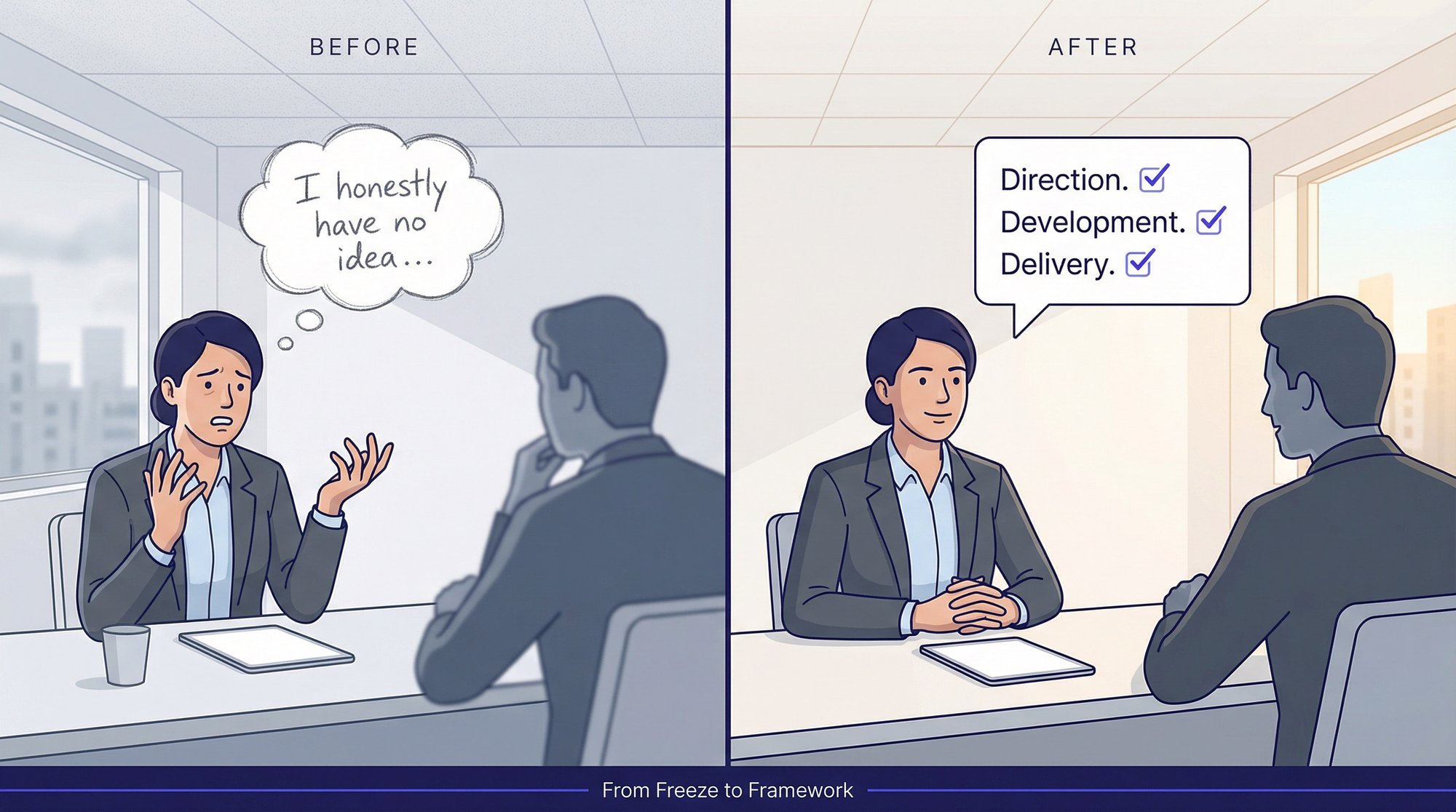
Why Do Interviewers Ask "Where Do You See Yourself in 5 Years?"
They're not asking you to predict the future. They're trying to reduce risk.
Hiring is a bet. Every time a company brings someone on, they're gambling time and money on a person they can't fully evaluate in a few conversations. They can't directly observe how hard you'll push once the novelty wears off, whether you'll grow into the role's real demands, or whether you'll stick around long enough for the investment to pay off.
That's why this question exists. It's a risk assessment disguised as a conversation starter.
Career experts consistently point to the same themes when explaining what employers are really evaluating. It comes down to alignment with the role, fit with the company's mission, a realistic trajectory, and signs you won't bolt after six months.
How Interviewers Actually Score Your Answer
Most interviewers won't say this out loud, but they're mentally grading you on five dimensions:
That last row matters more than most candidates realize. Replacing people is expensive. According to SHRM's 2025 benchmarking data, the average cost-per-hire is $5,475 for non-executive hires and $35,879 for executive positions. And Gallup's analysis (updated February 2026) estimates replacing leaders and managers can cost around 200% of their salary, while technical professionals run about 80% and frontline employees about 40%.
So when you answer this question, you're doing one thing: lowering their perceived risk while raising their perceived upside. It's the same logic behind preparing thoroughly for every interview. The more you understand what the interviewer is evaluating, the more precisely you can deliver what they need to hear.
Why the 5-Year Question Is Hard to Answer in 2026
Two realities make long-term forecasting harder than it used to be. And both of them actually work in your favor if you know how to use them.
How Long Do People Actually Stay at a Job?
In the U.S., median tenure with a current employer was 3.9 years as of January 2024 (and just 3.5 years in the private sector), according to Bureau of Labor Statistics data published in April 2025.
In the UK, the picture is similar. CIPD analysis of the Annual Population Survey found average labour turnover of 34% between January 2022 and December 2023, with the most common length of service being 2 to 5 years. About 16% of workers had less than 12 months' tenure.
Employers know "5 years" is aspirational. They're not expecting a binding contract. But they still want to hear that you have a direction that makes staying plausible.
How Fast Are Job Skills Changing?
The World Economic Forum's Future of Jobs Report 2025 projects that 39% of workers' core skills will change by 2030. And the Microsoft and LinkedIn 2024 Work Trend Index found that 75% of knowledge workers globally already use generative AI at work, with 78% bringing their own AI tools.
What does this mean for your answer? A modern "5-year" answer works best when it's skills-focused and impact-focused, not title-focused. Rigid titles break. Skills and trajectory don't. If you want to understand what skills matter most for your target role, browsing AIApply's skills guides by job title can help you identify what to emphasize.
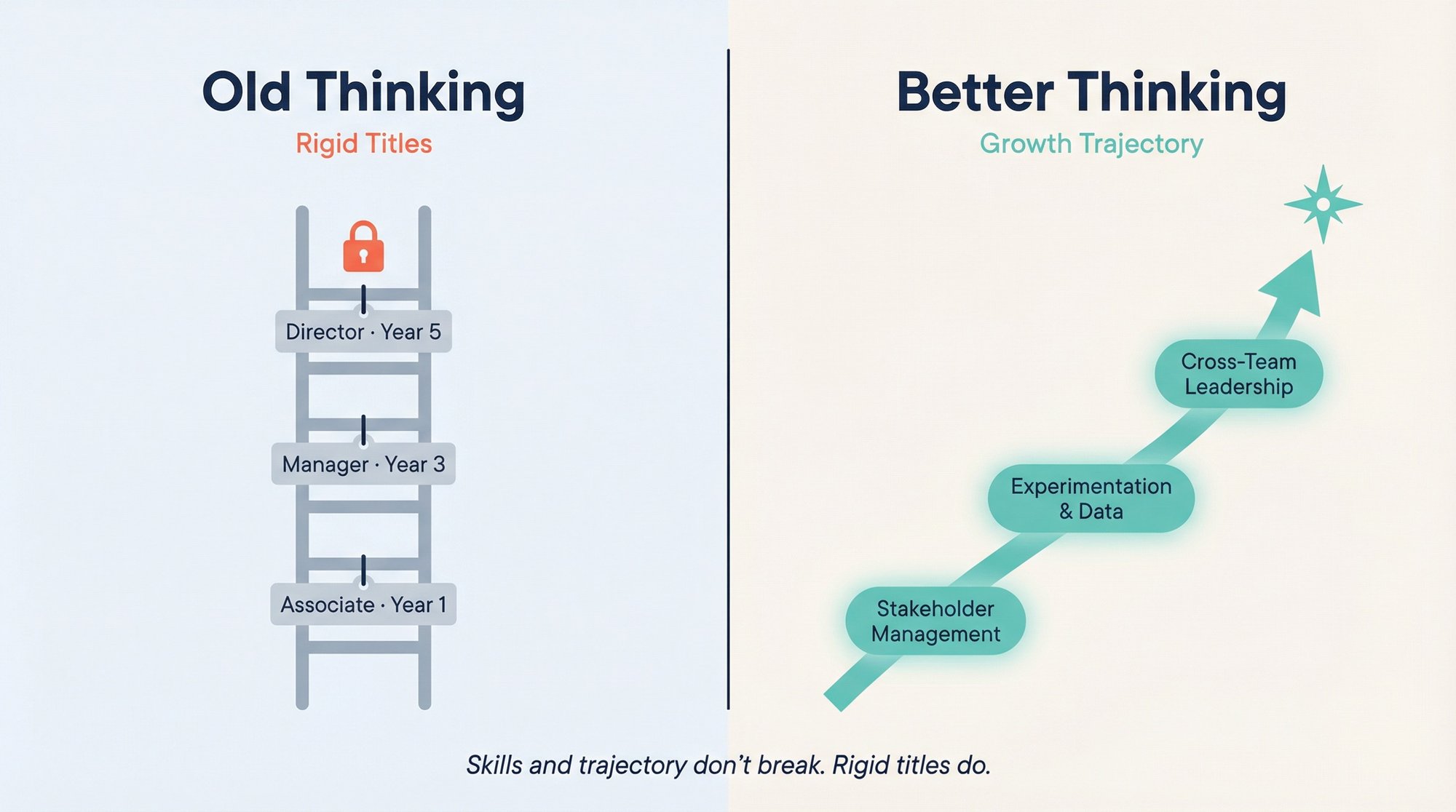
The core mindset shift: Don't give a "plan." Give a "trajectory."
Old mental model: "They want a specific job title I'll have in 5 years."
Better mental model: "They want to know if this role is a logical step in the story of my growth."
The DDV Framework: How to Structure Your 5-Year Answer
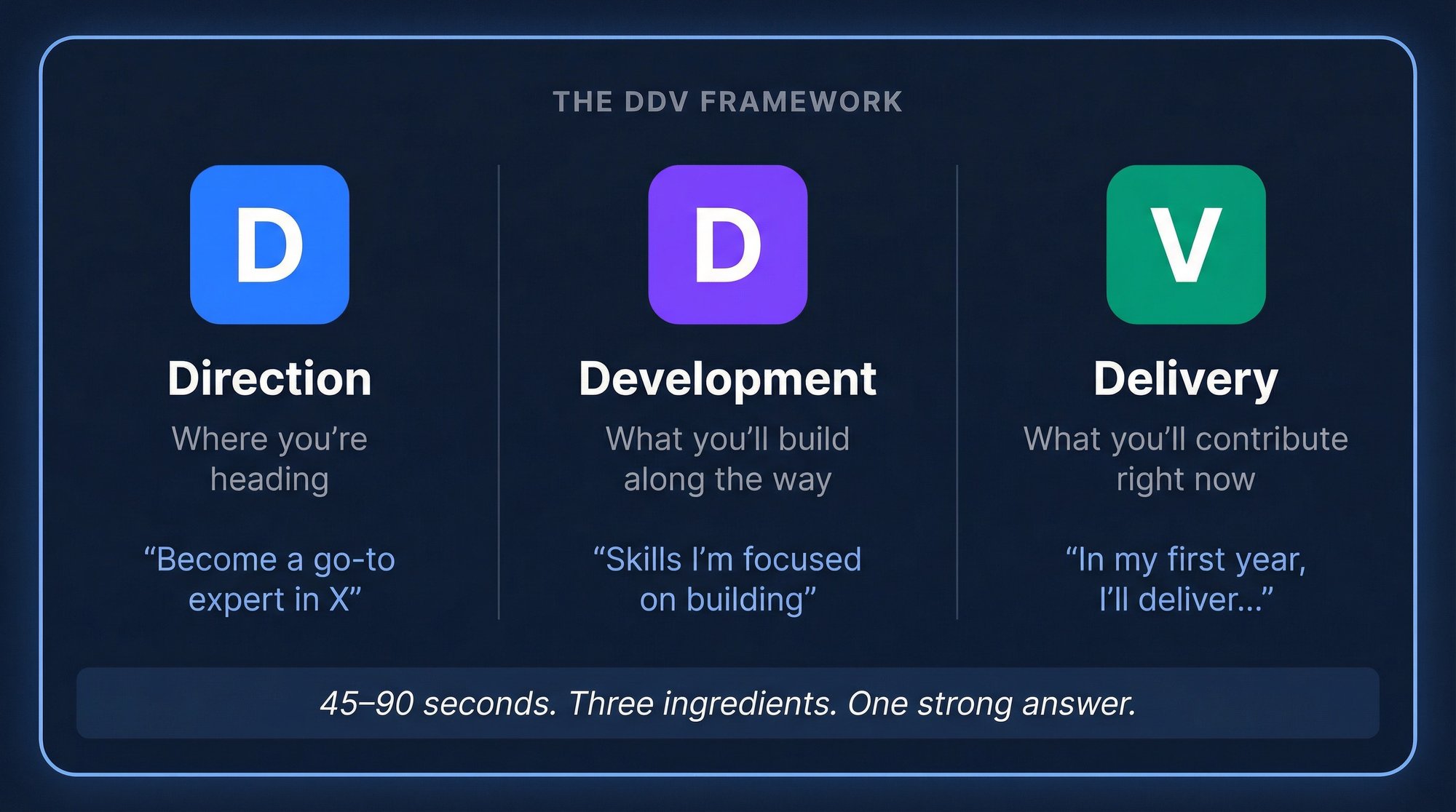
Your answer needs three ingredients. We call it the DDV Framework, and it works because it mirrors exactly what interviewers are scoring you on:
Direction = where you're heading
Development = what you'll build along the way
Delivery = what you'll contribute right now
If you can hit all three in 45 to 90 seconds, you win. Seriously. That's the whole formula.
How to Choose a Career Direction That Resonates
Your direction should be broad enough to stay true even if the company changes, but specific enough to signal intention. Think of it as a "North Star" for your career.
Strong North Stars look like this:
"Become a go-to expert in X"
"Own a bigger slice of the process end-to-end"
"Lead cross-functional projects in Y"
"Move from execution to strategy in Z"
"Become someone who can build, ship, and measure outcomes"
Avoid these:
"Be a CEO" (unless the path genuinely leads there)
"Be in management" when the role is clearly individual-contributor with no management ladder
"Not sure" with zero direction (especially past entry level)
The key is finding something that's true for you and relevant to them. If your direction has nothing to do with the company's work, that's a red flag for the interviewer. If it fits naturally, it becomes the strongest signal you can send. Working through a career development plan before your interview can help you clarify your direction so it sounds genuine, not rehearsed.
How to Name the Skills You Want to Build
This is where most people get generic. "I want to grow my skills" tells the interviewer nothing. You need to be concrete.
Generic (forgettable): "I want to develop my leadership skills."
Concrete (memorable): "I want to build my ability to manage stakeholders across product, design, and engineering, and get real reps running experiments rather than just reporting metrics."
Here are examples of development goals that actually land:
"Stakeholder management across product, design, and engineering"
"Running experiments, not just reporting metrics"
"Writing clearly and making decisions with incomplete data"
"Mentoring and coaching junior team members"
"AI-assisted workflows and evaluation, with good judgment about when to use them"
Career experts consistently recommend focusing on skills and flexibility rather than locking into rigid titles and timelines. That advice is more relevant than ever in 2026, where the skills landscape shifts every 18 months. AIApply's Resume Scanner can also flag the specific skill gaps between your current profile and target roles, which feeds directly into your development narrative.
How to Show What You Will Deliver in the Role
This is the money line. The part where you prove you're not just daydreaming about your future but actually thinking about what you'll produce for them.
You want at least one sentence that sounds like:
"In the first year, my goal is to become fully effective in X and deliver Y outcome."
"By year two or three, I want to own Z and reliably move A metric."
"Longer-term, I want to take on broader scope in B while continuing to deliver C."
This approach aligns with how university career services teach interview prep: relate your future answer to how you'd perform in the position and show logical progression. When your resume and your interview answer both emphasize the same outcomes and skills, interviewers experience you as coherent and credible rather than just a good talker.
The 1-3-5 Ladder: A Simple Structure That Works
If you freeze easily and want a dead-simple structure, use this:
You can say it in 60 seconds. It works in almost every industry. And it hits all three DDV elements without overcomplicating things.
5 Answer Templates for "Where Do You See Yourself in 5 Years"
These templates are designed so you can swap in your own details and have a strong answer ready in minutes. Each one follows the DDV framework.
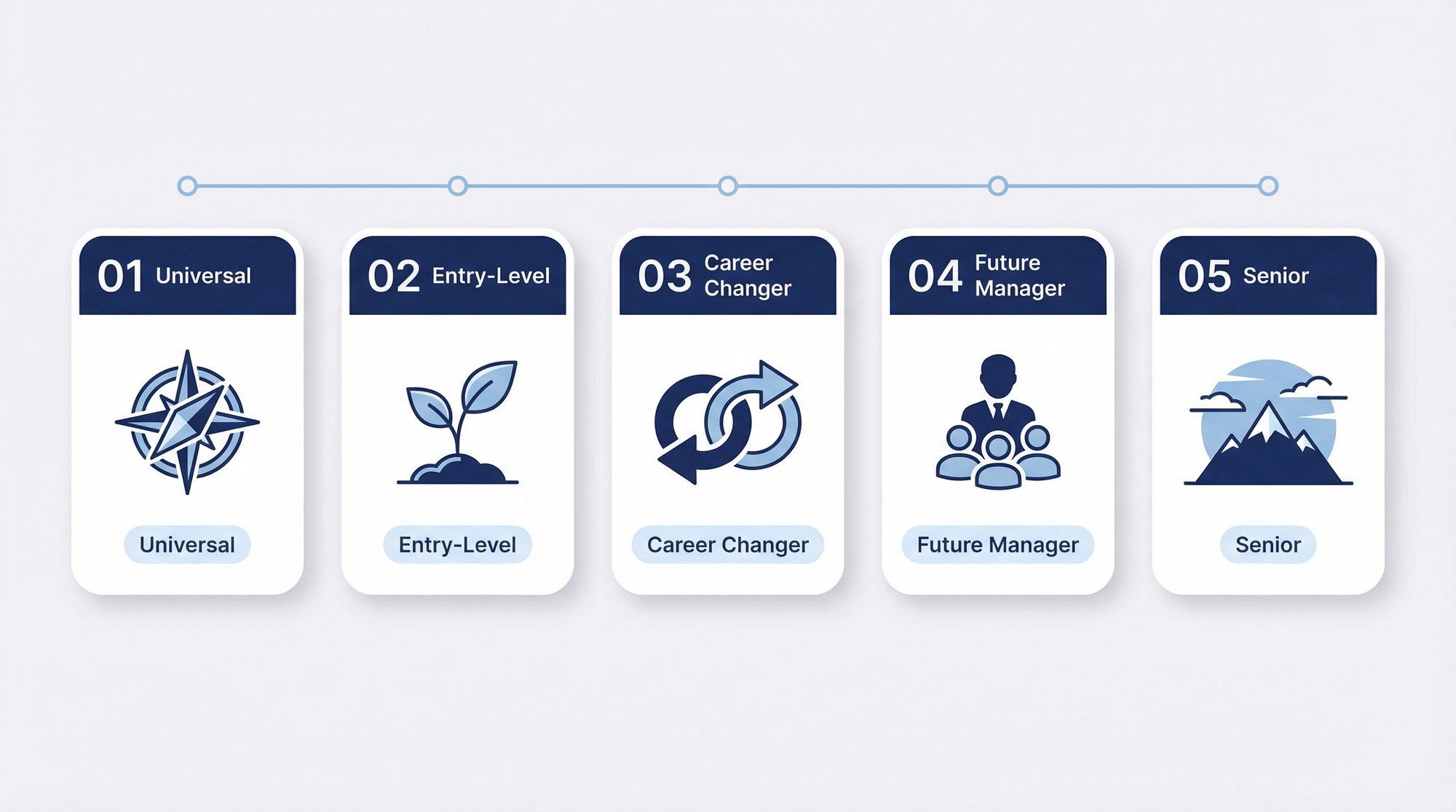
Universal Template (Works for Most Roles)
"In five years, I want to be [a strong senior contributor / a trusted owner / a lead in X]. To get there, I'm focused on building [skill 1] and [skill 2], and getting real reps in [skill 3 if needed].
What excites me about this role is that it's a strong step because [this role directly gives those reps]. In the near term, my priority is to [deliver a concrete first-year outcome], and over time, take on [bigger scope] while continuing to produce measurable results."
Template for Entry-Level and Early Career
"In five years, I want to be really strong at [core skill of this role] and trusted as someone who can [deliver outcome]. I'm still early enough that I'm exploring the exact specialization, but I know I want to grow in [2 skills] and take on increasing responsibility.
This role stands out because it will let me learn [specific tools/process] and contribute quickly by [contribution]. My goal in the first year is to ramp fast and become someone the team can rely on for [specific work]."
If you're early in your career, it's completely fine to not have everything figured out. What matters is showing you understand the role and why it's a good next step. Interviewers at this level are looking for direction, not certainty. Pairing this answer with solid entry-level interview preparation makes the difference between sounding uncertain and sounding self-aware.
Template for Career Changers
"In five years, I see myself as [role direction] in this industry, using my background in [old domain] to bring a different angle. The skills I'm intentionally building are [new skill 1] and [new skill 2], and I'm already doing that through [proof: project/course/freelance].
This role makes sense because it's a practical bridge: it lets me apply [transferable strength] immediately while building depth in [new domain]. In the first year, I want to deliver [specific outcome], and then expand scope as I demonstrate results."
Career changers often face extra scrutiny on this question because interviewers are evaluating whether the switch is credible. A strong 5-year answer helps. So does having a resume built specifically for career transitions that presents your transferable story clearly before you even get to the interview.
Template for Saying You Want to Be a Manager
"In five years, I'd like to be in a position where I'm leading projects and mentoring others, potentially as a people manager if the fit is right. The reason is I enjoy [coaching/ownership/cross-functional coordination] and I've seen I'm effective when I can help others succeed.
To earn that, I want to first become excellent at [core IC work], then take on opportunities like [mentoring, onboarding, leading a small initiative]. In this role, my focus would be to deliver strongly in the fundamentals first and then gradually expand into leadership responsibilities."
The important word there is "earn." Career experts note that saying "I want to be a manager" works fine as long as you frame it as something you'll grow into through performance, not something you expect to be handed. A solid career development plan can help you map out what those concrete milestones look like over time.
Template for Senior Candidates
"In five years, I want to be operating at a level where I'm owning larger, messier problems and helping shape strategy and execution. The themes for me are [scaling systems/process], [developing other people], [driving measurable business outcomes].
What I'm looking for now is a role where I can immediately deliver value in [area], and also have the runway to expand scope as impact is proven. In the near term, I'd be focused on [first 90 days: diagnose, align, deliver early win], and then building a durable system that improves [metric]."
8 Role-Specific Answer Examples That Actually Work
Each example below is written to be deliverable in about 45 to 75 seconds. They follow the DDV framework so you can see how direction, development, and delivery play out across different careers.

1. Software Engineer (Mid-Level)
"In five years, I want to be a senior engineer who can own systems end-to-end and be the person people trust for performance and reliability. To get there, I'm focusing on system design, writing maintainable code, and getting better at driving work across teams, not just within my lane.
This role fits because it's building product at scale, and I'd get to work on the kinds of technical decisions that force you to level up. In the first year, my goal would be to ramp fast, ship reliably, and then take ownership of a service or critical component and improve stability or latency in a measurable way."
Why it works: Direction is plausible. Skills are specific. Value is clear from day one.
If you're applying for software engineering roles, reviewing a software engineer resume example shows you how to structure the experience and skills sections so your written materials reinforce what you're saying in the interview. You can also explore the software engineer career path to understand where the role typically leads.
2. Data Analyst
"In five years, I want to be someone who isn't just reporting numbers but driving decisions. I'd like to be trusted as the person who can frame questions, run analysis, and turn it into actions teams actually take. To build that, I'm focusing on stronger experimentation skills, stakeholder management, and getting better at communicating insights simply.
This role is a great step because it's close to the business and I'd be partnering with teams who act on the data. In the first year, I'd aim to master your data model, deliver clean recurring reporting, and then start owning deeper analyses that move one or two core metrics."
Strong data analyst candidates demonstrate clarity not just in their answers but in their application materials. See how a data analyst resume presents the combination of technical skills and business impact. To understand what skills hiring managers look for at each level, the data analyst skills guide gives you a structured breakdown.
3. Product Manager (Career Switch from Engineering)
"In five years, I want to be leading products where I'm accountable for outcomes, not just shipping features. I'm building my product toolkit around customer discovery, prioritization, and aligning teams around a clear definition of success. I've already started that through [project or side product], where I [proof].
This PM role makes sense because it's a strong bridge from my technical background while forcing me to develop the customer and business muscles. In the first year, I'd focus on learning your users and metrics fast, then taking ownership of a problem area where I can deliver measurable improvement."
The engineering-to-PM transition is one of the most common career switches, and interviewers will probe whether you understand the role change. A product manager resume example can help you see how to frame your engineering background as an advantage rather than a detour. It's also worth reading how to pivot careers before the interview to sharpen your transition narrative.
4. Sales Development Rep (SDR)
"In five years, I want to be a strong closer, ideally in an account executive role, where I'm running full-cycle deals and owning a number. To get there, I'm focused on mastering discovery, objection handling, and building the discipline to improve through feedback and metrics.
This SDR role is the right step because it gives me high reps, coaching, and a path to develop the fundamentals properly. In the short term, my goal is to ramp quickly, hit quota consistently, and become known for a repeatable process I can teach to new hires."
The SDR-to-AE path is one of the clearest career progressions in tech sales. See how top candidates frame that trajectory in a sales development representative resume, and check out what hiring managers look for in the sales development representative career guide. If you want to explore what the role pays at different seniority levels, the SDR salary data is a useful reference.
5. Customer Success Manager
"In five years, I want to be leading larger, more complex accounts and be seen as someone who can drive retention and expansion through real value creation. I'm focused on deepening my skills in stakeholder management, product adoption strategies, and translating customer goals into measurable outcomes.
This role fits because the customer base and product complexity will stretch those skills. In the first year, I'd aim to learn your product and customer segments quickly, stabilize a portfolio, and then run a few initiatives that lift retention or expansion."
Customer success sits at the intersection of relationship management and product expertise. A customer success manager resume example shows how to highlight both dimensions effectively. The customer success manager career page also outlines what different experience levels look like, which helps you calibrate your 5-year answer to what's realistic at your current stage.
6. Marketing (Performance or Growth)
"In five years, I want to be operating as a growth marketer who can own a channel or a full funnel and reliably improve CAC-to-LTV outcomes. To get there, I'm building depth in experimentation, creative testing, and measurement, especially attribution and decision-making with imperfect data.
This role is a strong step because it's hands-on and metrics-driven. In the first year, I'd focus on learning the customer and current funnel, shipping a steady cadence of tests, and then scaling what works into a repeatable system."
Growth and performance marketing roles evolve quickly, and your 5-year answer should reflect where the discipline is heading. Explore the digital marketing manager career path to understand the typical progression from specialist to strategist roles in this space.
7. Finance Analyst
"In five years, I want to be a finance partner who helps leaders make better decisions, not just produce reports. I'm focused on developing stronger forecasting, business partnering, and communication skills so I can connect the numbers to tradeoffs and strategy.
This role fits because it's close to the operational teams and gives exposure to how decisions get made. In the first year, I'd focus on becoming reliable in the core reporting and then gradually take ownership of forecasting or a business area where I can improve accuracy and decision speed."
Finance analyst candidates who understand the typical progression (from analyst to senior analyst to finance business partner) tend to give more credible 5-year answers. A financial analyst resume example shows how to present that upward trajectory visually. The financial analyst career page breaks down the skills and experience that distinguish candidates at each level.
8. Operations / Project Coordinator
"In five years, I want to be running bigger cross-functional projects where I'm responsible for outcomes and execution quality. To build that, I'm focusing on project planning, stakeholder communication, and learning how to identify bottlenecks and fix process issues.
This role makes sense because it gives me exposure to how work actually flows through the organization. In the first year, I'd aim to become excellent at the fundamentals and then take ownership of a project or process improvement that measurably reduces delays or errors."
Project coordinators who have a clear picture of where they're heading (toward senior project manager, program manager, or operations director) give much stronger answers to this question. Review a project coordinator resume example to see how candidates frame their trajectory, and explore the project coordinator career page for a clearer view of typical advancement paths.
What Not to Say When Asked Where You See Yourself in 5 Years
Some answers don't just miss the mark. They actively hurt your chances. Here are the five most common mistakes and exactly how to fix each one.
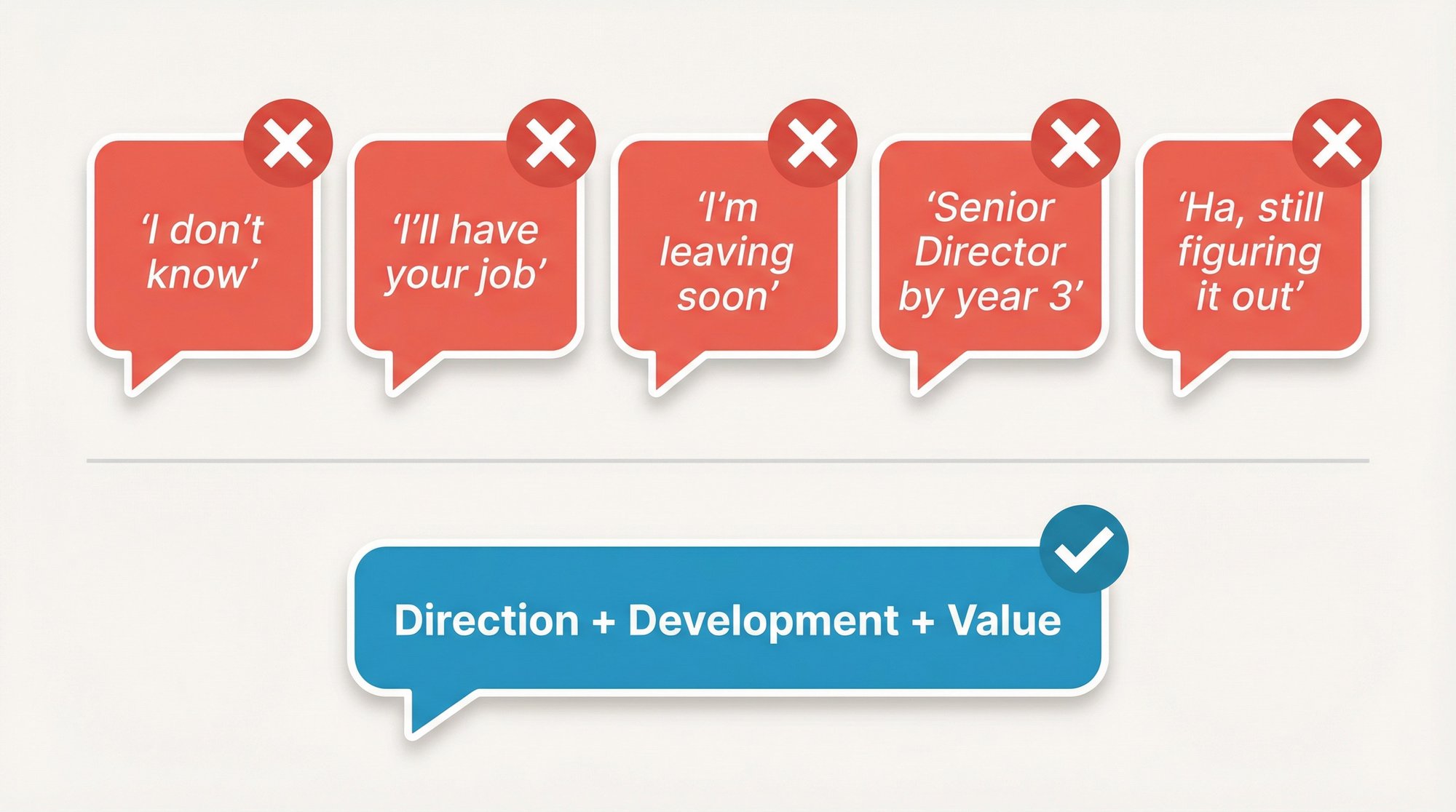
Mistake 1: Saying "I Don't Know"
If you're early career, you can get away with some uncertainty. But "I don't know" by itself sends a signal that you haven't thought about your career at all, and that's a problem at any level.
The upgrade:
"I'm still early enough that I'm exploring the exact specialization, but I'm sure I want to grow in [skills] and take on increasing responsibility in [direction]."
Mistake 2: "In 5 Years I'll Have Your Job"
This one gets brought up in almost every career advice column because candidates still say it thinking it sounds ambitious. It doesn't. It reads as naive and arrogant, not driven.
The upgrade:
"I'd like to grow one or two levels in scope by taking ownership of bigger projects and mentoring others, based on performance."
Mistake 3: Hinting You Won't Stay
Even if it's true, saying it out loud kills your candidacy on the spot. No hiring manager will invest in someone who's already planning their exit.
The upgrade:
Keep the focus on what you want to become and what you'll contribute. Don't mention leaving.
Mistake 4: Giving Overly Rigid Titles and Timelines
"I'll be a Senior Director by year three" sounds like you've scripted a movie about your career without checking if the plot makes sense. Career experts recommend being realistic and focusing on scope, skills, and impact rather than boxing yourself into specific titles and time frames. This is especially important for entry-level candidates preparing for interviews, where interviewers have lower expectations for precision but higher expectations for genuine self-awareness.
The upgrade:
Talk about scope, skills, and impact instead of "Senior Director by year 3."
Mistake 5: Using Joke Answers
It might get a laugh, but it tells the interviewer you don't take the question seriously. And if there are other candidates who gave a thoughtful answer, you just made their job easy.
The upgrade:
Even if you hate the question, answer it like a professional: direction + development + value.
Understanding common interview mistakes is part of a broader set of behavioral interview questions and answers you'll want to master before walking in. The same principle applies to other values-based questions interviewers use to assess how you think.
How to Tailor Your 5-Year Answer in 10 Minutes
Generic answers are the new red flag in 2026. Every interviewer has heard "I want to grow and take on more responsibility" a thousand times. Here's how to tailor your answer fast without overthinking.
Worth remembering: A tailored answer isn't just more impressive. It's actually easier to deliver, because you're talking about something real rather than reciting a script.
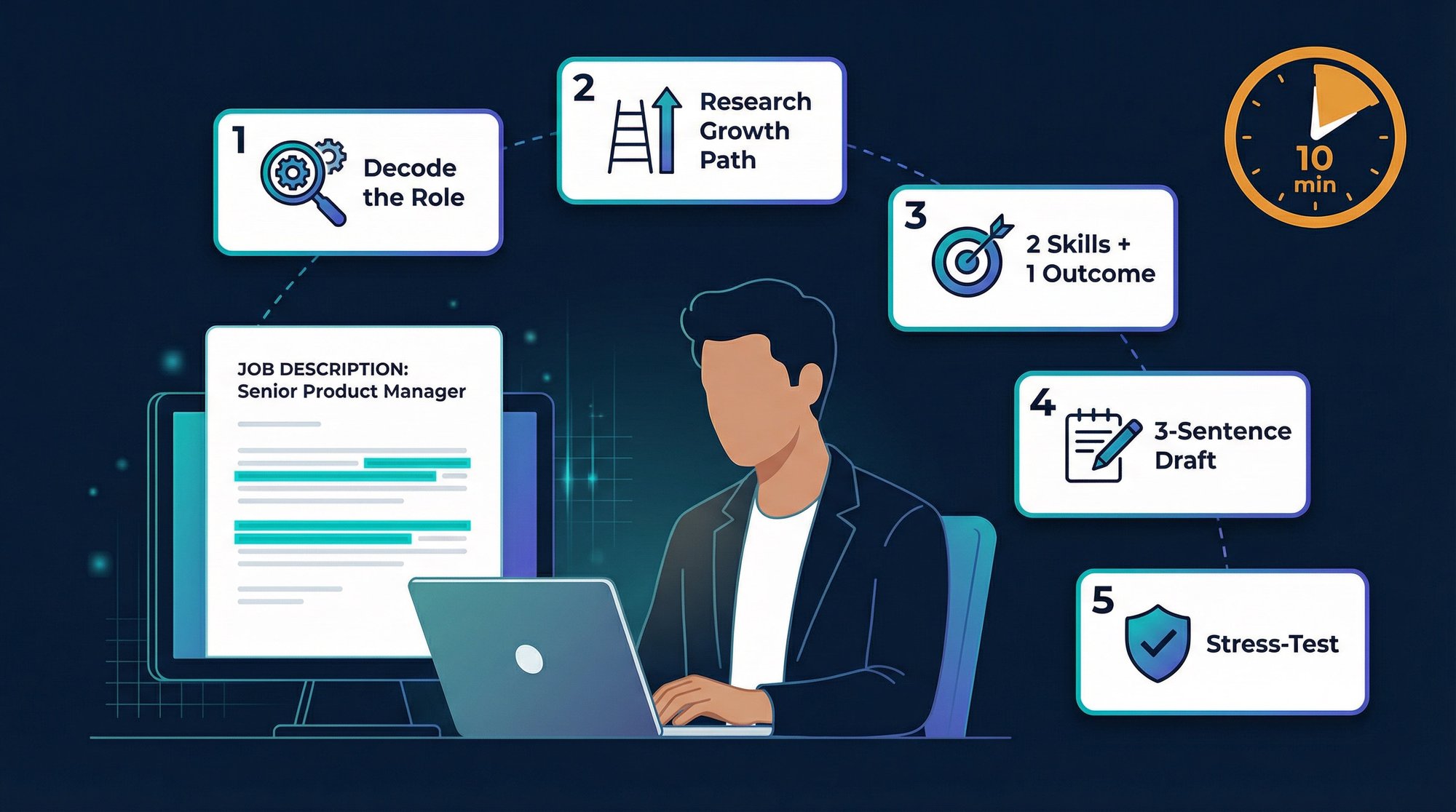
Step 1: Decode What the Role Actually Rewards
Open the job description and underline three things:
The 3 to 5 responsibilities they keep repeating
The outcomes they care about (speed, quality, revenue, retention, risk)
The "must-have" skills listed at the top
Step 2: Find Out What Growth Looks Like at the Company
Look for signals about what "good" looks like at the next level:
What's the role above this one? What changes?
Check LinkedIn for common promotions at the same company
Scan their other job posts for recurring themes
Step 3: Pick 2 Skills and 1 Impact Outcome
Narrow your answer down to two skills you want to build and one measurable outcome you'll deliver.
Example: "experimentation + stakeholder management" and "improve conversion rate."
Step 4: Write a 3-Sentence Version First
If you can't say your answer in three sentences, you're probably rambling. Start tight, then expand only if you need to.
Step 5: Stress-Test for Red Flags
Before your interview, ask yourself:
Does this answer still make sense if I actually stay here for 2 to 3 years?
Does it sound like I'm using this job as a stepping-stone to something unrelated?
Did I mention value I'll deliver, or only personal growth?
If any of those feel off, revise before you walk in.
Applying this tailoring approach to the "5 years" question is just one part of a complete job interview cheat sheet mindset. Interviewers evaluate many dimensions simultaneously: how you describe your past, how you frame your future, and how confidently you handle pressure. The tailoring method prepares you for all of them.
How to Practice Your 5-Year Answer Before the Interview
Knowing what to say and being able to say it smoothly are two different things. The difference between a candidate who sounds rehearsed (bad) and one who sounds prepared (good) comes down to practice.
How to Rehearse With a Mock Interviewer
The fastest way to sharpen your answer is to say it out loud in a simulated interview setting. AIApply's Mock Interview tool lets you paste a job description and practice with role-specific questions, including "Where do you see yourself in 5 years?" You get instant AI-powered feedback on your response, so you can iterate until your answer sounds natural and stays tight.

This is especially useful because you'll hear yourself say it. Reading your answer silently is not the same as delivering it under pressure. If you want a broader look at how to use AI tools to prepare for interviews, the AI interview prep guide covers the full landscape of what's possible and what works.
Using Interview Buddy for Real-Time Interview Support
For the actual interview, AIApply's Interview Buddy works as a real-time on-screen coaching tool during live video interviews on Zoom, Google Meet, or Teams. It provides live transcripts and suggested responses while you're in the conversation.
An important boundary here: use tools like this as a coach, not a puppet. Your answer to "Where do you see yourself in 5 years?" should genuinely reflect your thinking. Interview Buddy helps you articulate it better under pressure, not replace your own thoughts. If an employer has explicit rules about interview assistance, always follow them.

How to Align Your Resume, Cover Letter, and Interview Story
One thing that separates candidates who get offers from those who don't is consistency across touchpoints. When your resume, cover letter, and interview answers all point in the same direction, you come across as coherent and credible.
AIApply's Resume Builder and Cover Letter Generator are designed to tailor your documents to each specific job description, so the skills and trajectory you highlight in writing match what you'll say in the interview. That alignment is powerful because interviewers compare your written materials to what you say in person.
How Auto Apply Helps You Focus on Interview Prep
If you're applying to dozens of roles, spending 10 minutes tailoring your 5-year answer for each one can feel overwhelming. AIApply's Auto Apply handles the high-volume application work (scanning job boards, customizing materials, submitting tailored applications), which frees you up to spend your limited prep time on the interviews that actually matter.
Let automation handle the breadth so you can focus on the depth. The goal isn't to apply everywhere. It's to be maximally prepared for the conversations that result. You can read more about smart job search strategy to understand how the best candidates balance volume with targeted preparation.
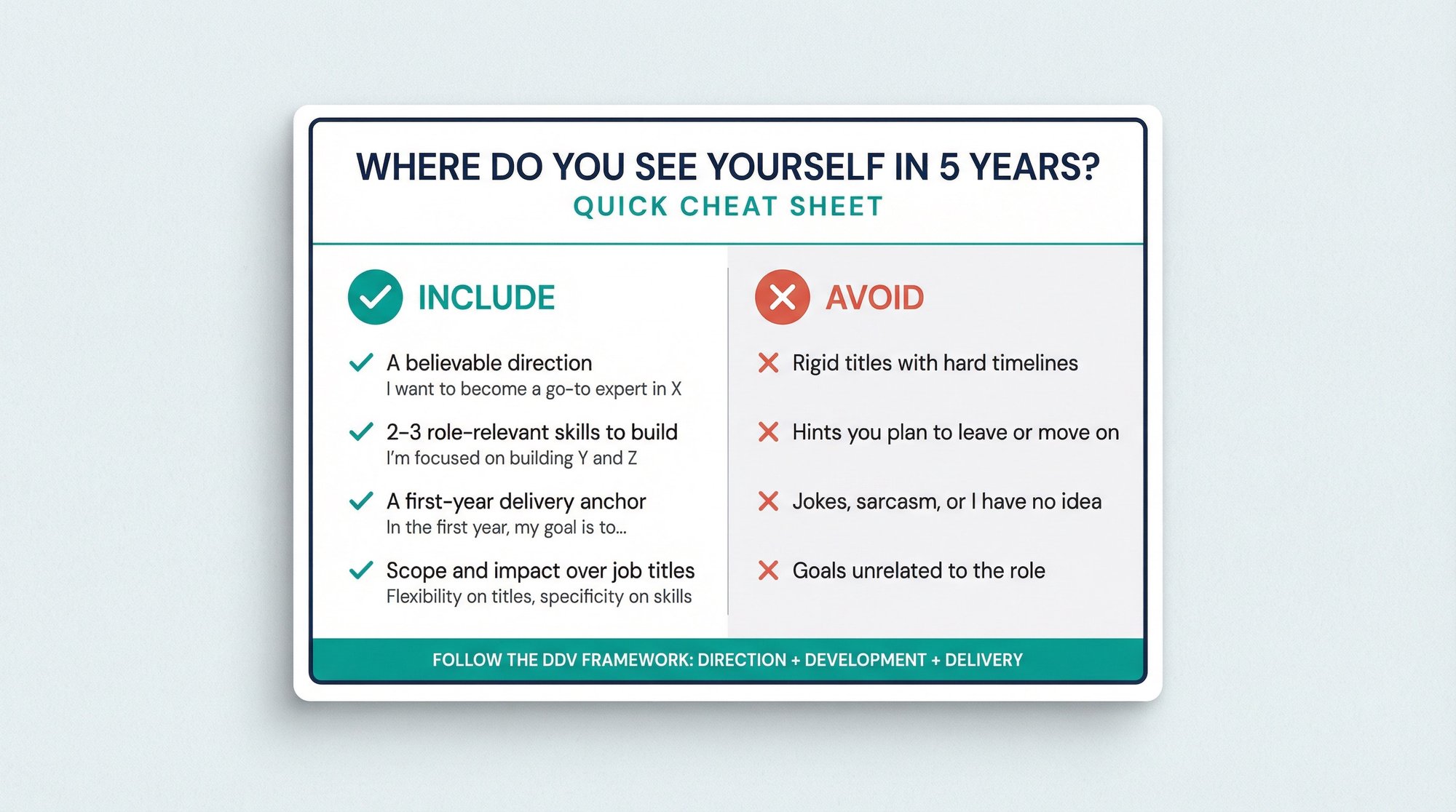
Quick Cheat Sheet: Where Do You See Yourself in 5 Years
Save this for right before your next interview.
And your answer should NOT include:
Specific titles with hard timelines
Anything about leaving or "moving on"
Jokes, sarcasm, or "I have no idea"
Goals that have nothing to do with the role
FAQ: Where Do You See Yourself in 5 Years
Is it okay to say "I want to be a manager"?
Yes, if you frame it correctly. Say it as something you want to earn through excellent work, not as something you expect to be given. "I'd like to grow into a leadership role by first becoming excellent at the fundamentals and then gradually expanding into mentoring and team leadership" works much better than "I plan to be managing a team within two years."
What if I genuinely don't know what I want in 5 years?
That's normal, especially early in your career. You don't need a specific end point. You need a direction and a reason why this role is a good next step. Something like "I'm still exploring the exact specialization, but I know I want to grow in [these skills] and take on increasing responsibility" shows self-awareness without faking certainty. Reading the entry-level interview questions guide can help you understand what interviewers are actually testing at this career stage.
Should I say I want to stay at the company for 5 years?
You don't have to explicitly promise five years. It's safer (and more authentic) to imply it by showing how your growth path fits inside the company. Career experts recommend avoiding answers that make it obvious you plan to leave. Focus on what you'll build and contribute there.
How long should my answer be?
Aim for 45 to 90 seconds. You can give a strong answer in 2 to 3 minutes if the interviewer asks follow-up questions, but most candidates do best keeping their initial response tight. If you can't say it in under 90 seconds, you're probably including too much detail. Practicing with AIApply's mock interview tool gives you real-time feedback on response length, so you can calibrate before the actual conversation.
What if the company doesn't have a clear growth path for this role?
Focus your answer on skills and impact rather than titles. "I want to become stronger at X and deliver Y" works regardless of whether the company has a formal promotion ladder. This approach also protects you from sounding like you're making assumptions about their internal structure.
Can I mention wanting to start my own business someday?
Generally, no. Even if it's your long-term dream, mentioning it in an interview signals that you view this role as temporary. Keep your answer focused on what you'll contribute and grow into within the professional context of this company and role.
Should my answer change for different interview rounds?
Your core message should stay consistent, but you can adjust the emphasis. In early rounds (phone screens, HR interviews), keep it high-level and focused on alignment. In later rounds with hiring managers or team leads, add more specifics about how you'd deliver value and what skills you'd build in their particular environment. Understanding how to answer situational interview questions will also help you adapt your answer style to the format and depth each round requires.
What if I'm overqualified for the role?
This is where the "Delivery" part of the DDV framework becomes critical. Emphasize the value you'll bring immediately and the interesting challenges you see in the role. Instead of talking about "growing into" something, talk about what you'll build, improve, or solve. Something like "I see an opportunity to bring my experience in X to help accelerate Y" reframes the conversation from overqualification to impact.
How do I handle this question if I was recently laid off?
Don't let the layoff define your answer. Focus forward. A layoff actually gives you a natural reason to be thoughtful about your next move: "After my last role, I've been intentional about finding a position that aligns with where I want to grow. This role fits because [specific reasons]. In five years, I want to have built deep expertise in [area] and be delivering [outcomes]." If you're also navigating how to frame the gap itself, the guide on explaining employment gaps in interviews gives you a framework for handling both questions with confidence.
Is it okay to ask the interviewer what growth looks like at the company before answering?
Absolutely. Turning it into a brief two-way conversation shows genuine interest. You could say, "I'd love to share where I'm heading, and I'm also curious about what growth typically looks like here for someone in this role." Then give your answer. This signals that you're thinking about fit, not just reciting a script. Knowing the right questions to ask at the end of an interview also helps you continue the conversation naturally once you've answered.
Preparing for an interview is about more than memorizing answers. It's about building a consistent story across every touchpoint, from your resume to your cover letter to the words that come out of your mouth when someone asks about your future. AIApply helps you do exactly that. Practice with our Mock Interview tool and get real-time coaching with Interview Buddy so you walk into every conversation fully prepared.
"Where do you see yourself in 5 years?"
Six words. And somehow they make even experienced professionals freeze mid-sentence, stare at the ceiling, and start wondering if "I honestly have no idea" counts as an acceptable answer.
It doesn't. But your answer doesn't need to be perfect, poetic, or some grand life narrative. It needs to be believable, relevant, and short. That's it.
This guide gives you a simple framework, five ready-to-use templates, eight role-specific examples, and a 10-minute method to tailor your answer to any job description. Whether you're entry-level, mid-career, switching industries, or aiming for leadership, you'll walk away with an answer you actually feel confident saying out loud.
Why Do Interviewers Ask "Where Do You See Yourself in 5 Years?"
They're not asking you to predict the future. They're trying to reduce risk.
Hiring is a bet. Every time a company brings someone on, they're gambling time and money on a person they can't fully evaluate in a few conversations. They can't directly observe how hard you'll push once the novelty wears off, whether you'll grow into the role's real demands, or whether you'll stick around long enough for the investment to pay off.
That's why this question exists. It's a risk assessment disguised as a conversation starter.
Career experts consistently point to the same themes when explaining what employers are really evaluating. It comes down to alignment with the role, fit with the company's mission, a realistic trajectory, and signs you won't bolt after six months.
How Interviewers Actually Score Your Answer
Most interviewers won't say this out loud, but they're mentally grading you on five dimensions:
That last row matters more than most candidates realize. Replacing people is expensive. According to SHRM's 2025 benchmarking data, the average cost-per-hire is $5,475 for non-executive hires and $35,879 for executive positions. And Gallup's analysis (updated February 2026) estimates replacing leaders and managers can cost around 200% of their salary, while technical professionals run about 80% and frontline employees about 40%.
So when you answer this question, you're doing one thing: lowering their perceived risk while raising their perceived upside. It's the same logic behind preparing thoroughly for every interview. The more you understand what the interviewer is evaluating, the more precisely you can deliver what they need to hear.
Why the 5-Year Question Is Hard to Answer in 2026
Two realities make long-term forecasting harder than it used to be. And both of them actually work in your favor if you know how to use them.
How Long Do People Actually Stay at a Job?
In the U.S., median tenure with a current employer was 3.9 years as of January 2024 (and just 3.5 years in the private sector), according to Bureau of Labor Statistics data published in April 2025.
In the UK, the picture is similar. CIPD analysis of the Annual Population Survey found average labour turnover of 34% between January 2022 and December 2023, with the most common length of service being 2 to 5 years. About 16% of workers had less than 12 months' tenure.
Employers know "5 years" is aspirational. They're not expecting a binding contract. But they still want to hear that you have a direction that makes staying plausible.
How Fast Are Job Skills Changing?
The World Economic Forum's Future of Jobs Report 2025 projects that 39% of workers' core skills will change by 2030. And the Microsoft and LinkedIn 2024 Work Trend Index found that 75% of knowledge workers globally already use generative AI at work, with 78% bringing their own AI tools.
What does this mean for your answer? A modern "5-year" answer works best when it's skills-focused and impact-focused, not title-focused. Rigid titles break. Skills and trajectory don't. If you want to understand what skills matter most for your target role, browsing AIApply's skills guides by job title can help you identify what to emphasize.
The core mindset shift: Don't give a "plan." Give a "trajectory."
Old mental model: "They want a specific job title I'll have in 5 years."
Better mental model: "They want to know if this role is a logical step in the story of my growth."
The DDV Framework: How to Structure Your 5-Year Answer
Your answer needs three ingredients. We call it the DDV Framework, and it works because it mirrors exactly what interviewers are scoring you on:
Direction = where you're heading
Development = what you'll build along the way
Delivery = what you'll contribute right now
If you can hit all three in 45 to 90 seconds, you win. Seriously. That's the whole formula.
How to Choose a Career Direction That Resonates
Your direction should be broad enough to stay true even if the company changes, but specific enough to signal intention. Think of it as a "North Star" for your career.
Strong North Stars look like this:
"Become a go-to expert in X"
"Own a bigger slice of the process end-to-end"
"Lead cross-functional projects in Y"
"Move from execution to strategy in Z"
"Become someone who can build, ship, and measure outcomes"
Avoid these:
"Be a CEO" (unless the path genuinely leads there)
"Be in management" when the role is clearly individual-contributor with no management ladder
"Not sure" with zero direction (especially past entry level)
The key is finding something that's true for you and relevant to them. If your direction has nothing to do with the company's work, that's a red flag for the interviewer. If it fits naturally, it becomes the strongest signal you can send. Working through a career development plan before your interview can help you clarify your direction so it sounds genuine, not rehearsed.
How to Name the Skills You Want to Build
This is where most people get generic. "I want to grow my skills" tells the interviewer nothing. You need to be concrete.
Generic (forgettable): "I want to develop my leadership skills."
Concrete (memorable): "I want to build my ability to manage stakeholders across product, design, and engineering, and get real reps running experiments rather than just reporting metrics."
Here are examples of development goals that actually land:
"Stakeholder management across product, design, and engineering"
"Running experiments, not just reporting metrics"
"Writing clearly and making decisions with incomplete data"
"Mentoring and coaching junior team members"
"AI-assisted workflows and evaluation, with good judgment about when to use them"
Career experts consistently recommend focusing on skills and flexibility rather than locking into rigid titles and timelines. That advice is more relevant than ever in 2026, where the skills landscape shifts every 18 months. AIApply's Resume Scanner can also flag the specific skill gaps between your current profile and target roles, which feeds directly into your development narrative.
How to Show What You Will Deliver in the Role
This is the money line. The part where you prove you're not just daydreaming about your future but actually thinking about what you'll produce for them.
You want at least one sentence that sounds like:
"In the first year, my goal is to become fully effective in X and deliver Y outcome."
"By year two or three, I want to own Z and reliably move A metric."
"Longer-term, I want to take on broader scope in B while continuing to deliver C."
This approach aligns with how university career services teach interview prep: relate your future answer to how you'd perform in the position and show logical progression. When your resume and your interview answer both emphasize the same outcomes and skills, interviewers experience you as coherent and credible rather than just a good talker.
The 1-3-5 Ladder: A Simple Structure That Works
If you freeze easily and want a dead-simple structure, use this:
You can say it in 60 seconds. It works in almost every industry. And it hits all three DDV elements without overcomplicating things.
5 Answer Templates for "Where Do You See Yourself in 5 Years"
These templates are designed so you can swap in your own details and have a strong answer ready in minutes. Each one follows the DDV framework.
Universal Template (Works for Most Roles)
"In five years, I want to be [a strong senior contributor / a trusted owner / a lead in X]. To get there, I'm focused on building [skill 1] and [skill 2], and getting real reps in [skill 3 if needed].
What excites me about this role is that it's a strong step because [this role directly gives those reps]. In the near term, my priority is to [deliver a concrete first-year outcome], and over time, take on [bigger scope] while continuing to produce measurable results."
Template for Entry-Level and Early Career
"In five years, I want to be really strong at [core skill of this role] and trusted as someone who can [deliver outcome]. I'm still early enough that I'm exploring the exact specialization, but I know I want to grow in [2 skills] and take on increasing responsibility.
This role stands out because it will let me learn [specific tools/process] and contribute quickly by [contribution]. My goal in the first year is to ramp fast and become someone the team can rely on for [specific work]."
If you're early in your career, it's completely fine to not have everything figured out. What matters is showing you understand the role and why it's a good next step. Interviewers at this level are looking for direction, not certainty. Pairing this answer with solid entry-level interview preparation makes the difference between sounding uncertain and sounding self-aware.
Template for Career Changers
"In five years, I see myself as [role direction] in this industry, using my background in [old domain] to bring a different angle. The skills I'm intentionally building are [new skill 1] and [new skill 2], and I'm already doing that through [proof: project/course/freelance].
This role makes sense because it's a practical bridge: it lets me apply [transferable strength] immediately while building depth in [new domain]. In the first year, I want to deliver [specific outcome], and then expand scope as I demonstrate results."
Career changers often face extra scrutiny on this question because interviewers are evaluating whether the switch is credible. A strong 5-year answer helps. So does having a resume built specifically for career transitions that presents your transferable story clearly before you even get to the interview.
Template for Saying You Want to Be a Manager
"In five years, I'd like to be in a position where I'm leading projects and mentoring others, potentially as a people manager if the fit is right. The reason is I enjoy [coaching/ownership/cross-functional coordination] and I've seen I'm effective when I can help others succeed.
To earn that, I want to first become excellent at [core IC work], then take on opportunities like [mentoring, onboarding, leading a small initiative]. In this role, my focus would be to deliver strongly in the fundamentals first and then gradually expand into leadership responsibilities."
The important word there is "earn." Career experts note that saying "I want to be a manager" works fine as long as you frame it as something you'll grow into through performance, not something you expect to be handed. A solid career development plan can help you map out what those concrete milestones look like over time.
Template for Senior Candidates
"In five years, I want to be operating at a level where I'm owning larger, messier problems and helping shape strategy and execution. The themes for me are [scaling systems/process], [developing other people], [driving measurable business outcomes].
What I'm looking for now is a role where I can immediately deliver value in [area], and also have the runway to expand scope as impact is proven. In the near term, I'd be focused on [first 90 days: diagnose, align, deliver early win], and then building a durable system that improves [metric]."
8 Role-Specific Answer Examples That Actually Work
Each example below is written to be deliverable in about 45 to 75 seconds. They follow the DDV framework so you can see how direction, development, and delivery play out across different careers.
1. Software Engineer (Mid-Level)
"In five years, I want to be a senior engineer who can own systems end-to-end and be the person people trust for performance and reliability. To get there, I'm focusing on system design, writing maintainable code, and getting better at driving work across teams, not just within my lane.
This role fits because it's building product at scale, and I'd get to work on the kinds of technical decisions that force you to level up. In the first year, my goal would be to ramp fast, ship reliably, and then take ownership of a service or critical component and improve stability or latency in a measurable way."
Why it works: Direction is plausible. Skills are specific. Value is clear from day one.
If you're applying for software engineering roles, reviewing a software engineer resume example shows you how to structure the experience and skills sections so your written materials reinforce what you're saying in the interview. You can also explore the software engineer career path to understand where the role typically leads.
2. Data Analyst
"In five years, I want to be someone who isn't just reporting numbers but driving decisions. I'd like to be trusted as the person who can frame questions, run analysis, and turn it into actions teams actually take. To build that, I'm focusing on stronger experimentation skills, stakeholder management, and getting better at communicating insights simply.
This role is a great step because it's close to the business and I'd be partnering with teams who act on the data. In the first year, I'd aim to master your data model, deliver clean recurring reporting, and then start owning deeper analyses that move one or two core metrics."
Strong data analyst candidates demonstrate clarity not just in their answers but in their application materials. See how a data analyst resume presents the combination of technical skills and business impact. To understand what skills hiring managers look for at each level, the data analyst skills guide gives you a structured breakdown.
3. Product Manager (Career Switch from Engineering)
"In five years, I want to be leading products where I'm accountable for outcomes, not just shipping features. I'm building my product toolkit around customer discovery, prioritization, and aligning teams around a clear definition of success. I've already started that through [project or side product], where I [proof].
This PM role makes sense because it's a strong bridge from my technical background while forcing me to develop the customer and business muscles. In the first year, I'd focus on learning your users and metrics fast, then taking ownership of a problem area where I can deliver measurable improvement."
The engineering-to-PM transition is one of the most common career switches, and interviewers will probe whether you understand the role change. A product manager resume example can help you see how to frame your engineering background as an advantage rather than a detour. It's also worth reading how to pivot careers before the interview to sharpen your transition narrative.
4. Sales Development Rep (SDR)
"In five years, I want to be a strong closer, ideally in an account executive role, where I'm running full-cycle deals and owning a number. To get there, I'm focused on mastering discovery, objection handling, and building the discipline to improve through feedback and metrics.
This SDR role is the right step because it gives me high reps, coaching, and a path to develop the fundamentals properly. In the short term, my goal is to ramp quickly, hit quota consistently, and become known for a repeatable process I can teach to new hires."
The SDR-to-AE path is one of the clearest career progressions in tech sales. See how top candidates frame that trajectory in a sales development representative resume, and check out what hiring managers look for in the sales development representative career guide. If you want to explore what the role pays at different seniority levels, the SDR salary data is a useful reference.
5. Customer Success Manager
"In five years, I want to be leading larger, more complex accounts and be seen as someone who can drive retention and expansion through real value creation. I'm focused on deepening my skills in stakeholder management, product adoption strategies, and translating customer goals into measurable outcomes.
This role fits because the customer base and product complexity will stretch those skills. In the first year, I'd aim to learn your product and customer segments quickly, stabilize a portfolio, and then run a few initiatives that lift retention or expansion."
Customer success sits at the intersection of relationship management and product expertise. A customer success manager resume example shows how to highlight both dimensions effectively. The customer success manager career page also outlines what different experience levels look like, which helps you calibrate your 5-year answer to what's realistic at your current stage.
6. Marketing (Performance or Growth)
"In five years, I want to be operating as a growth marketer who can own a channel or a full funnel and reliably improve CAC-to-LTV outcomes. To get there, I'm building depth in experimentation, creative testing, and measurement, especially attribution and decision-making with imperfect data.
This role is a strong step because it's hands-on and metrics-driven. In the first year, I'd focus on learning the customer and current funnel, shipping a steady cadence of tests, and then scaling what works into a repeatable system."
Growth and performance marketing roles evolve quickly, and your 5-year answer should reflect where the discipline is heading. Explore the digital marketing manager career path to understand the typical progression from specialist to strategist roles in this space.
7. Finance Analyst
"In five years, I want to be a finance partner who helps leaders make better decisions, not just produce reports. I'm focused on developing stronger forecasting, business partnering, and communication skills so I can connect the numbers to tradeoffs and strategy.
This role fits because it's close to the operational teams and gives exposure to how decisions get made. In the first year, I'd focus on becoming reliable in the core reporting and then gradually take ownership of forecasting or a business area where I can improve accuracy and decision speed."
Finance analyst candidates who understand the typical progression (from analyst to senior analyst to finance business partner) tend to give more credible 5-year answers. A financial analyst resume example shows how to present that upward trajectory visually. The financial analyst career page breaks down the skills and experience that distinguish candidates at each level.
8. Operations / Project Coordinator
"In five years, I want to be running bigger cross-functional projects where I'm responsible for outcomes and execution quality. To build that, I'm focusing on project planning, stakeholder communication, and learning how to identify bottlenecks and fix process issues.
This role makes sense because it gives me exposure to how work actually flows through the organization. In the first year, I'd aim to become excellent at the fundamentals and then take ownership of a project or process improvement that measurably reduces delays or errors."
Project coordinators who have a clear picture of where they're heading (toward senior project manager, program manager, or operations director) give much stronger answers to this question. Review a project coordinator resume example to see how candidates frame their trajectory, and explore the project coordinator career page for a clearer view of typical advancement paths.
What Not to Say When Asked Where You See Yourself in 5 Years
Some answers don't just miss the mark. They actively hurt your chances. Here are the five most common mistakes and exactly how to fix each one.
Mistake 1: Saying "I Don't Know"
If you're early career, you can get away with some uncertainty. But "I don't know" by itself sends a signal that you haven't thought about your career at all, and that's a problem at any level.
The upgrade:
"I'm still early enough that I'm exploring the exact specialization, but I'm sure I want to grow in [skills] and take on increasing responsibility in [direction]."
Mistake 2: "In 5 Years I'll Have Your Job"
This one gets brought up in almost every career advice column because candidates still say it thinking it sounds ambitious. It doesn't. It reads as naive and arrogant, not driven.
The upgrade:
"I'd like to grow one or two levels in scope by taking ownership of bigger projects and mentoring others, based on performance."
Mistake 3: Hinting You Won't Stay
Even if it's true, saying it out loud kills your candidacy on the spot. No hiring manager will invest in someone who's already planning their exit.
The upgrade:
Keep the focus on what you want to become and what you'll contribute. Don't mention leaving.
Mistake 4: Giving Overly Rigid Titles and Timelines
"I'll be a Senior Director by year three" sounds like you've scripted a movie about your career without checking if the plot makes sense. Career experts recommend being realistic and focusing on scope, skills, and impact rather than boxing yourself into specific titles and time frames. This is especially important for entry-level candidates preparing for interviews, where interviewers have lower expectations for precision but higher expectations for genuine self-awareness.
The upgrade:
Talk about scope, skills, and impact instead of "Senior Director by year 3."
Mistake 5: Using Joke Answers
It might get a laugh, but it tells the interviewer you don't take the question seriously. And if there are other candidates who gave a thoughtful answer, you just made their job easy.
The upgrade:
Even if you hate the question, answer it like a professional: direction + development + value.
Understanding common interview mistakes is part of a broader set of behavioral interview questions and answers you'll want to master before walking in. The same principle applies to other values-based questions interviewers use to assess how you think.
How to Tailor Your 5-Year Answer in 10 Minutes
Generic answers are the new red flag in 2026. Every interviewer has heard "I want to grow and take on more responsibility" a thousand times. Here's how to tailor your answer fast without overthinking.
Worth remembering: A tailored answer isn't just more impressive. It's actually easier to deliver, because you're talking about something real rather than reciting a script.
Step 1: Decode What the Role Actually Rewards
Open the job description and underline three things:
The 3 to 5 responsibilities they keep repeating
The outcomes they care about (speed, quality, revenue, retention, risk)
The "must-have" skills listed at the top
Step 2: Find Out What Growth Looks Like at the Company
Look for signals about what "good" looks like at the next level:
What's the role above this one? What changes?
Check LinkedIn for common promotions at the same company
Scan their other job posts for recurring themes
Step 3: Pick 2 Skills and 1 Impact Outcome
Narrow your answer down to two skills you want to build and one measurable outcome you'll deliver.
Example: "experimentation + stakeholder management" and "improve conversion rate."
Step 4: Write a 3-Sentence Version First
If you can't say your answer in three sentences, you're probably rambling. Start tight, then expand only if you need to.
Step 5: Stress-Test for Red Flags
Before your interview, ask yourself:
Does this answer still make sense if I actually stay here for 2 to 3 years?
Does it sound like I'm using this job as a stepping-stone to something unrelated?
Did I mention value I'll deliver, or only personal growth?
If any of those feel off, revise before you walk in.
Applying this tailoring approach to the "5 years" question is just one part of a complete job interview cheat sheet mindset. Interviewers evaluate many dimensions simultaneously: how you describe your past, how you frame your future, and how confidently you handle pressure. The tailoring method prepares you for all of them.
How to Practice Your 5-Year Answer Before the Interview
Knowing what to say and being able to say it smoothly are two different things. The difference between a candidate who sounds rehearsed (bad) and one who sounds prepared (good) comes down to practice.
How to Rehearse With a Mock Interviewer
The fastest way to sharpen your answer is to say it out loud in a simulated interview setting. AIApply's Mock Interview tool lets you paste a job description and practice with role-specific questions, including "Where do you see yourself in 5 years?" You get instant AI-powered feedback on your response, so you can iterate until your answer sounds natural and stays tight.
This is especially useful because you'll hear yourself say it. Reading your answer silently is not the same as delivering it under pressure. If you want a broader look at how to use AI tools to prepare for interviews, the AI interview prep guide covers the full landscape of what's possible and what works.
Using Interview Buddy for Real-Time Interview Support
For the actual interview, AIApply's Interview Buddy works as a real-time on-screen coaching tool during live video interviews on Zoom, Google Meet, or Teams. It provides live transcripts and suggested responses while you're in the conversation.
An important boundary here: use tools like this as a coach, not a puppet. Your answer to "Where do you see yourself in 5 years?" should genuinely reflect your thinking. Interview Buddy helps you articulate it better under pressure, not replace your own thoughts. If an employer has explicit rules about interview assistance, always follow them.
How to Align Your Resume, Cover Letter, and Interview Story
One thing that separates candidates who get offers from those who don't is consistency across touchpoints. When your resume, cover letter, and interview answers all point in the same direction, you come across as coherent and credible.
AIApply's Resume Builder and Cover Letter Generator are designed to tailor your documents to each specific job description, so the skills and trajectory you highlight in writing match what you'll say in the interview. That alignment is powerful because interviewers compare your written materials to what you say in person.
How Auto Apply Helps You Focus on Interview Prep
If you're applying to dozens of roles, spending 10 minutes tailoring your 5-year answer for each one can feel overwhelming. AIApply's Auto Apply handles the high-volume application work (scanning job boards, customizing materials, submitting tailored applications), which frees you up to spend your limited prep time on the interviews that actually matter.
Let automation handle the breadth so you can focus on the depth. The goal isn't to apply everywhere. It's to be maximally prepared for the conversations that result. You can read more about smart job search strategy to understand how the best candidates balance volume with targeted preparation.
Quick Cheat Sheet: Where Do You See Yourself in 5 Years
Save this for right before your next interview.
And your answer should NOT include:
Specific titles with hard timelines
Anything about leaving or "moving on"
Jokes, sarcasm, or "I have no idea"
Goals that have nothing to do with the role
FAQ: Where Do You See Yourself in 5 Years
Is it okay to say "I want to be a manager"?
Yes, if you frame it correctly. Say it as something you want to earn through excellent work, not as something you expect to be given. "I'd like to grow into a leadership role by first becoming excellent at the fundamentals and then gradually expanding into mentoring and team leadership" works much better than "I plan to be managing a team within two years."
What if I genuinely don't know what I want in 5 years?
That's normal, especially early in your career. You don't need a specific end point. You need a direction and a reason why this role is a good next step. Something like "I'm still exploring the exact specialization, but I know I want to grow in [these skills] and take on increasing responsibility" shows self-awareness without faking certainty. Reading the entry-level interview questions guide can help you understand what interviewers are actually testing at this career stage.
Should I say I want to stay at the company for 5 years?
You don't have to explicitly promise five years. It's safer (and more authentic) to imply it by showing how your growth path fits inside the company. Career experts recommend avoiding answers that make it obvious you plan to leave. Focus on what you'll build and contribute there.
How long should my answer be?
Aim for 45 to 90 seconds. You can give a strong answer in 2 to 3 minutes if the interviewer asks follow-up questions, but most candidates do best keeping their initial response tight. If you can't say it in under 90 seconds, you're probably including too much detail. Practicing with AIApply's mock interview tool gives you real-time feedback on response length, so you can calibrate before the actual conversation.
What if the company doesn't have a clear growth path for this role?
Focus your answer on skills and impact rather than titles. "I want to become stronger at X and deliver Y" works regardless of whether the company has a formal promotion ladder. This approach also protects you from sounding like you're making assumptions about their internal structure.
Can I mention wanting to start my own business someday?
Generally, no. Even if it's your long-term dream, mentioning it in an interview signals that you view this role as temporary. Keep your answer focused on what you'll contribute and grow into within the professional context of this company and role.
Should my answer change for different interview rounds?
Your core message should stay consistent, but you can adjust the emphasis. In early rounds (phone screens, HR interviews), keep it high-level and focused on alignment. In later rounds with hiring managers or team leads, add more specifics about how you'd deliver value and what skills you'd build in their particular environment. Understanding how to answer situational interview questions will also help you adapt your answer style to the format and depth each round requires.
What if I'm overqualified for the role?
This is where the "Delivery" part of the DDV framework becomes critical. Emphasize the value you'll bring immediately and the interesting challenges you see in the role. Instead of talking about "growing into" something, talk about what you'll build, improve, or solve. Something like "I see an opportunity to bring my experience in X to help accelerate Y" reframes the conversation from overqualification to impact.
How do I handle this question if I was recently laid off?
Don't let the layoff define your answer. Focus forward. A layoff actually gives you a natural reason to be thoughtful about your next move: "After my last role, I've been intentional about finding a position that aligns with where I want to grow. This role fits because [specific reasons]. In five years, I want to have built deep expertise in [area] and be delivering [outcomes]." If you're also navigating how to frame the gap itself, the guide on explaining employment gaps in interviews gives you a framework for handling both questions with confidence.
Is it okay to ask the interviewer what growth looks like at the company before answering?
Absolutely. Turning it into a brief two-way conversation shows genuine interest. You could say, "I'd love to share where I'm heading, and I'm also curious about what growth typically looks like here for someone in this role." Then give your answer. This signals that you're thinking about fit, not just reciting a script. Knowing the right questions to ask at the end of an interview also helps you continue the conversation naturally once you've answered.
Preparing for an interview is about more than memorizing answers. It's about building a consistent story across every touchpoint, from your resume to your cover letter to the words that come out of your mouth when someone asks about your future. AIApply helps you do exactly that. Practice with our Mock Interview tool and get real-time coaching with Interview Buddy so you walk into every conversation fully prepared.
.webp)
.webp)
.webp)
Don't miss out on
your next opportunity.
Create and send applications in seconds, not hours.


