
What Is Your Greatest Weakness? 35 Example Answers for 2026

.webp)
If you think "What is your greatest weakness?" is a trap, you're half right.
It's not a trap because the interviewer wants to catch you and reject you on the spot. It's a trap because most candidates answer it in a way that accidentally reveals one of four things: they lack self-awareness, they can't take feedback, they're hiding something, or they're so rehearsed that nothing they say feels real.
Any one of those is a hiring risk. Interviewers know how to spot them.
This guide walks you through exactly why the question exists, how to pick the right weakness, a structure that works every time, and 35 example answers you can adapt in minutes. Once you've locked in your answer, AIApply's Mock Interview tool lets you practice it against a tailored job simulation so it sounds like you, not a rehearsed script.
Why Interviewers Ask "What Is Your Greatest Weakness?"
An interview is fundamentally a risk-reduction exercise. Hiring is expensive and uncertain, and the interviewer is trying to answer four questions before making a decision:
Can you do the work?
Will you be easy to work with?
Will you grow, or repeat the same mistakes?
Will you create hidden problems down the line?
Your answer to "What is your greatest weakness?" is a shortcut to all four. It tells them more in 60 seconds than almost any other question.
The most insightful framing we've seen: interviewers want to know whether you're self-aware enough to recognize a flaw and self-motivated enough to fix it. That's the bar. It's not about finding someone without weaknesses. Everyone has them. It's about finding someone who can see themselves clearly and act accordingly.
What Interviewers Are Really Scoring When They Ask This
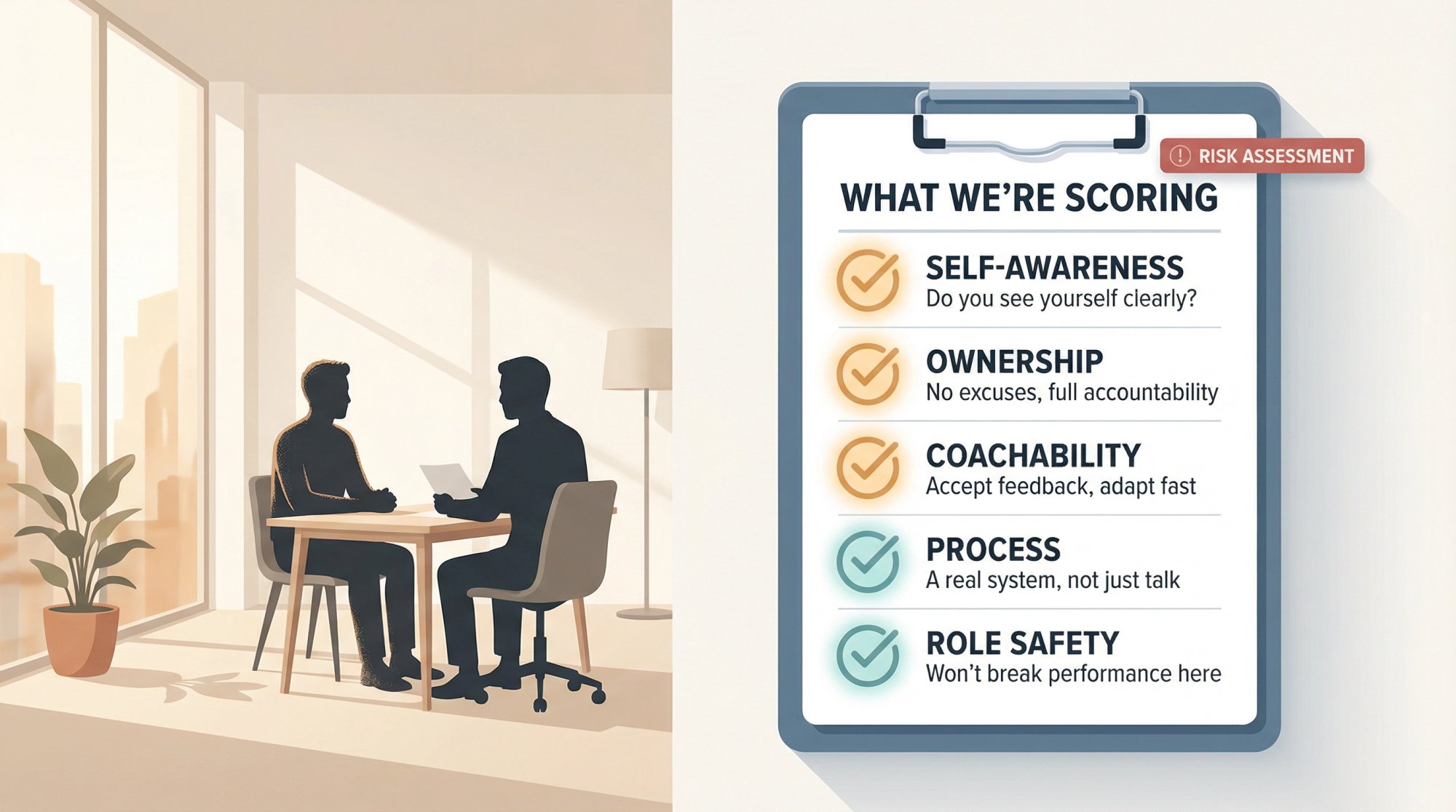
Even when the conversation feels casual, many organizations use structured interview criteria to make candidates comparable. When you answer this question, you're usually being scored on five dimensions:
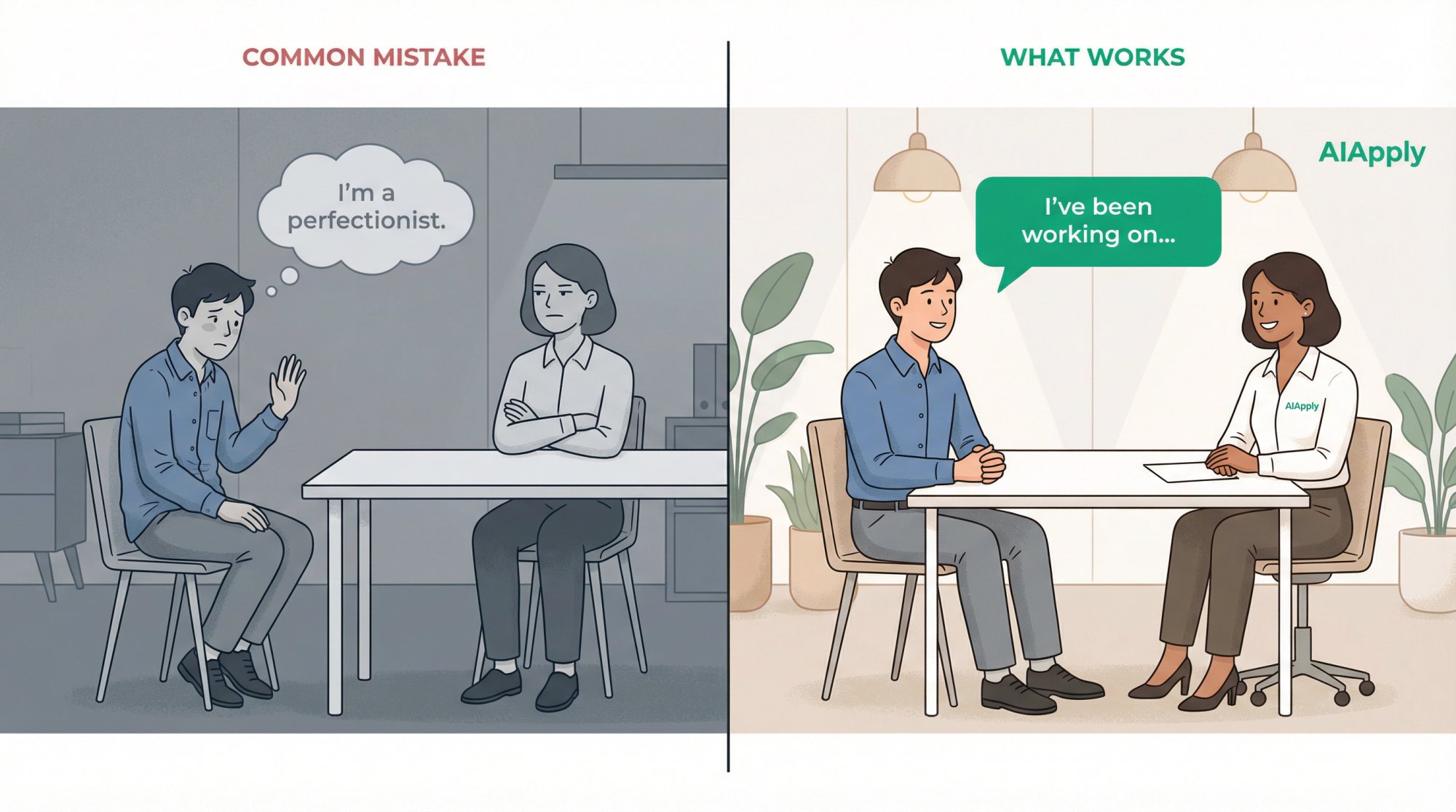
Build your answer to hit all five, and what feels like a scary question becomes a genuine advantage over every candidate who tried to dodge it with "I'm a perfectionist."
How to Answer "What Is Your Greatest Weakness?" (Quick Template)
No time to overthink it. Use this structure:
Weakness (specific, real, not fatal to the role) + What you're doing about it (system, habit, training, or feedback loop) + Proof it's improving (result, metric, or concrete change)
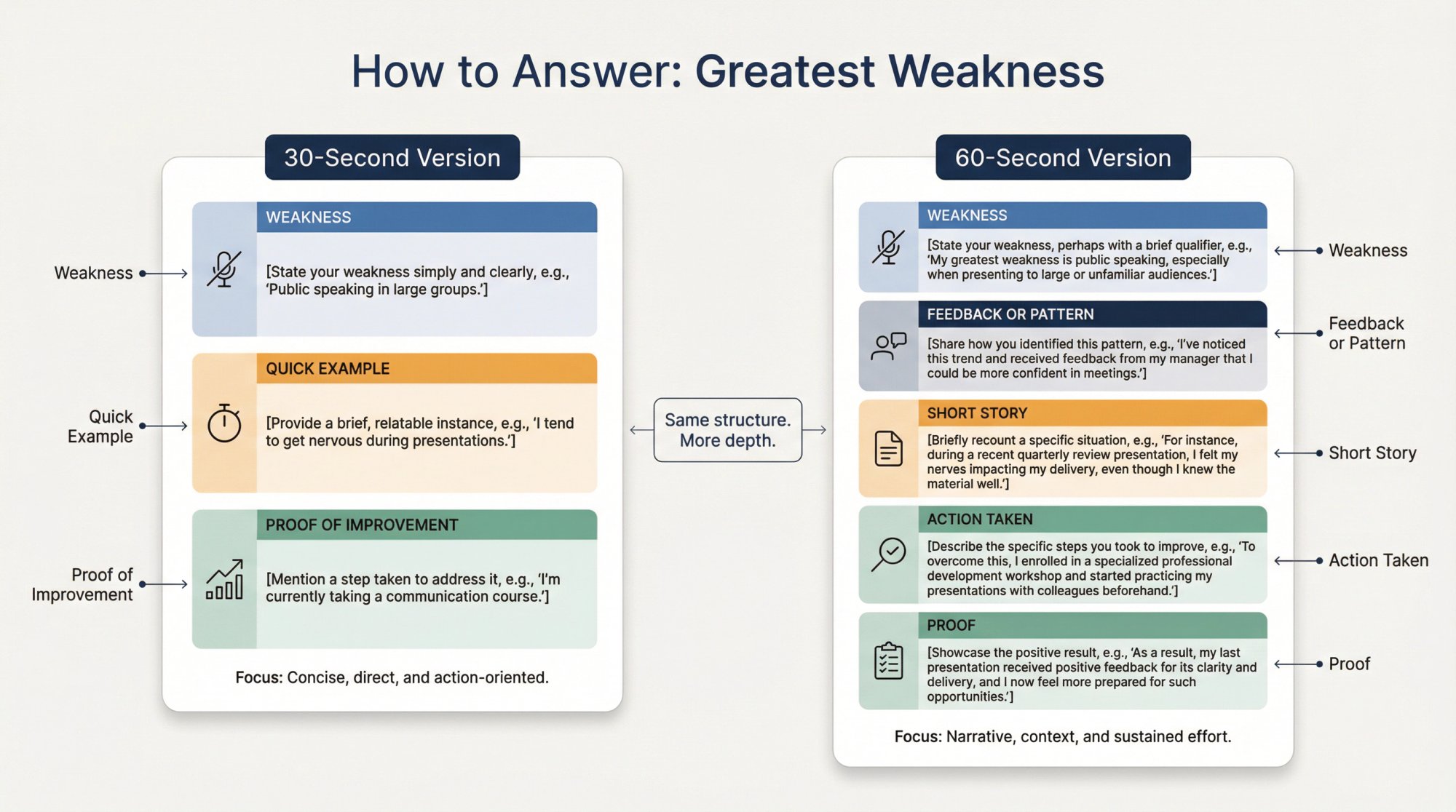
30-second version:
"A weakness I've worked on is [weakness]. Earlier in my career it showed up when [quick example]. To improve, I started [specific action or system], and now [proof of improvement]. It's still something I watch, but the trend is definitely positive."
60-second version (better when the interviewer seems genuinely engaged):
"A weakness I've worked on is [weakness]. I noticed it because [feedback or pattern]. One example was [short story]. What I changed was [action] and [second action]. I measure it by [signal], and lately I've seen [proof]. I'm comfortable sharing this one because it's not a blocker for this role, and I've built a process to keep improving."
These aren't scripts to memorize word-for-word. They're scaffolding. Fill in the brackets with your actual experience and say it out loud a few times until it sounds like you, not a reading.
How to Pick the Right Weakness for a Job Interview
The mistake isn't being honest. The mistake is being honest about the wrong thing.
A good weakness for an interview is:
Real (you can talk about it naturally, without stumbling)
Not core to the job's success (a data analyst can mention public speaking; they probably shouldn't mention attention to detail)
Improving (you've already started working on it)
Provable (you can point to a behavior change, system, or result)
Weaknesses That Will Cost You the Job
Avoid anything that directly contradicts the role's core requirements:
Cliché Weakness Answers Interviewers Have Stopped Believing
Please don't say these. Interviewers have heard them so many times they've stopped believing them entirely:
"I'm a perfectionist."
"I work too hard."
"I care too much."
"I don't really have weaknesses."
They're not just clichés. They're signals that you either don't know yourself or you're not willing to be honest. Neither is a quality hiring managers want.
4 Questions to Ask Before Choosing Your Interview Weakness
Run every weakness idea through these four questions before you commit to it:
Would this scare them for this specific role? If yes, drop it.
Can I explain it with a real story? If not, it'll sound fake.
Can I name the actual fix I'm using? If not, I'll sound like I'm not working on it.
Can I show proof the fix is working? If not, the answer feels incomplete.
Pass all four, and you've got a strong choice.
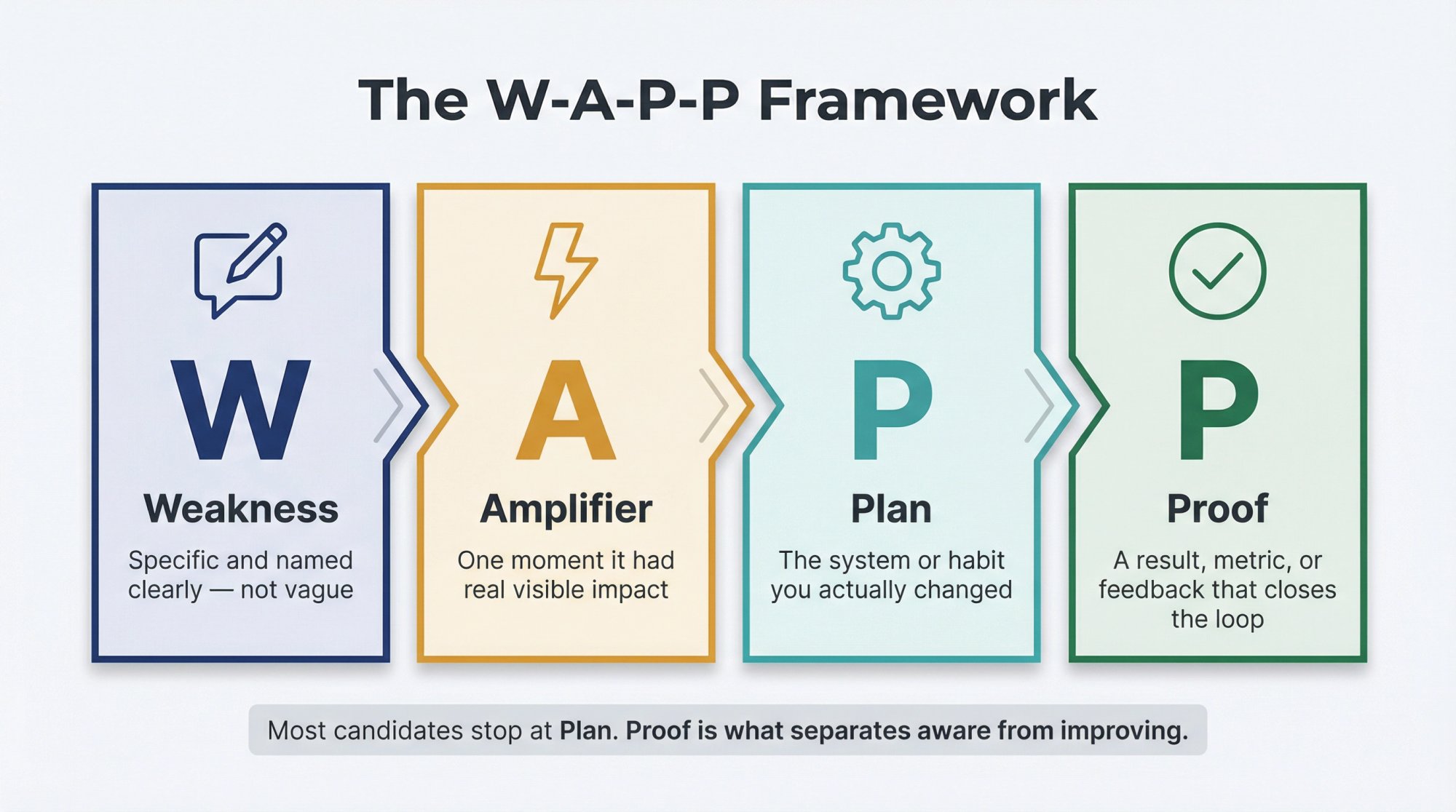
The W-A-P-P Framework: How to Structure a Weakness Answer That Holds Up
There are a lot of frameworks for interview questions. This one is specifically designed for the weakness question, and it works because each step forces you to say something more meaningful than the step before it.
W: Weakness (specific, named clearly)
Don't say "communication." Say "I used to over-explain in written updates." Specificity signals self-awareness.
A: Amplifier (when it shows up, and why)
This is the moment the weakness had visible impact. One sentence is enough. It makes the weakness feel real, not theoretical.
P: Plan (what you actually changed)
Not "I'm working on it." Describe the system, habit, or process you put in place. A specific action is far more credible than vague intention.
P: Proof (evidence it's improving)
This is what turns a decent answer into a hire-level answer. A metric, a result, a piece of feedback you received, a behavior change others have noticed. It closes the loop.
The key insight: Most candidates give you W and maybe P-for-plan, but they skip the proof. That's the gap. The proof is what separates someone who's aware of a weakness from someone who's actually doing something about it.
How to Deliver Your Weakness Answer Confidently
Two things matter more than people give them credit for:
Tone: Stay calm and factual. Not apologetic, not over-explaining. You're sharing a professional observation, not confessing something.
Length: 30 to 60 seconds. Then stop. If you ramble for two minutes, your weakness becomes the story, and not in a good way.
Also, interviewers will sometimes phrase this question differently: "What would you change about yourself?" or "What would your previous manager say you have trouble with?" or "What feedback are you actively working on right now?" The structure stays the same regardless of how they ask it.
35 Greatest Weakness Examples for Job Interviews
Each of these is written to be specific, improvement-driven, and easy to tailor. Use them as starting points, not scripts.
Self-Management Weakness Examples for Any Role
These are safe for most roles because they're about how you work, not whether you can do the work.
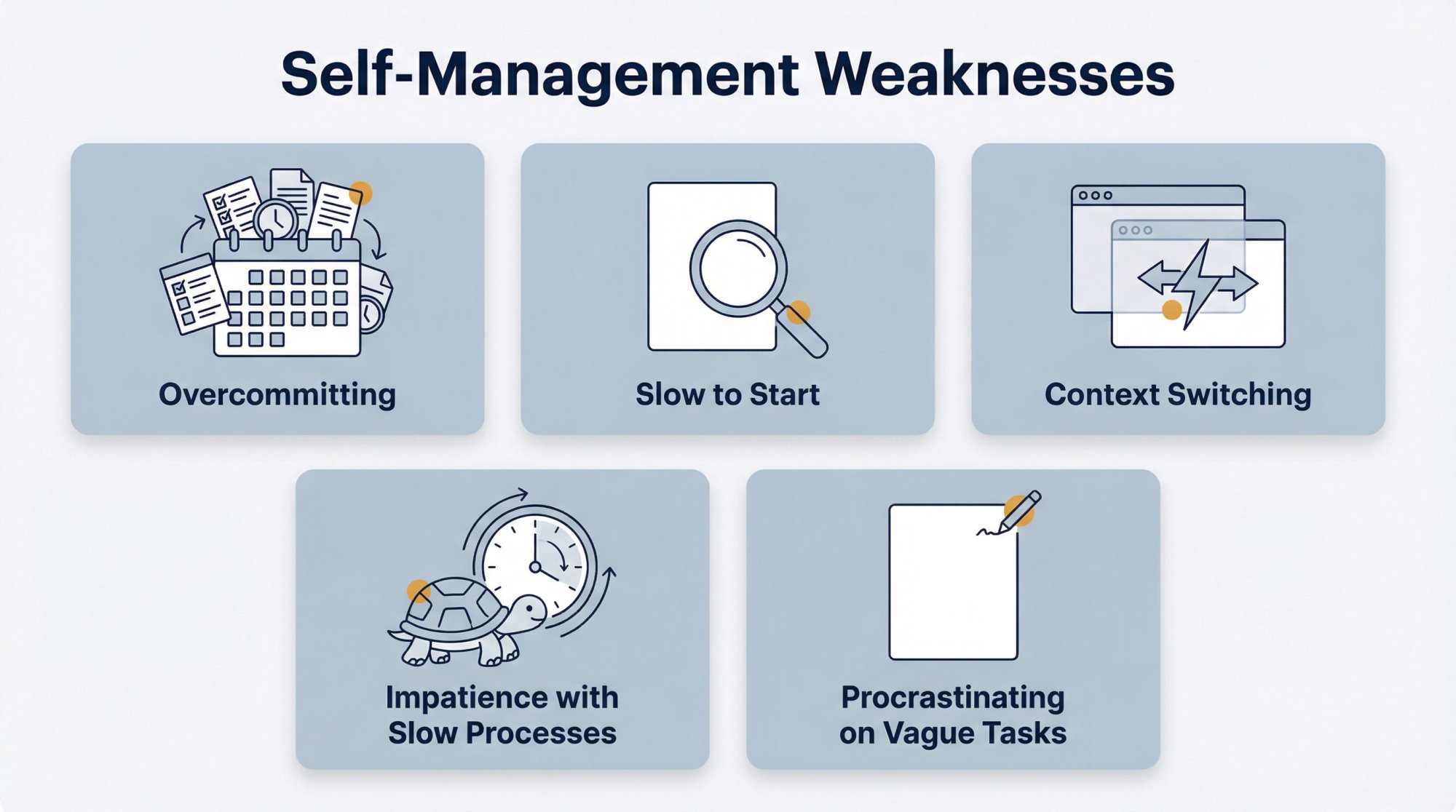
1. "I used to overcommit"
"I used to say yes too quickly, especially when multiple teams needed help. The downside was I'd stretch myself thin and create avoidable stress. I fixed it by switching to capacity planning: I map tasks to a weekly time budget and confirm priorities before committing. Now I'm more predictable, and I've had fewer last-minute crunches while still staying responsive."
2. "I can be slow to start until I clarify expectations"
"My weakness used to be spending too long clarifying before moving, because I wanted to avoid rework. I noticed it most on ambiguous projects. I've improved by starting with a 'first draft in 24 hours' rule and validating assumptions early. That keeps momentum high while still reducing rework."
3. "I'm not naturally great at switching contexts"
"Context switching used to hurt my efficiency. If I bounced between tasks, I'd lose focus and quality. I've addressed it by grouping similar work into blocks, using a short daily plan, and setting clear boundaries for interruptions. I still stay responsive, but I'm much more consistent in output."
4. "I can be impatient with slow processes"
"I can get impatient with slow or bureaucratic processes, especially when the outcome feels obvious. Earlier on, that sometimes came across as frustration. I've worked on it by separating what I can influence from what I can't, and by proposing small, concrete improvements instead of venting. It's made me better at driving change without creating friction."
5. "I used to procrastinate on large, vague tasks"
"I used to delay starting big projects when the first step wasn't clear. The fix was learning to break work into a very small first action and putting it on my calendar. I also do a quick outline before deep work. I start earlier now and hit deadlines with less stress."
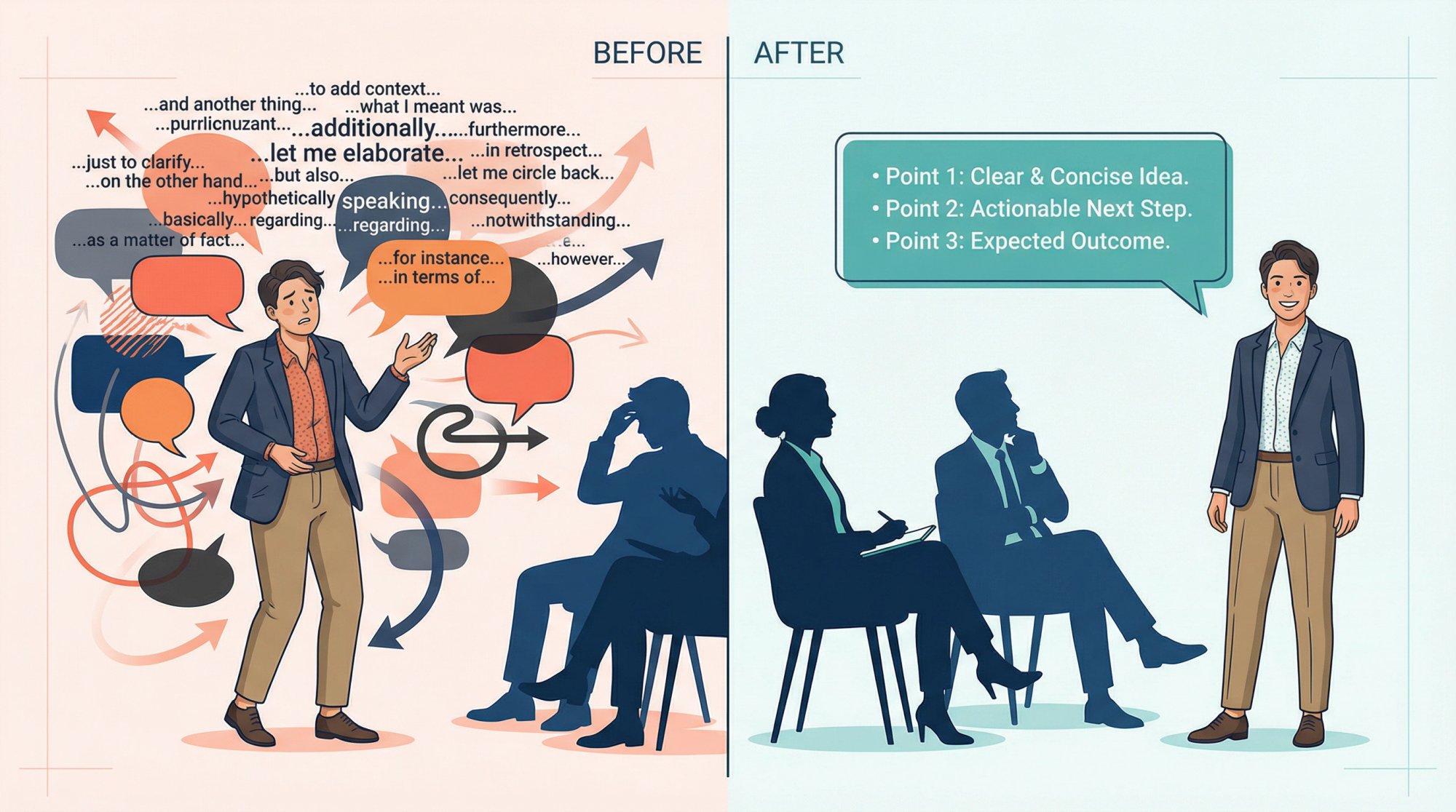
Communication Weakness Examples for Job Interviews
Pick carefully here based on the role. A public speaking weakness is fine for a data analyst; it's riskier for a sales director.
① "I used to over-explain"
"My weakness used to be over-explaining, especially in written updates. I was trying to be thorough, but it sometimes buried the main point. I've improved by using a 'headline first' format: one sentence summary, then key bullets, then details if needed. It's improved clarity and reduced back-and-forth."
② "I'm working on being more concise in meetings"
"In meetings, I used to give too much context before making my point. I've been working on leading with the conclusion and sharing only the context that changes the decision. I can tell it's working because meetings move faster and I get fewer follow-up clarification questions."
③ "Public speaking used to make me nervous"
"Public speaking used to make me nervous, so I'd avoid presenting unless I had to. I realized that was limiting. I started practicing with smaller groups, preparing structured talking points, and volunteering for short updates. Now I'm comfortable presenting, and I'm much clearer under pressure."
Use this when the role isn't heavily presentation-based, and only if you can back it up with real progress. Generic improvement claims on this one won't land.
④ "I used to hesitate to ask questions"
"Earlier in my career I sometimes hesitated to ask questions because I didn't want to slow others down. The downside is I'd occasionally make assumptions that caused rework. I fixed it by asking clarifying questions early and summarizing my understanding before I start. It saves time overall and improves alignment."
⑤ "Giving direct feedback didn't come naturally"
"I used to avoid giving direct feedback because I didn't want to create tension. I realized that actually creates more problems long-term. I learned to give feedback with specifics and shared goals, and to do it early. Now I'm more comfortable having those conversations, and it's improved team execution."
Collaboration and Leadership Weakness Examples
These work well for senior roles, especially if you frame them as things you've genuinely wrestled with and improved.
→ "Delegation was hard for me at first" (Example 11)
"When I first started leading projects, delegation was a weakness because I wanted to ensure quality and move fast. That created bottlenecks. I improved by defining clear outcomes, sharing examples, and setting check-in points rather than doing everything myself. It's helped the team grow and improved delivery speed."
→ "I used to take on too much responsibility" (Example 12)
"I have a tendency to take ownership of everything, which can be good, but it used to turn into doing too much myself. I've worked on shifting from 'I'll do it' to 'I'll make sure it gets done.' That means assigning owners, setting deadlines, and following up. It keeps quality high without me becoming the bottleneck."
→ "I can be cautious about taking risks" (Example 13)
"I'm naturally cautious with risk, which helps with quality, but it can slow experimentation. I've worked on taking smaller, reversible risks: trying an approach in a limited scope, measuring results, and then scaling. That keeps the upside while managing downside."
→ "I used to avoid conflict" (Example 14)
"I used to avoid conflict, especially when opinions were strong. I learned that respectful disagreement is part of good work. I now focus on separating the person from the problem, using data, and aligning on the goal. I'm much more comfortable addressing issues early."
→ "I had to learn how to say no" (Example 15)
"Saying no used to be hard, especially when someone senior asked. The problem was I'd accept work that didn't fit the priority list. Now I respond with trade-offs: 'I can do this, but it means X moves.' That keeps me helpful, but also protects delivery."
Execution and Quality Weakness Examples
These resonate well with roles where the output quality is highly visible.
16. "I used to get stuck polishing"
"I can get pulled into polishing, especially when quality matters. Earlier, that sometimes meant spending too long on details that didn't change outcomes. I've improved by defining 'done' upfront, timeboxing, and doing a quick review focused on impact. The work stays high-quality, but I move faster."
17. "I used to underestimate how long tasks take"
"I used to underestimate timelines because I'd plan based on best-case scenarios. I fixed it by using historical time estimates and building in buffer for unknowns. I also communicate risk early. Now my estimates are more accurate and projects are more predictable."
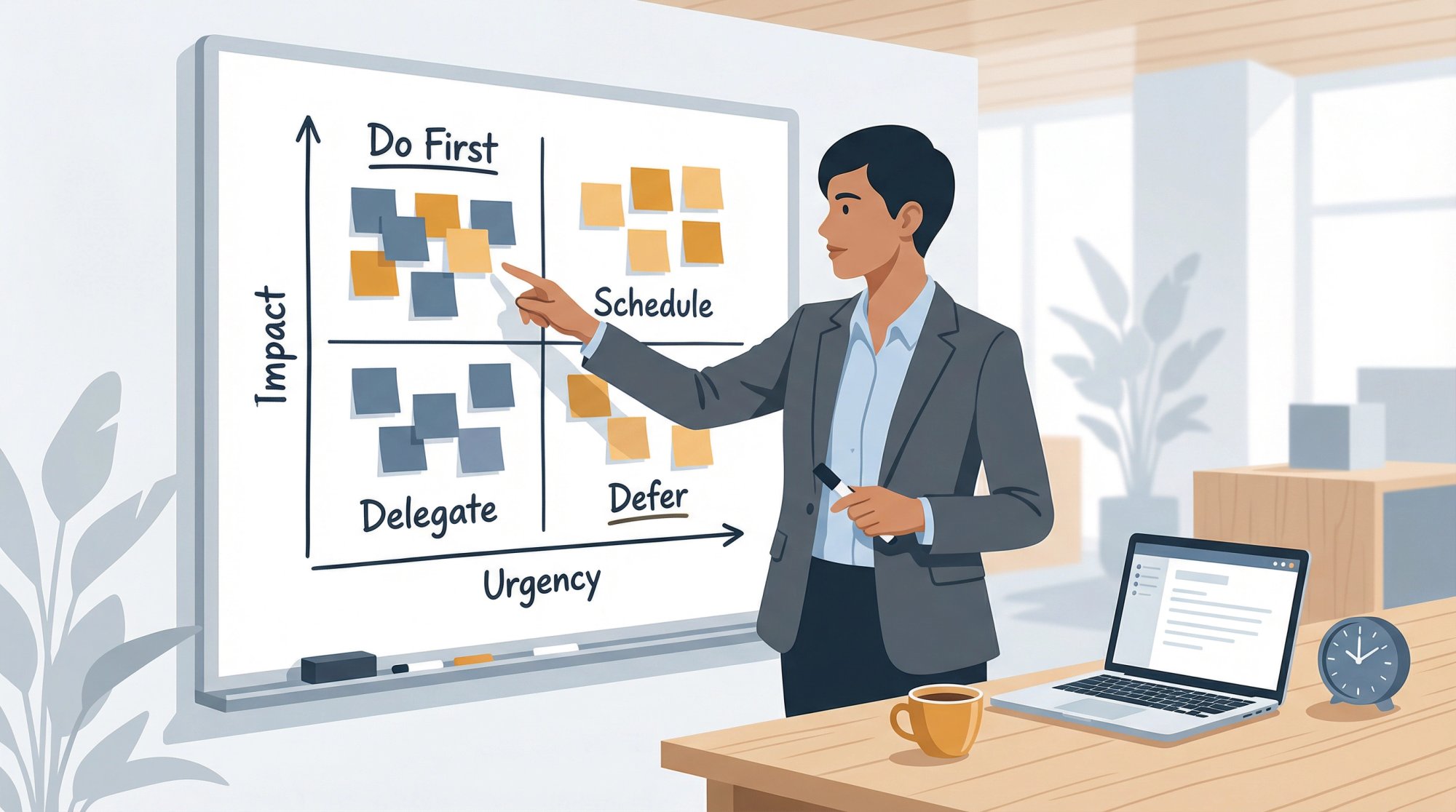
18. "I needed to get better at prioritization"
"When I had multiple competing tasks, prioritization was a weakness. I've improved by using a simple framework: impact, urgency, and effort, then confirming priorities with stakeholders. It reduced rework and helped me deliver the highest-value work first."
Skill Gap Weakness Examples for Job Interviews
These can work when the gap is learnable and isn't fundamental to the role. Always check the job description first. If the skill is listed as a core requirement, choose a different weakness.
19. "I'm newer to [tool], but closing the gap fast"
"I'm newer to [tool] than I'd like to be. I've used [alternative], so the concepts transfer, but I wanted to go deeper. I started a structured course and built a small project to practice. I'm already comfortable with [specific features], and I'm continuing to level up."
20. "I'm strengthening my data analysis depth"
"I'm solid with basic analysis, but I wanted more depth in interpreting results and communicating implications. I've been improving by doing post-project reviews and reading more case studies to connect analysis to decisions. It's made my recommendations sharper and more actionable."
Role-Specific Greatest Weakness Examples
These are tailored to specific job functions. Match them to your actual target role.
21. Software engineer: "I used to optimize too early"
"My weakness used to be optimizing too early, before we proved the requirements. That sometimes meant building something elegant that wasn't needed. I've improved by aligning on success metrics first and building the simplest version that validates the approach. It reduced wasted work and improved iteration speed."
If you're preparing for a software engineer interview, this framing is particularly effective because it shows you understand the build-measure-learn cycle that modern engineering teams value. Check what software engineers earn in your target market so your conversation about role fit is grounded in realistic expectations. A polished software engineer resume that reflects your actual growth trajectory will reinforce this answer.
22. Data analyst: "I used to focus too much on correctness, not clarity"
"I used to put most of my energy into making analysis perfect, and less into making it understandable. I've improved by writing a short executive summary first and designing visuals for decisions, not for data density. Stakeholders now act faster on the insights."
For anyone targeting a data analyst role, this answer signals business acumen on top of technical skill, a combination that stands out. Review the data analyst skills that top employers are hiring for, and make sure your data analyst resume reflects both analytical depth and communication ability.
23. Product manager: "I used to avoid hard trade-offs publicly"
"Earlier, I sometimes tried to keep everyone happy, which delayed decisions. I've improved by making trade-offs explicit, documenting them, and communicating the why. It increased trust even when the answer is no."
This is one of the most credible answers for a product manager interview because it addresses the exact tension PM roles require: stakeholder alignment without paralysis. Explore product manager salaries by level and location, and pair your interview prep with a strong product manager cover letter that showcases your decisiveness.
24. Sales: "I used to avoid cold outreach"
"Cold outreach used to be uncomfortable, so I'd lean too heavily on warm leads. I fixed it by creating a repeatable outreach system: daily targets, short scripts, and quick iteration based on response rates. I'm now consistent and more confident starting conversations."
This answer works for any sales development representative or account executive role. It shows you identified a gap that directly affects quota attainment and built a system around it, which is exactly what sales managers want to hear. See how sales manager salaries break down by experience level, and make your application stand out with a targeted sales resume.
25. Customer support: "I used to take escalations personally"
"Early on, I sometimes took escalations personally, which added stress. I've improved by focusing on the customer's outcome, not the emotion in the moment, and by using a structured troubleshooting flow. It keeps me calm and improves resolution time."
Hiring managers for customer support specialist roles hear emotional regulation as one of the key differentiators between good and great agents. Understand the skills customer service representatives need most, and use a customer service cover letter that highlights your composure under pressure.
26. Marketing: "I used to chase too many experiments at once"
"I used to run too many experiments in parallel, which made it hard to learn what actually worked. I improved by limiting concurrent tests, defining hypotheses, and tracking one primary metric per test. Results are clearer and performance is more stable."
This resonates strongly with marketing manager interviewers because it shows you understand the difference between activity and learning. Explore marketing manager salaries at your target level, and have a marketing specialist resume ready that demonstrates your ability to run disciplined experiments.
27. Finance: "I used to over-index on details instead of decision impact"
"I'm naturally detail-oriented, and earlier I sometimes delivered analysis that was technically strong but didn't directly answer the decision. I've improved by starting with the decision question first, then building only the analysis needed to support it. It's made my work more useful to stakeholders."
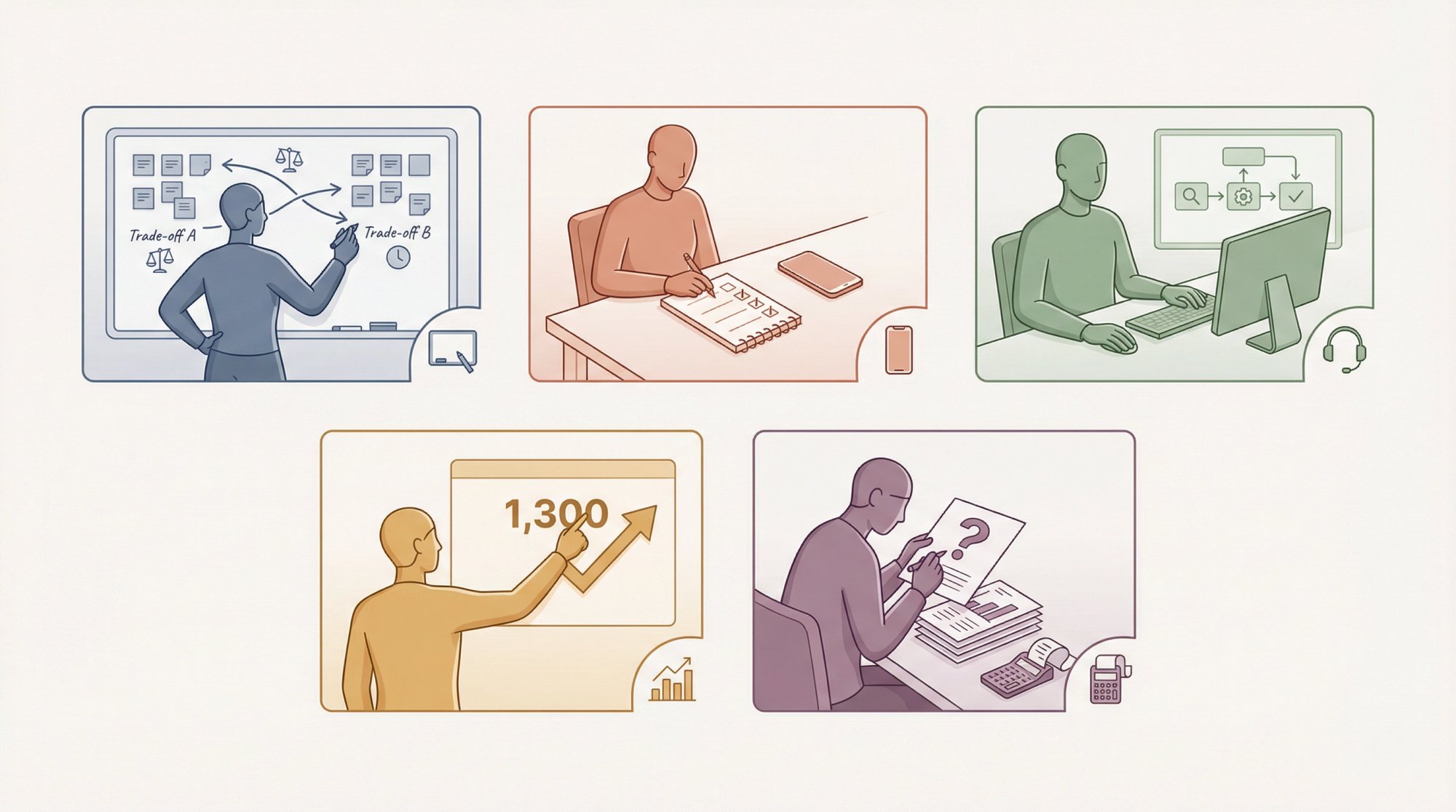
For a financial analyst interview, this shows maturity: moving from technician to strategic partner. See what financial analyst salaries look like across industries, and pair your interview prep with a financial analyst resume that positions you as business-impact driven, not just numbers-focused.
28. Designer: "I used to defend my first idea too strongly"
"Earlier I sometimes got attached to my first design direction. I improved by presenting multiple options and asking for constraints before defending an approach. It's made collaboration smoother and outcomes better."
This is particularly compelling for UX designer interviews where collaborative iteration is core to the role. Explore UX designer salaries to negotiate confidently, and build a standout application with a cover letter for software engineer (or adapt it for design roles) that highlights your collaborative design process.
29. Operations: "Ambiguity made me uncomfortable"
"I used to be uncomfortable with ambiguity because I like clear processes. In operations, ambiguity is normal. I've improved by breaking ambiguous work into smaller testable steps, clarifying assumptions early, and documenting decisions. Now I can move forward even when things aren't fully defined."
For an operations manager role, this weakness-to-growth arc is ideal because it shows you've built exactly the mindset the role demands. Check operations manager salaries by region, and make your application land with an operations manager resume that demonstrates structured thinking in ambiguous environments.
30. New grad: "I lacked confidence speaking up"
"As a newer professional, I used to hesitate to speak up, especially around more experienced people. I've improved by preparing one or two points before meetings and asking at least one clarifying question. I'm much more comfortable contributing now, and feedback from peers has been positive."
This is one of the most authentic answers a recent graduate can give, and it works precisely because it's expected and shows self-awareness. Explore entry-level sales rep careers and junior developer roles as strong starting points, and use a junior graduate software developer resume or a cover letter for no experience to put your best foot forward.

Low-Stakes Weaknesses to Have Ready as Backup Answers
These are great when you need a second or third weakness ready (some interviewers ask for more than one), or when you want something crisp and quick.
"I'm working on being more assertive when priorities conflict."
"I'm improving how I handle interruptions and protect deep work time."
"I'm getting better at simplifying complex topics for non-technical audiences."
"I'm improving how quickly I surface risks instead of trying to solve them silently."
"I'm working on pacing: not rushing through answers when I'm under pressure."
Follow-Up Questions After "What Is Your Greatest Weakness?"
This is where a lot of candidates get caught. They prepare the main weakness answer, then stumble on the follow-up.
In 2026, some interviewers are asking a variation that feels like a different question but isn't: "What feedback are you working on right now?" According to reporting from Business Insider on how executives approach interviews, one senior leader uses exactly this framing and treats it as a problem if the candidate says they don't get feedback or have nothing to work on. The implication: self-aware professionals are always in improvement mode.
Here's how to handle the most common follow-ups:
"How Are You Working on It?"
Structure your answer around: system + frequency + signal
"I'm using [habit or system], and I do it [weekly / daily / per project]. I track progress by [signal], and I review it every [timeframe]."
The more specific the system, the more credible the answer.
"Tell Me About a Time It Caused a Problem"
This is asking for a behavioral example. Use a compressed STAR format:
Situation: One sentence on the context.
What went wrong: One sentence on the impact of the weakness.
What you changed: Two sentences on your response.
Result: One sentence on the outcome.
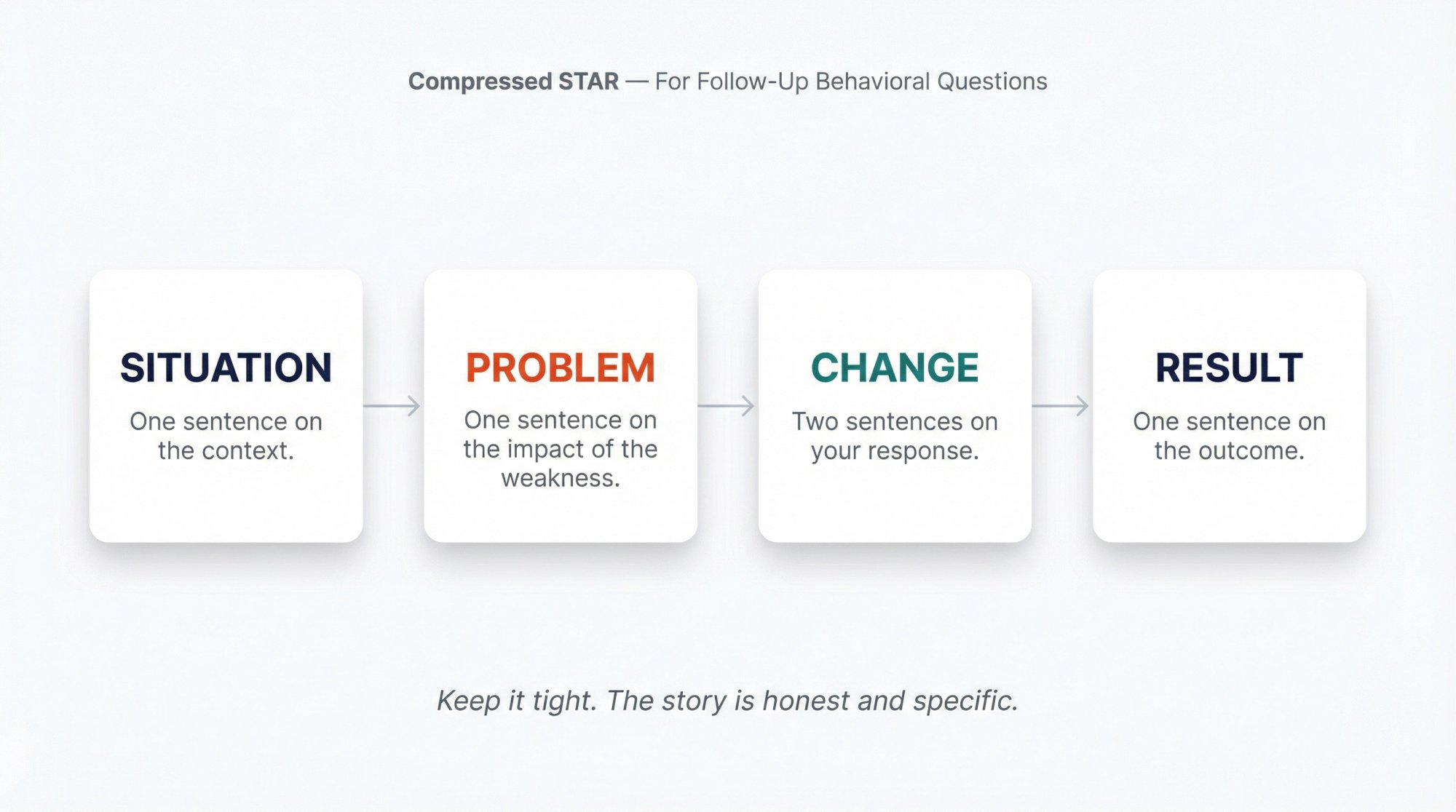
Keep it tight. The story isn't meant to be long; it's meant to be honest and specific. If you want to get better at this kind of structured storytelling, our guide on STAR method interview examples walks through the framework with real examples.
"What Would Your Manager Say You Need to Improve?"
Answer with a weakness that came from actual feedback, has a fix in progress, and doesn't sound like a personality flaw with no solution. A good template:
"They'd probably say I'm strongest when I'm proactive, and the growth area is making sure I [weakness]. We've worked on it by [plan], and it's improved because [proof]."
The "we've worked on it" framing signals you've already had that conversation with your manager, which is itself a sign of maturity.
How AI Is Changing Job Interviews in 2026
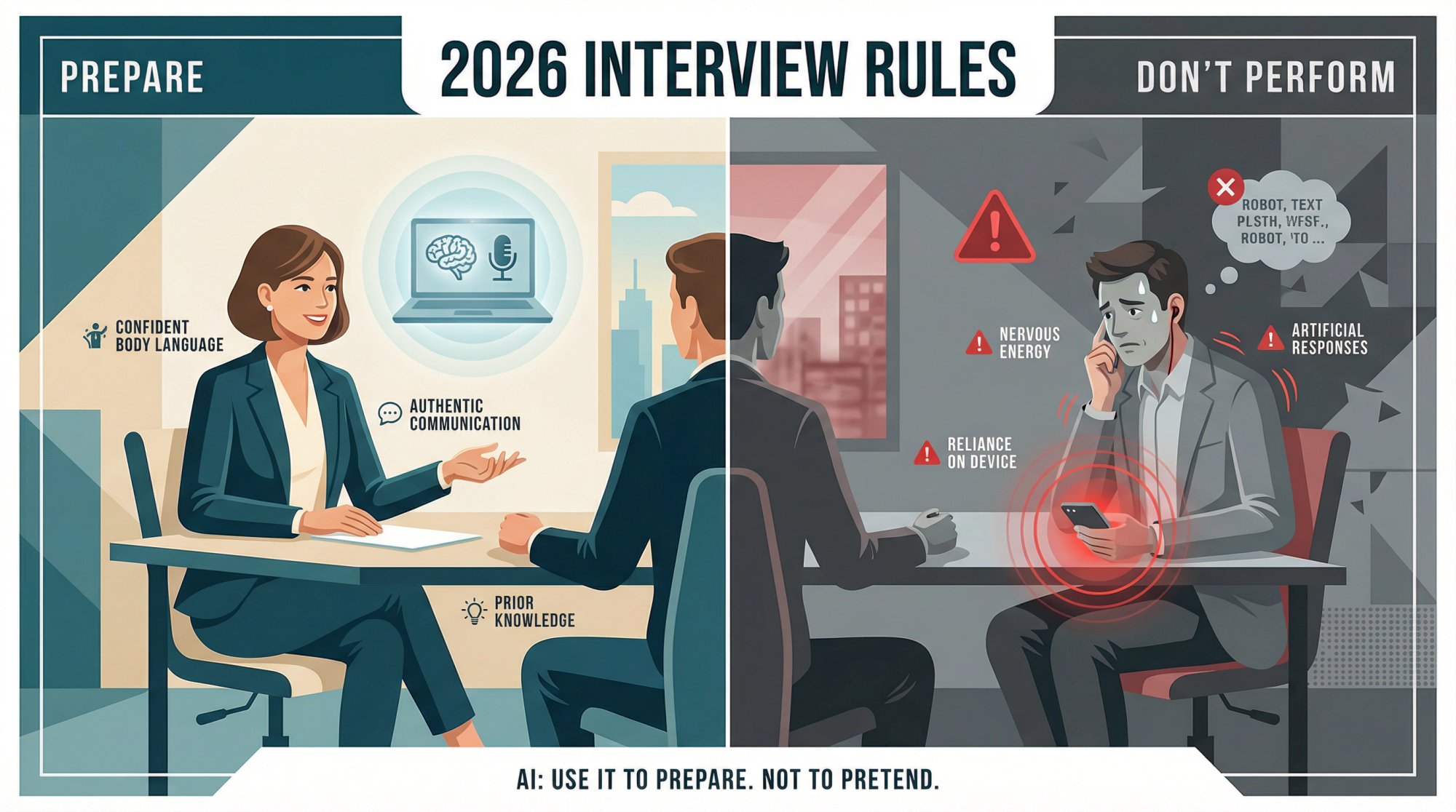
Two things are happening simultaneously in the hiring world right now.
Employers are using more technology: AI-assisted screening, structured scoring, video analysis tools. At the same time, employers are getting more frustrated with candidates who sound like they were generated. A Washington Post report from February 2026 described employers explicitly calling out that AI-generated applications are detectable and feel inauthentic.
The weakness question is one of the easiest places to sound like a template.
Your answer to "What is your greatest weakness?" is one of the few places in an interview that demands genuine self-reflection. If you paste in a generated answer and recite it word-for-word, it shows. The specificity won't be there. The story won't be yours. The emotional honesty won't come through.
Can You Use AI Tools During a Job Interview?
Some employers now have explicit policies against real-time AI assistance during interviews. According to Business Insider, Amazon has guidelines allowing candidates to be disqualified for using AI tools during interviews unless they're explicitly permitted to do so.
The safe rule in 2026: Use AI to practice and prepare, not to perform in real-time. Brainstorm which weaknesses fit your profile, generate draft answers to critique and improve, practice with simulated questions, and tighten your language. Don't use it during the interview itself unless you've confirmed it's allowed.
If you're unsure whether tools are permitted, ask the recruiter. In 2026, that question is completely normal.
How to Practice Your Weakness Answer Until It Sounds Natural
There's a gap between knowing the right answer and delivering it smoothly when you're nervous and someone's watching. That gap closes with practice, and that's exactly what we built our interview tools for.
AIApply's Mock Interview lets you paste in a job description and get a tailored simulation, including questions like this one, with structured feedback on your answers. You can run through a full mock interview in 15 to 30 minutes. A lot of our users go through it two or three times before the real thing, each time refining their answers until they stop reading from notes and start speaking naturally.
Interview Buddy is our real-time coaching tool. It listens to what's being asked during your interview and offers structured guidance on-screen. Where it's appropriate to use (and only where it's explicitly permitted by the employer), it can be valuable for high-stakes interviews. Use it responsibly.
One thing people underestimate: consistency. Your weakness answer can be undermined if your resume tells a different story. If you're talking about delegation growth in your interview but your resume suggests you've never led anything, that's a disconnect. Our Resume Builder helps you build a resume that actually reflects your experience accurately, and our Cover Letter Generator ensures your written materials match what you're saying in the room.
For broader interview preparation beyond the weakness question, we've put together a detailed guide on how to prepare for a final interview. It's worth reading especially if you're heading into later rounds where this question often comes up again.
Pre-Interview Checklist: Is Your Weakness Answer Ready?
Run through this before any interview. Your weakness answer is ready when you can check all seven boxes:
My weakness is specific, not a cliché
It doesn't undermine the core requirements of this role
I gave one real example of when it showed up and had impact
I explained what I'm actually doing to improve (a system, not just intention)
I can point to proof that it's working (a result, metric, or behavior change)
I can deliver it in 30 to 60 seconds without rushing or rambling
If they ask for a second weakness, I have one ready

If you're checking all seven, you're not just prepared. You're genuinely prepared. When your interview prep is solid, the next step is making sure your entire application is just as strong: from ATS-optimized resume templates to an AI-powered resume scanner that identifies gaps before recruiters do. AIApply's Auto Apply can also handle the volume of applications so you spend your time preparing for interviews, not filling out forms.
Frequently Asked Questions About "What Is Your Greatest Weakness?"

What is the best weakness to say in a job interview?
The best weakness is one that's real, not central to the job's core requirements, and already being improved. Self-management weaknesses (like overcommitting, struggling with ambiguous tasks, or difficulty with context switching) are often the safest choices because they show self-awareness without raising red flags about core job competencies. Avoid clichés like "I'm a perfectionist" or "I work too hard."
Should I tell the truth about my weaknesses in an interview?
Yes, but strategically. Interviewers have heard every deflection. A genuine answer, even a vulnerable one, builds more trust than a carefully crafted non-answer. The goal isn't to find a weakness that makes you look good. It's to find a weakness that's real, safe for the role, and demonstrably improving. Honesty backed by a clear improvement plan is far more compelling than pretending you have no flaws.
What if I can't think of a real weakness?
Most people can when they think carefully. Ask yourself:
What do colleagues or managers tend to push back on?
What tasks do you procrastinate on?
What feedback have you received more than once?
What do you find draining compared to colleagues who seem energized by it?
Those are your real weaknesses. Pick the one that's most job-safe and easiest to demonstrate you're improving.
How long should my answer to "What is your greatest weakness?" be?
30 to 60 seconds in most cases. Any shorter and it sounds evasive. Any longer and the weakness becomes the whole conversation. Time yourself when you practice. If your answer is consistently over 90 seconds, trim it: usually the Amplifier (the example) is running too long.
What if they ask for more than one weakness?
Have at least two prepared. The second one can be shorter and simpler (the "low drama" examples from section G above work well for this). Interviewers sometimes ask for a second one to see if you have depth, or to test whether your first answer was the only genuine thing you had prepared.
Can I use my weakness answer to highlight a strength?
Indirectly, yes. If your weakness is "I used to be too slow to delegate," the improvement story naturally demonstrates leadership growth. If your weakness is "I overcommitted because I genuinely wanted to help everyone," it surfaces work ethic. But this should be a side effect of an honest answer, not the primary strategy. Interviewers recognize when someone is engineering a compliment out of a weakness question.
How do I handle "What would your previous manager say is your weakness?"
Use a weakness that came from real feedback, not something you invented. Grounding it in actual performance conversations ("She gave me feedback that...") makes the answer more credible and shows you take feedback seriously enough to remember it and act on it.
Is it okay to say I'm working on a skill that's relevant to this job?
Only if it's not a core requirement. A product manager can mention they're strengthening their financial modeling skills. They probably shouldn't mention they're working on building a product roadmap for the first time. Check the job description carefully. If the skill appears as a requirement, find a different weakness. If it's listed as a "nice to have" and you genuinely have a plan to close the gap, it can be fair game.
How should I prepare for the weakness question specifically?
Write it down first. Draft your answer using the W-A-P-P structure (Weakness, Amplifier, Plan, Proof), then say it out loud. Record yourself if possible. The gap between how it reads and how it sounds can be significant. Once it feels natural, practice it in a simulated interview. AIApply's Mock Interview tool lets you rehearse with a job-specific simulation so you can hear yourself answer the question in context, not just in isolation.
What if the interviewer pushes back on my answer or asks follow-up questions I didn't expect?
Stay calm and stay specific. Pushback usually means the interviewer wants more detail, not that they've rejected your answer. The follow-up questions covered earlier in this post (how you're working on it, a time it caused a problem, what your manager would say) cover most of what they'll ask. The principle is the same in every case: be specific, be honest, and show that you're actively in motion.
Ready to stop guessing and start practicing? AIApply offers a full mock interview simulator where you can rehearse this exact question against a tailored job description and get structured feedback before the real interview. For panel interviews, we also cover panel interview tips that apply to any format where more than one person is asking questions.
If you think "What is your greatest weakness?" is a trap, you're half right.
It's not a trap because the interviewer wants to catch you and reject you on the spot. It's a trap because most candidates answer it in a way that accidentally reveals one of four things: they lack self-awareness, they can't take feedback, they're hiding something, or they're so rehearsed that nothing they say feels real.
Any one of those is a hiring risk. Interviewers know how to spot them.
This guide walks you through exactly why the question exists, how to pick the right weakness, a structure that works every time, and 35 example answers you can adapt in minutes. Once you've locked in your answer, AIApply's Mock Interview tool lets you practice it against a tailored job simulation so it sounds like you, not a rehearsed script.
Why Interviewers Ask "What Is Your Greatest Weakness?"
An interview is fundamentally a risk-reduction exercise. Hiring is expensive and uncertain, and the interviewer is trying to answer four questions before making a decision:
Can you do the work?
Will you be easy to work with?
Will you grow, or repeat the same mistakes?
Will you create hidden problems down the line?
Your answer to "What is your greatest weakness?" is a shortcut to all four. It tells them more in 60 seconds than almost any other question.
The most insightful framing we've seen: interviewers want to know whether you're self-aware enough to recognize a flaw and self-motivated enough to fix it. That's the bar. It's not about finding someone without weaknesses. Everyone has them. It's about finding someone who can see themselves clearly and act accordingly.
What Interviewers Are Really Scoring When They Ask This
Even when the conversation feels casual, many organizations use structured interview criteria to make candidates comparable. When you answer this question, you're usually being scored on five dimensions:
Build your answer to hit all five, and what feels like a scary question becomes a genuine advantage over every candidate who tried to dodge it with "I'm a perfectionist."
How to Answer "What Is Your Greatest Weakness?" (Quick Template)
No time to overthink it. Use this structure:
Weakness (specific, real, not fatal to the role) + What you're doing about it (system, habit, training, or feedback loop) + Proof it's improving (result, metric, or concrete change)
30-second version:
"A weakness I've worked on is [weakness]. Earlier in my career it showed up when [quick example]. To improve, I started [specific action or system], and now [proof of improvement]. It's still something I watch, but the trend is definitely positive."
60-second version (better when the interviewer seems genuinely engaged):
"A weakness I've worked on is [weakness]. I noticed it because [feedback or pattern]. One example was [short story]. What I changed was [action] and [second action]. I measure it by [signal], and lately I've seen [proof]. I'm comfortable sharing this one because it's not a blocker for this role, and I've built a process to keep improving."
These aren't scripts to memorize word-for-word. They're scaffolding. Fill in the brackets with your actual experience and say it out loud a few times until it sounds like you, not a reading.
How to Pick the Right Weakness for a Job Interview
The mistake isn't being honest. The mistake is being honest about the wrong thing.
A good weakness for an interview is:
Real (you can talk about it naturally, without stumbling)
Not core to the job's success (a data analyst can mention public speaking; they probably shouldn't mention attention to detail)
Improving (you've already started working on it)
Provable (you can point to a behavior change, system, or result)
Weaknesses That Will Cost You the Job
Avoid anything that directly contradicts the role's core requirements:
Cliché Weakness Answers Interviewers Have Stopped Believing
Please don't say these. Interviewers have heard them so many times they've stopped believing them entirely:
"I'm a perfectionist."
"I work too hard."
"I care too much."
"I don't really have weaknesses."
They're not just clichés. They're signals that you either don't know yourself or you're not willing to be honest. Neither is a quality hiring managers want.
4 Questions to Ask Before Choosing Your Interview Weakness
Run every weakness idea through these four questions before you commit to it:
Would this scare them for this specific role? If yes, drop it.
Can I explain it with a real story? If not, it'll sound fake.
Can I name the actual fix I'm using? If not, I'll sound like I'm not working on it.
Can I show proof the fix is working? If not, the answer feels incomplete.
Pass all four, and you've got a strong choice.
The W-A-P-P Framework: How to Structure a Weakness Answer That Holds Up
There are a lot of frameworks for interview questions. This one is specifically designed for the weakness question, and it works because each step forces you to say something more meaningful than the step before it.
W: Weakness (specific, named clearly)
Don't say "communication." Say "I used to over-explain in written updates." Specificity signals self-awareness.
A: Amplifier (when it shows up, and why)
This is the moment the weakness had visible impact. One sentence is enough. It makes the weakness feel real, not theoretical.
P: Plan (what you actually changed)
Not "I'm working on it." Describe the system, habit, or process you put in place. A specific action is far more credible than vague intention.
P: Proof (evidence it's improving)
This is what turns a decent answer into a hire-level answer. A metric, a result, a piece of feedback you received, a behavior change others have noticed. It closes the loop.
The key insight: Most candidates give you W and maybe P-for-plan, but they skip the proof. That's the gap. The proof is what separates someone who's aware of a weakness from someone who's actually doing something about it.
How to Deliver Your Weakness Answer Confidently
Two things matter more than people give them credit for:
Tone: Stay calm and factual. Not apologetic, not over-explaining. You're sharing a professional observation, not confessing something.
Length: 30 to 60 seconds. Then stop. If you ramble for two minutes, your weakness becomes the story, and not in a good way.
Also, interviewers will sometimes phrase this question differently: "What would you change about yourself?" or "What would your previous manager say you have trouble with?" or "What feedback are you actively working on right now?" The structure stays the same regardless of how they ask it.
35 Greatest Weakness Examples for Job Interviews
Each of these is written to be specific, improvement-driven, and easy to tailor. Use them as starting points, not scripts.
Self-Management Weakness Examples for Any Role
These are safe for most roles because they're about how you work, not whether you can do the work.
1. "I used to overcommit"
"I used to say yes too quickly, especially when multiple teams needed help. The downside was I'd stretch myself thin and create avoidable stress. I fixed it by switching to capacity planning: I map tasks to a weekly time budget and confirm priorities before committing. Now I'm more predictable, and I've had fewer last-minute crunches while still staying responsive."
2. "I can be slow to start until I clarify expectations"
"My weakness used to be spending too long clarifying before moving, because I wanted to avoid rework. I noticed it most on ambiguous projects. I've improved by starting with a 'first draft in 24 hours' rule and validating assumptions early. That keeps momentum high while still reducing rework."
3. "I'm not naturally great at switching contexts"
"Context switching used to hurt my efficiency. If I bounced between tasks, I'd lose focus and quality. I've addressed it by grouping similar work into blocks, using a short daily plan, and setting clear boundaries for interruptions. I still stay responsive, but I'm much more consistent in output."
4. "I can be impatient with slow processes"
"I can get impatient with slow or bureaucratic processes, especially when the outcome feels obvious. Earlier on, that sometimes came across as frustration. I've worked on it by separating what I can influence from what I can't, and by proposing small, concrete improvements instead of venting. It's made me better at driving change without creating friction."
5. "I used to procrastinate on large, vague tasks"
"I used to delay starting big projects when the first step wasn't clear. The fix was learning to break work into a very small first action and putting it on my calendar. I also do a quick outline before deep work. I start earlier now and hit deadlines with less stress."
Communication Weakness Examples for Job Interviews
Pick carefully here based on the role. A public speaking weakness is fine for a data analyst; it's riskier for a sales director.
① "I used to over-explain"
"My weakness used to be over-explaining, especially in written updates. I was trying to be thorough, but it sometimes buried the main point. I've improved by using a 'headline first' format: one sentence summary, then key bullets, then details if needed. It's improved clarity and reduced back-and-forth."
② "I'm working on being more concise in meetings"
"In meetings, I used to give too much context before making my point. I've been working on leading with the conclusion and sharing only the context that changes the decision. I can tell it's working because meetings move faster and I get fewer follow-up clarification questions."
③ "Public speaking used to make me nervous"
"Public speaking used to make me nervous, so I'd avoid presenting unless I had to. I realized that was limiting. I started practicing with smaller groups, preparing structured talking points, and volunteering for short updates. Now I'm comfortable presenting, and I'm much clearer under pressure."
Use this when the role isn't heavily presentation-based, and only if you can back it up with real progress. Generic improvement claims on this one won't land.
④ "I used to hesitate to ask questions"
"Earlier in my career I sometimes hesitated to ask questions because I didn't want to slow others down. The downside is I'd occasionally make assumptions that caused rework. I fixed it by asking clarifying questions early and summarizing my understanding before I start. It saves time overall and improves alignment."
⑤ "Giving direct feedback didn't come naturally"
"I used to avoid giving direct feedback because I didn't want to create tension. I realized that actually creates more problems long-term. I learned to give feedback with specifics and shared goals, and to do it early. Now I'm more comfortable having those conversations, and it's improved team execution."
Collaboration and Leadership Weakness Examples
These work well for senior roles, especially if you frame them as things you've genuinely wrestled with and improved.
→ "Delegation was hard for me at first" (Example 11)
"When I first started leading projects, delegation was a weakness because I wanted to ensure quality and move fast. That created bottlenecks. I improved by defining clear outcomes, sharing examples, and setting check-in points rather than doing everything myself. It's helped the team grow and improved delivery speed."
→ "I used to take on too much responsibility" (Example 12)
"I have a tendency to take ownership of everything, which can be good, but it used to turn into doing too much myself. I've worked on shifting from 'I'll do it' to 'I'll make sure it gets done.' That means assigning owners, setting deadlines, and following up. It keeps quality high without me becoming the bottleneck."
→ "I can be cautious about taking risks" (Example 13)
"I'm naturally cautious with risk, which helps with quality, but it can slow experimentation. I've worked on taking smaller, reversible risks: trying an approach in a limited scope, measuring results, and then scaling. That keeps the upside while managing downside."
→ "I used to avoid conflict" (Example 14)
"I used to avoid conflict, especially when opinions were strong. I learned that respectful disagreement is part of good work. I now focus on separating the person from the problem, using data, and aligning on the goal. I'm much more comfortable addressing issues early."
→ "I had to learn how to say no" (Example 15)
"Saying no used to be hard, especially when someone senior asked. The problem was I'd accept work that didn't fit the priority list. Now I respond with trade-offs: 'I can do this, but it means X moves.' That keeps me helpful, but also protects delivery."
Execution and Quality Weakness Examples
These resonate well with roles where the output quality is highly visible.
16. "I used to get stuck polishing"
"I can get pulled into polishing, especially when quality matters. Earlier, that sometimes meant spending too long on details that didn't change outcomes. I've improved by defining 'done' upfront, timeboxing, and doing a quick review focused on impact. The work stays high-quality, but I move faster."
17. "I used to underestimate how long tasks take"
"I used to underestimate timelines because I'd plan based on best-case scenarios. I fixed it by using historical time estimates and building in buffer for unknowns. I also communicate risk early. Now my estimates are more accurate and projects are more predictable."
18. "I needed to get better at prioritization"
"When I had multiple competing tasks, prioritization was a weakness. I've improved by using a simple framework: impact, urgency, and effort, then confirming priorities with stakeholders. It reduced rework and helped me deliver the highest-value work first."
Skill Gap Weakness Examples for Job Interviews
These can work when the gap is learnable and isn't fundamental to the role. Always check the job description first. If the skill is listed as a core requirement, choose a different weakness.
19. "I'm newer to [tool], but closing the gap fast"
"I'm newer to [tool] than I'd like to be. I've used [alternative], so the concepts transfer, but I wanted to go deeper. I started a structured course and built a small project to practice. I'm already comfortable with [specific features], and I'm continuing to level up."
20. "I'm strengthening my data analysis depth"
"I'm solid with basic analysis, but I wanted more depth in interpreting results and communicating implications. I've been improving by doing post-project reviews and reading more case studies to connect analysis to decisions. It's made my recommendations sharper and more actionable."
Role-Specific Greatest Weakness Examples
These are tailored to specific job functions. Match them to your actual target role.
21. Software engineer: "I used to optimize too early"
"My weakness used to be optimizing too early, before we proved the requirements. That sometimes meant building something elegant that wasn't needed. I've improved by aligning on success metrics first and building the simplest version that validates the approach. It reduced wasted work and improved iteration speed."
If you're preparing for a software engineer interview, this framing is particularly effective because it shows you understand the build-measure-learn cycle that modern engineering teams value. Check what software engineers earn in your target market so your conversation about role fit is grounded in realistic expectations. A polished software engineer resume that reflects your actual growth trajectory will reinforce this answer.
22. Data analyst: "I used to focus too much on correctness, not clarity"
"I used to put most of my energy into making analysis perfect, and less into making it understandable. I've improved by writing a short executive summary first and designing visuals for decisions, not for data density. Stakeholders now act faster on the insights."
For anyone targeting a data analyst role, this answer signals business acumen on top of technical skill, a combination that stands out. Review the data analyst skills that top employers are hiring for, and make sure your data analyst resume reflects both analytical depth and communication ability.
23. Product manager: "I used to avoid hard trade-offs publicly"
"Earlier, I sometimes tried to keep everyone happy, which delayed decisions. I've improved by making trade-offs explicit, documenting them, and communicating the why. It increased trust even when the answer is no."
This is one of the most credible answers for a product manager interview because it addresses the exact tension PM roles require: stakeholder alignment without paralysis. Explore product manager salaries by level and location, and pair your interview prep with a strong product manager cover letter that showcases your decisiveness.
24. Sales: "I used to avoid cold outreach"
"Cold outreach used to be uncomfortable, so I'd lean too heavily on warm leads. I fixed it by creating a repeatable outreach system: daily targets, short scripts, and quick iteration based on response rates. I'm now consistent and more confident starting conversations."
This answer works for any sales development representative or account executive role. It shows you identified a gap that directly affects quota attainment and built a system around it, which is exactly what sales managers want to hear. See how sales manager salaries break down by experience level, and make your application stand out with a targeted sales resume.
25. Customer support: "I used to take escalations personally"
"Early on, I sometimes took escalations personally, which added stress. I've improved by focusing on the customer's outcome, not the emotion in the moment, and by using a structured troubleshooting flow. It keeps me calm and improves resolution time."
Hiring managers for customer support specialist roles hear emotional regulation as one of the key differentiators between good and great agents. Understand the skills customer service representatives need most, and use a customer service cover letter that highlights your composure under pressure.
26. Marketing: "I used to chase too many experiments at once"
"I used to run too many experiments in parallel, which made it hard to learn what actually worked. I improved by limiting concurrent tests, defining hypotheses, and tracking one primary metric per test. Results are clearer and performance is more stable."
This resonates strongly with marketing manager interviewers because it shows you understand the difference between activity and learning. Explore marketing manager salaries at your target level, and have a marketing specialist resume ready that demonstrates your ability to run disciplined experiments.
27. Finance: "I used to over-index on details instead of decision impact"
"I'm naturally detail-oriented, and earlier I sometimes delivered analysis that was technically strong but didn't directly answer the decision. I've improved by starting with the decision question first, then building only the analysis needed to support it. It's made my work more useful to stakeholders."
For a financial analyst interview, this shows maturity: moving from technician to strategic partner. See what financial analyst salaries look like across industries, and pair your interview prep with a financial analyst resume that positions you as business-impact driven, not just numbers-focused.
28. Designer: "I used to defend my first idea too strongly"
"Earlier I sometimes got attached to my first design direction. I improved by presenting multiple options and asking for constraints before defending an approach. It's made collaboration smoother and outcomes better."
This is particularly compelling for UX designer interviews where collaborative iteration is core to the role. Explore UX designer salaries to negotiate confidently, and build a standout application with a cover letter for software engineer (or adapt it for design roles) that highlights your collaborative design process.
29. Operations: "Ambiguity made me uncomfortable"
"I used to be uncomfortable with ambiguity because I like clear processes. In operations, ambiguity is normal. I've improved by breaking ambiguous work into smaller testable steps, clarifying assumptions early, and documenting decisions. Now I can move forward even when things aren't fully defined."
For an operations manager role, this weakness-to-growth arc is ideal because it shows you've built exactly the mindset the role demands. Check operations manager salaries by region, and make your application land with an operations manager resume that demonstrates structured thinking in ambiguous environments.
30. New grad: "I lacked confidence speaking up"
"As a newer professional, I used to hesitate to speak up, especially around more experienced people. I've improved by preparing one or two points before meetings and asking at least one clarifying question. I'm much more comfortable contributing now, and feedback from peers has been positive."
This is one of the most authentic answers a recent graduate can give, and it works precisely because it's expected and shows self-awareness. Explore entry-level sales rep careers and junior developer roles as strong starting points, and use a junior graduate software developer resume or a cover letter for no experience to put your best foot forward.
Low-Stakes Weaknesses to Have Ready as Backup Answers
These are great when you need a second or third weakness ready (some interviewers ask for more than one), or when you want something crisp and quick.
"I'm working on being more assertive when priorities conflict."
"I'm improving how I handle interruptions and protect deep work time."
"I'm getting better at simplifying complex topics for non-technical audiences."
"I'm improving how quickly I surface risks instead of trying to solve them silently."
"I'm working on pacing: not rushing through answers when I'm under pressure."
Follow-Up Questions After "What Is Your Greatest Weakness?"
This is where a lot of candidates get caught. They prepare the main weakness answer, then stumble on the follow-up.
In 2026, some interviewers are asking a variation that feels like a different question but isn't: "What feedback are you working on right now?" According to reporting from Business Insider on how executives approach interviews, one senior leader uses exactly this framing and treats it as a problem if the candidate says they don't get feedback or have nothing to work on. The implication: self-aware professionals are always in improvement mode.
Here's how to handle the most common follow-ups:
"How Are You Working on It?"
Structure your answer around: system + frequency + signal
"I'm using [habit or system], and I do it [weekly / daily / per project]. I track progress by [signal], and I review it every [timeframe]."
The more specific the system, the more credible the answer.
"Tell Me About a Time It Caused a Problem"
This is asking for a behavioral example. Use a compressed STAR format:
Situation: One sentence on the context.
What went wrong: One sentence on the impact of the weakness.
What you changed: Two sentences on your response.
Result: One sentence on the outcome.
Keep it tight. The story isn't meant to be long; it's meant to be honest and specific. If you want to get better at this kind of structured storytelling, our guide on STAR method interview examples walks through the framework with real examples.
"What Would Your Manager Say You Need to Improve?"
Answer with a weakness that came from actual feedback, has a fix in progress, and doesn't sound like a personality flaw with no solution. A good template:
"They'd probably say I'm strongest when I'm proactive, and the growth area is making sure I [weakness]. We've worked on it by [plan], and it's improved because [proof]."
The "we've worked on it" framing signals you've already had that conversation with your manager, which is itself a sign of maturity.
How AI Is Changing Job Interviews in 2026
Two things are happening simultaneously in the hiring world right now.
Employers are using more technology: AI-assisted screening, structured scoring, video analysis tools. At the same time, employers are getting more frustrated with candidates who sound like they were generated. A Washington Post report from February 2026 described employers explicitly calling out that AI-generated applications are detectable and feel inauthentic.
The weakness question is one of the easiest places to sound like a template.
Your answer to "What is your greatest weakness?" is one of the few places in an interview that demands genuine self-reflection. If you paste in a generated answer and recite it word-for-word, it shows. The specificity won't be there. The story won't be yours. The emotional honesty won't come through.
Can You Use AI Tools During a Job Interview?
Some employers now have explicit policies against real-time AI assistance during interviews. According to Business Insider, Amazon has guidelines allowing candidates to be disqualified for using AI tools during interviews unless they're explicitly permitted to do so.
The safe rule in 2026: Use AI to practice and prepare, not to perform in real-time. Brainstorm which weaknesses fit your profile, generate draft answers to critique and improve, practice with simulated questions, and tighten your language. Don't use it during the interview itself unless you've confirmed it's allowed.
If you're unsure whether tools are permitted, ask the recruiter. In 2026, that question is completely normal.
How to Practice Your Weakness Answer Until It Sounds Natural
There's a gap between knowing the right answer and delivering it smoothly when you're nervous and someone's watching. That gap closes with practice, and that's exactly what we built our interview tools for.
AIApply's Mock Interview lets you paste in a job description and get a tailored simulation, including questions like this one, with structured feedback on your answers. You can run through a full mock interview in 15 to 30 minutes. A lot of our users go through it two or three times before the real thing, each time refining their answers until they stop reading from notes and start speaking naturally.
Interview Buddy is our real-time coaching tool. It listens to what's being asked during your interview and offers structured guidance on-screen. Where it's appropriate to use (and only where it's explicitly permitted by the employer), it can be valuable for high-stakes interviews. Use it responsibly.
One thing people underestimate: consistency. Your weakness answer can be undermined if your resume tells a different story. If you're talking about delegation growth in your interview but your resume suggests you've never led anything, that's a disconnect. Our Resume Builder helps you build a resume that actually reflects your experience accurately, and our Cover Letter Generator ensures your written materials match what you're saying in the room.
For broader interview preparation beyond the weakness question, we've put together a detailed guide on how to prepare for a final interview. It's worth reading especially if you're heading into later rounds where this question often comes up again.
Pre-Interview Checklist: Is Your Weakness Answer Ready?
Run through this before any interview. Your weakness answer is ready when you can check all seven boxes:
My weakness is specific, not a cliché
It doesn't undermine the core requirements of this role
I gave one real example of when it showed up and had impact
I explained what I'm actually doing to improve (a system, not just intention)
I can point to proof that it's working (a result, metric, or behavior change)
I can deliver it in 30 to 60 seconds without rushing or rambling
If they ask for a second weakness, I have one ready
If you're checking all seven, you're not just prepared. You're genuinely prepared. When your interview prep is solid, the next step is making sure your entire application is just as strong: from ATS-optimized resume templates to an AI-powered resume scanner that identifies gaps before recruiters do. AIApply's Auto Apply can also handle the volume of applications so you spend your time preparing for interviews, not filling out forms.
Frequently Asked Questions About "What Is Your Greatest Weakness?"
What is the best weakness to say in a job interview?
The best weakness is one that's real, not central to the job's core requirements, and already being improved. Self-management weaknesses (like overcommitting, struggling with ambiguous tasks, or difficulty with context switching) are often the safest choices because they show self-awareness without raising red flags about core job competencies. Avoid clichés like "I'm a perfectionist" or "I work too hard."
Should I tell the truth about my weaknesses in an interview?
Yes, but strategically. Interviewers have heard every deflection. A genuine answer, even a vulnerable one, builds more trust than a carefully crafted non-answer. The goal isn't to find a weakness that makes you look good. It's to find a weakness that's real, safe for the role, and demonstrably improving. Honesty backed by a clear improvement plan is far more compelling than pretending you have no flaws.
What if I can't think of a real weakness?
Most people can when they think carefully. Ask yourself:
What do colleagues or managers tend to push back on?
What tasks do you procrastinate on?
What feedback have you received more than once?
What do you find draining compared to colleagues who seem energized by it?
Those are your real weaknesses. Pick the one that's most job-safe and easiest to demonstrate you're improving.
How long should my answer to "What is your greatest weakness?" be?
30 to 60 seconds in most cases. Any shorter and it sounds evasive. Any longer and the weakness becomes the whole conversation. Time yourself when you practice. If your answer is consistently over 90 seconds, trim it: usually the Amplifier (the example) is running too long.
What if they ask for more than one weakness?
Have at least two prepared. The second one can be shorter and simpler (the "low drama" examples from section G above work well for this). Interviewers sometimes ask for a second one to see if you have depth, or to test whether your first answer was the only genuine thing you had prepared.
Can I use my weakness answer to highlight a strength?
Indirectly, yes. If your weakness is "I used to be too slow to delegate," the improvement story naturally demonstrates leadership growth. If your weakness is "I overcommitted because I genuinely wanted to help everyone," it surfaces work ethic. But this should be a side effect of an honest answer, not the primary strategy. Interviewers recognize when someone is engineering a compliment out of a weakness question.
How do I handle "What would your previous manager say is your weakness?"
Use a weakness that came from real feedback, not something you invented. Grounding it in actual performance conversations ("She gave me feedback that...") makes the answer more credible and shows you take feedback seriously enough to remember it and act on it.
Is it okay to say I'm working on a skill that's relevant to this job?
Only if it's not a core requirement. A product manager can mention they're strengthening their financial modeling skills. They probably shouldn't mention they're working on building a product roadmap for the first time. Check the job description carefully. If the skill appears as a requirement, find a different weakness. If it's listed as a "nice to have" and you genuinely have a plan to close the gap, it can be fair game.
How should I prepare for the weakness question specifically?
Write it down first. Draft your answer using the W-A-P-P structure (Weakness, Amplifier, Plan, Proof), then say it out loud. Record yourself if possible. The gap between how it reads and how it sounds can be significant. Once it feels natural, practice it in a simulated interview. AIApply's Mock Interview tool lets you rehearse with a job-specific simulation so you can hear yourself answer the question in context, not just in isolation.
What if the interviewer pushes back on my answer or asks follow-up questions I didn't expect?
Stay calm and stay specific. Pushback usually means the interviewer wants more detail, not that they've rejected your answer. The follow-up questions covered earlier in this post (how you're working on it, a time it caused a problem, what your manager would say) cover most of what they'll ask. The principle is the same in every case: be specific, be honest, and show that you're actively in motion.
Ready to stop guessing and start practicing? AIApply offers a full mock interview simulator where you can rehearse this exact question against a tailored job description and get structured feedback before the real interview. For panel interviews, we also cover panel interview tips that apply to any format where more than one person is asking questions.
.webp)
%20(1).webp)
.webp)
Don't miss out on
your next opportunity.
Create and send applications in seconds, not hours.


