
How Much Does a Recruiter Make in 2026?

%20(1).webp)
If you've been searching for recruiter salaries online, you've probably noticed something frustrating. The numbers are all over the place. Some sources say £30,000, others claim $112,000, and you're left wondering which one is actually true.
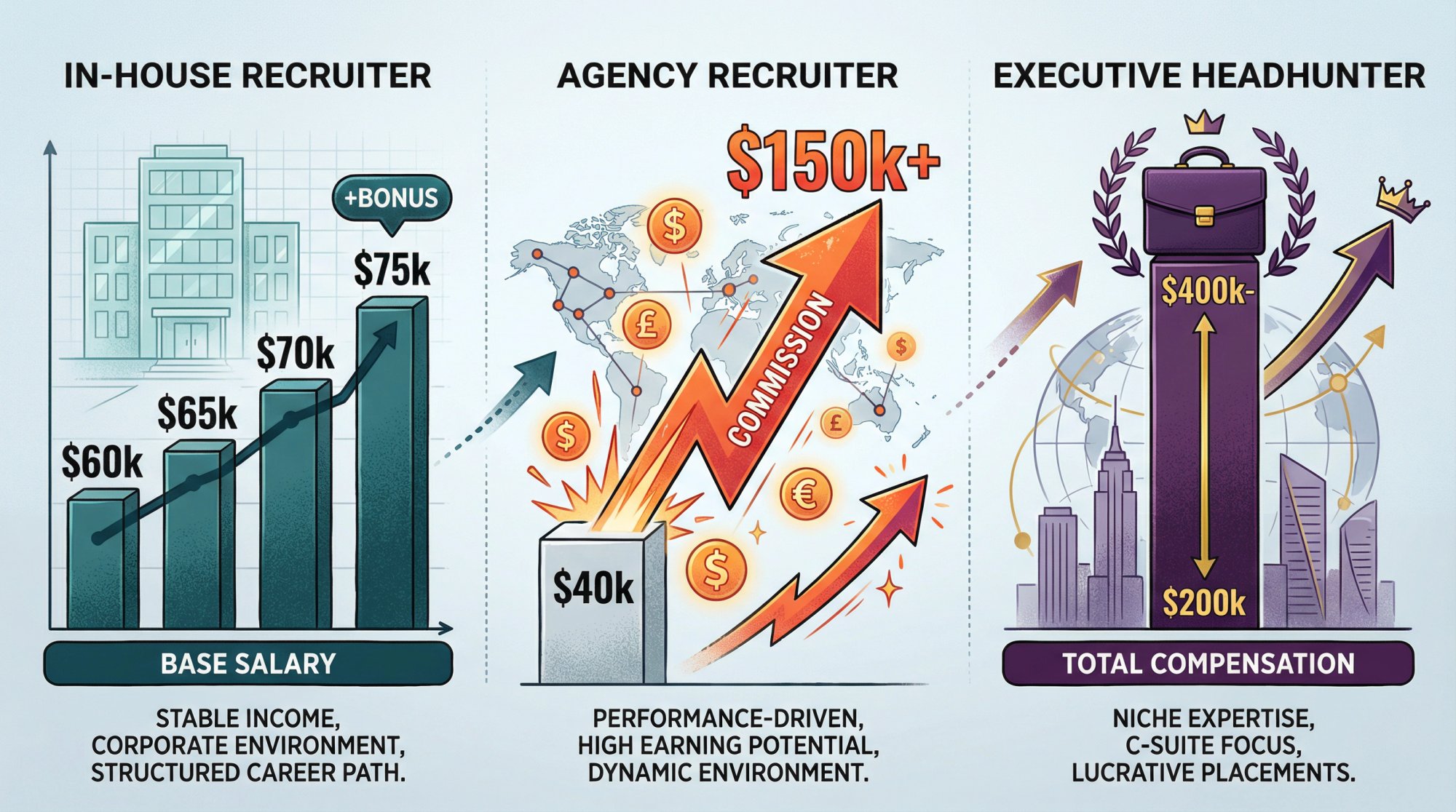
Here's why salary research for recruiters is confusing: the word "recruiter" actually describes three completely different jobs with wildly different pay structures. An in-house recruiter at a tech company, an agency recruiter earning commission, and an executive headhunter are all called "recruiters," but they might as well be in different professions when it comes to compensation.
This guide cuts through the confusion. We'll show you current 2026 salary benchmarks from multiple countries, break down exactly how commission structures work (with actual math), and explain what really drives recruiter pay. Whether you're considering recruiting as a career or trying to figure out if your current offer is fair, you'll have the numbers you need.
What you need to know: Recruiter pay is a function of how directly your work ties to money. Agency recruiters are closer to revenue, so they get more commission upside (and more variability). In-house recruiters are closer to cost control, so they get steadier base pay (and usually smaller variable pay).
What Do Recruiters Actually Earn in 2026?
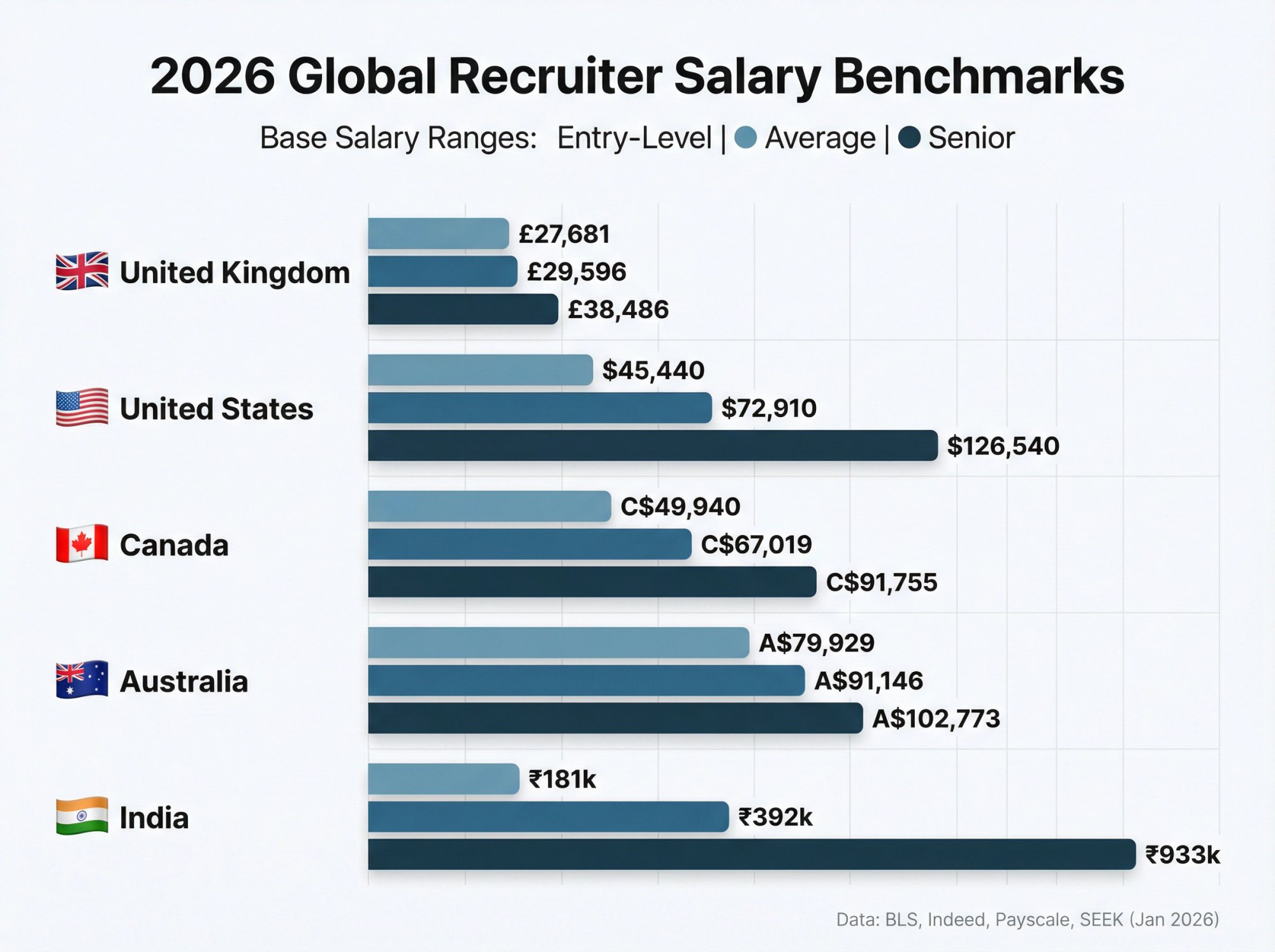
Let's start with the numbers you came here for. These are average base salary benchmarks updated for 2026. We're calling out base vs total pay because that's where most salary research goes wrong.
UK Recruiter Salaries by Role
Source: Indeed UK recruiter salaries
London premium: Recruitment consultants in London earn a higher base of £35,667, while technical recruiters in the capital command £48,541.
Here's what this shows: In the UK, general recruiter base pay clusters around £28k-£32k. Specialization and big-city markets push that higher.
US Recruiter Salary Data (2024-2026)
You need both of these to understand the US market:
Government baseline (BLS): Human resources specialists (which includes recruiters) earn a median of $72,910 per year as of May 2024. The bottom 10% earn under $45,440, while the top 10% earn over $126,540.
Market-reported total pay: Glassdoor estimates $112,082 average total pay for recruiters in the US, with a typical range of $85,982 to $148,988 (January 2026 data based on 87,750 salaries).
How to read this: BLS gives you a stable baseline. Glassdoor is closer to what people are actually seeing in the market, but it's model-based and self-reported. If you're interviewing for a corporate recruiter role, anchor to BLS. If it's agency or high-commission, Glassdoor's total pay is more relevant.
Canada Average Base Salaries
Toronto note: Recruitment consultants in Toronto show a base of C$63,217.
Australia Average Base Salaries
SEEK's market range for recruitment consultant roles: A$75,000 to A$90,000 (November 2025 data).
India Average Base Salary
Payscale reports recruiters in India earn an average base of ₹391,651 per year (median around ₹392k), with a range of ₹181k to ₹933k based on 389 profiles (last updated December 28, 2025).
Why Are Recruiter Salaries So Different?
You've seen the numbers. Now let's explain why they vary so wildly.
3 Types of Recruiter Jobs (And Their Pay)
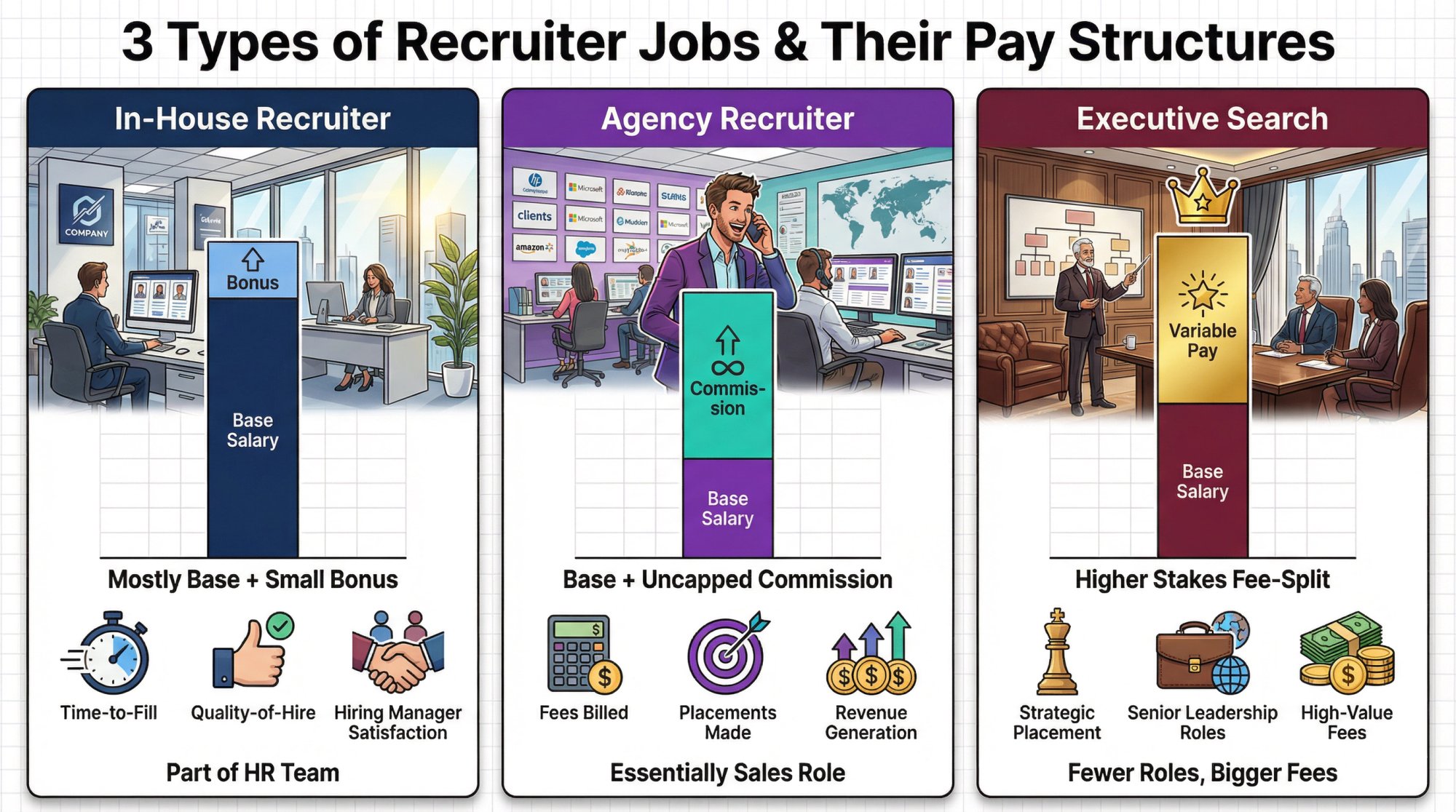
In-House (Corporate) Recruiter
Works inside one company. Success metrics: time-to-fill, quality-of-hire, hiring manager satisfaction.
Pay structure: mostly base salary, some bonus.
These recruiters are part of the HR team and their job is to keep the hiring pipeline full.
Agency Recruiter / Recruitment Consultant
Works for a staffing or recruiting firm. Success metrics: placements made and fees billed.
Pay structure: base salary plus commission (often uncapped).
These recruitment consultants are essentially salespeople who happen to sell talent.
Executive Search / Headhunter
Focuses on senior leadership roles. Pay structure: can be salary plus bonus or fee-split models, but typically higher stakes. These recruiters work on fewer roles but each placement is worth significantly more.
The problem? If you compare salaries across these three without separating them, the research becomes meaningless.
Base Salary vs Total Compensation
Some sources show base salary (the number on your paycheck before bonuses). Others show total pay estimates (base plus bonus plus commission). These can differ by tens of thousands of dollars.
For example, Indeed's career explorer pages explicitly report average base salary. Glassdoor's recruiter page shows total pay and additional pay dynamics. Both are valid, but you need to know which one you're looking at.
Recruiting is a "Market Mood" Job
When hiring slows down, agency commission drops fast. In-house recruiting can be steadier until layoffs hit recruiting teams (which often happens first in downturns). This is why 2025-2026 updated numbers matter. Recruiter pay from 2021 or 2022 doesn't reflect today's reality.
How Do Recruiters Get Paid?
Stop thinking about recruiter salaries as random numbers. Think about what you're actually being paid for.
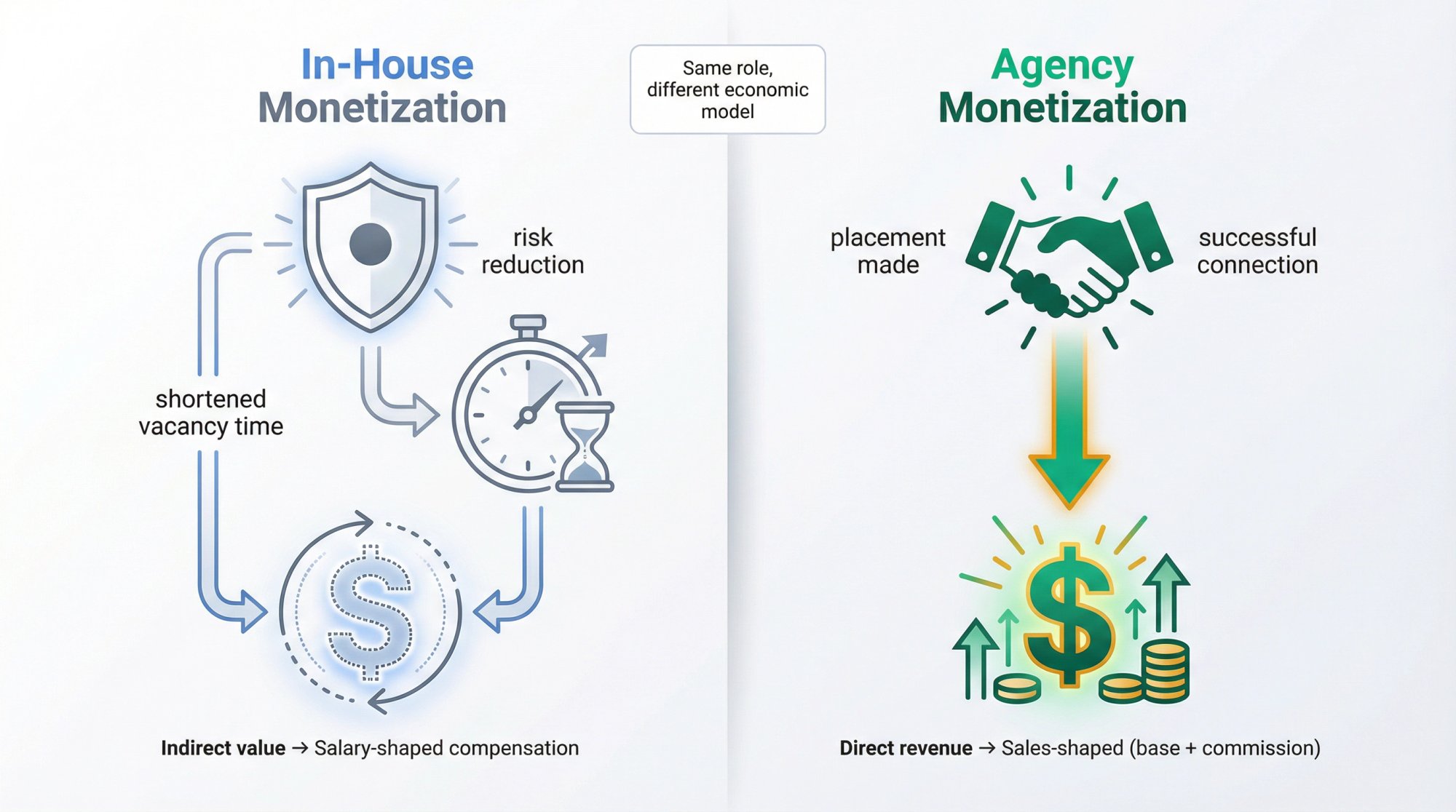
Recruiters get paid for reducing hiring risk and increasing hiring throughput. There are only two ways that gets monetized:
In-House Monetization
Your work prevents bad hires and shortens vacancy time. That saves money, but it's indirect, so your compensation is typically salary-shaped (steady, predictable).
Agency Monetization
Your work generates a fee. That's direct revenue, so compensation is often sales-shaped (base plus commission, with upside).
A simple mental model:
In-house recruiter pay ≈ HR pay band + scarcity premium (if niche/technical)
Agency recruiter pay ≈ base + (revenue you personally generate × payout rate)
This framework explains almost every pay difference you'll encounter.
How Much Do Entry-Level vs Senior Recruiters Make?
Experience matters, but not the way most people think. It's not just "more years = more money." It's about what you can prove you deliver.
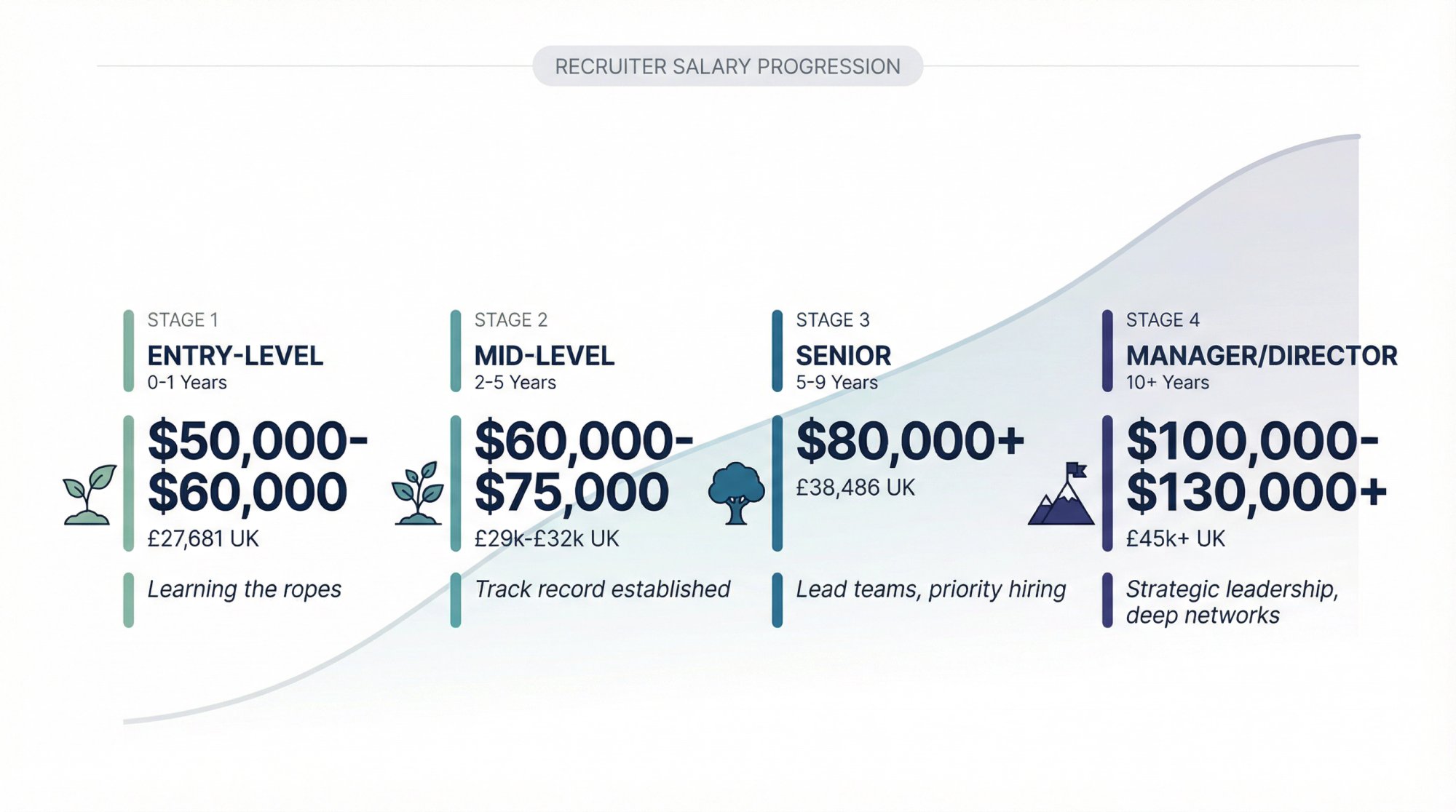
Entry-Level Recruiters (0-1 Years)
What to expect: New recruiters typically start around $50,000-$60,000 per year in the US. Glassdoor data shows early-career recruiters (under 1 year experience) average about $58,600 annually.
In the UK, entry-level recruiters earn around £27,681. This period is about learning the ropes, so pay is modest. You're building your network, understanding ATS systems, and making your first placements.
Mid-Level Recruiters (2-5 Years)
What to expect: With a few years of experience, recruiters command $60,000 to $75,000 per year in the US. Someone with 3-4 years experience typically earns around $63k-$74k.
At this stage, you have a track record. You can fill roles faster, you know how to source passive candidates, and hiring managers trust you. You're more valuable because you're more efficient.
Senior Recruiters (5-9 Years)
What to expect: Experienced recruiters who've spent 5+ years in the field often earn $80,000+ annually. Those with 7-9 years experience average around $77k-$83k.
In the UK, senior recruiters earn £38,486 on average. Senior recruiters often lead teams, handle high-priority hiring, or specialize in difficult-to-fill roles. The pay reflects that responsibility.
Recruiting Managers / Directors (10+ Years)
What to expect: Veteran recruiting professionals in management roles commonly make $100,000 to $130,000+ at large organizations. Glassdoor reports recruiters with 15+ years of experience average about $93k, and many in leadership roles earn well above that.
The pattern: A recruiter's earning potential grows substantially over time. Someone early in their career might be at the $50-60k level, while a seasoned recruitment manager can be pulling in over $100k. The more placements you've made and the deeper your network, the higher your market value.
Where Do Recruiters Make the Most Money?
Where you work geographically has a massive influence on pay. In the US, salaries track with cost of living and regional demand for talent.
Major Metro Areas
New York City: Recruiter salaries typically range from $65,000 to $110,000 for experienced recruiters. The intense competition for skilled recruiters drives up salaries.
San Francisco (Bay Area): Ranges of $70,000 to $120,000 are common, reflecting the competitive tech industry. Tech companies in the Bay Area pay premium rates for recruiters who can source engineering talent.
Other high-paying cities: Boston, MA (mid to high-$60Ks average) and Seattle, WA (around mid-$60Ks) also offer above-average compensation.
Secondary Cities and Regions
Mid-sized cities or regions with lower costs see lower recruiter pay. Recruiters in Dallas or Atlanta might see typical ranges of $55,000 to $90,000, a bit lower than the coasts. In many southern or midwestern areas, recruiter salaries tend toward $50k-$80k, consistent with lower living costs.
Remote Roles
Interestingly, remote recruiter positions (US-based) can offer competitive pay, often $55,000 to $100,000. Companies may adjust pay to attract talent from anywhere, which sometimes allows recruiters living in lower-cost areas to earn near big-city salaries.
International Differences
Recruiter pay varies widely by country. In the UK, the average recruiter earns around £29,596 per year (approximately $37,000 USD). That's notably lower than the US average, partly due to different market rates and how compensation is structured.
UK recruiters often have a lower base with higher commission potential (called OTE or "on-target earnings"). A trainee or junior recruitment consultant might start with a base of £24k-£30k, while a senior consultant might have a base in the low-to-mid £30k range. With commissions and bonuses included, experienced recruiters in the UK can earn totals exceeding £50k-£60k annually.
London recruiters generally earn more than those in smaller UK cities. London recruitment consultants average £35,667 base, reflecting higher demand and cost of living.
Key point: If you work in a major market (New York, San Francisco, London), you can expect significantly higher recruiter salaries than in smaller cities. Always factor in cost of living. A $70k salary in San Francisco might correspond to a $55k salary in a lower-cost city for comparable lifestyle.
Which Recruiter Specializations Pay the Most?
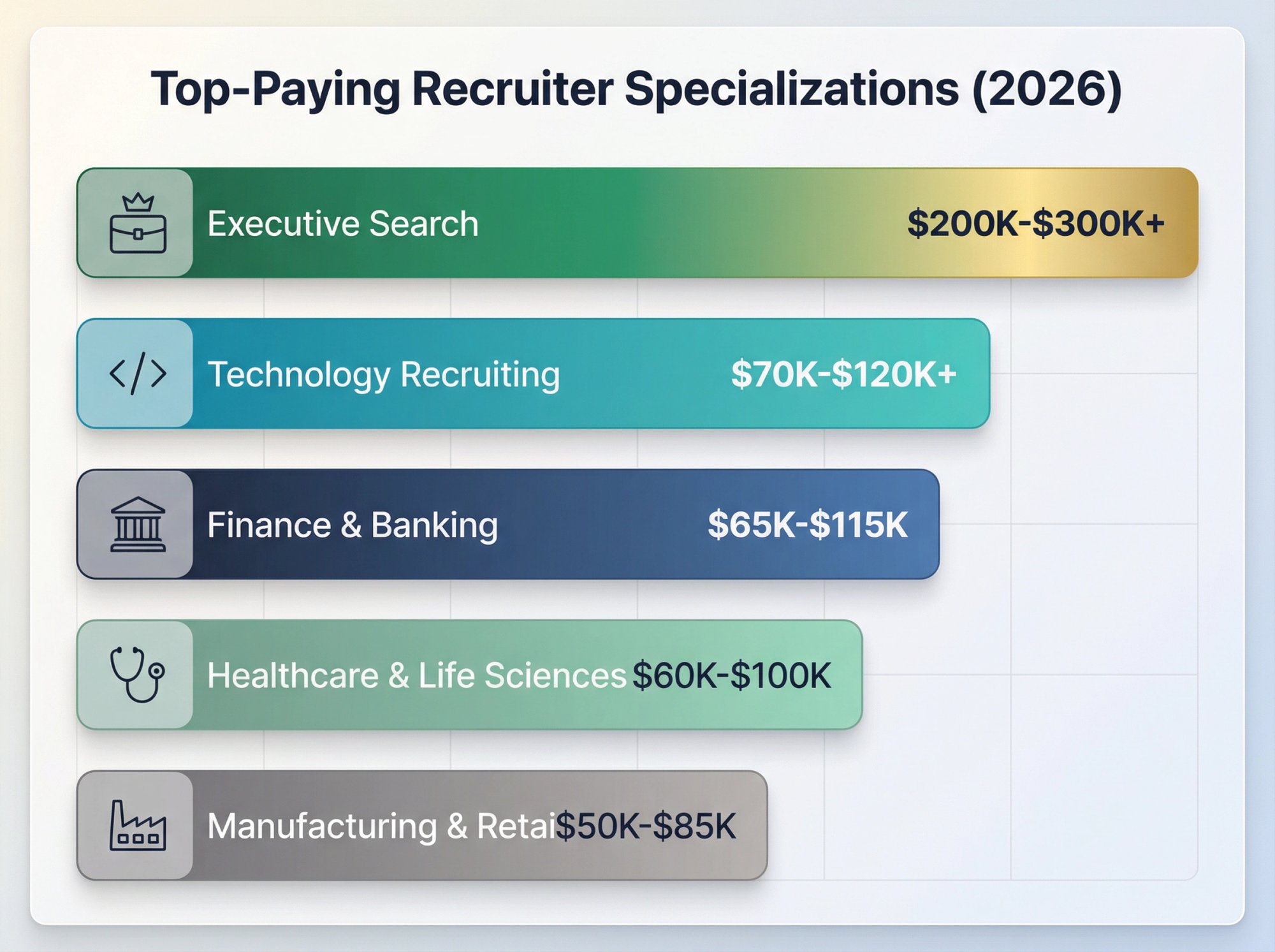
The industry you recruit for dramatically affects earnings. Some sectors pay a premium for talent acquisition expertise:
Technology
Tech companies and startups often pay top dollar for recruiters who can source software engineers, data scientists, and other in-demand tech talent. A technical recruiter in the tech sector typically earns $70,000 to $120,000 or more (especially in big tech hubs).
In the UK, technical recruiters earn £39,949 on average, with London technical recruiters earning £48,541. The competition for qualified candidates is fierce, and placing a single high-tech hire can be extremely valuable to the company. Tech recruiters may also receive stock options or higher bonuses.
Finance & Banking
Finance and banking recruiters see above-average pay. Salaries in finance recruitment might range from roughly $65,000 to $115,000 for experienced recruiters. Financial firms need specialized recruiters to find investment professionals, analysts, and compliance experts.
Healthcare & Life Sciences
These growing industries need specialized recruiters for nurses, medical technicians, and research scientists. Pay for recruiters in healthcare is solid, often in the $60k-$100k range. Life sciences and pharma recruiters may earn on the higher end due to specialized knowledge required.
Manufacturing, Retail, and Other Sectors
Industries like manufacturing, retail, hospitality, or administrative services tend to offer lower recruiter salaries in comparison. A recruiter in manufacturing might see ranges of $55k-$85k, and retail recruiter roles might be around $50k-$80k. These sectors may have high volumes of positions but lower profit margins per hire, translating to more modest pay.
Executive Search
Recruiters who specialize in executive positions (headhunters filling VP/C-suite roles) operate in a high-stakes arena. They might work at boutique executive search firms or inside large companies. These roles come with very high commission opportunities.
An executive recruiter might earn a base salary similar to other senior recruiters (around $80-100k), but the commissions for placing one CEO or senior executive can be enormous (sometimes tens of thousands of dollars for a single placement). Top earners in executive search can make well into six figures, even approaching $200k-$300k+ in good years.
Employment Setting Matters
According to BLS data, recruiters working in the "Employment Services" industry (staffing and temp agencies) had a median annual wage around $58,650 (lower than the overall median). Meanwhile, recruiters in professional/technical services or government had median wages above $77k-$81k (likely in-house recruiters in high-paying industries).
Key takeaway: If you recruit for high-demand skills or specialized fields, you'll earn more. A tech recruiter or finance recruiter often out-earns someone hiring retail staff. Specializing in a hot field boosts your market value, and working in an industry that values talent acquisition (and can afford to pay for it) leads to higher compensation.
How Does Recruiter Commission Work?
If you're on the agency side, your "salary" is often not the point. Your OTE (on-target earnings) is what matters. Let's break down exactly how commission works.
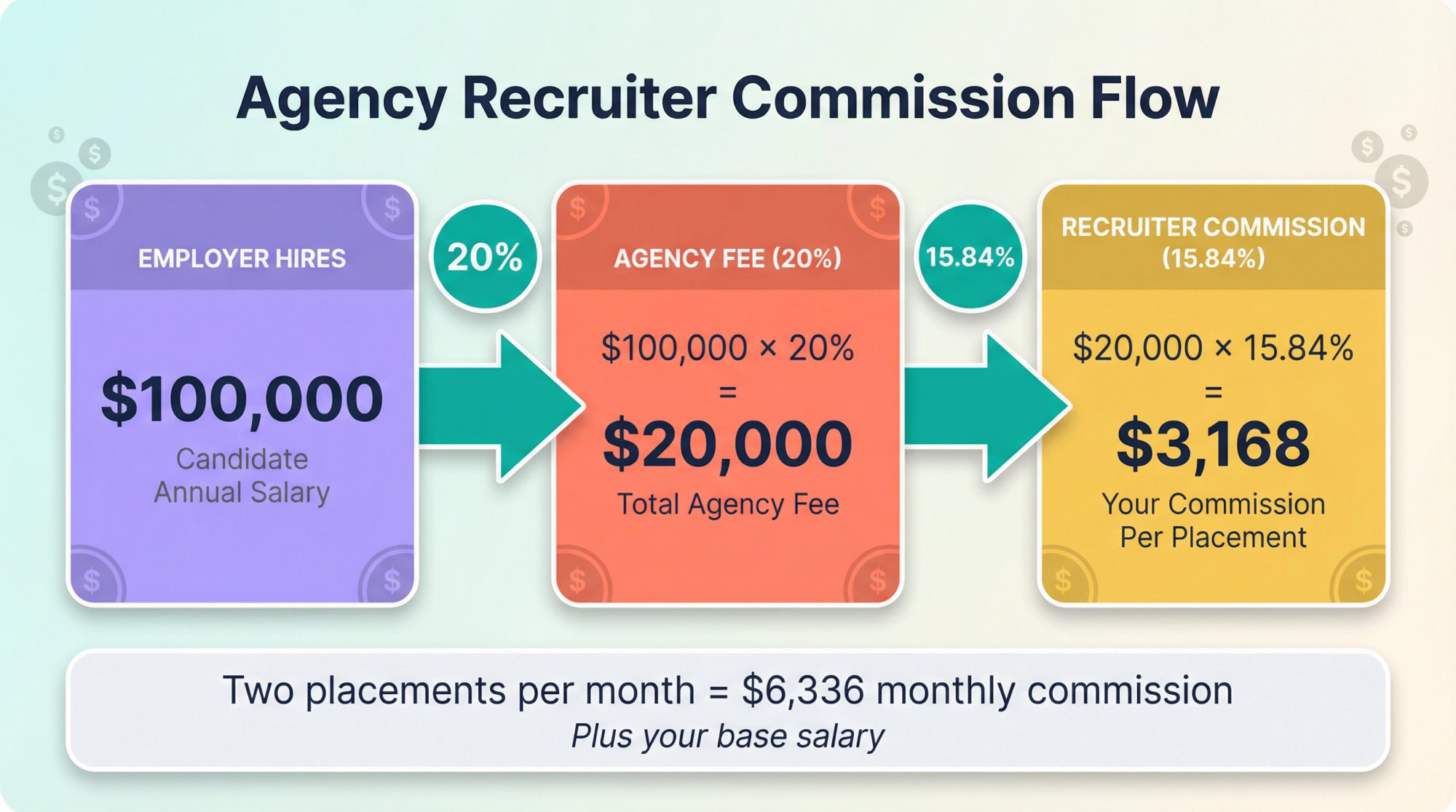
Understanding the Fee (What the Employer Pays the Agency)
When a company hires through a recruiting agency, they pay a fee. Industry sources indicate the average percentage fee is 20-25%, and it can range from 15% to 40% or more, depending on the firm and role.
That's the money flowing from the employer to the agency.
Understanding Your Payout (What the Agency Pays You)
Your commission is a slice of that fee (or a slice of "net fee," depending on how your firm defines it).
One useful benchmark: Industry data reports an average recruiter commission payout of 15.84%. That's not a universal law, but it's a solid market benchmark. Some firms pay lower, some pay way higher (especially at senior levels or with tiered plans).
Permanent Placement Commission Math (Simple Version)
Let's work through a real example:
Assumptions:
• Candidate salary: $100,000
• Agency fee: 20%
• Your payout: 15.84% of the fee
Math:
• Fee = $100,000 × 0.20 = $20,000
• Your commission = $20,000 × 0.1584 = $3,168
Do 2 similar placements per month and you're looking at approximately $6,336/month in commission, before your base salary. That's why agency recruiting can jump fast financially.
Contract/Temp Recruiting Commission Math (Spread Model)
Temp staffing often works off spread (bill rate minus pay rate minus burden/costs).
Industry commission guides show a spread calculation example:
(bill rate − ((pay rate × burden) + hourly costs/per diem)) × hours = spread
This example yields $800 spread for a week in a sample scenario. Then your plan applies a payout percentage to spread (or to margin). This is why high-volume contract desks can be incredibly lucrative.
Common Commission Structures
Industry guides explain various recruiter commission structures (published December 11, 2025). You'll encounter:
① Flat commission per placement: Simple, predictable. You get $X for every hire.
② Percentage of fees: Most common. You get a percentage of the fee the agency collects.
③ Tiered plans: The real money is at higher tiers. Hit certain billing thresholds and your percentage increases.
④ Thresholds: No commission until you bill past a target. Once you're over, you get paid.
⑤ Draws: Guaranteed money that's repaid by future commission. Protects you during slow months but comes out of future earnings.
Industry sources confirm that recruiters do earn commission in many setups, based on placed employee salary.
Real Earning Examples
Some staffing firms advertise very high on-target earnings. For example, one agency's commission plan allows average recruiters to earn around $90,000/year, while top performers earn about $240,000, and a few superstar recruiters hit $480,000 in a year.
These are exceptional cases, but they illustrate the upper end of commission-based income in recruiting. The flip side: if you don't make placements, you might earn just your base salary.
Agency vs In-House Recruiter: Which Pays More?
One of the biggest differentiators in recruiter earnings is whether you work in-house at a company or at a recruiting agency. These two paths have fundamentally different compensation structures.
In-House (Corporate) Recruiters
How they work: Employees of a single company, working in the HR or talent acquisition department.
How they get paid: Typically earn a straight salary plus sometimes a yearly bonus. Their compensation is similar to other corporate roles: relatively stable and predictable.
Average salaries: Internal corporate recruiters in the US earn around $60,000-$75,000 per year, depending on experience and company size. An "Executive Recruiter" employed by a corporation might average about $72k/year in base pay.
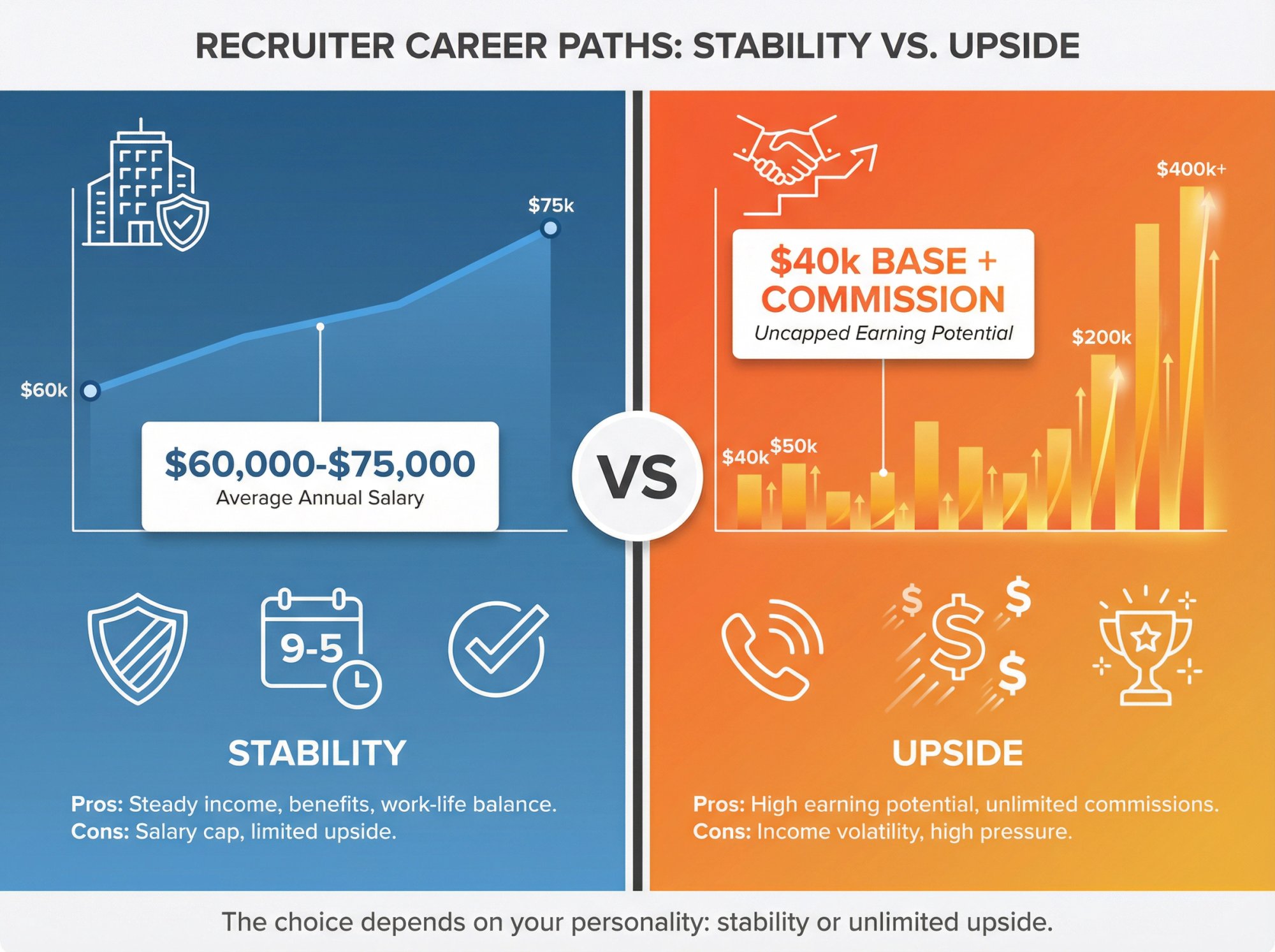
Pros: Job stability and steady income. Corporate recruiters usually enjoy benefits, normal work schedules, and predictable paychecks.
Cons: Typically have a salary cap. You won't usually make the dramatic commissions that agency recruiters can.
Agency (Third-Party) Recruiters
How they work: Work for staffing agencies or recruiting firms, matching candidates to job openings at client companies.
How they get paid: Combine a lower base salary plus commissions for each successful placement. Agencies make money by charging client companies a fee for each candidate hired (often 15-25% of the candidate's first-year salary). Recruiters at the agency receive a cut of that fee as commission.
Example: If you place a candidate in a $100,000/year job and the agency charges 20%, the client pays $20,000. If your commission agreement is 30% of the fee, you personally earn $6,000 from that one placement.
Base salaries: Agency recruiters usually have lower bases, often in the $40k-$50k range for junior recruiters, but uncapped earning potential through commissions.
Pros: Successful agency recruiters who fill many roles (or a few high-salary roles) can far exceed their base pay. Total compensation can double or triple base salary in a strong year.
Cons: High-pressure environment. Income isn't guaranteed. If you don't make placements, you might earn just your base salary.
Which Pays More?
On average, agency recruiters can earn more if they perform well. Industry surveys show agency recruiters often have higher average pay when commissions are good than corporate recruiters.
But not everyone thrives in a commission-driven environment. Corporate recruiters enjoy dependable paychecks and typically less volatility in income.
It comes down to personal preference: stability vs upside. If you're highly self-motivated and love closing deals, agency recruiting can be very lucrative. If you prefer stable income and focusing on one company's talent needs, an in-house role may be more comfortable (with still decent pay and benefits).
What Really Determines Recruiter Salary?
If you want to increase your income, stop thinking "more years = more pay." That's not the real engine. Think in levers:
→ 1. In-House vs Agency
Agency has bigger upside because revenue is direct. You're tied to the money your placements generate.
→ 2. Specialty Difficulty
Technical, healthcare, cleared/government, executive, niche industries lead to higher pay. Why? The candidate supply is smaller and the cost of a miss is larger. UK data shows this cleanly: technical recruiter base is higher than general recruiter base.
→ 3. Geography and City Density
London recruitment consultant base is higher than the national average. Major metros pay more because demand is higher and living costs are higher.
→ 4. Industry Pay Bands
Glassdoor's US industry breakdown puts information technology at the top for recruiter median total pay. BLS also shows HR specialists earn different medians by industry (government, professional/scientific/technical services vs employment services).
→ 5. Deal Cycle Speed (Volume)
Fast, repeatable roles (warehouse, retail, customer support) mean more volume but smaller fees. Slow, high-stakes roles (engineering leadership, finance leadership) mean fewer placements but bigger fees.
→ 6. Business Development vs Delivery
If you bring clients (BD), your payout often increases. If you only deliver on existing accounts, payout might be capped.
→ 7. Your Measurable Output
In agency recruiting, compensation usually follows: billings, starts, margin, and retention. Track these metrics and you can negotiate better terms.
Agency Recruiter Offer: Questions You Must Ask
Agency recruiting can be lucrative, but you need to ask the right questions to avoid compensation traps. Ask these directly:
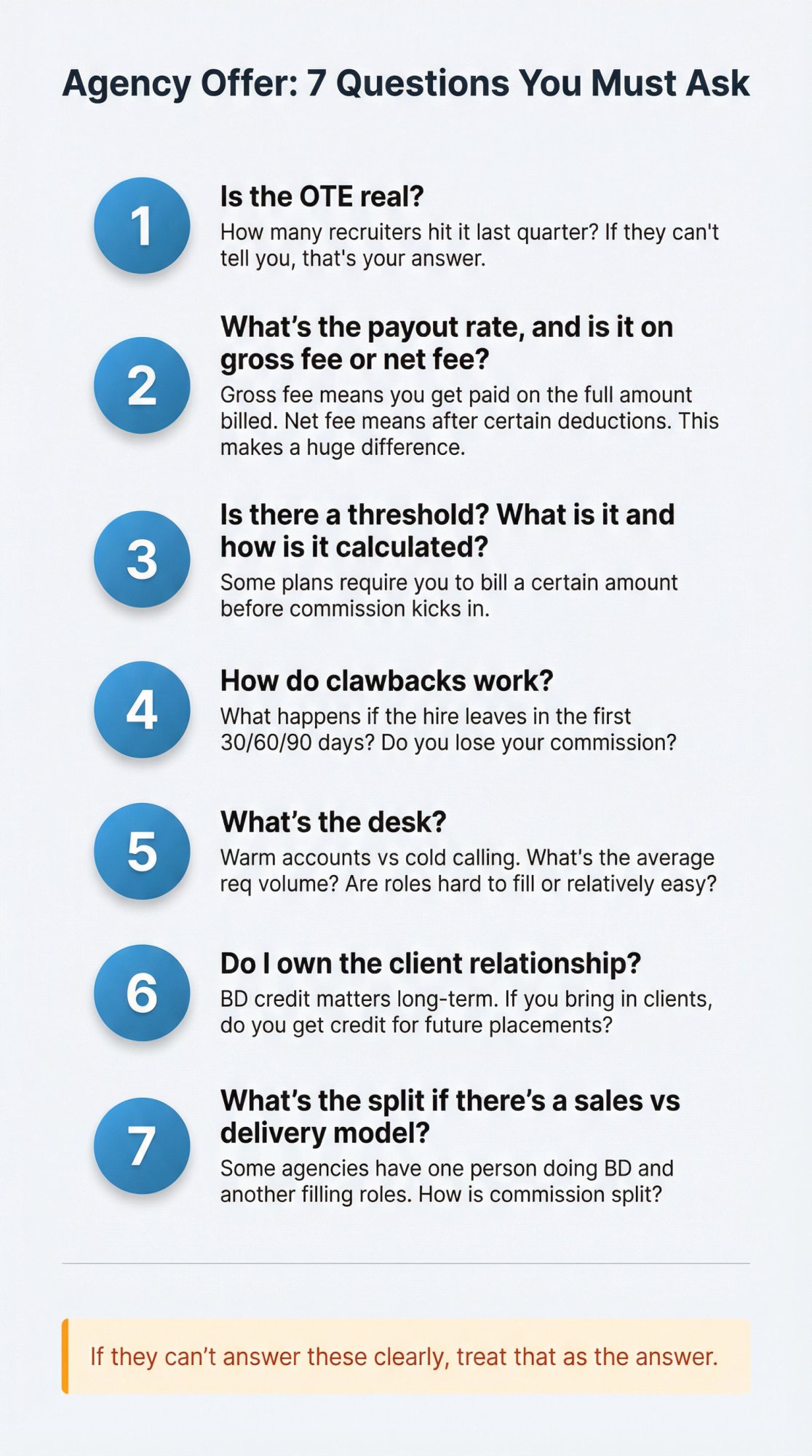
1. Is the OTE real?
How many recruiters hit it last quarter? If they can't tell you, that's your answer.
2. What's the payout rate, and is it on gross fee or net fee?
Gross fee means you get paid on the full amount billed. Net fee means after certain deductions. This makes a huge difference.
3. Is there a threshold? What is it and how is it calculated?
Some plans require you to bill a certain amount before commission kicks in.
4. How do clawbacks work?
What happens if the hire leaves in the first 30/60/90 days? Do you lose your commission?
5. What's the desk?
Warm accounts vs cold calling. What's the average req volume? Are roles hard to fill or relatively easy?
6. Do I own the client relationship?
BD credit matters long-term. If you bring in clients, do you get credit for future placements?
7. What's the split if there's a sales vs delivery model?
Some agencies have one person doing BD and another filling roles. How is commission split?
If they can't answer these clearly, treat that as the answer.
How to Negotiate a Higher Recruiter Salary
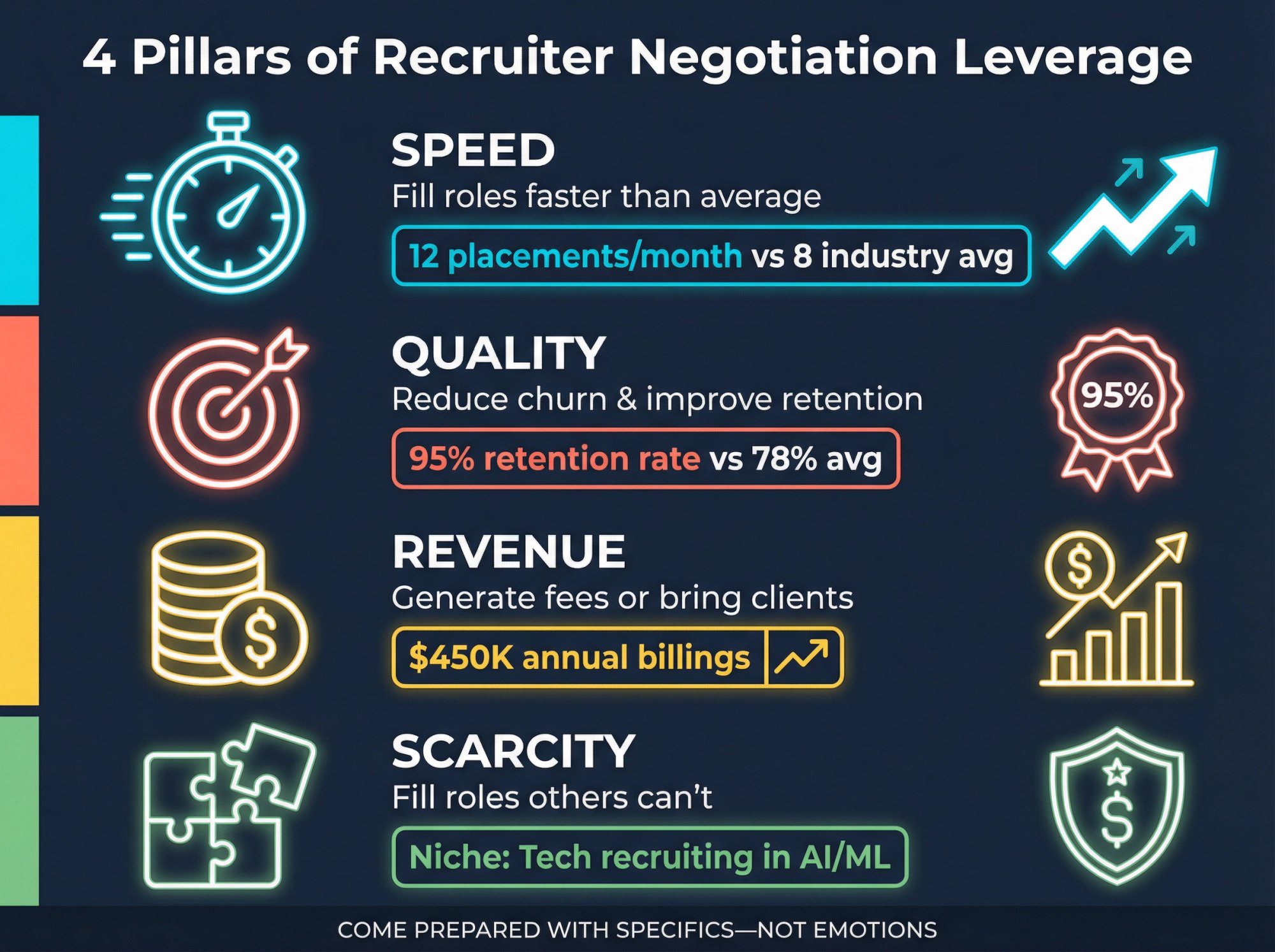
Your goal is to negotiate on the thing the company can justify internally. For recruiters, the strongest justification is always one of these:
• You'll fill roles faster
• You'll fill roles that others can't
• You'll reduce churn (better quality-of-hire)
• You'll increase revenue (if agency: client development or high fees)
Come prepared with specific examples. If you've averaged 12 placements per month with a 95% retention rate, that's your negotiating power.
A Simple Salary Counter Approach
Use AIApply's free salary negotiation template generator to turn your specifics into a clean email or script. Input your situation and get a polished counter.
If you're comparing multiple offers, the tools hub includes a free offer comparison calculator and salary expectation calculator.
What to Negotiate Besides Base
Especially in agency roles, consider negotiating:
• Higher payout tier earlier (lower threshold)
• Guarantee period protection (or reduced clawback)
• Better splits on split desks
• Access to warm accounts / existing req flow
• Marketing/sourcing support (which directly affects your output)
These can be worth more than a $5k bump in base salary.
How to Get a Higher-Paying Recruiter Job
If you're applying to recruiter roles, your competition is other recruiters. They know how hiring works. You need to look like you can perform immediately.
Here's a practical workflow:
1. Tailor Your Resume to the Job Description
Don't ship a generic recruiter resume. Use AIApply's AI Resume Builder to generate a job-specific resume that matches the exact role you're applying for. It takes under 2 minutes and ensures your skills align perfectly with what they're looking for.
2. Run an ATS Scan Before You Apply
Recruiting teams use ATS tools constantly. If your resume can't pass ATS parsing, it's game over before a human even sees it. Use AIApply's Resume Scanner to catch keyword gaps and formatting issues that would otherwise disqualify you.
3. Write a Cover Letter That Sounds Like a Recruiter Wrote It
You're applying to a role that screens for clarity, tone, and persuasion. AIApply's Cover Letter Generator can give you a clean draft that you can then tighten and personalize. It sounds natural and role-appropriate, not templated.
4. Rehearse Recruiter Interview Questions With Real Feedback
Recruiter interviews often test stakeholder management, sourcing strategy, and "tell me about a hard fill" scenarios. AIApply's Mock Interview tool helps you practice with structured AI-generated questions, and Interview Buddy provides real-time on-screen coaching during live interviews.
5. Scale Your Applications Without Losing Quality
Manual applications aren't sustainable when you're targeting multiple companies. AIApply's Auto Apply feature is built for high-volume job search while still tailoring documents to each role. You maintain quality at scale.
6. If You're Going Contract, Price Your Rate Properly
Contract recruiting can be lucrative, but pricing wrong leaves money on the table. Use AIApply's Contractor Rate Calculator to turn an annual income target into a realistic hourly rate (including time off and expenses).
Recruiter Salary FAQs
Do recruiters make good money?
Yes, recruiters can make good money, especially with experience and in the right specialization. Entry-level recruiters start around $50k-$60k in the US (£27k-£30k in the UK), but experienced recruiters commonly earn $80k-$120k+. Agency recruiters with strong commission structures can earn $150k-$300k+ in exceptional years.
The key is understanding that "recruiter" covers different roles. In-house recruiters have stable salaries but lower upside. Agency recruiters have more variability but significantly higher earning potential if they perform well.
What's the highest paying recruiter specialization?
Technical recruiting and executive search are typically the highest paying specializations. Technical recruiters (especially in tech hubs like San Francisco or London) can earn $70k-$120k+ base, with total compensation reaching $150k+. In the UK, technical recruiters in London earn around £48,541 on average.
Executive search recruiters (headhunters filling C-suite roles) can earn even more. While their base might be $80k-$100k, a single executive placement can generate tens of thousands in commission. Top executive recruiters can make $200k-$300k+ annually.
Can you make six figures as a recruiter?
Absolutely. There are several paths to six-figure earnings as a recruiter:
1. Senior in-house recruiter at a tech company: Base salaries of $100k-$130k+ are common for recruiting managers at large tech firms.
2. High-performing agency recruiter: With a solid commission structure, agency recruiters can easily exceed $100k. Some top performers earn $200k-$400k+ annually.
3. Technical recruiter in a major market: Experienced technical recruiters in cities like San Francisco or New York regularly earn six figures when you include base, bonus, and equity.
4. Executive search: Headhunters specializing in senior leadership placements often earn well into six figures.
The Glassdoor estimate of $112,082 average total pay for US recruiters suggests six-figure compensation is quite achievable, not exceptional.
How long does it take to significantly increase your recruiter salary?
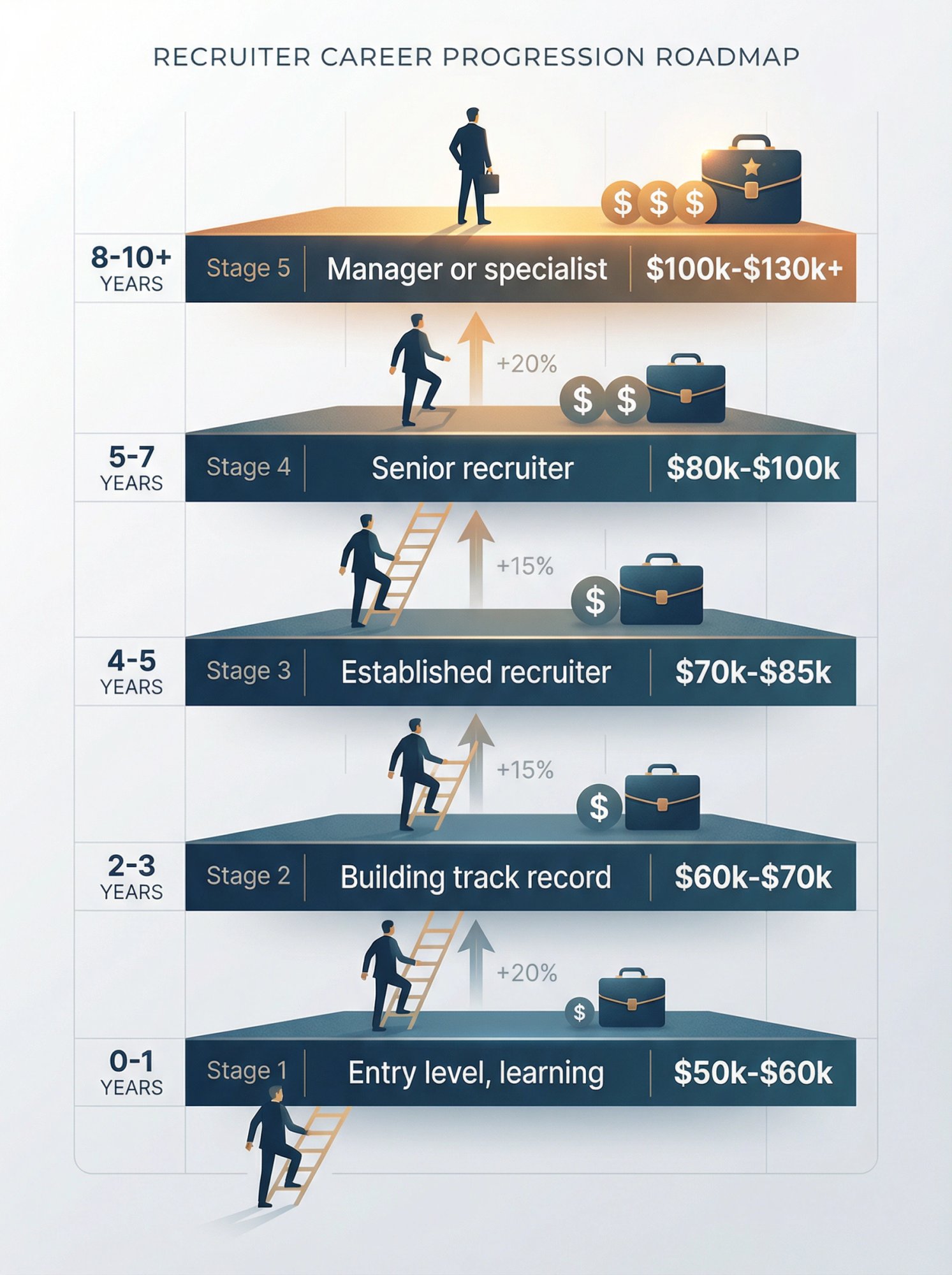
Most recruiters see significant salary increases within 3-5 years. Here's the typical progression:
Agency recruiters can accelerate this timeline significantly if they're strong performers. It's not uncommon for someone to go from $50k year one to $100k+ by year three in a high-commission agency environment.
The fastest way to increase your earnings is to specialize in a high-demand area (tech, finance, healthcare) and consistently deliver results you can quantify.
Are agency or in-house recruiters paid more?
On average, agency recruiters have higher earning potential when they perform well, but in-house recruiters have more stable income.
Agency recruiters typically earn a lower base ($40k-$50k for junior roles) plus uncapped commission. Successful agency recruiters can double or triple their base through commissions. Some top performers earn $200k-$400k+ annually.
In-house recruiters earn a steady salary with predictable bonuses. Corporate recruiter salaries typically range from $60k-$75k, with senior roles and managers earning $80k-$130k+.
The trade-off: Agency = higher risk, higher reward. In-house = stability, predictable income, benefits, and normal work-life balance.
Your choice depends on your personality. If you thrive in sales environments and want unlimited upside, agency is better. If you prefer stability and focusing deeply on one company's needs, in-house is better.
What percentage commission do agency recruiters typically earn?
Industry benchmark studies found the average recruiter commission payout is 15.84% of the placement fee.
Here's how that works:
① Agency charges client company a fee (typically 20-25% of the candidate's first-year salary, though it can range from 15-40%+)
② Recruiter receives a percentage of that fee (the 15.84% average payout)
Example: You place a $100k candidate. Agency charges 20% = $20,000 fee. You earn 15.84% of $20,000 = $3,168 commission.
Commission percentages vary widely:
• Junior recruiters: 10-15%
• Mid-level recruiters: 15-25%
• Senior recruiters: 25-40%+
• Top performers with tiered plans: 50%+ at highest tiers
Some agencies use flat commission per placement instead. Others use tiered structures where your percentage increases as you hit billing thresholds.
Do in-house recruiters get bonuses?
Yes, many in-house recruiters receive annual bonuses, though they're typically smaller and more predictable than agency commissions.
Common in-house bonus structures:
• Annual performance bonus: Usually 5-15% of base salary, tied to individual and company performance
• Hiring volume bonuses: Some companies pay per successful hire (e.g., $500-$2,000 per placement)
• Retention bonuses: Additional pay if hires stay past 90 days or 1 year
• Sign-on bonuses: One-time payment when you join (common for senior roles)
In-house bonuses are structured more like typical corporate bonuses. They're not based on direct fee generation like agency commissions. Instead, they reward metrics like:
• Time-to-fill targets met
• Quality-of-hire scores
• Hiring manager satisfaction ratings
• Overall company/department performance
The predictability is the key difference. Agency commission can vary wildly month-to-month. In-house bonuses are usually annual and more stable.
Final Thoughts: Your Recruiter Compensation Roadmap
Recruiter compensation isn't mysterious once you understand the structure. Here's what you need to remember:
Base salaries cluster around £28k-£32k in the UK, $60k-$75k in the US for general recruiters, with significant premiums for specialization, experience, and major metro locations.
Commission structures in agency recruiting can dramatically increase total compensation. The math is straightforward: understand the fee percentage, your payout rate, and your typical placement volume. Do the math before accepting any agency offer.
The highest earners are either high-performing agency recruiters with strong commission plans, or specialized recruiters (tech, executive search) in high-paying industries.
Your path to higher pay depends on five factors:
Specializing in high-demand areas
Building a strong track record with quantifiable metrics
Choosing the right compensation structure for your personality
Being strategic about location and industry
Negotiating effectively using data, not emotion
If you're applying for recruiter roles right now, remember: your competition knows how hiring works. Your resume, cover letter, and interview performance need to be flawless. Use AIApply's AI-powered tools to ensure you're positioning yourself for the highest-paying opportunities available.
The recruiter job market is competitive, but the compensation can be excellent for those who understand how to navigate it. Now you have the numbers, the commission math, and the strategy. Time to put it to work.
If you've been searching for recruiter salaries online, you've probably noticed something frustrating. The numbers are all over the place. Some sources say £30,000, others claim $112,000, and you're left wondering which one is actually true.
Here's why salary research for recruiters is confusing: the word "recruiter" actually describes three completely different jobs with wildly different pay structures. An in-house recruiter at a tech company, an agency recruiter earning commission, and an executive headhunter are all called "recruiters," but they might as well be in different professions when it comes to compensation.
This guide cuts through the confusion. We'll show you current 2026 salary benchmarks from multiple countries, break down exactly how commission structures work (with actual math), and explain what really drives recruiter pay. Whether you're considering recruiting as a career or trying to figure out if your current offer is fair, you'll have the numbers you need.
What you need to know: Recruiter pay is a function of how directly your work ties to money. Agency recruiters are closer to revenue, so they get more commission upside (and more variability). In-house recruiters are closer to cost control, so they get steadier base pay (and usually smaller variable pay).
What Do Recruiters Actually Earn in 2026?
Let's start with the numbers you came here for. These are average base salary benchmarks updated for 2026. We're calling out base vs total pay because that's where most salary research goes wrong.
UK Recruiter Salaries by Role
Source: Indeed UK recruiter salaries
London premium: Recruitment consultants in London earn a higher base of £35,667, while technical recruiters in the capital command £48,541.
Here's what this shows: In the UK, general recruiter base pay clusters around £28k-£32k. Specialization and big-city markets push that higher.
US Recruiter Salary Data (2024-2026)
You need both of these to understand the US market:
Government baseline (BLS): Human resources specialists (which includes recruiters) earn a median of $72,910 per year as of May 2024. The bottom 10% earn under $45,440, while the top 10% earn over $126,540.
Market-reported total pay: Glassdoor estimates $112,082 average total pay for recruiters in the US, with a typical range of $85,982 to $148,988 (January 2026 data based on 87,750 salaries).
How to read this: BLS gives you a stable baseline. Glassdoor is closer to what people are actually seeing in the market, but it's model-based and self-reported. If you're interviewing for a corporate recruiter role, anchor to BLS. If it's agency or high-commission, Glassdoor's total pay is more relevant.
Canada Average Base Salaries
Toronto note: Recruitment consultants in Toronto show a base of C$63,217.
Australia Average Base Salaries
SEEK's market range for recruitment consultant roles: A$75,000 to A$90,000 (November 2025 data).
India Average Base Salary
Payscale reports recruiters in India earn an average base of ₹391,651 per year (median around ₹392k), with a range of ₹181k to ₹933k based on 389 profiles (last updated December 28, 2025).
Why Are Recruiter Salaries So Different?
You've seen the numbers. Now let's explain why they vary so wildly.
3 Types of Recruiter Jobs (And Their Pay)
In-House (Corporate) Recruiter
Works inside one company. Success metrics: time-to-fill, quality-of-hire, hiring manager satisfaction.
Pay structure: mostly base salary, some bonus.
These recruiters are part of the HR team and their job is to keep the hiring pipeline full.
Agency Recruiter / Recruitment Consultant
Works for a staffing or recruiting firm. Success metrics: placements made and fees billed.
Pay structure: base salary plus commission (often uncapped).
These recruitment consultants are essentially salespeople who happen to sell talent.
Executive Search / Headhunter
Focuses on senior leadership roles. Pay structure: can be salary plus bonus or fee-split models, but typically higher stakes. These recruiters work on fewer roles but each placement is worth significantly more.
The problem? If you compare salaries across these three without separating them, the research becomes meaningless.
Base Salary vs Total Compensation
Some sources show base salary (the number on your paycheck before bonuses). Others show total pay estimates (base plus bonus plus commission). These can differ by tens of thousands of dollars.
For example, Indeed's career explorer pages explicitly report average base salary. Glassdoor's recruiter page shows total pay and additional pay dynamics. Both are valid, but you need to know which one you're looking at.
Recruiting is a "Market Mood" Job
When hiring slows down, agency commission drops fast. In-house recruiting can be steadier until layoffs hit recruiting teams (which often happens first in downturns). This is why 2025-2026 updated numbers matter. Recruiter pay from 2021 or 2022 doesn't reflect today's reality.
How Do Recruiters Get Paid?
Stop thinking about recruiter salaries as random numbers. Think about what you're actually being paid for.
Recruiters get paid for reducing hiring risk and increasing hiring throughput. There are only two ways that gets monetized:
In-House Monetization
Your work prevents bad hires and shortens vacancy time. That saves money, but it's indirect, so your compensation is typically salary-shaped (steady, predictable).
Agency Monetization
Your work generates a fee. That's direct revenue, so compensation is often sales-shaped (base plus commission, with upside).
A simple mental model:
In-house recruiter pay ≈ HR pay band + scarcity premium (if niche/technical)
Agency recruiter pay ≈ base + (revenue you personally generate × payout rate)
This framework explains almost every pay difference you'll encounter.
How Much Do Entry-Level vs Senior Recruiters Make?
Experience matters, but not the way most people think. It's not just "more years = more money." It's about what you can prove you deliver.
Entry-Level Recruiters (0-1 Years)
What to expect: New recruiters typically start around $50,000-$60,000 per year in the US. Glassdoor data shows early-career recruiters (under 1 year experience) average about $58,600 annually.
In the UK, entry-level recruiters earn around £27,681. This period is about learning the ropes, so pay is modest. You're building your network, understanding ATS systems, and making your first placements.
Mid-Level Recruiters (2-5 Years)
What to expect: With a few years of experience, recruiters command $60,000 to $75,000 per year in the US. Someone with 3-4 years experience typically earns around $63k-$74k.
At this stage, you have a track record. You can fill roles faster, you know how to source passive candidates, and hiring managers trust you. You're more valuable because you're more efficient.
Senior Recruiters (5-9 Years)
What to expect: Experienced recruiters who've spent 5+ years in the field often earn $80,000+ annually. Those with 7-9 years experience average around $77k-$83k.
In the UK, senior recruiters earn £38,486 on average. Senior recruiters often lead teams, handle high-priority hiring, or specialize in difficult-to-fill roles. The pay reflects that responsibility.
Recruiting Managers / Directors (10+ Years)
What to expect: Veteran recruiting professionals in management roles commonly make $100,000 to $130,000+ at large organizations. Glassdoor reports recruiters with 15+ years of experience average about $93k, and many in leadership roles earn well above that.
The pattern: A recruiter's earning potential grows substantially over time. Someone early in their career might be at the $50-60k level, while a seasoned recruitment manager can be pulling in over $100k. The more placements you've made and the deeper your network, the higher your market value.
Where Do Recruiters Make the Most Money?
Where you work geographically has a massive influence on pay. In the US, salaries track with cost of living and regional demand for talent.
Major Metro Areas
New York City: Recruiter salaries typically range from $65,000 to $110,000 for experienced recruiters. The intense competition for skilled recruiters drives up salaries.
San Francisco (Bay Area): Ranges of $70,000 to $120,000 are common, reflecting the competitive tech industry. Tech companies in the Bay Area pay premium rates for recruiters who can source engineering talent.
Other high-paying cities: Boston, MA (mid to high-$60Ks average) and Seattle, WA (around mid-$60Ks) also offer above-average compensation.
Secondary Cities and Regions
Mid-sized cities or regions with lower costs see lower recruiter pay. Recruiters in Dallas or Atlanta might see typical ranges of $55,000 to $90,000, a bit lower than the coasts. In many southern or midwestern areas, recruiter salaries tend toward $50k-$80k, consistent with lower living costs.
Remote Roles
Interestingly, remote recruiter positions (US-based) can offer competitive pay, often $55,000 to $100,000. Companies may adjust pay to attract talent from anywhere, which sometimes allows recruiters living in lower-cost areas to earn near big-city salaries.
International Differences
Recruiter pay varies widely by country. In the UK, the average recruiter earns around £29,596 per year (approximately $37,000 USD). That's notably lower than the US average, partly due to different market rates and how compensation is structured.
UK recruiters often have a lower base with higher commission potential (called OTE or "on-target earnings"). A trainee or junior recruitment consultant might start with a base of £24k-£30k, while a senior consultant might have a base in the low-to-mid £30k range. With commissions and bonuses included, experienced recruiters in the UK can earn totals exceeding £50k-£60k annually.
London recruiters generally earn more than those in smaller UK cities. London recruitment consultants average £35,667 base, reflecting higher demand and cost of living.
Key point: If you work in a major market (New York, San Francisco, London), you can expect significantly higher recruiter salaries than in smaller cities. Always factor in cost of living. A $70k salary in San Francisco might correspond to a $55k salary in a lower-cost city for comparable lifestyle.
Which Recruiter Specializations Pay the Most?
The industry you recruit for dramatically affects earnings. Some sectors pay a premium for talent acquisition expertise:
Technology
Tech companies and startups often pay top dollar for recruiters who can source software engineers, data scientists, and other in-demand tech talent. A technical recruiter in the tech sector typically earns $70,000 to $120,000 or more (especially in big tech hubs).
In the UK, technical recruiters earn £39,949 on average, with London technical recruiters earning £48,541. The competition for qualified candidates is fierce, and placing a single high-tech hire can be extremely valuable to the company. Tech recruiters may also receive stock options or higher bonuses.
Finance & Banking
Finance and banking recruiters see above-average pay. Salaries in finance recruitment might range from roughly $65,000 to $115,000 for experienced recruiters. Financial firms need specialized recruiters to find investment professionals, analysts, and compliance experts.
Healthcare & Life Sciences
These growing industries need specialized recruiters for nurses, medical technicians, and research scientists. Pay for recruiters in healthcare is solid, often in the $60k-$100k range. Life sciences and pharma recruiters may earn on the higher end due to specialized knowledge required.
Manufacturing, Retail, and Other Sectors
Industries like manufacturing, retail, hospitality, or administrative services tend to offer lower recruiter salaries in comparison. A recruiter in manufacturing might see ranges of $55k-$85k, and retail recruiter roles might be around $50k-$80k. These sectors may have high volumes of positions but lower profit margins per hire, translating to more modest pay.
Executive Search
Recruiters who specialize in executive positions (headhunters filling VP/C-suite roles) operate in a high-stakes arena. They might work at boutique executive search firms or inside large companies. These roles come with very high commission opportunities.
An executive recruiter might earn a base salary similar to other senior recruiters (around $80-100k), but the commissions for placing one CEO or senior executive can be enormous (sometimes tens of thousands of dollars for a single placement). Top earners in executive search can make well into six figures, even approaching $200k-$300k+ in good years.
Employment Setting Matters
According to BLS data, recruiters working in the "Employment Services" industry (staffing and temp agencies) had a median annual wage around $58,650 (lower than the overall median). Meanwhile, recruiters in professional/technical services or government had median wages above $77k-$81k (likely in-house recruiters in high-paying industries).
Key takeaway: If you recruit for high-demand skills or specialized fields, you'll earn more. A tech recruiter or finance recruiter often out-earns someone hiring retail staff. Specializing in a hot field boosts your market value, and working in an industry that values talent acquisition (and can afford to pay for it) leads to higher compensation.
How Does Recruiter Commission Work?
If you're on the agency side, your "salary" is often not the point. Your OTE (on-target earnings) is what matters. Let's break down exactly how commission works.
Understanding the Fee (What the Employer Pays the Agency)
When a company hires through a recruiting agency, they pay a fee. Industry sources indicate the average percentage fee is 20-25%, and it can range from 15% to 40% or more, depending on the firm and role.
That's the money flowing from the employer to the agency.
Understanding Your Payout (What the Agency Pays You)
Your commission is a slice of that fee (or a slice of "net fee," depending on how your firm defines it).
One useful benchmark: Industry data reports an average recruiter commission payout of 15.84%. That's not a universal law, but it's a solid market benchmark. Some firms pay lower, some pay way higher (especially at senior levels or with tiered plans).
Permanent Placement Commission Math (Simple Version)
Let's work through a real example:
Assumptions:
• Candidate salary: $100,000
• Agency fee: 20%
• Your payout: 15.84% of the fee
Math:
• Fee = $100,000 × 0.20 = $20,000
• Your commission = $20,000 × 0.1584 = $3,168
Do 2 similar placements per month and you're looking at approximately $6,336/month in commission, before your base salary. That's why agency recruiting can jump fast financially.
Contract/Temp Recruiting Commission Math (Spread Model)
Temp staffing often works off spread (bill rate minus pay rate minus burden/costs).
Industry commission guides show a spread calculation example:
(bill rate − ((pay rate × burden) + hourly costs/per diem)) × hours = spread
This example yields $800 spread for a week in a sample scenario. Then your plan applies a payout percentage to spread (or to margin). This is why high-volume contract desks can be incredibly lucrative.
Common Commission Structures
Industry guides explain various recruiter commission structures (published December 11, 2025). You'll encounter:
① Flat commission per placement: Simple, predictable. You get $X for every hire.
② Percentage of fees: Most common. You get a percentage of the fee the agency collects.
③ Tiered plans: The real money is at higher tiers. Hit certain billing thresholds and your percentage increases.
④ Thresholds: No commission until you bill past a target. Once you're over, you get paid.
⑤ Draws: Guaranteed money that's repaid by future commission. Protects you during slow months but comes out of future earnings.
Industry sources confirm that recruiters do earn commission in many setups, based on placed employee salary.
Real Earning Examples
Some staffing firms advertise very high on-target earnings. For example, one agency's commission plan allows average recruiters to earn around $90,000/year, while top performers earn about $240,000, and a few superstar recruiters hit $480,000 in a year.
These are exceptional cases, but they illustrate the upper end of commission-based income in recruiting. The flip side: if you don't make placements, you might earn just your base salary.
Agency vs In-House Recruiter: Which Pays More?
One of the biggest differentiators in recruiter earnings is whether you work in-house at a company or at a recruiting agency. These two paths have fundamentally different compensation structures.
In-House (Corporate) Recruiters
How they work: Employees of a single company, working in the HR or talent acquisition department.
How they get paid: Typically earn a straight salary plus sometimes a yearly bonus. Their compensation is similar to other corporate roles: relatively stable and predictable.
Average salaries: Internal corporate recruiters in the US earn around $60,000-$75,000 per year, depending on experience and company size. An "Executive Recruiter" employed by a corporation might average about $72k/year in base pay.
Pros: Job stability and steady income. Corporate recruiters usually enjoy benefits, normal work schedules, and predictable paychecks.
Cons: Typically have a salary cap. You won't usually make the dramatic commissions that agency recruiters can.
Agency (Third-Party) Recruiters
How they work: Work for staffing agencies or recruiting firms, matching candidates to job openings at client companies.
How they get paid: Combine a lower base salary plus commissions for each successful placement. Agencies make money by charging client companies a fee for each candidate hired (often 15-25% of the candidate's first-year salary). Recruiters at the agency receive a cut of that fee as commission.
Example: If you place a candidate in a $100,000/year job and the agency charges 20%, the client pays $20,000. If your commission agreement is 30% of the fee, you personally earn $6,000 from that one placement.
Base salaries: Agency recruiters usually have lower bases, often in the $40k-$50k range for junior recruiters, but uncapped earning potential through commissions.
Pros: Successful agency recruiters who fill many roles (or a few high-salary roles) can far exceed their base pay. Total compensation can double or triple base salary in a strong year.
Cons: High-pressure environment. Income isn't guaranteed. If you don't make placements, you might earn just your base salary.
Which Pays More?
On average, agency recruiters can earn more if they perform well. Industry surveys show agency recruiters often have higher average pay when commissions are good than corporate recruiters.
But not everyone thrives in a commission-driven environment. Corporate recruiters enjoy dependable paychecks and typically less volatility in income.
It comes down to personal preference: stability vs upside. If you're highly self-motivated and love closing deals, agency recruiting can be very lucrative. If you prefer stable income and focusing on one company's talent needs, an in-house role may be more comfortable (with still decent pay and benefits).
What Really Determines Recruiter Salary?
If you want to increase your income, stop thinking "more years = more pay." That's not the real engine. Think in levers:
→ 1. In-House vs Agency
Agency has bigger upside because revenue is direct. You're tied to the money your placements generate.
→ 2. Specialty Difficulty
Technical, healthcare, cleared/government, executive, niche industries lead to higher pay. Why? The candidate supply is smaller and the cost of a miss is larger. UK data shows this cleanly: technical recruiter base is higher than general recruiter base.
→ 3. Geography and City Density
London recruitment consultant base is higher than the national average. Major metros pay more because demand is higher and living costs are higher.
→ 4. Industry Pay Bands
Glassdoor's US industry breakdown puts information technology at the top for recruiter median total pay. BLS also shows HR specialists earn different medians by industry (government, professional/scientific/technical services vs employment services).
→ 5. Deal Cycle Speed (Volume)
Fast, repeatable roles (warehouse, retail, customer support) mean more volume but smaller fees. Slow, high-stakes roles (engineering leadership, finance leadership) mean fewer placements but bigger fees.
→ 6. Business Development vs Delivery
If you bring clients (BD), your payout often increases. If you only deliver on existing accounts, payout might be capped.
→ 7. Your Measurable Output
In agency recruiting, compensation usually follows: billings, starts, margin, and retention. Track these metrics and you can negotiate better terms.
Agency Recruiter Offer: Questions You Must Ask
Agency recruiting can be lucrative, but you need to ask the right questions to avoid compensation traps. Ask these directly:
1. Is the OTE real?
How many recruiters hit it last quarter? If they can't tell you, that's your answer.
2. What's the payout rate, and is it on gross fee or net fee?
Gross fee means you get paid on the full amount billed. Net fee means after certain deductions. This makes a huge difference.
3. Is there a threshold? What is it and how is it calculated?
Some plans require you to bill a certain amount before commission kicks in.
4. How do clawbacks work?
What happens if the hire leaves in the first 30/60/90 days? Do you lose your commission?
5. What's the desk?
Warm accounts vs cold calling. What's the average req volume? Are roles hard to fill or relatively easy?
6. Do I own the client relationship?
BD credit matters long-term. If you bring in clients, do you get credit for future placements?
7. What's the split if there's a sales vs delivery model?
Some agencies have one person doing BD and another filling roles. How is commission split?
If they can't answer these clearly, treat that as the answer.
How to Negotiate a Higher Recruiter Salary
Your goal is to negotiate on the thing the company can justify internally. For recruiters, the strongest justification is always one of these:
• You'll fill roles faster
• You'll fill roles that others can't
• You'll reduce churn (better quality-of-hire)
• You'll increase revenue (if agency: client development or high fees)
Come prepared with specific examples. If you've averaged 12 placements per month with a 95% retention rate, that's your negotiating power.
A Simple Salary Counter Approach
Use AIApply's free salary negotiation template generator to turn your specifics into a clean email or script. Input your situation and get a polished counter.
If you're comparing multiple offers, the tools hub includes a free offer comparison calculator and salary expectation calculator.
What to Negotiate Besides Base
Especially in agency roles, consider negotiating:
• Higher payout tier earlier (lower threshold)
• Guarantee period protection (or reduced clawback)
• Better splits on split desks
• Access to warm accounts / existing req flow
• Marketing/sourcing support (which directly affects your output)
These can be worth more than a $5k bump in base salary.
How to Get a Higher-Paying Recruiter Job
If you're applying to recruiter roles, your competition is other recruiters. They know how hiring works. You need to look like you can perform immediately.
Here's a practical workflow:
1. Tailor Your Resume to the Job Description
Don't ship a generic recruiter resume. Use AIApply's AI Resume Builder to generate a job-specific resume that matches the exact role you're applying for. It takes under 2 minutes and ensures your skills align perfectly with what they're looking for.
2. Run an ATS Scan Before You Apply
Recruiting teams use ATS tools constantly. If your resume can't pass ATS parsing, it's game over before a human even sees it. Use AIApply's Resume Scanner to catch keyword gaps and formatting issues that would otherwise disqualify you.
3. Write a Cover Letter That Sounds Like a Recruiter Wrote It
You're applying to a role that screens for clarity, tone, and persuasion. AIApply's Cover Letter Generator can give you a clean draft that you can then tighten and personalize. It sounds natural and role-appropriate, not templated.
4. Rehearse Recruiter Interview Questions With Real Feedback
Recruiter interviews often test stakeholder management, sourcing strategy, and "tell me about a hard fill" scenarios. AIApply's Mock Interview tool helps you practice with structured AI-generated questions, and Interview Buddy provides real-time on-screen coaching during live interviews.
5. Scale Your Applications Without Losing Quality
Manual applications aren't sustainable when you're targeting multiple companies. AIApply's Auto Apply feature is built for high-volume job search while still tailoring documents to each role. You maintain quality at scale.
6. If You're Going Contract, Price Your Rate Properly
Contract recruiting can be lucrative, but pricing wrong leaves money on the table. Use AIApply's Contractor Rate Calculator to turn an annual income target into a realistic hourly rate (including time off and expenses).
Recruiter Salary FAQs
Do recruiters make good money?
Yes, recruiters can make good money, especially with experience and in the right specialization. Entry-level recruiters start around $50k-$60k in the US (£27k-£30k in the UK), but experienced recruiters commonly earn $80k-$120k+. Agency recruiters with strong commission structures can earn $150k-$300k+ in exceptional years.
The key is understanding that "recruiter" covers different roles. In-house recruiters have stable salaries but lower upside. Agency recruiters have more variability but significantly higher earning potential if they perform well.
What's the highest paying recruiter specialization?
Technical recruiting and executive search are typically the highest paying specializations. Technical recruiters (especially in tech hubs like San Francisco or London) can earn $70k-$120k+ base, with total compensation reaching $150k+. In the UK, technical recruiters in London earn around £48,541 on average.
Executive search recruiters (headhunters filling C-suite roles) can earn even more. While their base might be $80k-$100k, a single executive placement can generate tens of thousands in commission. Top executive recruiters can make $200k-$300k+ annually.
Can you make six figures as a recruiter?
Absolutely. There are several paths to six-figure earnings as a recruiter:
1. Senior in-house recruiter at a tech company: Base salaries of $100k-$130k+ are common for recruiting managers at large tech firms.
2. High-performing agency recruiter: With a solid commission structure, agency recruiters can easily exceed $100k. Some top performers earn $200k-$400k+ annually.
3. Technical recruiter in a major market: Experienced technical recruiters in cities like San Francisco or New York regularly earn six figures when you include base, bonus, and equity.
4. Executive search: Headhunters specializing in senior leadership placements often earn well into six figures.
The Glassdoor estimate of $112,082 average total pay for US recruiters suggests six-figure compensation is quite achievable, not exceptional.
How long does it take to significantly increase your recruiter salary?
Most recruiters see significant salary increases within 3-5 years. Here's the typical progression:
Agency recruiters can accelerate this timeline significantly if they're strong performers. It's not uncommon for someone to go from $50k year one to $100k+ by year three in a high-commission agency environment.
The fastest way to increase your earnings is to specialize in a high-demand area (tech, finance, healthcare) and consistently deliver results you can quantify.
Are agency or in-house recruiters paid more?
On average, agency recruiters have higher earning potential when they perform well, but in-house recruiters have more stable income.
Agency recruiters typically earn a lower base ($40k-$50k for junior roles) plus uncapped commission. Successful agency recruiters can double or triple their base through commissions. Some top performers earn $200k-$400k+ annually.
In-house recruiters earn a steady salary with predictable bonuses. Corporate recruiter salaries typically range from $60k-$75k, with senior roles and managers earning $80k-$130k+.
The trade-off: Agency = higher risk, higher reward. In-house = stability, predictable income, benefits, and normal work-life balance.
Your choice depends on your personality. If you thrive in sales environments and want unlimited upside, agency is better. If you prefer stability and focusing deeply on one company's needs, in-house is better.
What percentage commission do agency recruiters typically earn?
Industry benchmark studies found the average recruiter commission payout is 15.84% of the placement fee.
Here's how that works:
① Agency charges client company a fee (typically 20-25% of the candidate's first-year salary, though it can range from 15-40%+)
② Recruiter receives a percentage of that fee (the 15.84% average payout)
Example: You place a $100k candidate. Agency charges 20% = $20,000 fee. You earn 15.84% of $20,000 = $3,168 commission.
Commission percentages vary widely:
• Junior recruiters: 10-15%
• Mid-level recruiters: 15-25%
• Senior recruiters: 25-40%+
• Top performers with tiered plans: 50%+ at highest tiers
Some agencies use flat commission per placement instead. Others use tiered structures where your percentage increases as you hit billing thresholds.
Do in-house recruiters get bonuses?
Yes, many in-house recruiters receive annual bonuses, though they're typically smaller and more predictable than agency commissions.
Common in-house bonus structures:
• Annual performance bonus: Usually 5-15% of base salary, tied to individual and company performance
• Hiring volume bonuses: Some companies pay per successful hire (e.g., $500-$2,000 per placement)
• Retention bonuses: Additional pay if hires stay past 90 days or 1 year
• Sign-on bonuses: One-time payment when you join (common for senior roles)
In-house bonuses are structured more like typical corporate bonuses. They're not based on direct fee generation like agency commissions. Instead, they reward metrics like:
• Time-to-fill targets met
• Quality-of-hire scores
• Hiring manager satisfaction ratings
• Overall company/department performance
The predictability is the key difference. Agency commission can vary wildly month-to-month. In-house bonuses are usually annual and more stable.
Final Thoughts: Your Recruiter Compensation Roadmap
Recruiter compensation isn't mysterious once you understand the structure. Here's what you need to remember:
Base salaries cluster around £28k-£32k in the UK, $60k-$75k in the US for general recruiters, with significant premiums for specialization, experience, and major metro locations.
Commission structures in agency recruiting can dramatically increase total compensation. The math is straightforward: understand the fee percentage, your payout rate, and your typical placement volume. Do the math before accepting any agency offer.
The highest earners are either high-performing agency recruiters with strong commission plans, or specialized recruiters (tech, executive search) in high-paying industries.
Your path to higher pay depends on five factors:
Specializing in high-demand areas
Building a strong track record with quantifiable metrics
Choosing the right compensation structure for your personality
Being strategic about location and industry
Negotiating effectively using data, not emotion
If you're applying for recruiter roles right now, remember: your competition knows how hiring works. Your resume, cover letter, and interview performance need to be flawless. Use AIApply's AI-powered tools to ensure you're positioning yourself for the highest-paying opportunities available.
The recruiter job market is competitive, but the compensation can be excellent for those who understand how to navigate it. Now you have the numbers, the commission math, and the strategy. Time to put it to work.
.webp)
.webp)
Don't miss out on
your next opportunity.
Create and send applications in seconds, not hours.


