
Resume Objective vs Summary: Which to Use in 2026?

.webp)
Your resume gets about 6-8 seconds of attention from a hiring manager. That's it.
In those few seconds, the opening lines at the top of your resume will either convince them to keep reading or send your application to the rejection pile. If you're wondering whether to use a resume objective or a summary, you're really asking one question: What do I put at the top of my resume so recruiters immediately understand what I do and why I'm worth interviewing?
This guide answers that question clearly, then shows you exactly how to write an opening that actually gets you interviews.
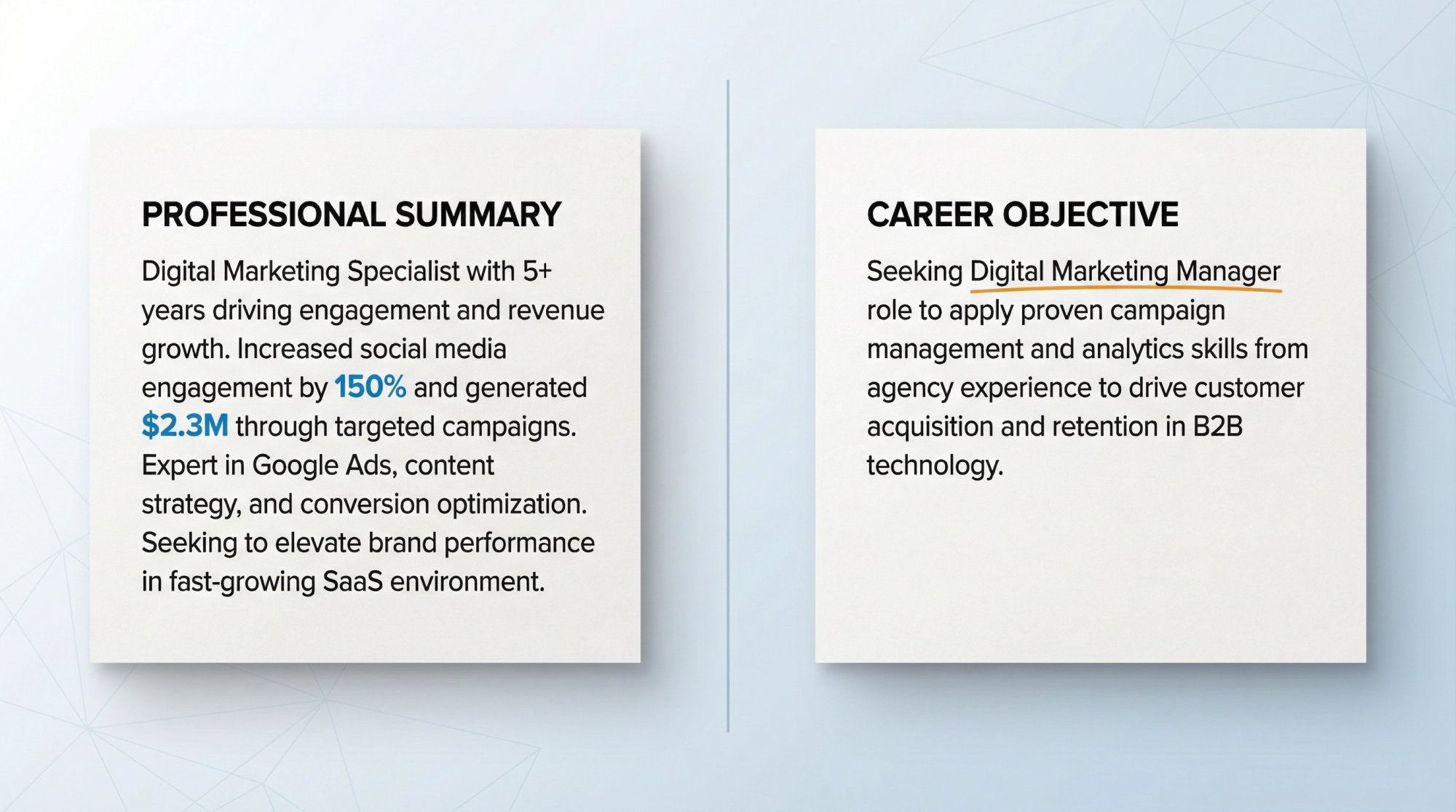
Resume Objective vs Summary: Quick Answer
Use a resume summary when you have relevant experience and results to show. You're proving you're already the safe bet. This applies to most job seekers.
Use a resume objective when your resume needs context. You're entry-level, switching careers, returning after a gap, or you don't have obvious same-field experience yet.
The deeper principle:
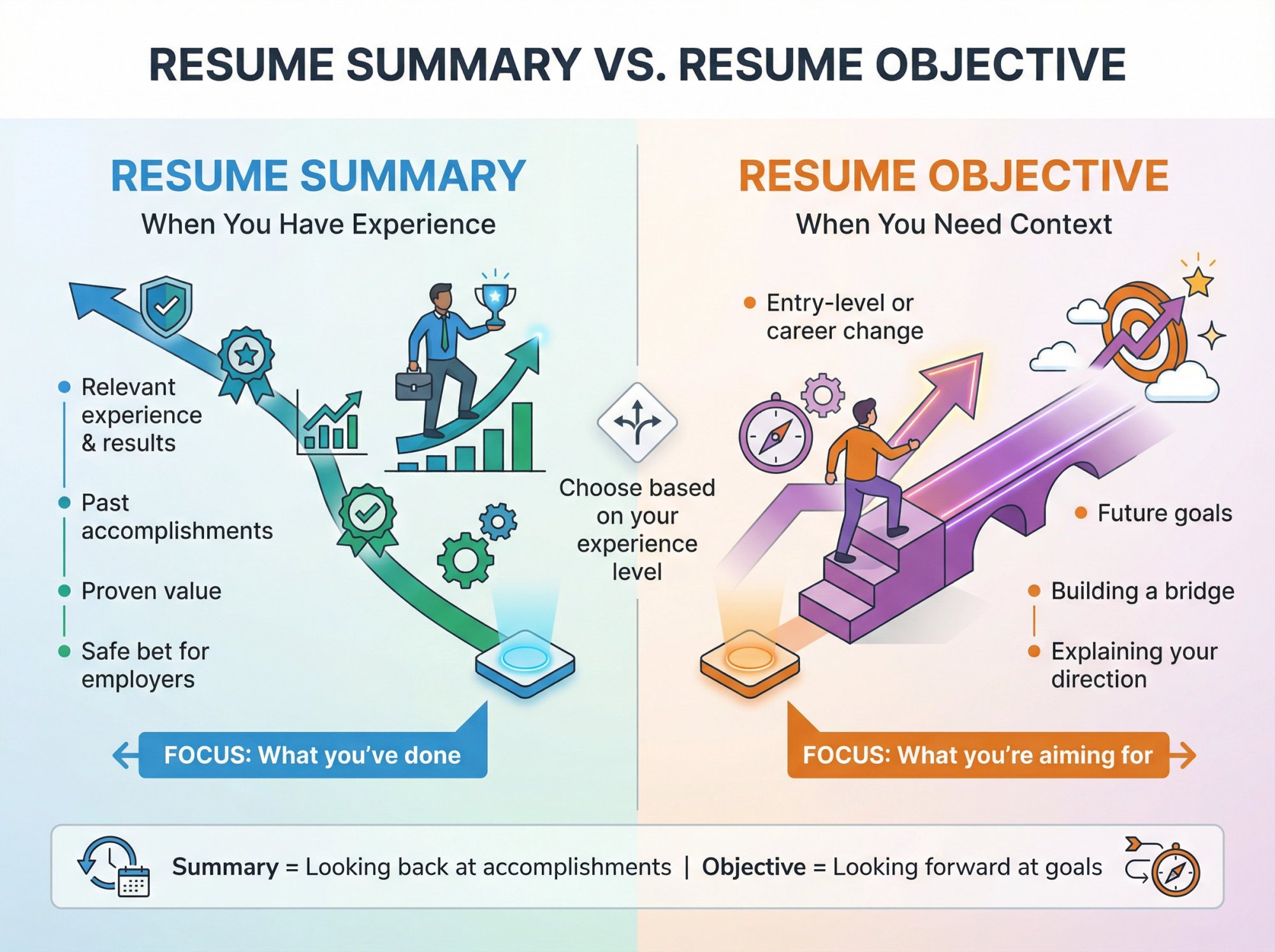
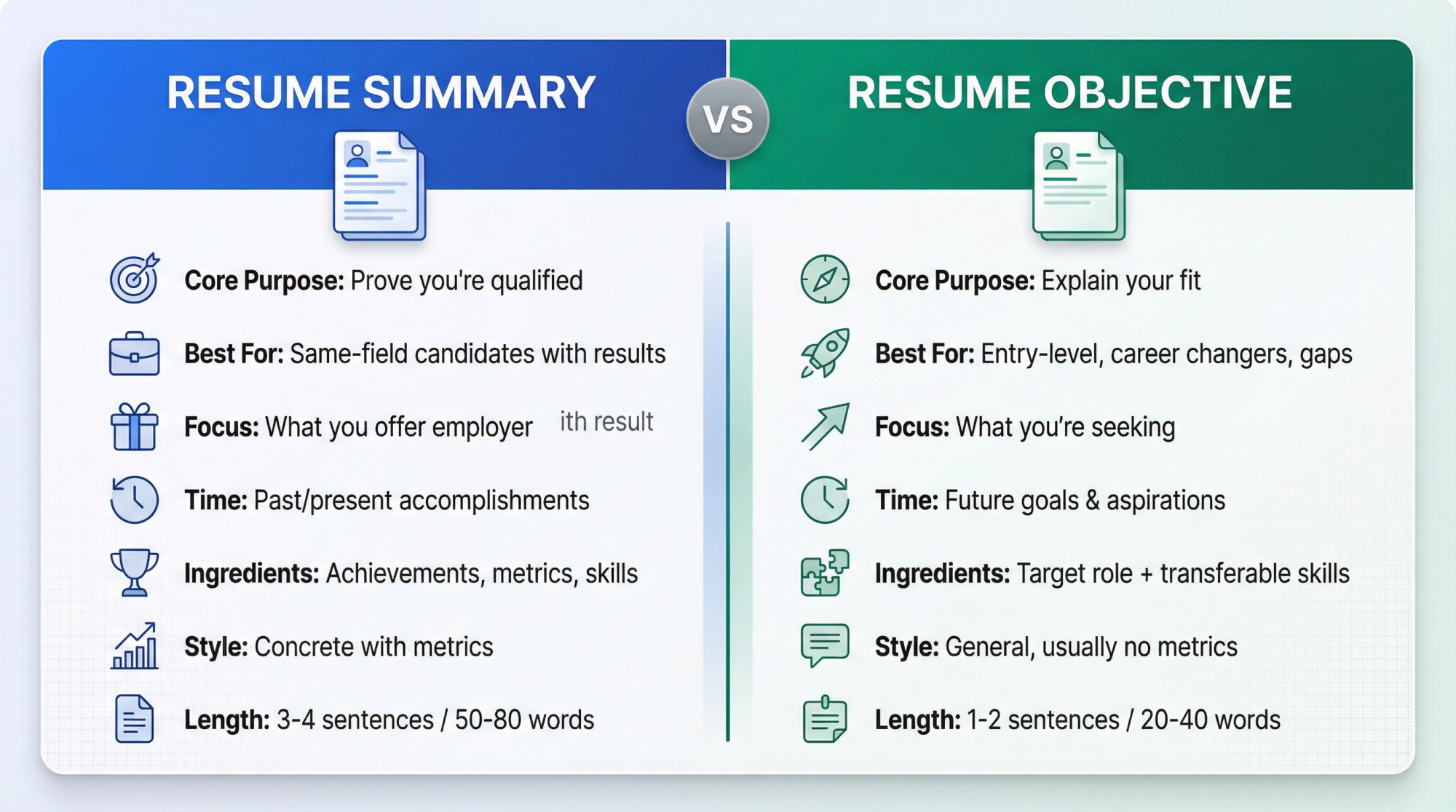
Summary = "Here's what I've done and the value I create." It looks at your past and present accomplishments.
Objective = "Here's what I'm aiming for, why it makes sense, and what I'll contribute." It's future-facing and builds a bridge to explain your direction.
Research shows the key difference is time perspective. Summaries look back at accomplishments while objectives look forward at goals.
Why Resume Opening Statements Matter More in 2026
Two major forces make your resume's opening section more critical than ever:
ATS Software Does the First Screening
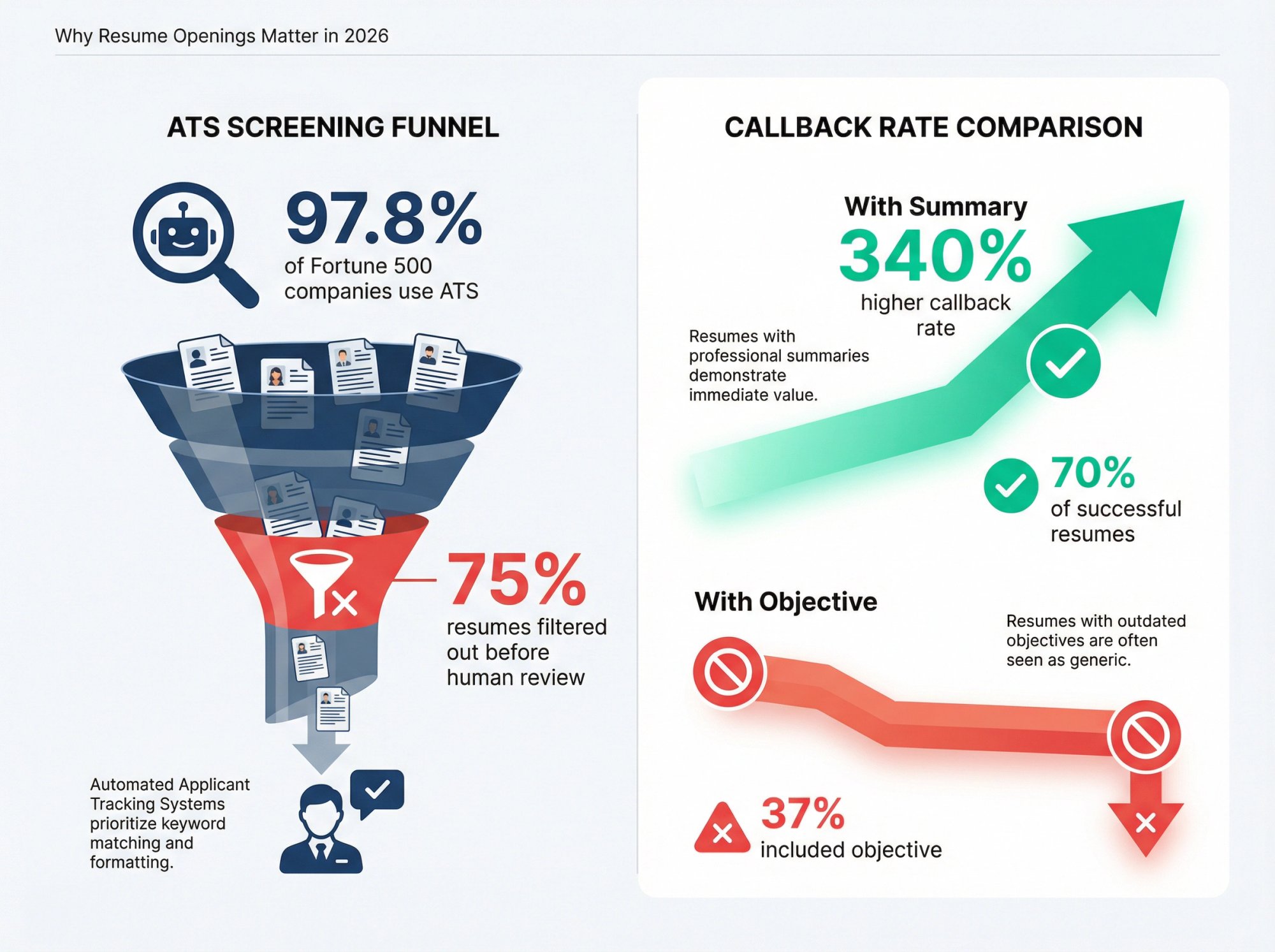
Filtering is increasingly software-assisted. Studies show an Applicant Tracking System on 97.8% of Fortune 500 career sites (489 out of 500 companies). And over 75% of resumes get filtered out by ATS software before a human ever reads them.
Skills-First Hiring Is the New Standard
Industry research reveals some telling data:
→ 37% of recruiting organizations are actively integrating or experimenting with gen AI tools
→ Companies with the most skills-based searches are 12% more likely to make a quality hire
→ 93% of talent acquisition professionals say accurately assessing skills is crucial for quality of hire
Translation: your opening isn't just a nice introduction. It's a keyword, credibility, and direction block that helps both humans and systems quickly classify you as a fit (or not).
The performance data backs this up. Resumes with a professional summary receive 340% more interview callbacks than those with a traditional objective. Research found that 70% of successful resumes had a summary, while only 37% included an objective.
What Is a Resume Summary?
A resume summary (also called a professional summary, career profile, or summary of qualifications) is a short professional introduction that highlights your biggest achievements and most valuable skills. It's essentially your career elevator pitch in 3-5 sentences.
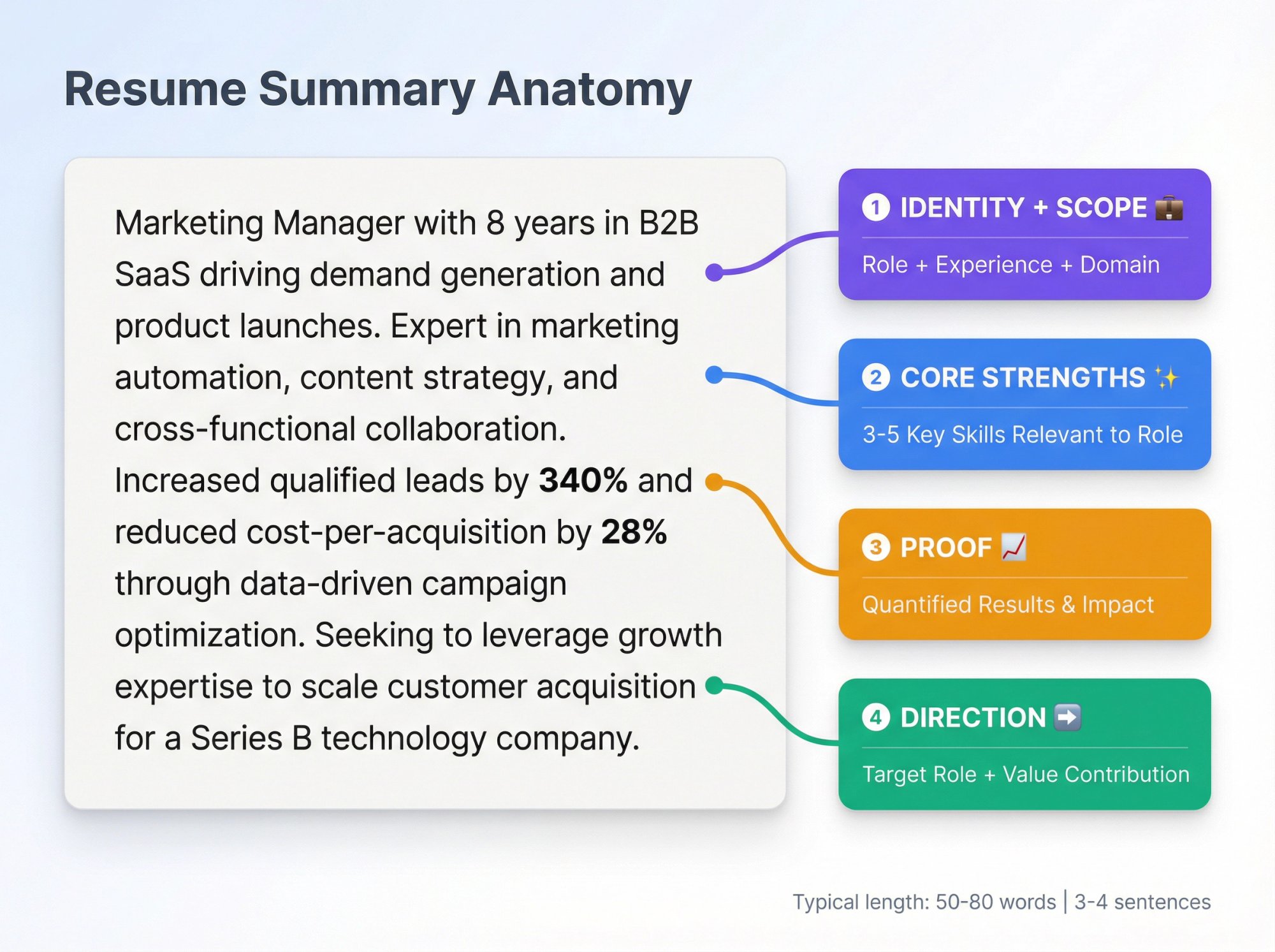
Typical length: 3-4 sentences, roughly 50-80 words
Core job: Prove you're qualified by showing what you've accomplished
Mental model: "Here's my proof."
For inspiration on crafting compelling summaries, check out AIApply's resume examples library for real-world formats across hundreds of roles.
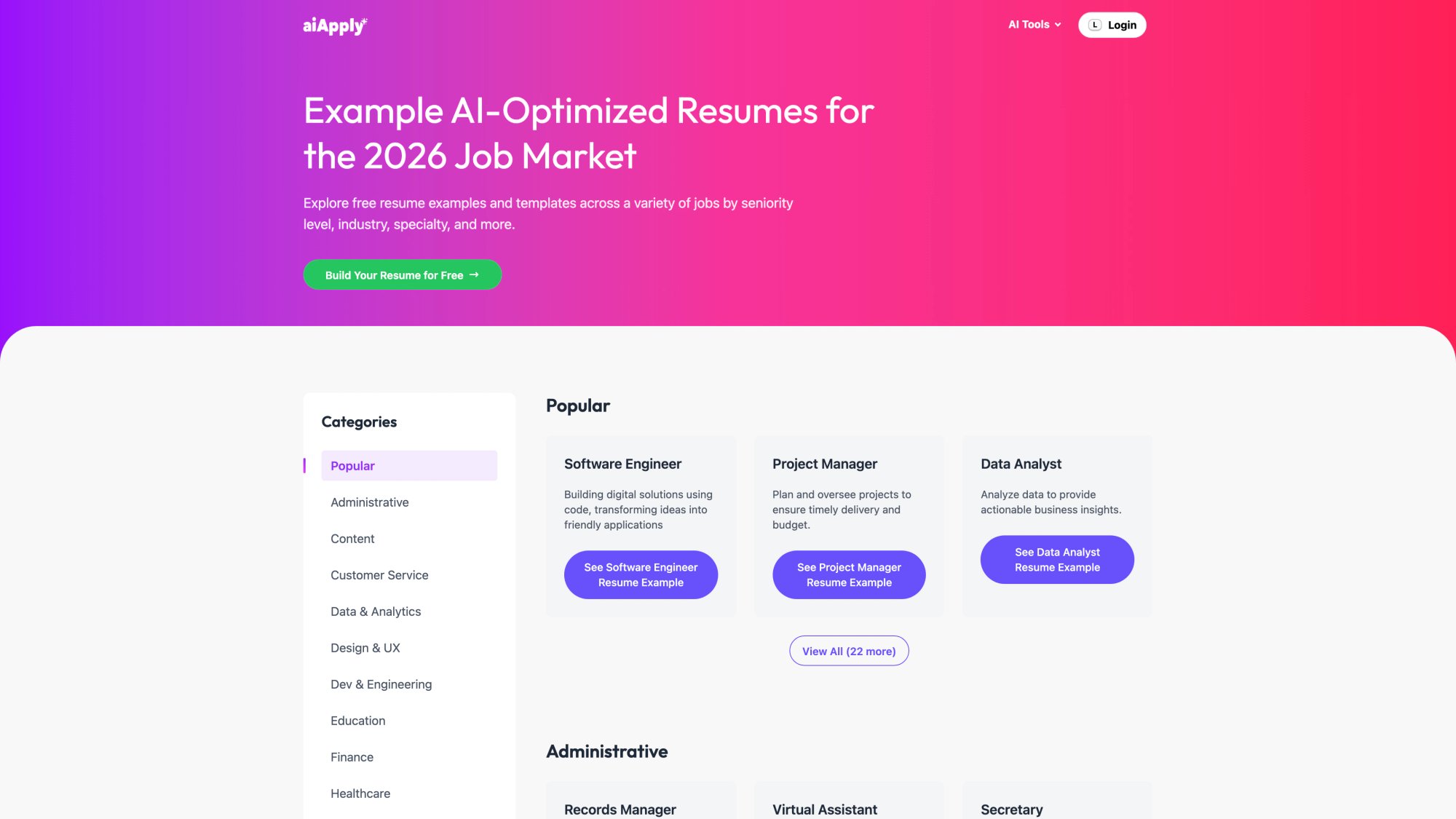
The examples library features resume formats for over 100 different careers, each showing real summary examples tailored to specific industries and experience levels. You can browse by role, download templates, or use them as inspiration for writing your own.
What Is a Resume Objective?
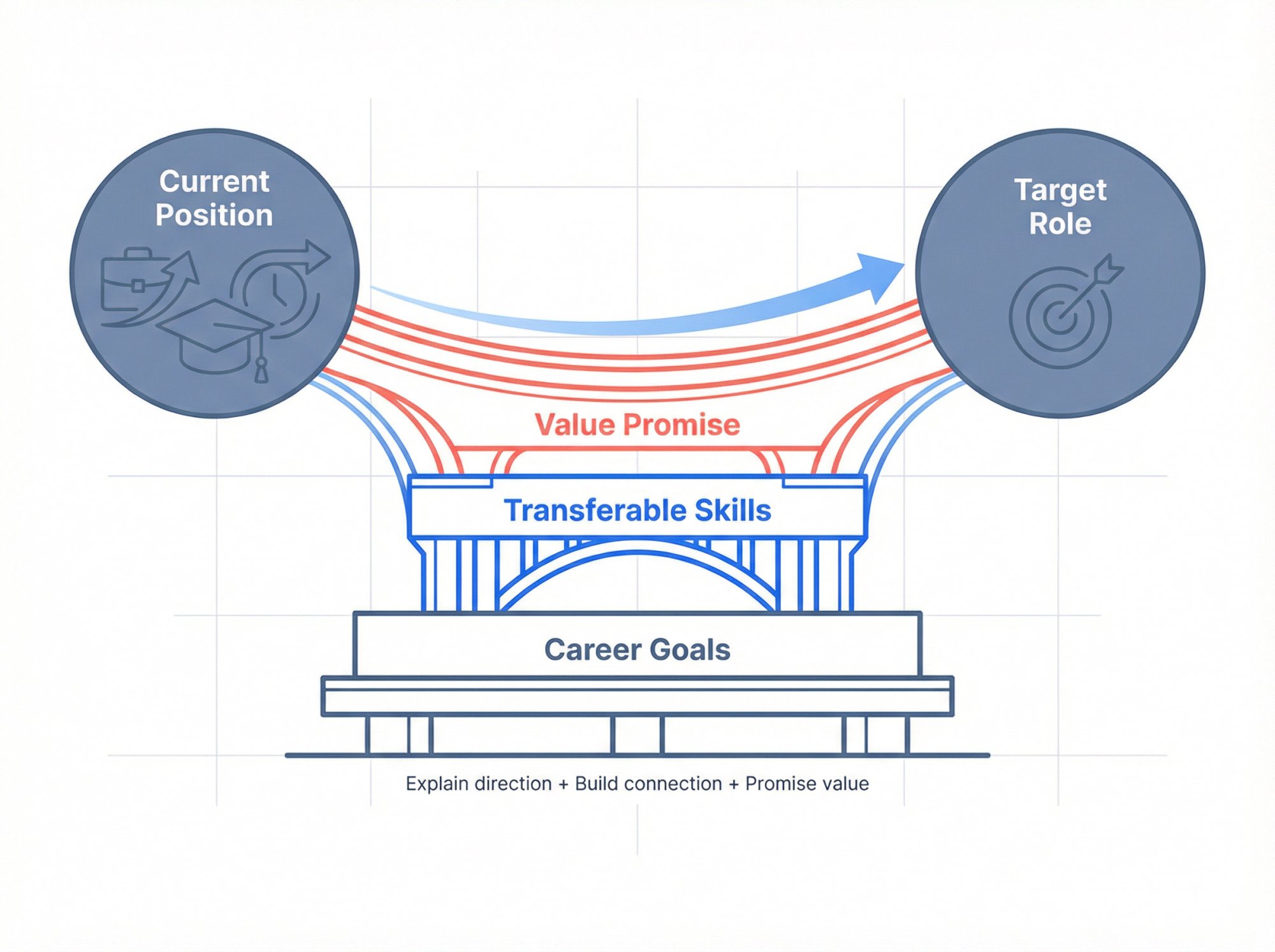
A resume objective is a brief statement (usually 1-2 sentences, 20-40 words) explaining your career goals and how they connect to the role. It's best used when you need to explain direction more than results.
Traditionally, objectives outlined what the candidate wanted from a job. But experts now point out that objectives have fallen out of favor because they focus on your needs instead of what value you deliver to the employer.
Core job: Explain why you're a fit despite a non-obvious background
Mental model: "Here's my direction and bridge."
When writing objectives for career transitions, you can reference cover letter examples for career changers to see how others have bridged experience gaps effectively.
Resume Objective vs Summary: Side-by-Side Comparison
How to Choose Between Resume Objective or Summary
Answer these questions in order:
Can You Credibly Claim "I've Done This Before"?
→ Yes? Use a summary
→ No / not exactly? Go to question 2
Will a Recruiter Wonder Why You're Applying?
→ Yes (career change, employment gap, adjacent industry, moving from operations to product management, academic to industry) → Use an objective or a hybrid profile
→ No → You can still use a summary (even if early-career), but it must focus on skills plus proof from projects
Are You Applying in the UK?
In the UK, the top section is often called a personal statement or professional profile: a short 2-5 line summary under contact details. If you have little experience, UK guidance suggests using a CV objective instead (shorter, more goal-focused).
For UK professionals in specialized roles, explore career-specific guides like software engineer, data scientist, or business analyst positions to understand regional expectations.
How to Write a Resume Summary That Gets Interviews
Most summaries fail because they're adjective soup ("results-driven team player…") with zero proof.
A summary is a compressed argument:
• Claim: who you are
• Evidence: what you did
• Relevance: why it matches this job
Resume experts explicitly recommend using the summary to surface keywords from the job ad and keeping it short and prominent.
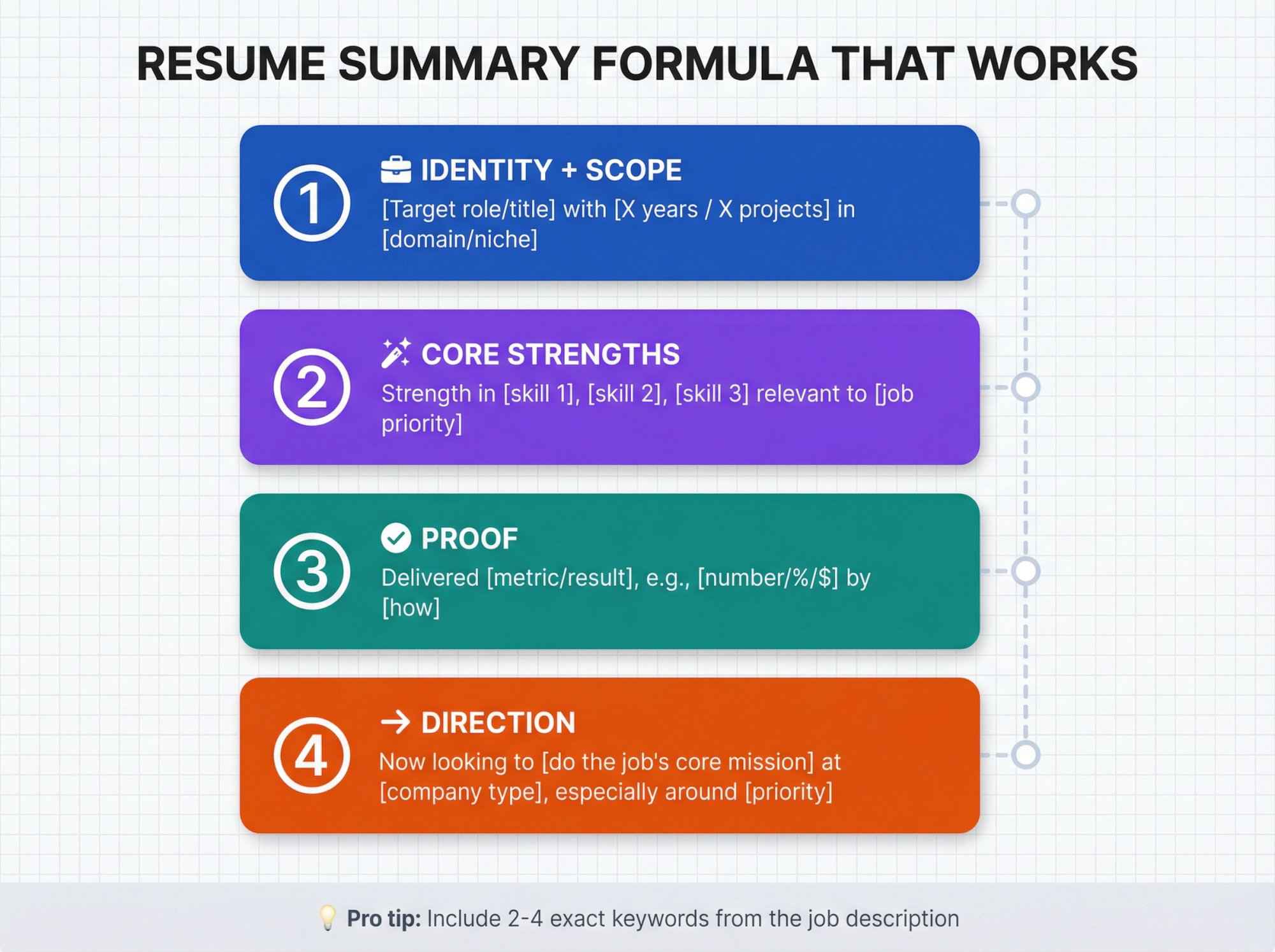
Resume Summary Formula That Works
Copy this structure and fill in your details:
① Identity + Scope[Target role/title] with [X years / X projects] in [domain/niche].
② Core StrengthsStrength in [skill 1], [skill 2], [skill 3] relevant to [job priority].
③ ProofDelivered [metric/result], e.g., [number/%/$] by [how].
④ DirectionNow looking to [do the job's core mission] at [company type], especially around [priority].
You don't always need all 4 lines. But if you can't include any proof, your summary is probably too weak to justify its space.
How to Write a Strong Resume Summary
Keep it concise: Aim for 3 sentences or bullet points, around 50-80 words.
Lead with your title and experience: Start by stating your profession and years of experience. For example: "Marketing Manager with 8 years in SaaS…"
Highlight key accomplishments using numbers: Quantify wherever possible. Numbers catch the eye and prove impact.
Mention 3-5 key skills: Include the most job-relevant skills, especially those in the job description.
Tailor it to the job: Customize your summary for each application. Use AIApply's AI Resume Builder to quickly generate and edit tailored summaries, or try the Resume Summary Generator for instant professional drafts.
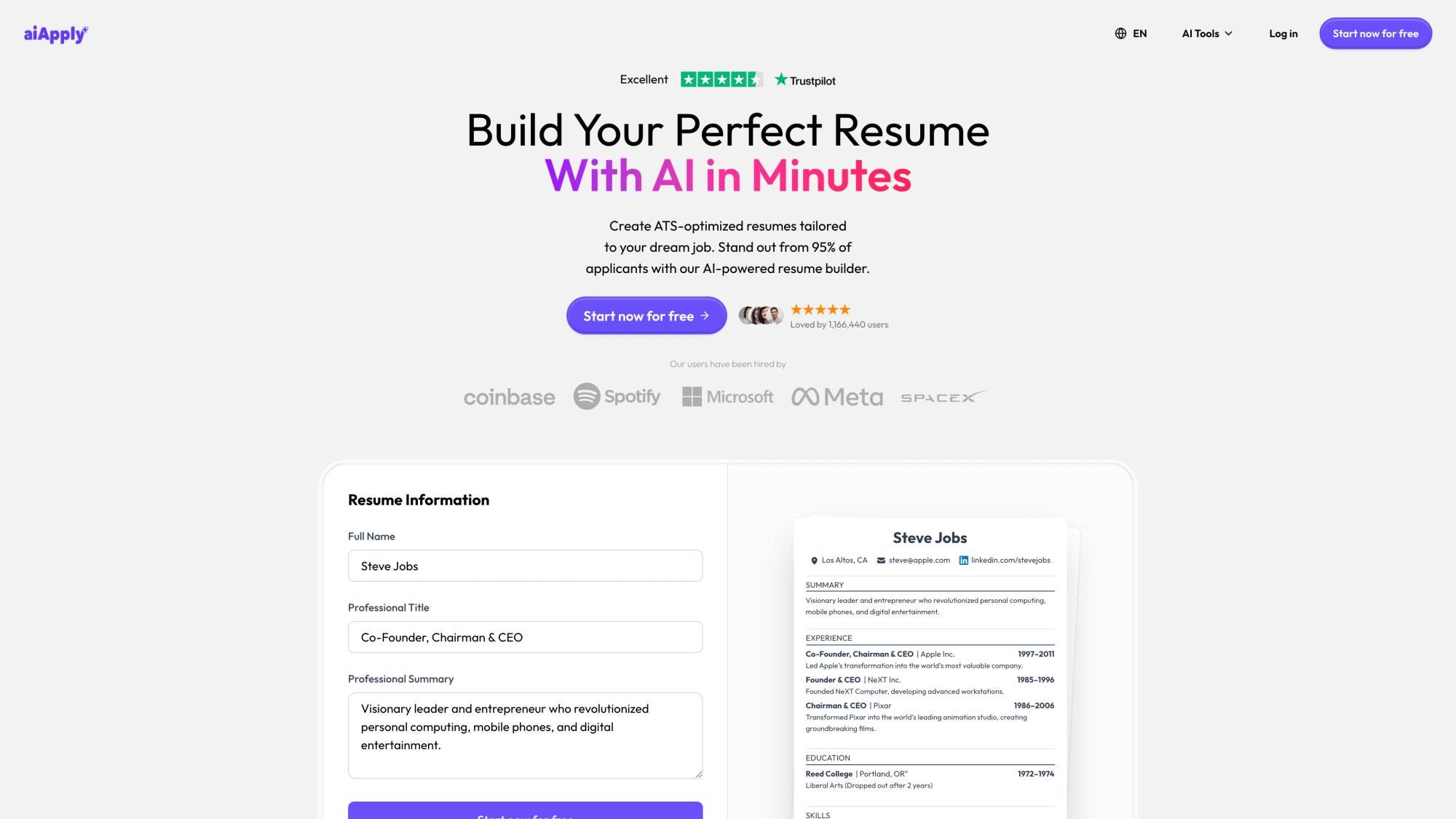
The Resume Builder lets you create and customize professional summaries in minutes, with AI-powered suggestions that match your experience to specific job descriptions. The interface makes it easy to adjust keywords, add metrics, and save multiple versions for different applications.
Focus on value to the employer: Phrase it so it's clear how your background will benefit them.
ATS Keywords: How to Get Past the Robots
In your summary, include 2-4 exact phrases from the job description that are:
• Skills or tools (like "SQL" or "stakeholder management")
• Role keywords (like "B2B SaaS" or "demand gen")
Modern ATS can search by skills, job titles, degrees, certifications, and keywords. Missing exact strings can literally stop you from being surfaced. Modern ATS rank resumes based on keyword relevance, and a well-crafted summary naturally packs in more relevant keywords than a generic objective.
6 Resume Summary Examples You Can Copy
1. Experienced, Same Role (Classic)
[Title] with [X] years in [industry]. Specialize in [skill 1/2] and [domain]. Known for [metric result]. Looking to bring [strength] to [target team/company type].
Example:
"Digital marketing specialist with 5+ years of experience who increased social media engagement by 150% and generated $2.3M in revenue through targeted campaigns. Expert in Google Ads, content strategy, and conversion optimization."
2. Technical (Tools-First)
[Title] with [X] years building [systems/products]. Strong in [tool stack] and [method]. Shipped [impact/metric]. Interested in roles focused on [job's main technical theme].
Example:
"Backend engineer with 5 years in fintech building high-throughput APIs. Strong in Java, Postgres, and AWS; shipped observability and performance improvements across billing services. Reduced p95 latency by 28% by redesigning caching and query patterns. Looking to own reliability and platform scalability in a product-led team."
3. Leadership (Scope-First)
Example:
*"Product manager with 6 years shipping B2B SaaS workflows. Specialize in discovery, stakeholder alignment, and roadmap execution across engineering and design. Led onboarding revamp that improved activation by 17% and reduced support tickets by 22%. Seeking a PM role focused on retention and monetization."*
4. Early-Career Summary (Projects-as-Proof)
Format:
[Aspiring title]with hands-on project experienceBuilt
[project]using[skills/tools]Achieved
[result]or improved[thing]by[X]Ready to contribute to
[job priority]
Example:
"Computer science graduate with project experience in Python, React, and REST APIs. Built a job-tracker app with auth and search and deployed it on Vercel; partnered with 2 teammates using Git and Agile. Comfortable learning fast and shipping iteratively. Aiming for a junior full-stack role where I can grow in production systems."
5. Operations / Support (Reliability + Volume)
Structure:
Role → Supporting specific customers/teams in industry
Scale → Handle volume and improve processes
Impact → Reduced time/errors by X
Goal → Own priority in high-velocity environment
Example:
"Customer success manager with 4 years in mid-market SaaS. Manage 60+ accounts across onboarding, adoption, and renewals; strong in QBRs, risk management, and upsell plays. Improved net revenue retention by 12 points through health scoring and executive alignment. Excited to scale CS motions in a growth-stage organization."
6. Creative (Outcome-First, Not Vibes)
[Title] with [X] years creating [deliverables]. Work spans [channels]. Drove [metric] through [approach]. Seeking to elevate [brand/product] with [strength].
Example:
"Data analyst with 3 years supporting marketing and revenue teams. Advanced SQL and Tableau; build dashboards and attribution models that turn messy data into decisions. Improved campaign ROI reporting by automating weekly pipelines, saving around 6 hours per week. Looking to partner closely with growth to improve forecasting and spend efficiency."
How to Write a Resume Objective That Works
Old-school objectives were basically: "Seeking a challenging position to grow my skills."
That's useless because it's all about you, and it doesn't explain why you're a fit.
A modern objective has 3 jobs:
① Name the target role (so you're classifiable)
② Explain the bridge (so your pivot makes sense)
③ Promise value (so you're not just asking for a chance)
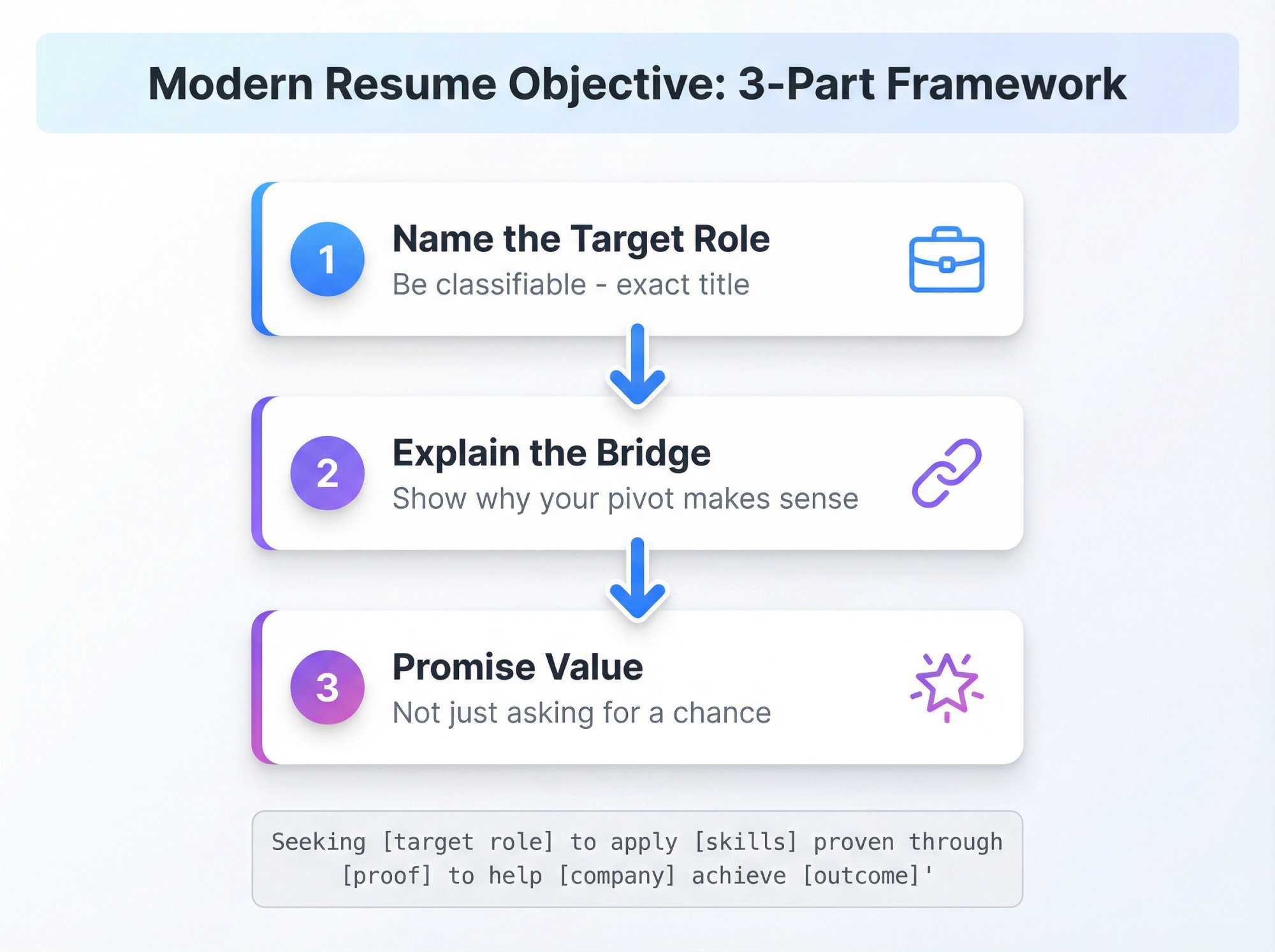
Career advisors recommend keeping objectives to one or two sentences, being specific, and matching company goals.
Resume Objective Formula You Can Copy
Seeking [target role] to apply [transferable skill 1/2/3] proven through [proof: internship/project/previous role] to help [team/company] achieve [job outcome].
How to Write a Strong Resume Objective
Keep it short: 1-2 concise sentences (around 30 words or less).
Be specific about the role and company: Name the role or company if you can. Example: "…at TechNova to build scalable web applications…"
Highlight what you bring: Mention 2-3 key skills or qualifications you have that are relevant.
Connect to employer's goals: Show how your goal aligns with their needs.
Avoid first-person and fluff: Don't use "I" or empty clichés like "hard-working team player looking for growth opportunity."
6 Resume Objective Examples by Situation
1. Recent Graduate / Internship
Seeking an entry-level [role] where I can apply [relevant skills] from [degree/projects] to contribute to [team outcome], especially in [job priority].
Example:
"Recent Computer Science graduate eager to apply full-stack development and agile project management skills at TechNova to build scalable web applications that improve user engagement."
See entry-level software engineer resume examples for inspiration.
2. Career Change (The "Bridge" Version)
Transitioning from [current field] to [target role], bringing [transferable skills] and demonstrated results in [proof]. Eager to apply this to [job mission] and grow in [domain].
Example:
"Transitioning from education to customer success, bringing strengths in stakeholder communication, coaching, and problem-solving. Proven track record improving student outcomes and managing high-volume needs; excited to help customers adopt SaaS products and improve retention through structured onboarding."
Check out career change cover letter examples to complement your objective.
3. Return to Workforce
Returning to the workforce and targeting [role], leveraging prior experience in [domain] plus updated skills in [course/tool]. Ready to contribute to [outcome] in a [company type] environment.
Example:
"Returning to digital marketing and targeting a growth role focused on lifecycle and paid social. Previously led campaigns for SMB clients and recently refreshed skills in GA4 and Meta ads. Ready to drive measurable acquisition and retention outcomes."
4. Internal Move (Department Switch)
Seeking to move from [current team] into [target team/role], applying deep context in [product/process] and strengths in [skills] to drive [outcome].
5. Relocation / Work Authorization Clarity (Use Sparingly)
Seeking a [role] in [location] where I can apply [skills] to [outcome]. Currently based in [X] and relocating to [Y] on [date] (or: eligible to work in [country]).
6. "No Experience But Real Projects"
Seeking a junior [role] to apply [skills] demonstrated in [project]. Built [thing] that achieved [result]. Ready to learn fast and contribute to [job priority].
Example:
"Seeking an entry-level financial analyst role to apply financial modeling, Excel, and research skills from coursework and case competitions. Eager to support FP&A, budgeting, and performance tracking in a high-ownership environment."
Explore entry-level resume examples for more ideas.
Can You Use Both Summary and Objective Together?
90% of the time: No. Pick one.
Your resume top should be a single clean answer to "why you?" Do not use both an objective and a summary on the same resume. It's redundant and wastes space.
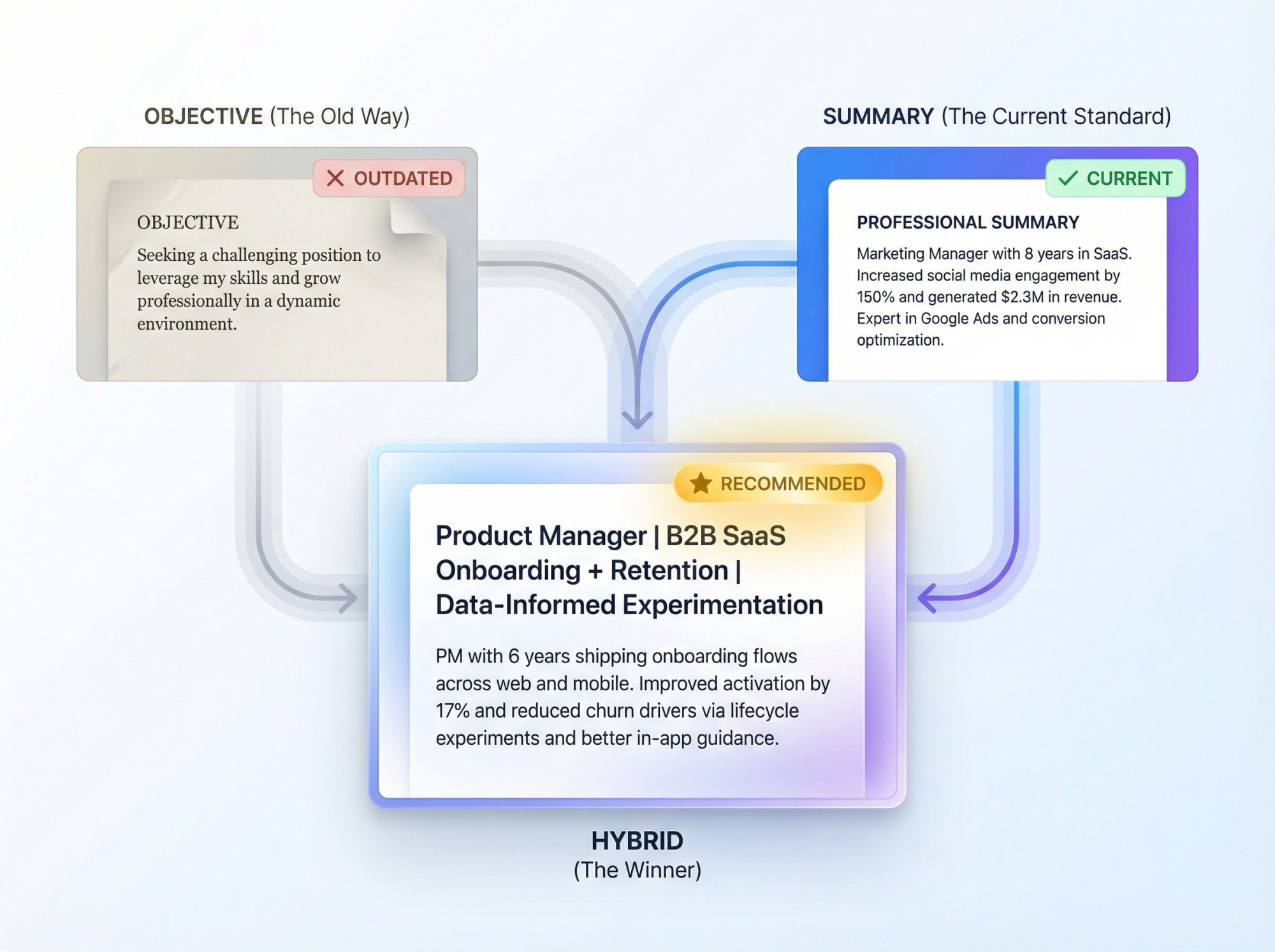
But there's a powerful hybrid that stays clean:
The "Headline + Summary" Hybrid
• Headline (1 line): Target role | Specialization | 1 differentiator
• Summary (2-3 lines): Achievements + skills + proof
Example:
Product Manager | B2B SaaS Onboarding + Retention | Data-Informed ExperimentationPM with 6 years shipping onboarding flows across web and mobile. Improved activation by 17% and reduced churn drivers via lifecycle experiments and better in-app guidance. Strong partner to engineering and design with clear roadmaps and crisp decision-making.This gives you objective-like direction without an "objective statement" vibe.
Why Summaries Outperform Objectives in 2026
The data is overwhelmingly in favor of the professional summary:

Recruiters Want Value Upfront
They prefer seeing a candidate's key qualifications at a glance rather than reading about personal goals. Your resume is a marketing document, not an autobiography.
340% Higher Callback Rate with Summaries
Resumes with summaries have 340% higher callback rates than those with objectives. Research found 70% of successful resumes had a summary, whereas only 37% included an objective.
Better ATS Keyword Optimization
Modern ATS rank resumes based on keyword relevance. A well-crafted summary naturally packs in more relevant keywords (skills, job titles, tools) from your experience than a generic objective.
Summaries Focus on Employer Value
A summary makes your resume feel focused on the employer ("this candidate understands what we need"). An objective can come off as you asking the employer for something ("give me a chance").
Objectives Look Outdated
The objective statement is often seen as a dated practice, a relic from an earlier era. A crisp summary demonstrates you're in tune with current professional norms.
Career coaches widely advise: "Use a summary, not an objective. Objectives ('Seeking a challenging role...') are outdated and focus on what you want. Summaries focus on what you offer."
How to Format Your Summary for ATS Success
Where to Put Your Resume Summary
Resume experts recommend giving your summary a "professional" label (like "Professional Summary") and placing it at the top so it's read first.
Make It ATS-Friendly
An ATS can search and filter by skills, titles, degrees, certifications, and keywords. If your top section is hard to parse or missing the exact terms, you can get filtered out before a human sees you.
Avoid These ATS Formatting Mistakes
Common ATS problems include:
• Tables or text boxes
• Headers/footers for important info
• Images or graphics
• Unusual fonts
• Multi-column layouts
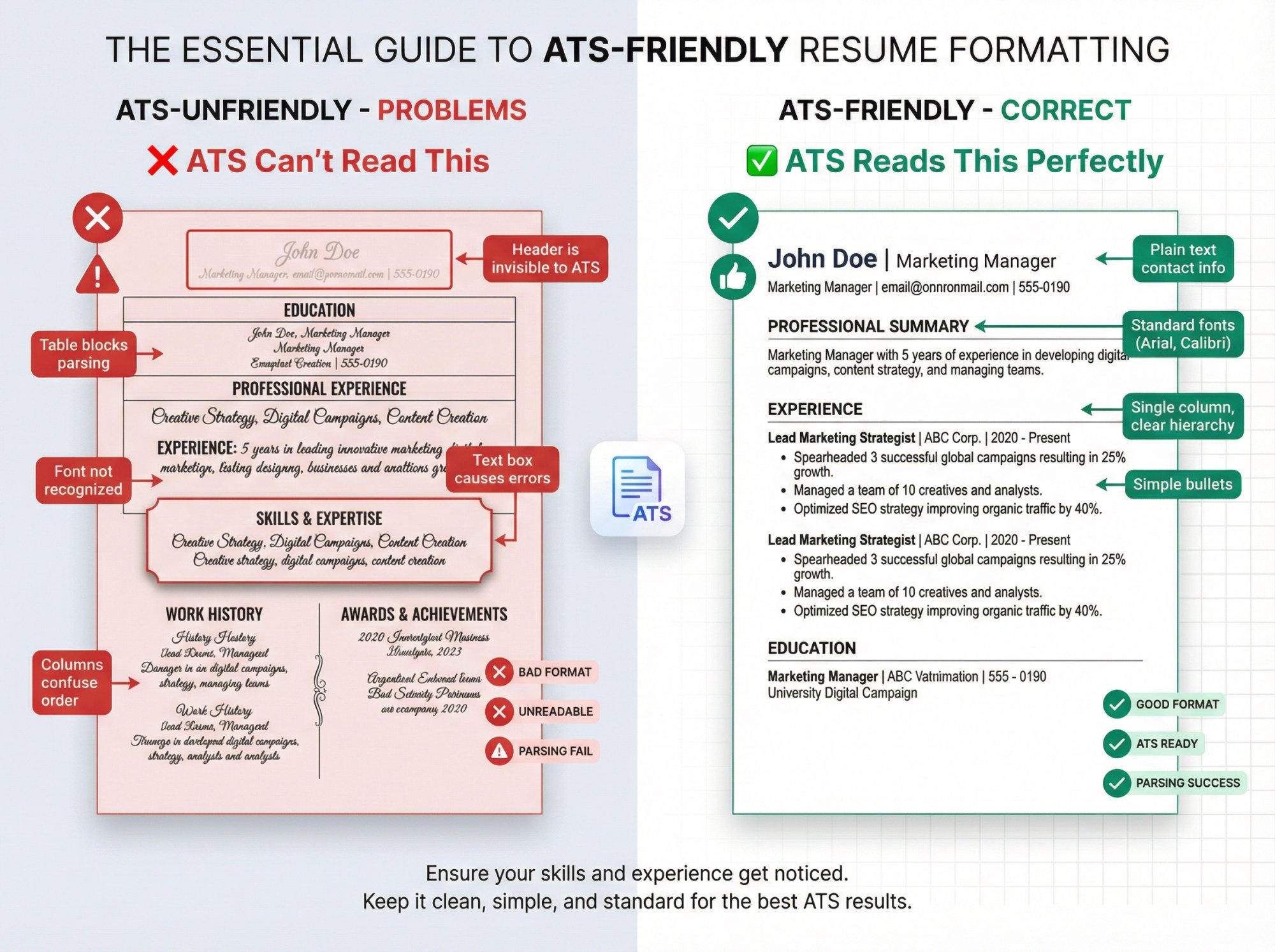
You can still have a clean modern resume. Just don't hide critical text in weird containers. Use AIApply's Resume ATS Checker to catch these issues before applying.
For role-specific ATS optimization guidance, check career pages like project manager or marketing manager to understand industry-specific formatting expectations.
How to Tailor Your Resume Summary in 5 Minutes
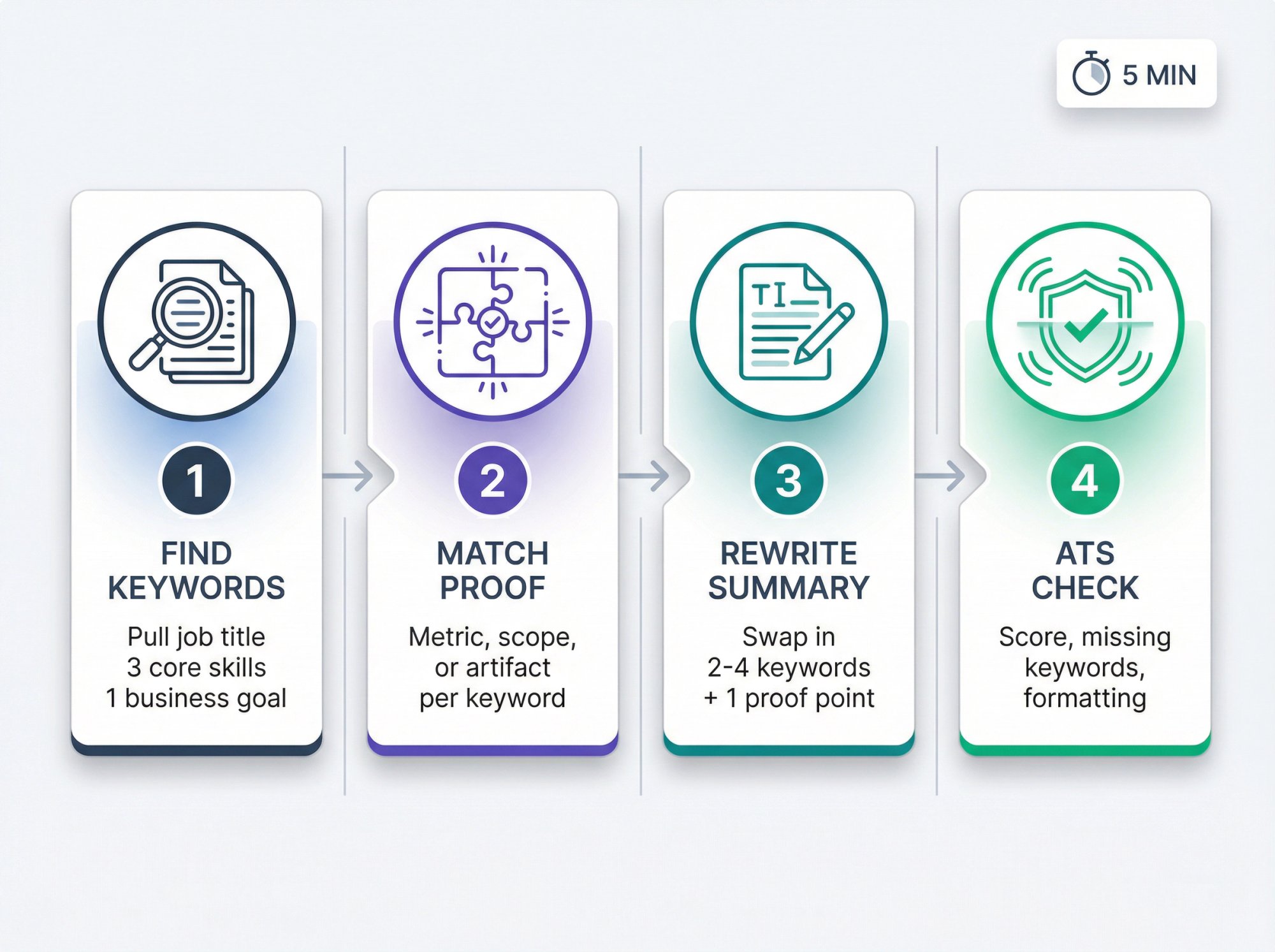
Here's the fastest way to tailor either a summary or objective without rewriting your whole resume.
Step 1: Find the Must-Have Keywords
From the job description, pull:
• The exact job title
• 3 core skills/tools (exact strings)
• 1 business goal (what they're trying to accomplish)
Step 2: Match Your Proof to Their Needs
For each must-have, write one proof snippet:
• Metric (best)
• Or scope (team size, volume, complexity)
• Or artifact (project shipped, system built, certification earned)
Step 3: Rewrite Only the Top Section
• Summary: Swap in the 2-4 keywords plus 1 proof point that matches their goal
• Objective: Swap target role plus bridge plus value contribution
Step 4: Run an ATS Reality Check
Use AIApply's free Resume ATS Checker: upload your resume and paste the job description to get an ATS score, missing keywords, and formatting issues.
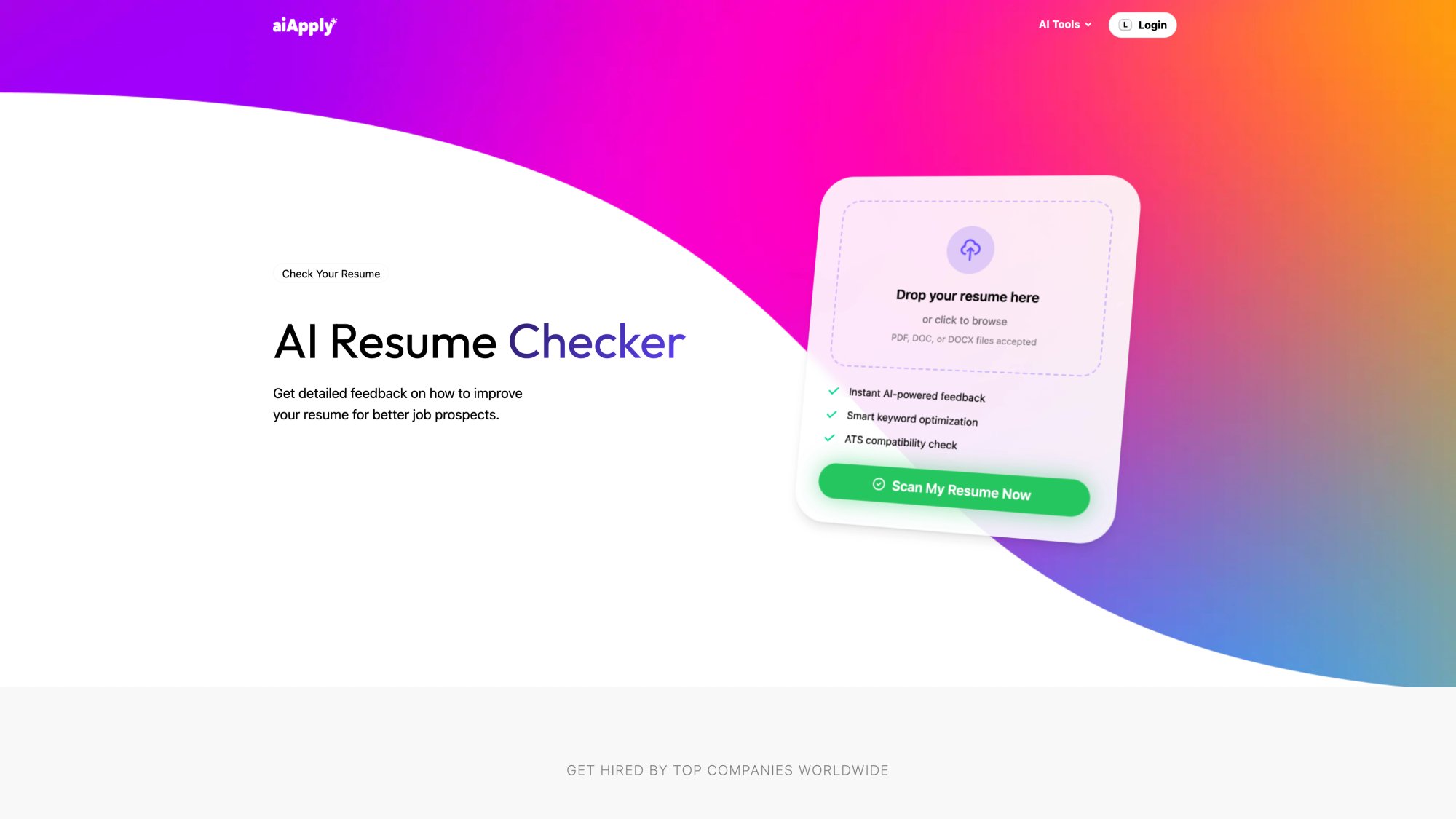
The ATS Checker provides instant analysis showing exactly which keywords you're missing, how your resume scores against the job description, and specific formatting fixes to improve your chances of passing automated screening.
If you want deeper feedback on content, keywords, and improvements, AIApply also has an AI Resume Checker that provides instant AI-powered feedback and keyword optimization.
Most Common Resume Summary Mistakes
Mistake 1: "Seeking a challenging position…"
Fix: Name the role and bring value. Objectives should be employer-relevant, not therapy.
Mistake 2: Summary with No Numbers, No Scope, No Proof
Fix: Add one hard proof signal: %, $, time saved, volume, team size, customers served, projects shipped.
Mistake 3: Generic Keywords Instead of Exact Job Keywords
Fix: Mirror exact phrases for tools and skills. ATS explicitly search by exact keyword matching.
Mistake 4: Trying to Cram Your Whole Life Story into 6 Lines
Fix: Your intro is a trailer, not the movie. Keep it tight.
Mistake 5: Using Both Objective and Summary
Fix: Choose one, or do "headline + summary" hybrid.
UK CV Personal Statement vs Resume Summary
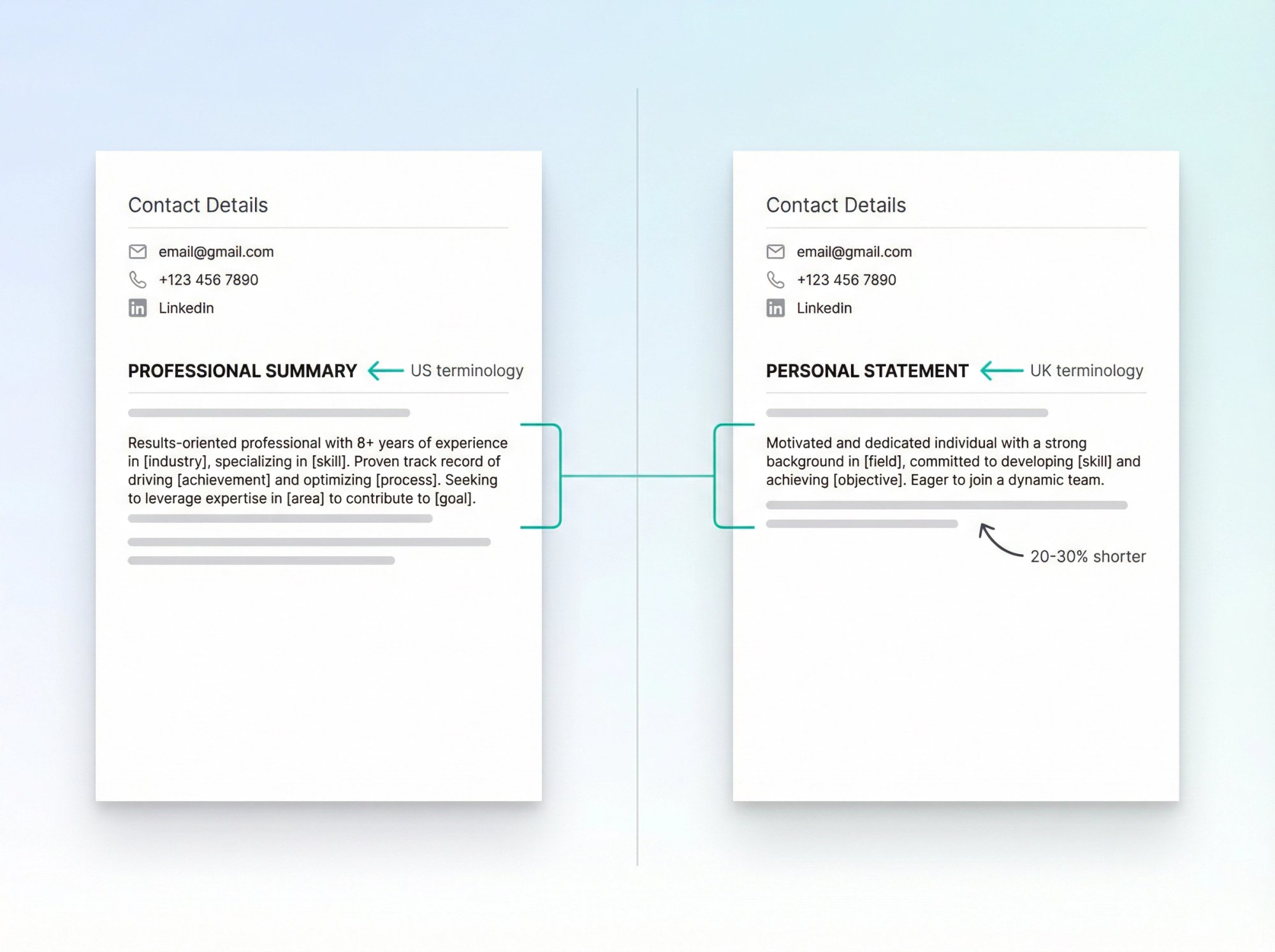
If you're writing for UK employers, you'll often use a personal statement or professional profile at the top.
• It's typically no more than 2-3 sentences under your contact details, summarizing experience, skills, achievements, and ambitions.
• Recent UK CV guides recommend a 3-5 line tailored personal statement in 2025.
If you have little or no relevant experience, a CV objective can be more appropriate.
How AIApply Speeds Up Your Job Search
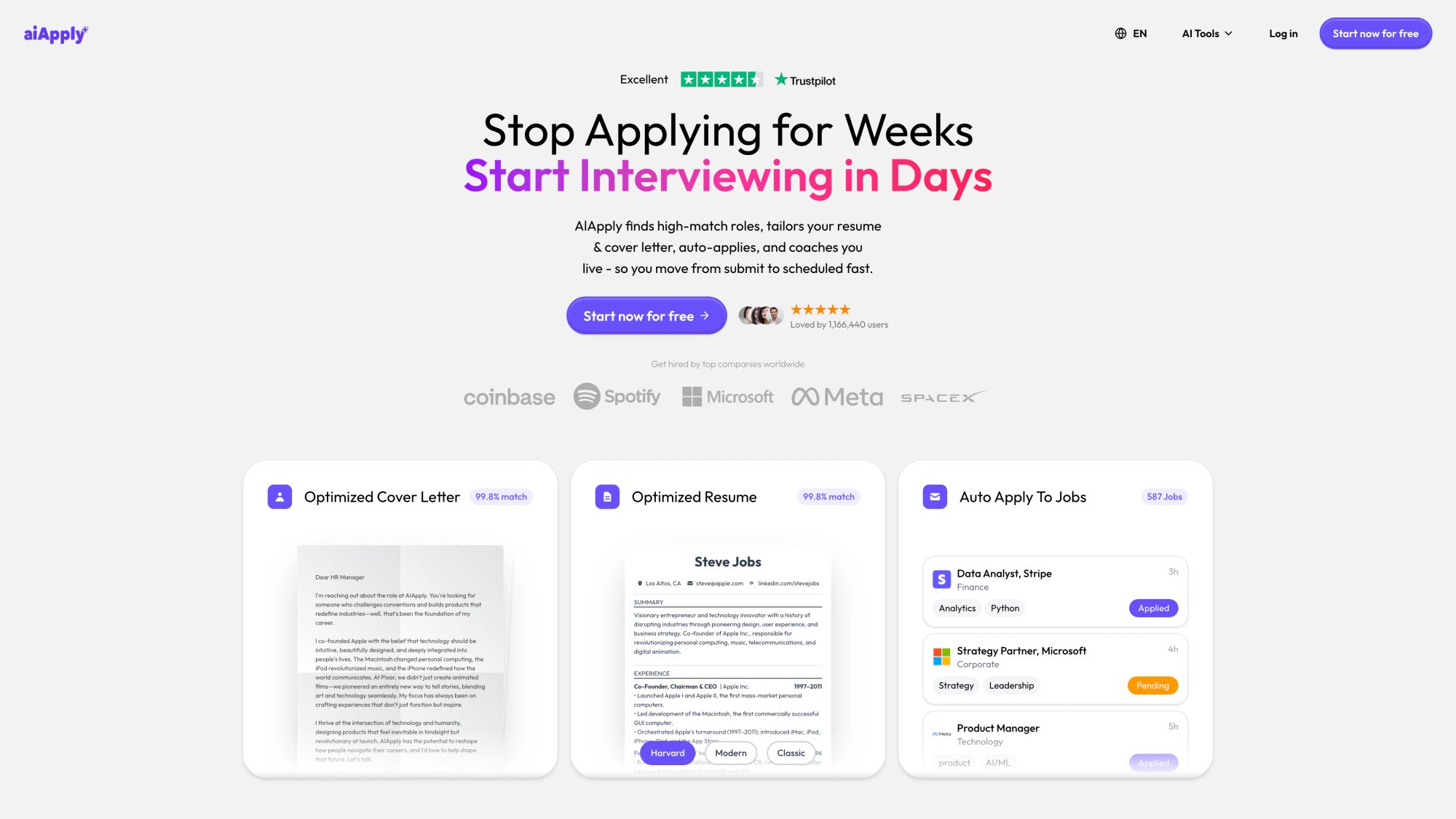
AIApply provides a complete job search toolkit that helps you create tailored resumes, apply to hundreds of positions automatically, and prepare for interviews. The platform integrates every step from resume creation to interview prep in one seamless workflow.
If you want to move quickly and keep quality high:
Build faster: Use AIApply's Resume Builder to generate and edit resumes quickly (including editing sections with prompts) and start from ATS-compliant templates.
Generate summaries: Use the Resume Summary Generator when you want a tailored professional summary draft you can then sharpen.
The Summary Generator analyzes your role, experience, and accomplishments to create multiple professional summary options. You can quickly customize the tone, length, and focus to match different job applications.
Check before you send: Run every version through the Free Resume ATS Checker to catch missing keywords and formatting problems before you apply.
The winning workflow is: Draft fast → Add proof → Tailor keywords → ATS check → Apply.
AIApply's Auto Apply feature takes this even further. It automatically finds and submits job applications on your behalf, using AI to optimize your resume and cover letter for each position. The system scans hundreds of job postings to match opportunities with your skills and career goals, then applies directly without manual intervention. 80% of AIApply users land interviews within the first month, and users are 80% more likely to secure a job with Auto Apply compared to manual applications.
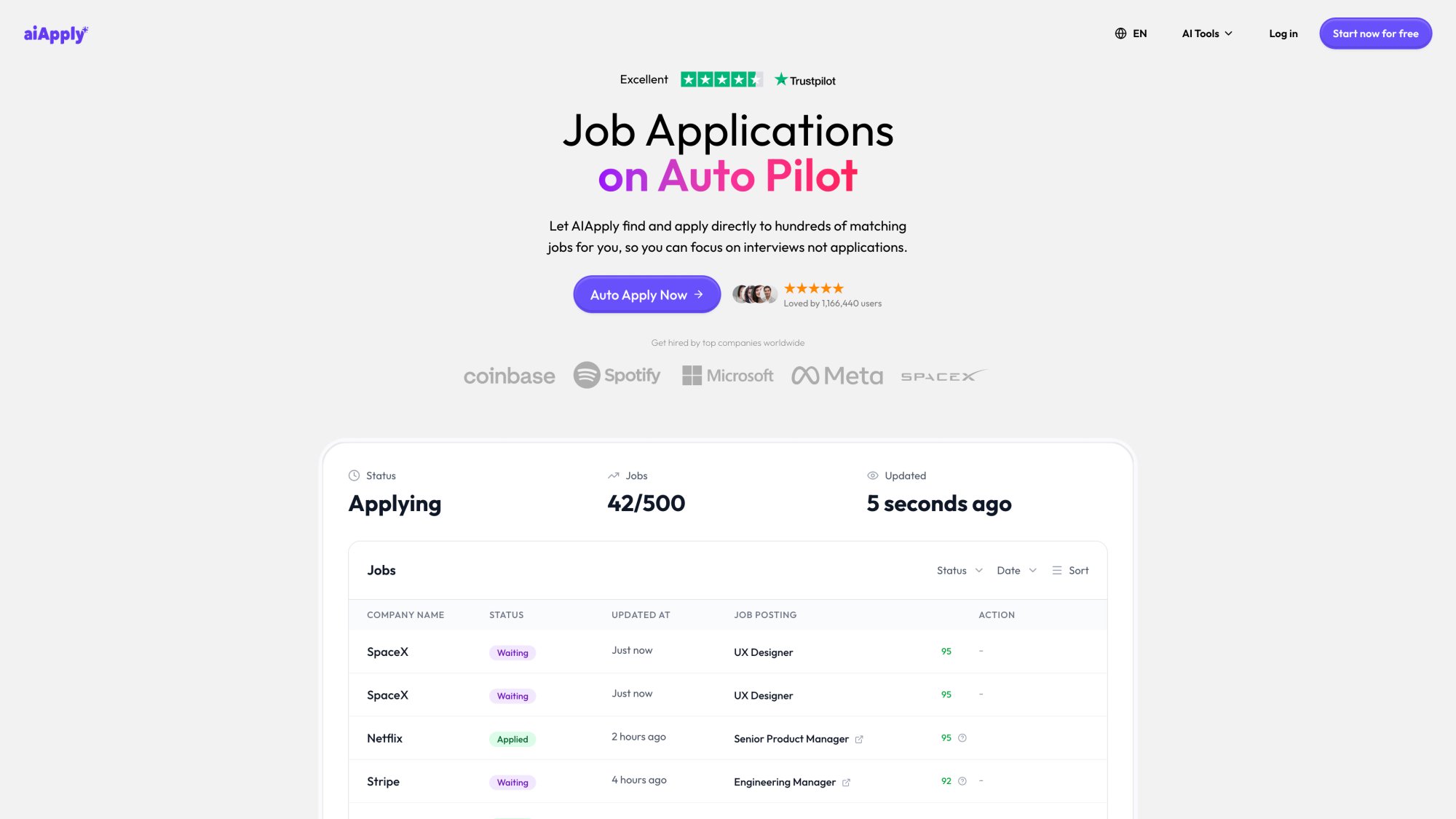
The Auto Apply dashboard shows all your automated applications in one place, tracking which jobs you've applied to, response rates, and interview invitations. You can set preferences for job types, locations, and salary ranges, then let the system handle the heavy lifting while you focus on preparing for interviews.
Resume Opening Checklist
Before you send your resume, your top section should answer:
• What role are you targeting (exact title)?
• What are your 2-4 most relevant skills (exact strings)?
• What proof do you have (metric/scope/artifact)?
• Why you, for this job, right now?
If you can answer those in 3-5 lines, you're ahead of most applicants.
Frequently Asked Questions
Is a resume objective outdated?
It's not "banned." It's just situational now, best when you need to explain direction or overcome a mismatch (entry-level, career change, gap).
Should I ever skip both?
Yes, if your experience is extremely obvious and your first bullets already scream fit. But most people benefit from a tight summary because resumes get scanned fast and filtered by skills and keywords.
What if I'm early-career but I still want a summary?
That's fine. Just treat projects and internships as proof, keep it keyword-rich, and avoid empty adjectives. Summaries work even with limited experience as long as you focus on your strongest qualifications.
Which has better ATS performance?
Summaries generally perform better in ATS because they contain more relevant keywords and specific skills from your experience. But if an objective is rich in keywords and very targeted, it can perform decently. Few objectives meet that bar, though.
What about length?
Keep summaries to 3-4 sentences (around 50-80 words) and objectives to 1-2 sentences (around 20-40 words). Brevity is key. Neither should be a full paragraph of fluff.
How do I know if my summary is good enough?
Read it out loud. If it could describe anyone in your field, it's too generic. A good summary should be so specific to your experience that nobody else could copy it word-for-word. It should include at least one concrete number or proof point.
Can I use the same summary for every application?
No. You should tailor your summary for each job by swapping in 2-4 exact keywords from the job description and adjusting your proof points to match their priorities. This takes about 2 minutes per application and dramatically increases your chances. AIApply's Resume Builder makes this fast and painless.
What if I don't have metrics to include?
Use scope instead: team size, project complexity, tools used, volume handled, or systems you built. If you truly have zero proof points, you might be better off with an objective that explains your direction and transferable skills.
Do hiring managers actually read the summary?
Yes, but only for 6-8 seconds. That's why it needs to be tight, keyword-rich, and focused on value. Generic summaries get skipped. Specific ones with proof get you to the next round.
Should I mention soft skills in my summary?
Only if you can prove them with a result. "Strong communicator" means nothing. "Led cross-functional alignment across 3 teams to ship feature 2 weeks early" proves communication and impact. Show, don't tell.
For specific role guidance, explore AIApply's extensive library of resume examples and cover letter examples tailored to hundreds of careers.
Your resume gets about 6-8 seconds of attention from a hiring manager. That's it.
In those few seconds, the opening lines at the top of your resume will either convince them to keep reading or send your application to the rejection pile. If you're wondering whether to use a resume objective or a summary, you're really asking one question: What do I put at the top of my resume so recruiters immediately understand what I do and why I'm worth interviewing?
This guide answers that question clearly, then shows you exactly how to write an opening that actually gets you interviews.
Resume Objective vs Summary: Quick Answer
Use a resume summary when you have relevant experience and results to show. You're proving you're already the safe bet. This applies to most job seekers.
Use a resume objective when your resume needs context. You're entry-level, switching careers, returning after a gap, or you don't have obvious same-field experience yet.
The deeper principle:
Summary = "Here's what I've done and the value I create." It looks at your past and present accomplishments.
Objective = "Here's what I'm aiming for, why it makes sense, and what I'll contribute." It's future-facing and builds a bridge to explain your direction.
Research shows the key difference is time perspective. Summaries look back at accomplishments while objectives look forward at goals.
Why Resume Opening Statements Matter More in 2026
Two major forces make your resume's opening section more critical than ever:
ATS Software Does the First Screening
Filtering is increasingly software-assisted. Studies show an Applicant Tracking System on 97.8% of Fortune 500 career sites (489 out of 500 companies). And over 75% of resumes get filtered out by ATS software before a human ever reads them.
Skills-First Hiring Is the New Standard
Industry research reveals some telling data:
→ 37% of recruiting organizations are actively integrating or experimenting with gen AI tools
→ Companies with the most skills-based searches are 12% more likely to make a quality hire
→ 93% of talent acquisition professionals say accurately assessing skills is crucial for quality of hire
Translation: your opening isn't just a nice introduction. It's a keyword, credibility, and direction block that helps both humans and systems quickly classify you as a fit (or not).
The performance data backs this up. Resumes with a professional summary receive 340% more interview callbacks than those with a traditional objective. Research found that 70% of successful resumes had a summary, while only 37% included an objective.
What Is a Resume Summary?
A resume summary (also called a professional summary, career profile, or summary of qualifications) is a short professional introduction that highlights your biggest achievements and most valuable skills. It's essentially your career elevator pitch in 3-5 sentences.
Typical length: 3-4 sentences, roughly 50-80 words
Core job: Prove you're qualified by showing what you've accomplished
Mental model: "Here's my proof."
For inspiration on crafting compelling summaries, check out AIApply's resume examples library for real-world formats across hundreds of roles.
The examples library features resume formats for over 100 different careers, each showing real summary examples tailored to specific industries and experience levels. You can browse by role, download templates, or use them as inspiration for writing your own.
What Is a Resume Objective?
A resume objective is a brief statement (usually 1-2 sentences, 20-40 words) explaining your career goals and how they connect to the role. It's best used when you need to explain direction more than results.
Traditionally, objectives outlined what the candidate wanted from a job. But experts now point out that objectives have fallen out of favor because they focus on your needs instead of what value you deliver to the employer.
Core job: Explain why you're a fit despite a non-obvious background
Mental model: "Here's my direction and bridge."
When writing objectives for career transitions, you can reference cover letter examples for career changers to see how others have bridged experience gaps effectively.
Resume Objective vs Summary: Side-by-Side Comparison
How to Choose Between Resume Objective or Summary
Answer these questions in order:
Can You Credibly Claim "I've Done This Before"?
→ Yes? Use a summary
→ No / not exactly? Go to question 2
Will a Recruiter Wonder Why You're Applying?
→ Yes (career change, employment gap, adjacent industry, moving from operations to product management, academic to industry) → Use an objective or a hybrid profile
→ No → You can still use a summary (even if early-career), but it must focus on skills plus proof from projects
Are You Applying in the UK?
In the UK, the top section is often called a personal statement or professional profile: a short 2-5 line summary under contact details. If you have little experience, UK guidance suggests using a CV objective instead (shorter, more goal-focused).
For UK professionals in specialized roles, explore career-specific guides like software engineer, data scientist, or business analyst positions to understand regional expectations.
How to Write a Resume Summary That Gets Interviews
Most summaries fail because they're adjective soup ("results-driven team player…") with zero proof.
A summary is a compressed argument:
• Claim: who you are
• Evidence: what you did
• Relevance: why it matches this job
Resume experts explicitly recommend using the summary to surface keywords from the job ad and keeping it short and prominent.
Resume Summary Formula That Works
Copy this structure and fill in your details:
① Identity + Scope[Target role/title] with [X years / X projects] in [domain/niche].
② Core StrengthsStrength in [skill 1], [skill 2], [skill 3] relevant to [job priority].
③ ProofDelivered [metric/result], e.g., [number/%/$] by [how].
④ DirectionNow looking to [do the job's core mission] at [company type], especially around [priority].
You don't always need all 4 lines. But if you can't include any proof, your summary is probably too weak to justify its space.
How to Write a Strong Resume Summary
Keep it concise: Aim for 3 sentences or bullet points, around 50-80 words.
Lead with your title and experience: Start by stating your profession and years of experience. For example: "Marketing Manager with 8 years in SaaS…"
Highlight key accomplishments using numbers: Quantify wherever possible. Numbers catch the eye and prove impact.
Mention 3-5 key skills: Include the most job-relevant skills, especially those in the job description.
Tailor it to the job: Customize your summary for each application. Use AIApply's AI Resume Builder to quickly generate and edit tailored summaries, or try the Resume Summary Generator for instant professional drafts.
The Resume Builder lets you create and customize professional summaries in minutes, with AI-powered suggestions that match your experience to specific job descriptions. The interface makes it easy to adjust keywords, add metrics, and save multiple versions for different applications.
Focus on value to the employer: Phrase it so it's clear how your background will benefit them.
ATS Keywords: How to Get Past the Robots
In your summary, include 2-4 exact phrases from the job description that are:
• Skills or tools (like "SQL" or "stakeholder management")
• Role keywords (like "B2B SaaS" or "demand gen")
Modern ATS can search by skills, job titles, degrees, certifications, and keywords. Missing exact strings can literally stop you from being surfaced. Modern ATS rank resumes based on keyword relevance, and a well-crafted summary naturally packs in more relevant keywords than a generic objective.
6 Resume Summary Examples You Can Copy
1. Experienced, Same Role (Classic)
[Title] with [X] years in [industry]. Specialize in [skill 1/2] and [domain]. Known for [metric result]. Looking to bring [strength] to [target team/company type].
Example:
"Digital marketing specialist with 5+ years of experience who increased social media engagement by 150% and generated $2.3M in revenue through targeted campaigns. Expert in Google Ads, content strategy, and conversion optimization."
2. Technical (Tools-First)
[Title] with [X] years building [systems/products]. Strong in [tool stack] and [method]. Shipped [impact/metric]. Interested in roles focused on [job's main technical theme].
Example:
"Backend engineer with 5 years in fintech building high-throughput APIs. Strong in Java, Postgres, and AWS; shipped observability and performance improvements across billing services. Reduced p95 latency by 28% by redesigning caching and query patterns. Looking to own reliability and platform scalability in a product-led team."
3. Leadership (Scope-First)
Example:
*"Product manager with 6 years shipping B2B SaaS workflows. Specialize in discovery, stakeholder alignment, and roadmap execution across engineering and design. Led onboarding revamp that improved activation by 17% and reduced support tickets by 22%. Seeking a PM role focused on retention and monetization."*
4. Early-Career Summary (Projects-as-Proof)
Format:
[Aspiring title]with hands-on project experienceBuilt
[project]using[skills/tools]Achieved
[result]or improved[thing]by[X]Ready to contribute to
[job priority]
Example:
"Computer science graduate with project experience in Python, React, and REST APIs. Built a job-tracker app with auth and search and deployed it on Vercel; partnered with 2 teammates using Git and Agile. Comfortable learning fast and shipping iteratively. Aiming for a junior full-stack role where I can grow in production systems."
5. Operations / Support (Reliability + Volume)
Structure:
Role → Supporting specific customers/teams in industry
Scale → Handle volume and improve processes
Impact → Reduced time/errors by X
Goal → Own priority in high-velocity environment
Example:
"Customer success manager with 4 years in mid-market SaaS. Manage 60+ accounts across onboarding, adoption, and renewals; strong in QBRs, risk management, and upsell plays. Improved net revenue retention by 12 points through health scoring and executive alignment. Excited to scale CS motions in a growth-stage organization."
6. Creative (Outcome-First, Not Vibes)
[Title] with [X] years creating [deliverables]. Work spans [channels]. Drove [metric] through [approach]. Seeking to elevate [brand/product] with [strength].
Example:
"Data analyst with 3 years supporting marketing and revenue teams. Advanced SQL and Tableau; build dashboards and attribution models that turn messy data into decisions. Improved campaign ROI reporting by automating weekly pipelines, saving around 6 hours per week. Looking to partner closely with growth to improve forecasting and spend efficiency."
How to Write a Resume Objective That Works
Old-school objectives were basically: "Seeking a challenging position to grow my skills."
That's useless because it's all about you, and it doesn't explain why you're a fit.
A modern objective has 3 jobs:
① Name the target role (so you're classifiable)
② Explain the bridge (so your pivot makes sense)
③ Promise value (so you're not just asking for a chance)
Career advisors recommend keeping objectives to one or two sentences, being specific, and matching company goals.
Resume Objective Formula You Can Copy
Seeking [target role] to apply [transferable skill 1/2/3] proven through [proof: internship/project/previous role] to help [team/company] achieve [job outcome].
How to Write a Strong Resume Objective
Keep it short: 1-2 concise sentences (around 30 words or less).
Be specific about the role and company: Name the role or company if you can. Example: "…at TechNova to build scalable web applications…"
Highlight what you bring: Mention 2-3 key skills or qualifications you have that are relevant.
Connect to employer's goals: Show how your goal aligns with their needs.
Avoid first-person and fluff: Don't use "I" or empty clichés like "hard-working team player looking for growth opportunity."
6 Resume Objective Examples by Situation
1. Recent Graduate / Internship
Seeking an entry-level [role] where I can apply [relevant skills] from [degree/projects] to contribute to [team outcome], especially in [job priority].
Example:
"Recent Computer Science graduate eager to apply full-stack development and agile project management skills at TechNova to build scalable web applications that improve user engagement."
See entry-level software engineer resume examples for inspiration.
2. Career Change (The "Bridge" Version)
Transitioning from [current field] to [target role], bringing [transferable skills] and demonstrated results in [proof]. Eager to apply this to [job mission] and grow in [domain].
Example:
"Transitioning from education to customer success, bringing strengths in stakeholder communication, coaching, and problem-solving. Proven track record improving student outcomes and managing high-volume needs; excited to help customers adopt SaaS products and improve retention through structured onboarding."
Check out career change cover letter examples to complement your objective.
3. Return to Workforce
Returning to the workforce and targeting [role], leveraging prior experience in [domain] plus updated skills in [course/tool]. Ready to contribute to [outcome] in a [company type] environment.
Example:
"Returning to digital marketing and targeting a growth role focused on lifecycle and paid social. Previously led campaigns for SMB clients and recently refreshed skills in GA4 and Meta ads. Ready to drive measurable acquisition and retention outcomes."
4. Internal Move (Department Switch)
Seeking to move from [current team] into [target team/role], applying deep context in [product/process] and strengths in [skills] to drive [outcome].
5. Relocation / Work Authorization Clarity (Use Sparingly)
Seeking a [role] in [location] where I can apply [skills] to [outcome]. Currently based in [X] and relocating to [Y] on [date] (or: eligible to work in [country]).
6. "No Experience But Real Projects"
Seeking a junior [role] to apply [skills] demonstrated in [project]. Built [thing] that achieved [result]. Ready to learn fast and contribute to [job priority].
Example:
"Seeking an entry-level financial analyst role to apply financial modeling, Excel, and research skills from coursework and case competitions. Eager to support FP&A, budgeting, and performance tracking in a high-ownership environment."
Explore entry-level resume examples for more ideas.
Can You Use Both Summary and Objective Together?
90% of the time: No. Pick one.
Your resume top should be a single clean answer to "why you?" Do not use both an objective and a summary on the same resume. It's redundant and wastes space.
But there's a powerful hybrid that stays clean:
The "Headline + Summary" Hybrid
• Headline (1 line): Target role | Specialization | 1 differentiator
• Summary (2-3 lines): Achievements + skills + proof
Example:
Product Manager | B2B SaaS Onboarding + Retention | Data-Informed ExperimentationPM with 6 years shipping onboarding flows across web and mobile. Improved activation by 17% and reduced churn drivers via lifecycle experiments and better in-app guidance. Strong partner to engineering and design with clear roadmaps and crisp decision-making.This gives you objective-like direction without an "objective statement" vibe.
Why Summaries Outperform Objectives in 2026
The data is overwhelmingly in favor of the professional summary:
Recruiters Want Value Upfront
They prefer seeing a candidate's key qualifications at a glance rather than reading about personal goals. Your resume is a marketing document, not an autobiography.
340% Higher Callback Rate with Summaries
Resumes with summaries have 340% higher callback rates than those with objectives. Research found 70% of successful resumes had a summary, whereas only 37% included an objective.
Better ATS Keyword Optimization
Modern ATS rank resumes based on keyword relevance. A well-crafted summary naturally packs in more relevant keywords (skills, job titles, tools) from your experience than a generic objective.
Summaries Focus on Employer Value
A summary makes your resume feel focused on the employer ("this candidate understands what we need"). An objective can come off as you asking the employer for something ("give me a chance").
Objectives Look Outdated
The objective statement is often seen as a dated practice, a relic from an earlier era. A crisp summary demonstrates you're in tune with current professional norms.
Career coaches widely advise: "Use a summary, not an objective. Objectives ('Seeking a challenging role...') are outdated and focus on what you want. Summaries focus on what you offer."
How to Format Your Summary for ATS Success
Where to Put Your Resume Summary
Resume experts recommend giving your summary a "professional" label (like "Professional Summary") and placing it at the top so it's read first.
Make It ATS-Friendly
An ATS can search and filter by skills, titles, degrees, certifications, and keywords. If your top section is hard to parse or missing the exact terms, you can get filtered out before a human sees you.
Avoid These ATS Formatting Mistakes
Common ATS problems include:
• Tables or text boxes
• Headers/footers for important info
• Images or graphics
• Unusual fonts
• Multi-column layouts
You can still have a clean modern resume. Just don't hide critical text in weird containers. Use AIApply's Resume ATS Checker to catch these issues before applying.
For role-specific ATS optimization guidance, check career pages like project manager or marketing manager to understand industry-specific formatting expectations.
How to Tailor Your Resume Summary in 5 Minutes
Here's the fastest way to tailor either a summary or objective without rewriting your whole resume.
Step 1: Find the Must-Have Keywords
From the job description, pull:
• The exact job title
• 3 core skills/tools (exact strings)
• 1 business goal (what they're trying to accomplish)
Step 2: Match Your Proof to Their Needs
For each must-have, write one proof snippet:
• Metric (best)
• Or scope (team size, volume, complexity)
• Or artifact (project shipped, system built, certification earned)
Step 3: Rewrite Only the Top Section
• Summary: Swap in the 2-4 keywords plus 1 proof point that matches their goal
• Objective: Swap target role plus bridge plus value contribution
Step 4: Run an ATS Reality Check
Use AIApply's free Resume ATS Checker: upload your resume and paste the job description to get an ATS score, missing keywords, and formatting issues.
The ATS Checker provides instant analysis showing exactly which keywords you're missing, how your resume scores against the job description, and specific formatting fixes to improve your chances of passing automated screening.
If you want deeper feedback on content, keywords, and improvements, AIApply also has an AI Resume Checker that provides instant AI-powered feedback and keyword optimization.
Most Common Resume Summary Mistakes
Mistake 1: "Seeking a challenging position…"
Fix: Name the role and bring value. Objectives should be employer-relevant, not therapy.
Mistake 2: Summary with No Numbers, No Scope, No Proof
Fix: Add one hard proof signal: %, $, time saved, volume, team size, customers served, projects shipped.
Mistake 3: Generic Keywords Instead of Exact Job Keywords
Fix: Mirror exact phrases for tools and skills. ATS explicitly search by exact keyword matching.
Mistake 4: Trying to Cram Your Whole Life Story into 6 Lines
Fix: Your intro is a trailer, not the movie. Keep it tight.
Mistake 5: Using Both Objective and Summary
Fix: Choose one, or do "headline + summary" hybrid.
UK CV Personal Statement vs Resume Summary
If you're writing for UK employers, you'll often use a personal statement or professional profile at the top.
• It's typically no more than 2-3 sentences under your contact details, summarizing experience, skills, achievements, and ambitions.
• Recent UK CV guides recommend a 3-5 line tailored personal statement in 2025.
If you have little or no relevant experience, a CV objective can be more appropriate.
How AIApply Speeds Up Your Job Search
AIApply provides a complete job search toolkit that helps you create tailored resumes, apply to hundreds of positions automatically, and prepare for interviews. The platform integrates every step from resume creation to interview prep in one seamless workflow.
If you want to move quickly and keep quality high:
Build faster: Use AIApply's Resume Builder to generate and edit resumes quickly (including editing sections with prompts) and start from ATS-compliant templates.
Generate summaries: Use the Resume Summary Generator when you want a tailored professional summary draft you can then sharpen.
The Summary Generator analyzes your role, experience, and accomplishments to create multiple professional summary options. You can quickly customize the tone, length, and focus to match different job applications.
Check before you send: Run every version through the Free Resume ATS Checker to catch missing keywords and formatting problems before you apply.
The winning workflow is: Draft fast → Add proof → Tailor keywords → ATS check → Apply.
AIApply's Auto Apply feature takes this even further. It automatically finds and submits job applications on your behalf, using AI to optimize your resume and cover letter for each position. The system scans hundreds of job postings to match opportunities with your skills and career goals, then applies directly without manual intervention. 80% of AIApply users land interviews within the first month, and users are 80% more likely to secure a job with Auto Apply compared to manual applications.
The Auto Apply dashboard shows all your automated applications in one place, tracking which jobs you've applied to, response rates, and interview invitations. You can set preferences for job types, locations, and salary ranges, then let the system handle the heavy lifting while you focus on preparing for interviews.
Resume Opening Checklist
Before you send your resume, your top section should answer:
• What role are you targeting (exact title)?
• What are your 2-4 most relevant skills (exact strings)?
• What proof do you have (metric/scope/artifact)?
• Why you, for this job, right now?
If you can answer those in 3-5 lines, you're ahead of most applicants.
Frequently Asked Questions
Is a resume objective outdated?
It's not "banned." It's just situational now, best when you need to explain direction or overcome a mismatch (entry-level, career change, gap).
Should I ever skip both?
Yes, if your experience is extremely obvious and your first bullets already scream fit. But most people benefit from a tight summary because resumes get scanned fast and filtered by skills and keywords.
What if I'm early-career but I still want a summary?
That's fine. Just treat projects and internships as proof, keep it keyword-rich, and avoid empty adjectives. Summaries work even with limited experience as long as you focus on your strongest qualifications.
Which has better ATS performance?
Summaries generally perform better in ATS because they contain more relevant keywords and specific skills from your experience. But if an objective is rich in keywords and very targeted, it can perform decently. Few objectives meet that bar, though.
What about length?
Keep summaries to 3-4 sentences (around 50-80 words) and objectives to 1-2 sentences (around 20-40 words). Brevity is key. Neither should be a full paragraph of fluff.
How do I know if my summary is good enough?
Read it out loud. If it could describe anyone in your field, it's too generic. A good summary should be so specific to your experience that nobody else could copy it word-for-word. It should include at least one concrete number or proof point.
Can I use the same summary for every application?
No. You should tailor your summary for each job by swapping in 2-4 exact keywords from the job description and adjusting your proof points to match their priorities. This takes about 2 minutes per application and dramatically increases your chances. AIApply's Resume Builder makes this fast and painless.
What if I don't have metrics to include?
Use scope instead: team size, project complexity, tools used, volume handled, or systems you built. If you truly have zero proof points, you might be better off with an objective that explains your direction and transferable skills.
Do hiring managers actually read the summary?
Yes, but only for 6-8 seconds. That's why it needs to be tight, keyword-rich, and focused on value. Generic summaries get skipped. Specific ones with proof get you to the next round.
Should I mention soft skills in my summary?
Only if you can prove them with a result. "Strong communicator" means nothing. "Led cross-functional alignment across 3 teams to ship feature 2 weeks early" proves communication and impact. Show, don't tell.
For specific role guidance, explore AIApply's extensive library of resume examples and cover letter examples tailored to hundreds of careers.
.webp)
%20(1).webp)
Don't miss out on
your next opportunity.
Create and send applications in seconds, not hours.


