
Can Employers Tell If You Use AI for a Cover Letter? (2026)

.webp)
If you've used AI to write your cover letter, you're probably wondering: can they actually tell?
The short answer? Sometimes they can suspect it, but they usually can't prove it.
The more important question is whether your cover letter still signals something real about you. If AI turns your application into a polished but generic blob, you lose. If it helps you express genuine qualifications more clearly, you win.
Here's what's actually happening in 2026 hiring rooms, what the data shows, and how to use AI without raising red flags.
Why Getting "Caught" Isn't the Real Problem
Most employers can't definitively prove you used AI for your cover letter. They can often sense when something feels off: too polished, too generic, strangely disconnected from your actual experience.
The bigger problem? When everyone submits equally polished letters, the cover letter stops being useful as a signal.
Hiring is fundamentally a signal game. Employers use cover letters to infer your communication skill, effort level, motivation, and cultural fit. When AI makes "good sounding" writing cheap to produce, that signal degrades.
So they adapt. They ask follow-up questions. They run live interview assessments. They check if you can actually discuss the specifics from your letter.

What "Getting Detected" Actually Means for Job Seekers
When people ask "can employers tell?", they usually mean one of these:
→ Certainty: Can they know beyond doubt?
→ Probability: Will it look AI-generated enough to raise suspicion?
→ Consequence: If they suspect it, will I get rejected?
In reality, hiring teams rarely operate on courtroom-level proof. They operate on time pressure and pattern recognition:
"This feels generic."
"This could be about anyone."
"The résumé voice and cover letter voice don't match."
Those aren't AI detectors. They're signal detectors.
How Do Employers Detect AI-Written Cover Letters?
1. You Disclosed AI Use (Through Policy or Direct Question)
Some employers explicitly ask applicants to confirm they didn't use AI. Anthropic became a high-profile example in 2025 by requiring candidates to write without AI assistance, wanting to assess "unassisted communication skills."
Sometimes detection isn't technical at all. It's just policy and disclosure.
2. Recruiters Spot AI Writing Patterns (Most Common Method)
Even without software, recruiters spot AI-style writing because it tends to converge on similar patterns.
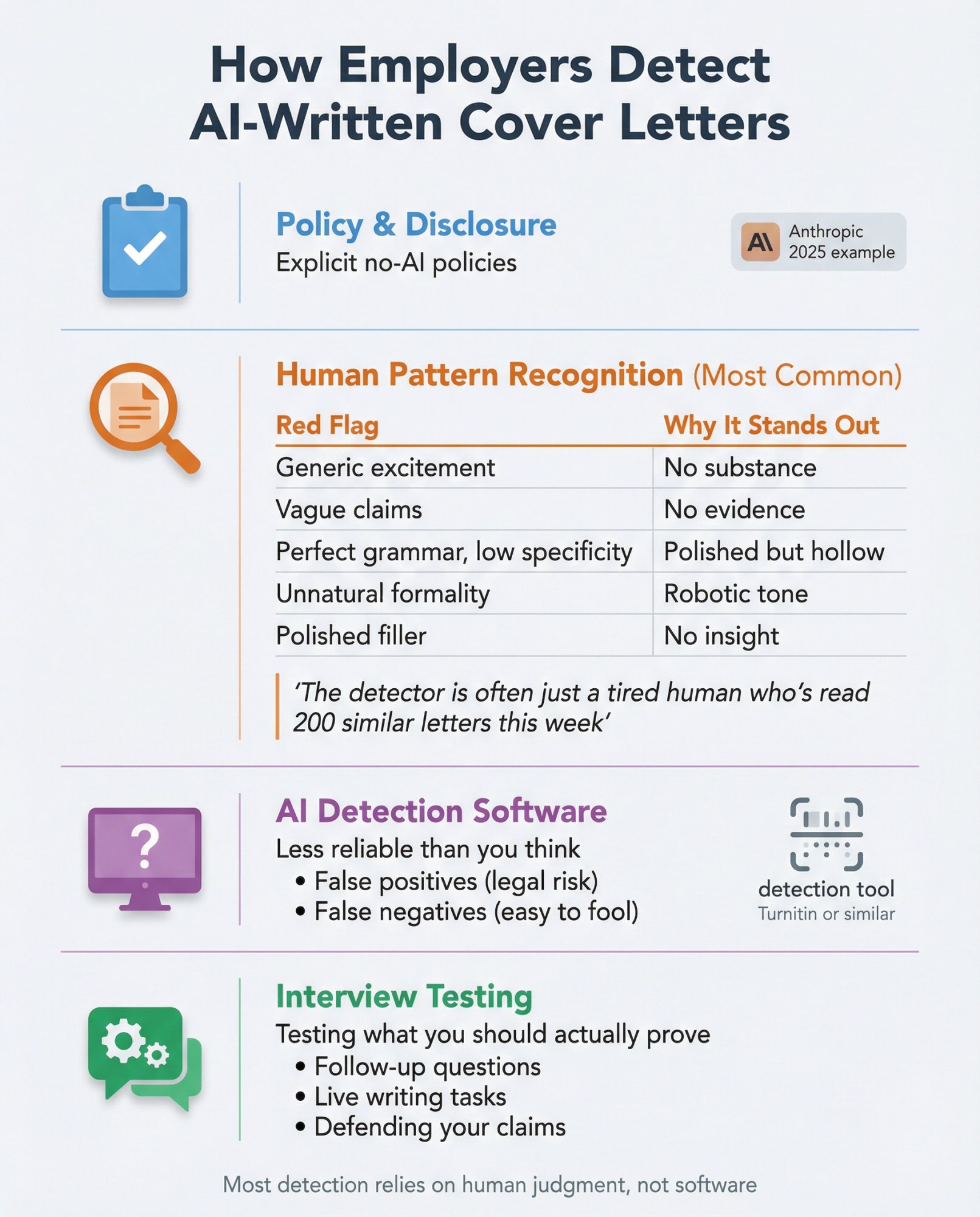
What screams "AI-written":
Career experts (updated January 7, 2026) explicitly warn: recruiters reject letters that sound generic, robotic, or obviously generated.
Employer research echoes the same theme: employers react negatively to messaging that feels "sugar-coated" or template-driven.
The "detector" is often just a tired human who's read 200 similar letters this week.
3. AI Detection Software (Less Reliable Than You Think)
Some employers might paste cover letters into detection tools. But that creates problems:
False positives mean accusing real humans of cheating, which is a legal and reputational risk.
False negatives happen constantly. A decent human edit can fool most detectors.
Turnitin (one of the most widely used tools in education) publicly acknowledges false positives and now doesn't surface scores below 20% to reduce incorrect flags. They also warn that AI scores shouldn't be used as the sole basis for decisions.
NIST research on generative AI shows detection performance varies wildly by system and setup, with many generators successfully deceiving discriminators.
Bottom line: AI detection is a cat-and-mouse problem. Employers who understand that use detectors cautiously or not at all.
4. Testing What Your Cover Letter Should Actually Prove
Here's the first-principles logic:
Cover letters exist to show communication skill, effort, motivation, and fit
AI makes polished writing cheap
So the value of writing as a signal drops
Employers adapt by:
Asking follow-up questions about your letter during job interviews
Running live writing assessments
Using work samples and timed exercises
Checking if you can expand on claims from your letter
Industry research explicitly recommends additional evaluation when AI use makes genuineness harder to assess.
Even if they can't detect AI, they can detect weak signals and respond with stronger filters.
What Hiring Managers Actually Do About AI Cover Letters (2025-2026 Data)
What Hiring Managers Say They Do
A May 2025 survey of 600 U.S. hiring managers found:
Key insight: There's pushback against "fully AI-generated" applications, but many managers accept AI as support. And a lot of hiring teams aren't deeply AI-enabled themselves.
What Job Seekers and Employers Are Actually Doing
A July 2025 survey of 1,421 job seekers and 529 employers found:
29.3% of job seekers used AI to write or customize applications (up from 17.3% in 2024)
25.9% of employers use AI in recruitment
Top employer concerns: fake candidates (24.4%) and inauthentic applications (24.2%)
"I Can Tell" Doesn't Mean "I Can Prove"
Insight Global's 2025 survey found:
88% say they can tell when someone used AI
54% say it's off-putting
Reality check: that's self-reported confidence. Humans are famously overconfident at pattern detection, especially for socially salient issues.
Treat this as: many people believe they can tell. That belief alone influences hiring behavior.
The Soft Consensus
Across employer-facing content, a theme emerges:
Light AI use for drafting and polishing is often tolerated
Heavy AI use that removes your voice or introduces inaccuracies is risky
Using AI during assessments or live interviews is widely seen as unacceptable
Industry research explicitly labels AI use for assessments as a "big no-no" that can lead to disqualification.
Why Do Employers Care If You Use AI for Cover Letters?
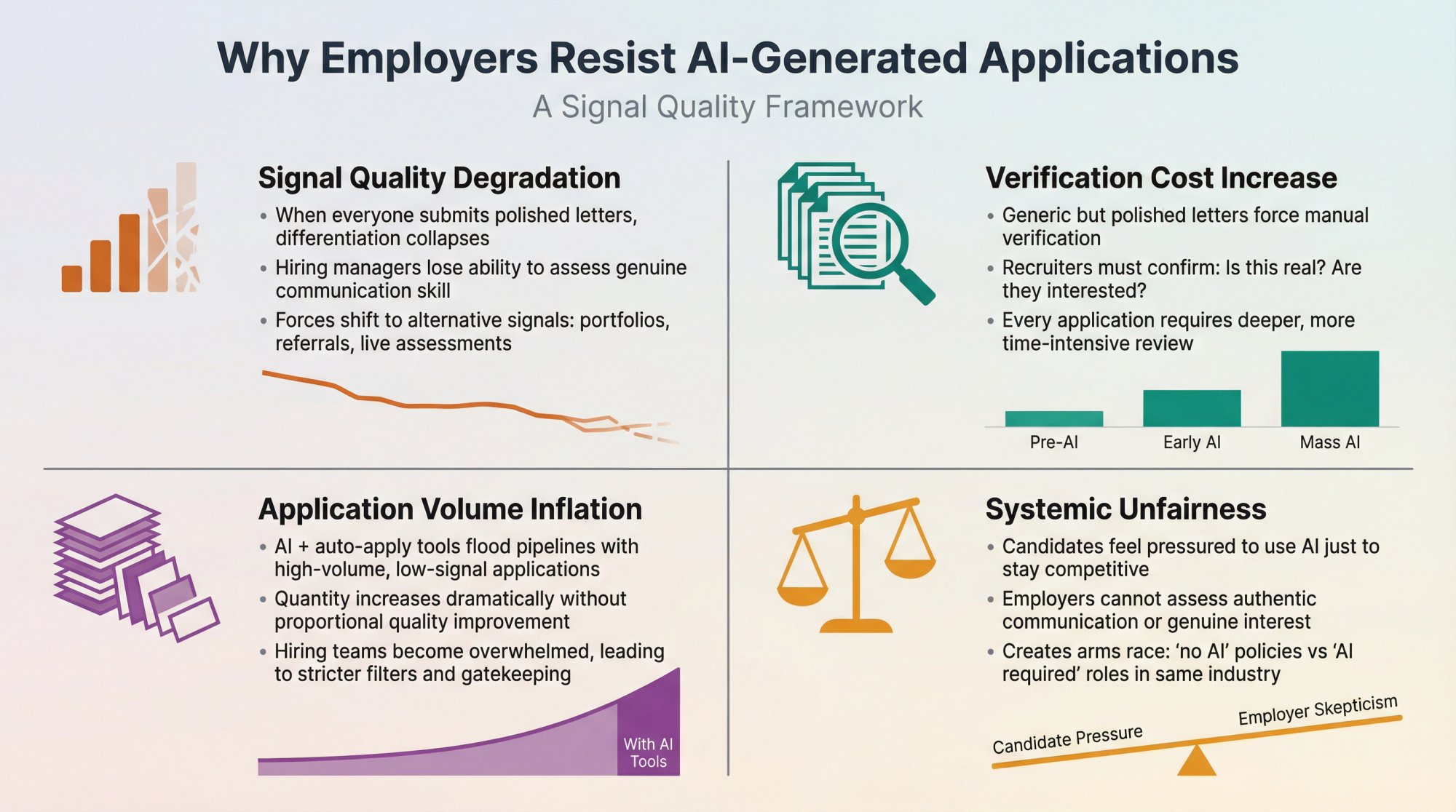
Most hiring managers don't hate AI because it's AI. They push back because AI can break the hiring process in predictable ways:
It Destroys Signal Quality
When everyone submits equally polished letters, letters stop distinguishing candidates. Employers shift to other signals: work samples, referrals, portfolios, structured interviews.
It Increases Verification Cost
A generic but polished letter forces recruiters to spend extra time figuring out:
Is this real experience?
Is the candidate genuinely interested?
Do they actually communicate like this?
It Increases Application Volume, Not Quality
Auto-apply tools plus AI can flood pipelines with applications that look good but say nothing.
Industry research notes that volume becomes overwhelming when it appears AI-generated, suggesting better matching and gating is needed.
It Creates Unfairness on Both Sides
Candidates feel pressured to use AI to keep up. Employers feel they can't assess authentic communication.
That's why you see "no AI" policies in some listings and "AI skills required" in others, sometimes in the same industry.
How to Use AI for Cover Letters Without Getting Rejected (Step-by-Step)
Stop thinking "How do I hide AI?" Start thinking "How do I use AI to express my real signal more clearly?"
If your letter is true, specific, consistent with your résumé, aligned to the job, and written in a voice you can defend in conversation, then "AI detection" becomes mostly irrelevant.
Step 0: Pick Your Line (Before You Start)
AI can play different roles depending on your risk tolerance:
Research shows hiring manager tolerance drops sharply between roles 3 and 4.
Step 1: Build Your "Evidence Bank" First
Before generating anything, write bullet points (not sentences) for:
→ 2-3 achievements with numbers (time saved, revenue, conversions, cost reductions)
→ 1 failure you learned from (optional but powerful)
→ 2 specific reasons you want this company
→ 3 job requirements and your matching proof
This is your anti-generic weapon. AI can't invent this.
See cover letter examples for role-specific inspiration on how to present your evidence bank effectively.
Step 2: Use AI to Map Requirements to Evidence
Ask AI to create a "requirement → proof" table.
Example prompt:
You are my cover letter strategist.Job description: [paste]My evidence bank: [paste bullets]Task:1) Extract the 6 most important requirements from the job description.2) For each, map it to the strongest proof from my evidence bank.3) Identify any gaps honestly (do not invent experience).Return as a simple table.This makes specificity built-in by design.
Step 3: Generate a Draft, But Constrain It Hard
If you let AI freestyle, you get generic output. Instead:
Example prompt:
Write a 300-word cover letter using only the evidence bank provided.Constraints:- No clichés (avoid "I am excited", "fast learner", "team player", "synergy").- Every claim must include evidence or a concrete example.- Match my writing style: short sentences, plain language, confident but not arrogant.- Include 1 sentence showing I understand the company specifically.Step 4: Rewrite So It Sounds Like You
This is where most people fail.
Rule: If you wouldn't say a sentence out loud in an interview, rewrite it.
Do a "read aloud test." If it feels like a press release, it's not you.
Step 5: Run the "Five Red Flag" Audit
Based on employer-facing advice, recruiters react badly to:
① Vague adjectives with no proof
Bad: "I'm a strong leader."
Fix: "I led a 5-person team to ship the project two weeks early by setting up daily standups and automated testing."
② Job description mirroring
Bad: Repeating their bullet points in new words
Fix: Show outcomes you produced under similar constraints
③ Overly formal tone
Bad: "I am writing to express my keen interest in..."
Fix: "I'm applying because I've spent three years optimizing conversion funnels, which maps directly to your growth role."
④ Company-specific details that are generic
Bad: "I admire your commitment to innovation."
Fix: Mention a specific product launch, strategy shift, or public artifact you actually read.
⑤ Voice mismatch with your résumé
If your résumé is concise and technical but your cover letter is flowery and sentimental, that's suspicious.
Step 6: Verify Facts Like Your Offer Depends on It
AI hallucinations kill cover letters silently:
Wrong company name
Wrong product
Wrong role title
"I have 7 years" when you have 3
Even employers who tolerate AI will reject careless errors.
What to Do About "No AI" Job Postings
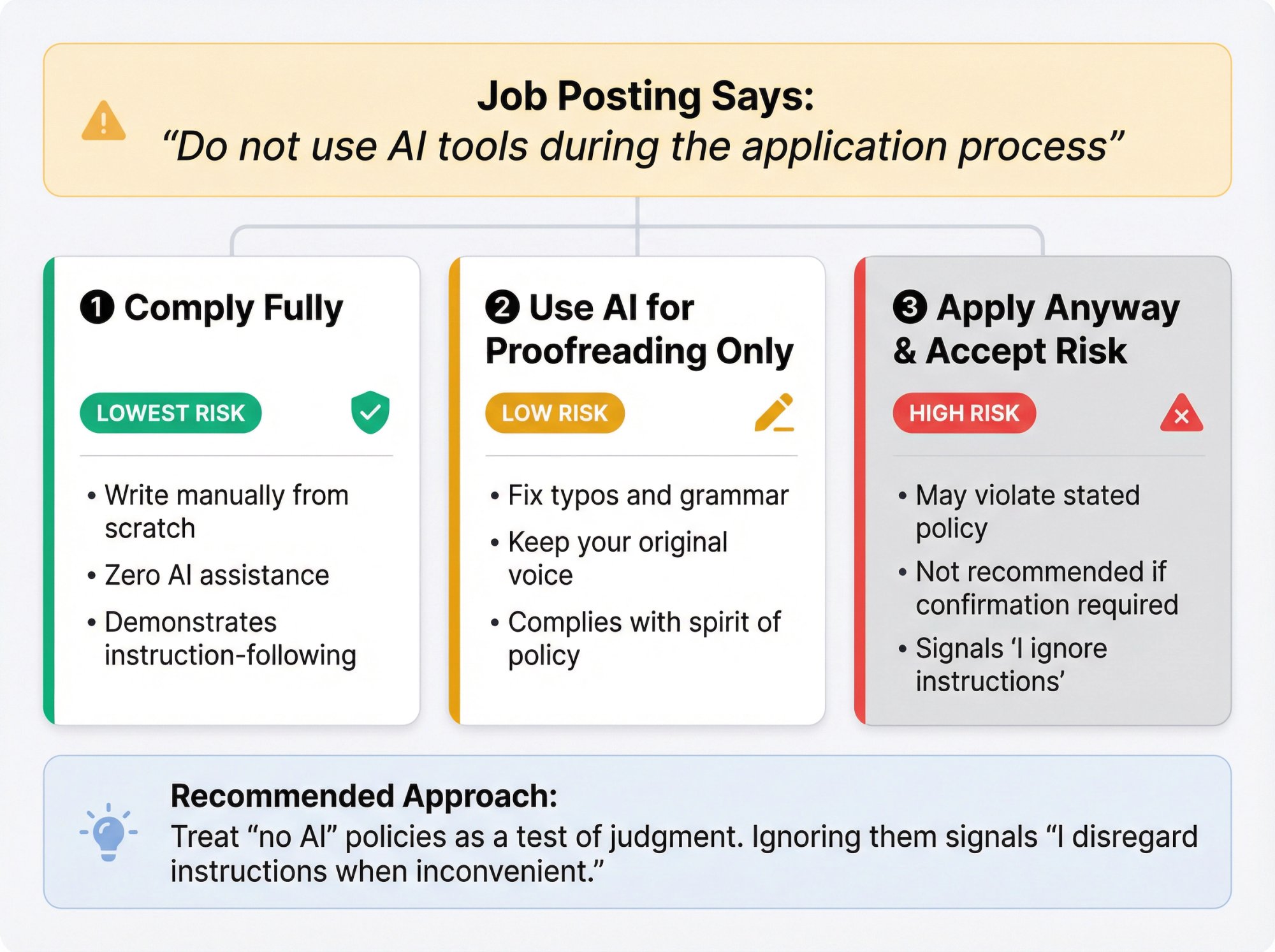
If a posting says "Do not use AI tools during the application process," you have three options:
① Comply fully
② Apply anyway and accept the risk (not recommended if they require confirmation)
③ Use AI only for proofreading and still comply with the spirit
Anthropic's policies show how visible these requirements have become.
Our recommendation: Treat "no AI" as a test of judgment. Ignoring it signals "I disregard instructions when inconvenient."
That's not the signal you want to send. Browse career-specific cover letter examples to understand what strong manual applications look like.
What to Do If Employers Accuse You of Using AI
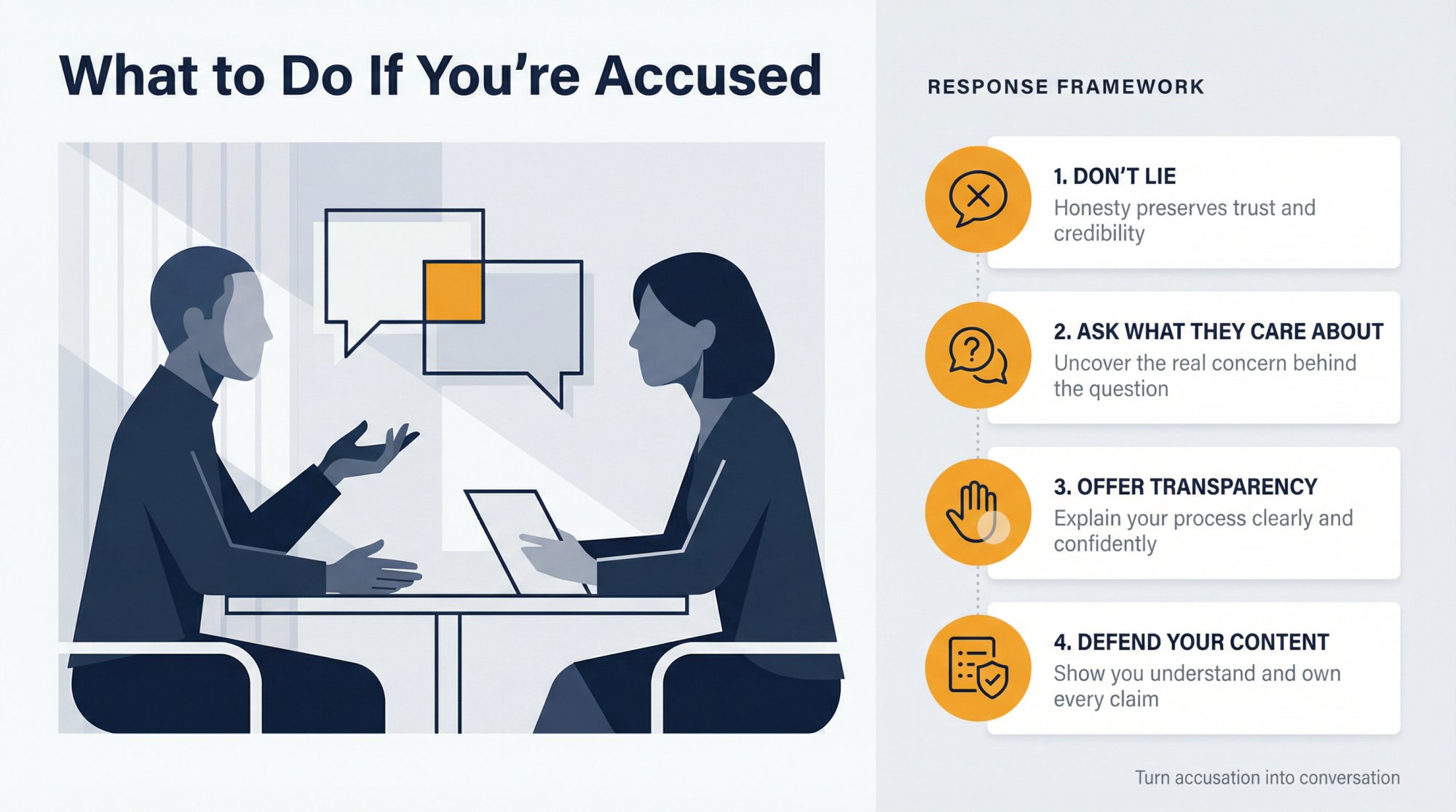
This is rare, but here's how to handle it:
First: Don't Lie
If you lie and they catch you later, you've turned a minor issue into a character issue.
Second: Ask What They Care About
Sometimes "AI use" is a proxy for:
"Is this truthful?"
"Can you communicate without assistance?"
"Do you understand what you wrote?"
Third: Offer Process Transparency
If true, say something like:
"I used AI to outline and tighten wording, but every example and claim is mine. I can walk you through any part of it."
This aligns with the idea that AI can be augmentation, not replacement.
Fourth: Be Ready to Defend the Content
If you can't explain a sentence you wrote, it doesn't belong in your letter.
If you need interview preparation, practice defending your cover letter claims before the conversation.
How AIApply Helps You Use AI the Right Way
A tool shouldn't promise "you'll never get detected." That's not realistic.
What a good tool can do is help you produce letters that are:
Tailored to the role
Consistent with your résumé
Specific and evidence-based
Written in a natural voice you can defend
AIApply's Cover Letter Generator uses GPT-4 and custom models to create role-specific drafts that map your qualifications to job requirements. But we've always emphasized that you need to customize and personalize the output.
The goal isn't to replace you. It's to help you communicate your actual strengths faster and more clearly.
Our approach:
Generate a tailored first draft in under 2 minutes
Highlight how your skills match employer needs
Provide editable content (so you add personal touches)
Make sure the language sounds natural and human
The result? Hiring managers see a polished, personalized cover letter, not an AI template.
We also offer a Resume Scanner to verify keyword alignment and ATS optimization, and our Auto Apply feature can submit up to 500 customized applications per month while maintaining quality (credits never expire).
If you want to understand AI's role across your entire job search, our AI job search tools guide breaks down when to use AI and when to go manual.
Frequently Asked Questions
Can ATS systems detect AI-written cover letters?
Most applicant tracking systems are designed to collect, parse, and route applications, not certify authorship. In practice, suspicion comes from human reviewers or separate detection tools, not from the ATS itself.
Does Grammarly count as "using AI"?
It depends on the employer policy. Some mean "don't have a machine write your content." Others mean "no AI assistance whatsoever." Follow the exact wording of the posting.
If you need a comprehensive solution that helps with the entire application, AIApply's Resume Builder and Cover Letter Generator offer transparent, customizable AI assistance.
Should you disclose AI use?
Only if asked or if policy requires it.
If asked, answer truthfully: "I used it to edit and structure, not to invent content."
Is it illegal to use AI for a cover letter?
In most places, there's no specific "AI cover letter law." The practical risk is trust and verification, not criminal liability. Hiring policies and professional ethics still apply.
If employers hate AI cover letters, why do they use AI in hiring?
Because both sides are optimizing:
Employers use AI for speed (job ads, messaging, screening)
Candidates use AI to keep up
Research shows employers using AI mainly for writing job ads and messaging, while job seekers use it for résumés and cover letters.
Will hiring managers know if I use ChatGPT?
Not with certainty. They might suspect it if your letter has telltale signs: generic content, overly formal phrasing, repetitive structures, or claims you can't back up in interviews.
The best defense? Edit heavily and make it genuinely yours. Browse role-specific examples to see what natural, personalized letters look like.
What percentage of job seekers use AI for cover letters?
About 29.3% in 2025 (up from 17.3% in 2024). Usage is rising quickly, and 70% of job seekers use generative AI somewhere in their search process.
Can AI detectors really identify AI-written text?
Not reliably. OpenAI shut down its own detector in 2023 due to low accuracy. Other tools produce false positives and false negatives constantly.
Most recruiters rely on human judgment instead of software.
The Real Takeaway
Can employers tell if you used AI for a cover letter?
Sometimes they can suspect it. Sometimes they might run a detector. They usually can't prove it with certainty.
But the more important question is: Does your cover letter still signal something real about you?
If AI turns your letter into a polished, generic blob, you lose signal and you lose interviews.
If AI helps you express real evidence more clearly, you win.
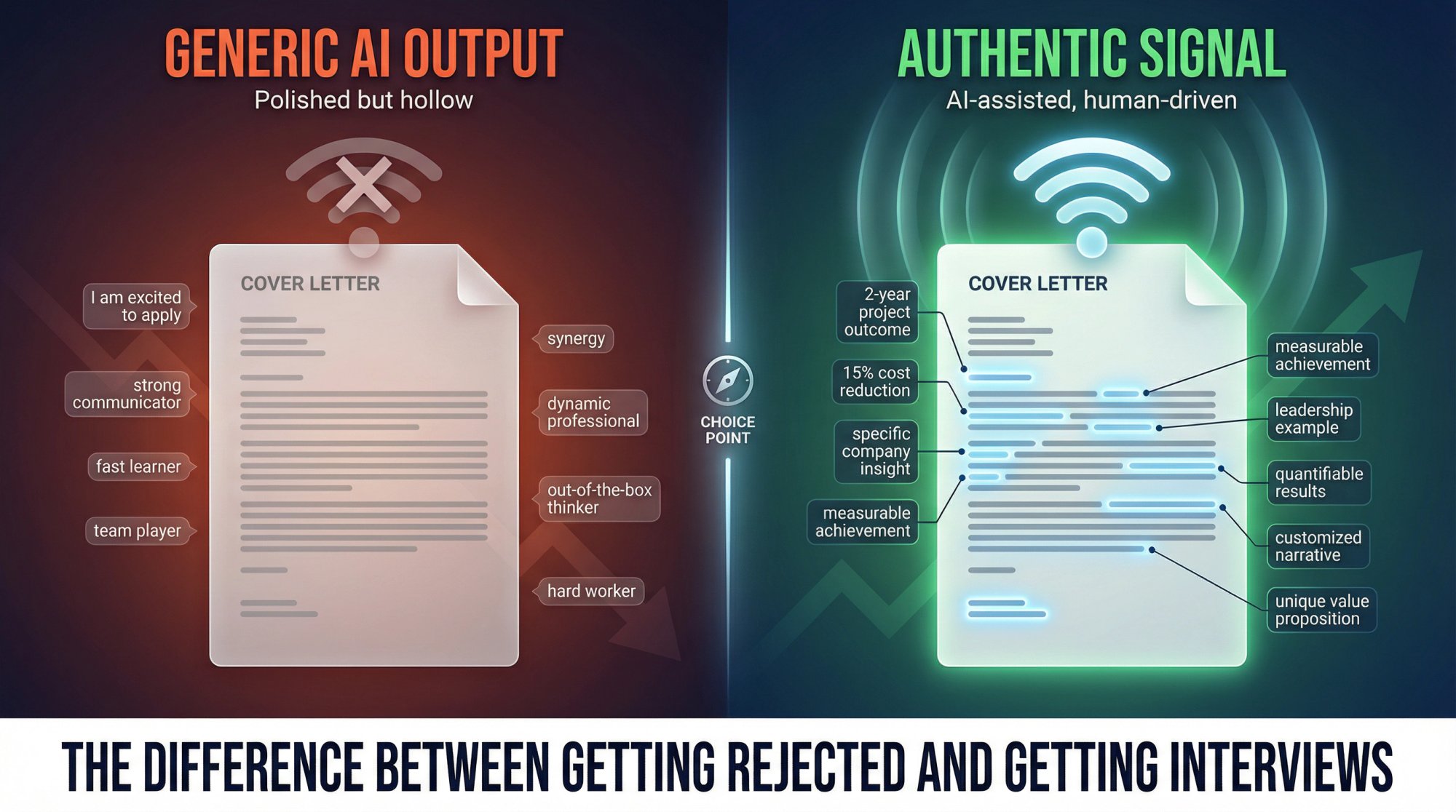
The goal isn't to hide AI. It's to use AI in a way that amplifies your authentic voice and genuine qualifications.
That's the difference between getting rejected and getting interviews.
Use AI as your assistant, not your replacement. Build the evidence bank first. Customize ruthlessly. Defend every claim.
When you approach it this way, whether you used AI becomes irrelevant. What matters is whether you communicated who you are, what you've done, and why you're the right fit.
And that's something only you can provide.
Ready to create a cover letter that passes the authenticity test? Try AIApply's Cover Letter Generator with our transparent, customizable approach. Or explore cover letters by career to see industry-specific examples.
If you've used AI to write your cover letter, you're probably wondering: can they actually tell?
The short answer? Sometimes they can suspect it, but they usually can't prove it.
The more important question is whether your cover letter still signals something real about you. If AI turns your application into a polished but generic blob, you lose. If it helps you express genuine qualifications more clearly, you win.
Here's what's actually happening in 2026 hiring rooms, what the data shows, and how to use AI without raising red flags.
Why Getting "Caught" Isn't the Real Problem
Most employers can't definitively prove you used AI for your cover letter. They can often sense when something feels off: too polished, too generic, strangely disconnected from your actual experience.
The bigger problem? When everyone submits equally polished letters, the cover letter stops being useful as a signal.
Hiring is fundamentally a signal game. Employers use cover letters to infer your communication skill, effort level, motivation, and cultural fit. When AI makes "good sounding" writing cheap to produce, that signal degrades.
So they adapt. They ask follow-up questions. They run live interview assessments. They check if you can actually discuss the specifics from your letter.
What "Getting Detected" Actually Means for Job Seekers
When people ask "can employers tell?", they usually mean one of these:
→ Certainty: Can they know beyond doubt?
→ Probability: Will it look AI-generated enough to raise suspicion?
→ Consequence: If they suspect it, will I get rejected?
In reality, hiring teams rarely operate on courtroom-level proof. They operate on time pressure and pattern recognition:
"This feels generic."
"This could be about anyone."
"The résumé voice and cover letter voice don't match."
Those aren't AI detectors. They're signal detectors.
How Do Employers Detect AI-Written Cover Letters?
1. You Disclosed AI Use (Through Policy or Direct Question)
Some employers explicitly ask applicants to confirm they didn't use AI. Anthropic became a high-profile example in 2025 by requiring candidates to write without AI assistance, wanting to assess "unassisted communication skills."
Sometimes detection isn't technical at all. It's just policy and disclosure.
2. Recruiters Spot AI Writing Patterns (Most Common Method)
Even without software, recruiters spot AI-style writing because it tends to converge on similar patterns.
What screams "AI-written":
Career experts (updated January 7, 2026) explicitly warn: recruiters reject letters that sound generic, robotic, or obviously generated.
Employer research echoes the same theme: employers react negatively to messaging that feels "sugar-coated" or template-driven.
The "detector" is often just a tired human who's read 200 similar letters this week.
3. AI Detection Software (Less Reliable Than You Think)
Some employers might paste cover letters into detection tools. But that creates problems:
False positives mean accusing real humans of cheating, which is a legal and reputational risk.
False negatives happen constantly. A decent human edit can fool most detectors.
Turnitin (one of the most widely used tools in education) publicly acknowledges false positives and now doesn't surface scores below 20% to reduce incorrect flags. They also warn that AI scores shouldn't be used as the sole basis for decisions.
NIST research on generative AI shows detection performance varies wildly by system and setup, with many generators successfully deceiving discriminators.
Bottom line: AI detection is a cat-and-mouse problem. Employers who understand that use detectors cautiously or not at all.
4. Testing What Your Cover Letter Should Actually Prove
Here's the first-principles logic:
Cover letters exist to show communication skill, effort, motivation, and fit
AI makes polished writing cheap
So the value of writing as a signal drops
Employers adapt by:
Asking follow-up questions about your letter during job interviews
Running live writing assessments
Using work samples and timed exercises
Checking if you can expand on claims from your letter
Industry research explicitly recommends additional evaluation when AI use makes genuineness harder to assess.
Even if they can't detect AI, they can detect weak signals and respond with stronger filters.
What Hiring Managers Actually Do About AI Cover Letters (2025-2026 Data)
What Hiring Managers Say They Do
A May 2025 survey of 600 U.S. hiring managers found:
Key insight: There's pushback against "fully AI-generated" applications, but many managers accept AI as support. And a lot of hiring teams aren't deeply AI-enabled themselves.
What Job Seekers and Employers Are Actually Doing
A July 2025 survey of 1,421 job seekers and 529 employers found:
29.3% of job seekers used AI to write or customize applications (up from 17.3% in 2024)
25.9% of employers use AI in recruitment
Top employer concerns: fake candidates (24.4%) and inauthentic applications (24.2%)
"I Can Tell" Doesn't Mean "I Can Prove"
Insight Global's 2025 survey found:
88% say they can tell when someone used AI
54% say it's off-putting
Reality check: that's self-reported confidence. Humans are famously overconfident at pattern detection, especially for socially salient issues.
Treat this as: many people believe they can tell. That belief alone influences hiring behavior.
The Soft Consensus
Across employer-facing content, a theme emerges:
Light AI use for drafting and polishing is often tolerated
Heavy AI use that removes your voice or introduces inaccuracies is risky
Using AI during assessments or live interviews is widely seen as unacceptable
Industry research explicitly labels AI use for assessments as a "big no-no" that can lead to disqualification.
Why Do Employers Care If You Use AI for Cover Letters?
Most hiring managers don't hate AI because it's AI. They push back because AI can break the hiring process in predictable ways:
It Destroys Signal Quality
When everyone submits equally polished letters, letters stop distinguishing candidates. Employers shift to other signals: work samples, referrals, portfolios, structured interviews.
It Increases Verification Cost
A generic but polished letter forces recruiters to spend extra time figuring out:
Is this real experience?
Is the candidate genuinely interested?
Do they actually communicate like this?
It Increases Application Volume, Not Quality
Auto-apply tools plus AI can flood pipelines with applications that look good but say nothing.
Industry research notes that volume becomes overwhelming when it appears AI-generated, suggesting better matching and gating is needed.
It Creates Unfairness on Both Sides
Candidates feel pressured to use AI to keep up. Employers feel they can't assess authentic communication.
That's why you see "no AI" policies in some listings and "AI skills required" in others, sometimes in the same industry.
How to Use AI for Cover Letters Without Getting Rejected (Step-by-Step)
Stop thinking "How do I hide AI?" Start thinking "How do I use AI to express my real signal more clearly?"
If your letter is true, specific, consistent with your résumé, aligned to the job, and written in a voice you can defend in conversation, then "AI detection" becomes mostly irrelevant.
Step 0: Pick Your Line (Before You Start)
AI can play different roles depending on your risk tolerance:
Research shows hiring manager tolerance drops sharply between roles 3 and 4.
Step 1: Build Your "Evidence Bank" First
Before generating anything, write bullet points (not sentences) for:
→ 2-3 achievements with numbers (time saved, revenue, conversions, cost reductions)
→ 1 failure you learned from (optional but powerful)
→ 2 specific reasons you want this company
→ 3 job requirements and your matching proof
This is your anti-generic weapon. AI can't invent this.
See cover letter examples for role-specific inspiration on how to present your evidence bank effectively.
Step 2: Use AI to Map Requirements to Evidence
Ask AI to create a "requirement → proof" table.
Example prompt:
You are my cover letter strategist.Job description: [paste]My evidence bank: [paste bullets]Task:1) Extract the 6 most important requirements from the job description.2) For each, map it to the strongest proof from my evidence bank.3) Identify any gaps honestly (do not invent experience).Return as a simple table.This makes specificity built-in by design.
Step 3: Generate a Draft, But Constrain It Hard
If you let AI freestyle, you get generic output. Instead:
Example prompt:
Write a 300-word cover letter using only the evidence bank provided.Constraints:- No clichés (avoid "I am excited", "fast learner", "team player", "synergy").- Every claim must include evidence or a concrete example.- Match my writing style: short sentences, plain language, confident but not arrogant.- Include 1 sentence showing I understand the company specifically.Step 4: Rewrite So It Sounds Like You
This is where most people fail.
Rule: If you wouldn't say a sentence out loud in an interview, rewrite it.
Do a "read aloud test." If it feels like a press release, it's not you.
Step 5: Run the "Five Red Flag" Audit
Based on employer-facing advice, recruiters react badly to:
① Vague adjectives with no proof
Bad: "I'm a strong leader."
Fix: "I led a 5-person team to ship the project two weeks early by setting up daily standups and automated testing."
② Job description mirroring
Bad: Repeating their bullet points in new words
Fix: Show outcomes you produced under similar constraints
③ Overly formal tone
Bad: "I am writing to express my keen interest in..."
Fix: "I'm applying because I've spent three years optimizing conversion funnels, which maps directly to your growth role."
④ Company-specific details that are generic
Bad: "I admire your commitment to innovation."
Fix: Mention a specific product launch, strategy shift, or public artifact you actually read.
⑤ Voice mismatch with your résumé
If your résumé is concise and technical but your cover letter is flowery and sentimental, that's suspicious.
Step 6: Verify Facts Like Your Offer Depends on It
AI hallucinations kill cover letters silently:
Wrong company name
Wrong product
Wrong role title
"I have 7 years" when you have 3
Even employers who tolerate AI will reject careless errors.
What to Do About "No AI" Job Postings
If a posting says "Do not use AI tools during the application process," you have three options:
① Comply fully
② Apply anyway and accept the risk (not recommended if they require confirmation)
③ Use AI only for proofreading and still comply with the spirit
Anthropic's policies show how visible these requirements have become.
Our recommendation: Treat "no AI" as a test of judgment. Ignoring it signals "I disregard instructions when inconvenient."
That's not the signal you want to send. Browse career-specific cover letter examples to understand what strong manual applications look like.
What to Do If Employers Accuse You of Using AI
This is rare, but here's how to handle it:
First: Don't Lie
If you lie and they catch you later, you've turned a minor issue into a character issue.
Second: Ask What They Care About
Sometimes "AI use" is a proxy for:
"Is this truthful?"
"Can you communicate without assistance?"
"Do you understand what you wrote?"
Third: Offer Process Transparency
If true, say something like:
"I used AI to outline and tighten wording, but every example and claim is mine. I can walk you through any part of it."
This aligns with the idea that AI can be augmentation, not replacement.
Fourth: Be Ready to Defend the Content
If you can't explain a sentence you wrote, it doesn't belong in your letter.
If you need interview preparation, practice defending your cover letter claims before the conversation.
How AIApply Helps You Use AI the Right Way
A tool shouldn't promise "you'll never get detected." That's not realistic.
What a good tool can do is help you produce letters that are:
Tailored to the role
Consistent with your résumé
Specific and evidence-based
Written in a natural voice you can defend
AIApply's Cover Letter Generator uses GPT-4 and custom models to create role-specific drafts that map your qualifications to job requirements. But we've always emphasized that you need to customize and personalize the output.
The goal isn't to replace you. It's to help you communicate your actual strengths faster and more clearly.
Our approach:
Generate a tailored first draft in under 2 minutes
Highlight how your skills match employer needs
Provide editable content (so you add personal touches)
Make sure the language sounds natural and human
The result? Hiring managers see a polished, personalized cover letter, not an AI template.
We also offer a Resume Scanner to verify keyword alignment and ATS optimization, and our Auto Apply feature can submit up to 500 customized applications per month while maintaining quality (credits never expire).
If you want to understand AI's role across your entire job search, our AI job search tools guide breaks down when to use AI and when to go manual.
Frequently Asked Questions
Can ATS systems detect AI-written cover letters?
Most applicant tracking systems are designed to collect, parse, and route applications, not certify authorship. In practice, suspicion comes from human reviewers or separate detection tools, not from the ATS itself.
Does Grammarly count as "using AI"?
It depends on the employer policy. Some mean "don't have a machine write your content." Others mean "no AI assistance whatsoever." Follow the exact wording of the posting.
If you need a comprehensive solution that helps with the entire application, AIApply's Resume Builder and Cover Letter Generator offer transparent, customizable AI assistance.
Should you disclose AI use?
Only if asked or if policy requires it.
If asked, answer truthfully: "I used it to edit and structure, not to invent content."
Is it illegal to use AI for a cover letter?
In most places, there's no specific "AI cover letter law." The practical risk is trust and verification, not criminal liability. Hiring policies and professional ethics still apply.
If employers hate AI cover letters, why do they use AI in hiring?
Because both sides are optimizing:
Employers use AI for speed (job ads, messaging, screening)
Candidates use AI to keep up
Research shows employers using AI mainly for writing job ads and messaging, while job seekers use it for résumés and cover letters.
Will hiring managers know if I use ChatGPT?
Not with certainty. They might suspect it if your letter has telltale signs: generic content, overly formal phrasing, repetitive structures, or claims you can't back up in interviews.
The best defense? Edit heavily and make it genuinely yours. Browse role-specific examples to see what natural, personalized letters look like.
What percentage of job seekers use AI for cover letters?
About 29.3% in 2025 (up from 17.3% in 2024). Usage is rising quickly, and 70% of job seekers use generative AI somewhere in their search process.
Can AI detectors really identify AI-written text?
Not reliably. OpenAI shut down its own detector in 2023 due to low accuracy. Other tools produce false positives and false negatives constantly.
Most recruiters rely on human judgment instead of software.
The Real Takeaway
Can employers tell if you used AI for a cover letter?
Sometimes they can suspect it. Sometimes they might run a detector. They usually can't prove it with certainty.
But the more important question is: Does your cover letter still signal something real about you?
If AI turns your letter into a polished, generic blob, you lose signal and you lose interviews.
If AI helps you express real evidence more clearly, you win.
The goal isn't to hide AI. It's to use AI in a way that amplifies your authentic voice and genuine qualifications.
That's the difference between getting rejected and getting interviews.
Use AI as your assistant, not your replacement. Build the evidence bank first. Customize ruthlessly. Defend every claim.
When you approach it this way, whether you used AI becomes irrelevant. What matters is whether you communicated who you are, what you've done, and why you're the right fit.
And that's something only you can provide.
Ready to create a cover letter that passes the authenticity test? Try AIApply's Cover Letter Generator with our transparent, customizable approach. Or explore cover letters by career to see industry-specific examples.
.webp)
.webp)
.webp)
Don't miss out on
your next opportunity.
Create and send applications in seconds, not hours.


