
Greatest Weakness Answer Examples: What to Say (2026)

.webp)
You're sitting across from your interviewer. Things are going well. Then they lean forward and ask: "What's your greatest weakness?"
Your brain freezes. Do they want honesty or strategy? A real flaw or a humble-brag? And how do you possibly answer without tanking your chances?
If you've ever felt this panic, you're not alone. This question isn't designed to catch you off guard, but it feels that way. The truth is simpler than you think: interviewers are testing whether you understand your own operating system and whether you've built a fix for the parts that sometimes glitch.
This guide gives you everything you need to nail this question:
• A simple three-part answer framework that prevents rambling
• A "safe weakness" selection system so you don't disqualify yourself
• 30+ ready-to-use answer examples with role-specific guidance
• Common mistakes that make interviewers cringe (and how to avoid them)
• How to practice using AIApply's Mock Interview and Interview Buddy tools
The goal? Turn this dreaded question into your moment to shine.
Why Do Interviewers Ask About Your Weaknesses?
Let's start with first principles. When someone asks about your greatest weakness, they're not collecting ammunition to eliminate you. Research shows they're looking for three specific signals:
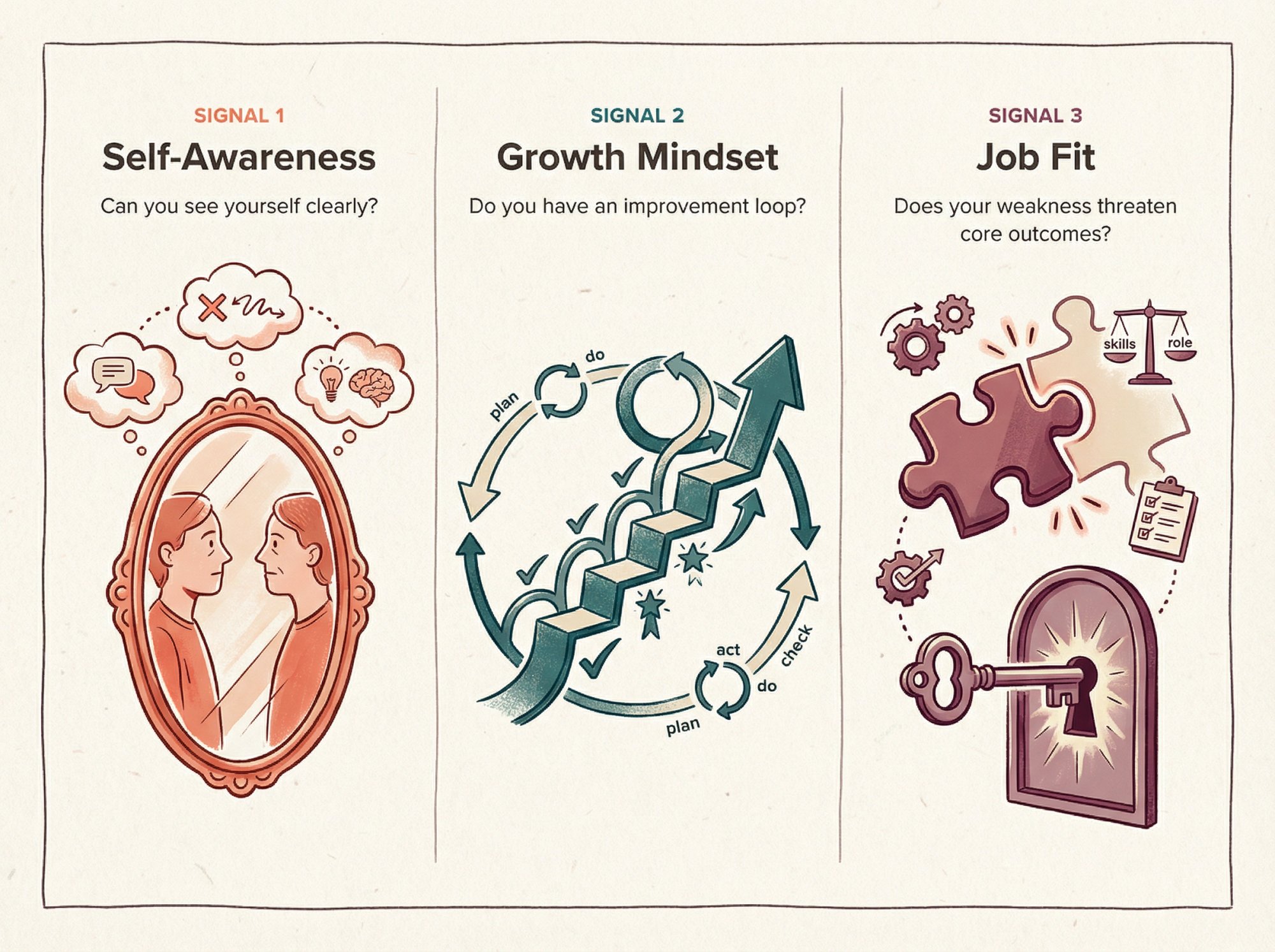
Signal 1: Self-Awareness
Can you see yourself clearly? If you can't name a real weakness, you might also ignore feedback, repeat mistakes, or deflect blame. Career experts frame this as a basic self-awareness test.
Think about it from their perspective. Every candidate has weaknesses. Pretending you don't is a bigger red flag than admitting you do.
Signal 2: Growth Mindset
Do you have a working improvement loop? A weakness without a plan signals stagnation. A weakness with a plan demonstrates maturity. Many companies use structured interview rubrics to evaluate candidates, and the "I noticed, I changed, here's proof" structure is exactly what those rubrics reward.
Signal 3: Job Fit
Does your weakness threaten the role's core outcomes? According to NACE's Job Outlook 2025 survey, employers prioritize problem-solving (88.3%), teamwork (81.0%), and communication when hiring. If you're applying for a sales role, don't say you struggle with cold outreach. If you're interviewing for an accounting position, don't admit you miss details.
The real game: Pick a weakness that is real, fixable, and not fatal for the job.
How to Answer "What Is Your Greatest Weakness?"
We've analyzed hundreds of successful weakness answers at AIApply. The ones that consistently work follow a simple three-part structure:
W-A-P = Weakness → Action → Proof
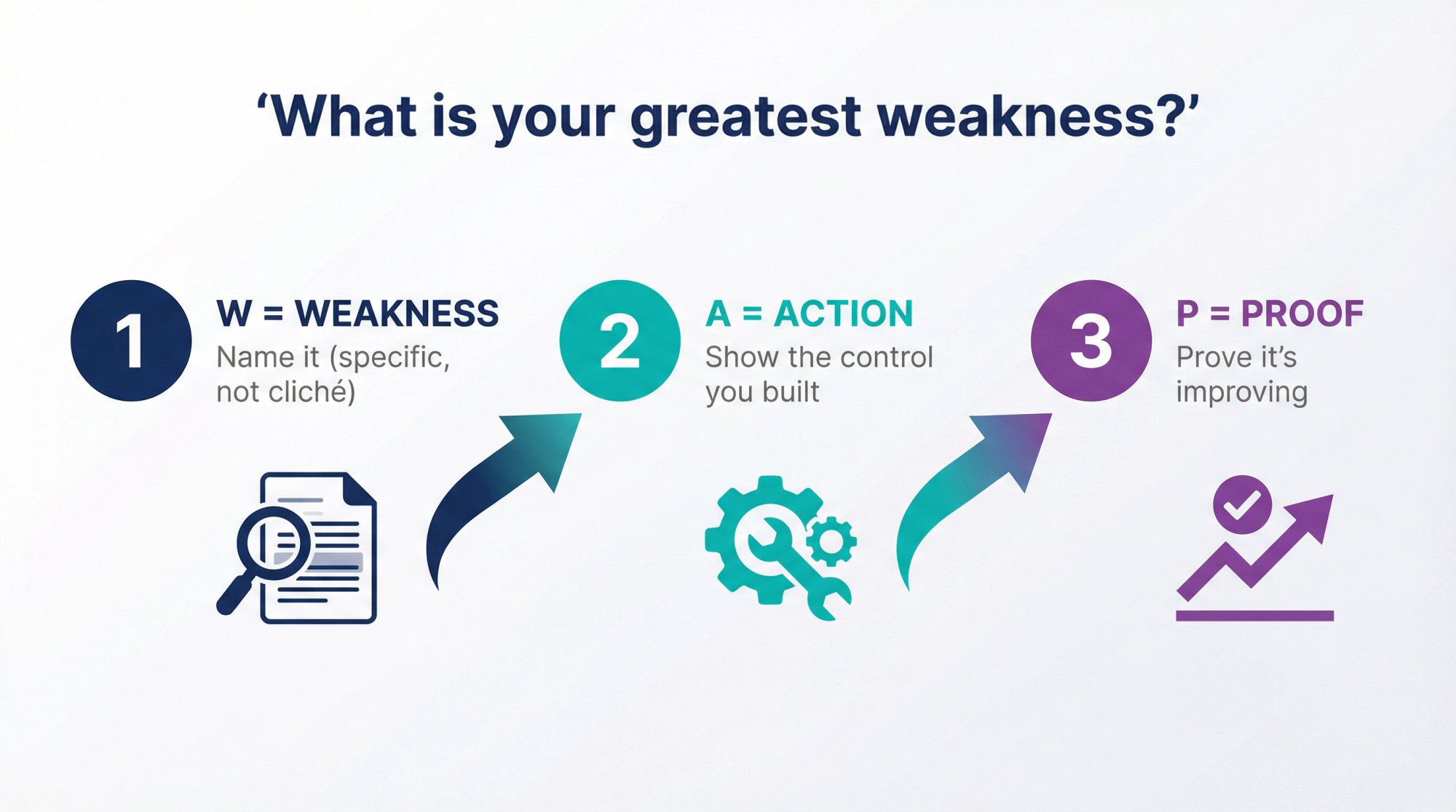
1. Name the weakness (specific, not a cliché)
Be direct. One sentence. No drama.
2. Show the control you built (process, tool, habit, training)
What did you change? Tools, habits, training, feedback loops.
3. Prove it's improving (result, feedback, metric, example)
What improved? Metric, result, feedback, concrete example.
Interview guidance literally frames the question as "weakness plus steps you're taking to improve." This structure maps perfectly to what interviewers are scoring.
Here's the template you can customize:
"One area I've been improving is [specific weakness]. I noticed it showed up when [specific situation]. So I started [specific fix], and now [proof of improvement]. I'm still improving it, but I'm much more consistent than I was."
Target delivery time: 25-35 seconds for the core answer. Have a 60-second version ready if they ask follow-ups.
How to Choose a Weakness for Job Interviews
Before you choose a weakness, run it through these filters:
Filter 1: Is it non-fatal for this role?
If the job is customer support, don't choose "I get frustrated with people." If it's data analysis, don't pick "I struggle with numbers." Career coaches consistently emphasize this as the foundational rule.
Filter 2: Can I show an actual fix I'm already doing?
Courses. Checklists. Rehearsal. Feedback loops. Tooling. Mentors. Anything concrete. Research confirms that pairing a weakness with specific improvement actions reflects extremely well on candidates.
Filter 3: Can I give proof?
Even light proof works. "My manager's feedback improved." "I've hit deadlines consistently since." "I now send weekly updates." The proof doesn't need to be dramatic, it just needs to be real.
Here's what makes the difference:
A weakness paired with action and proof tells interviewers you're honest, coachable, and improving. A weakness alone leaves a negative impression hanging.
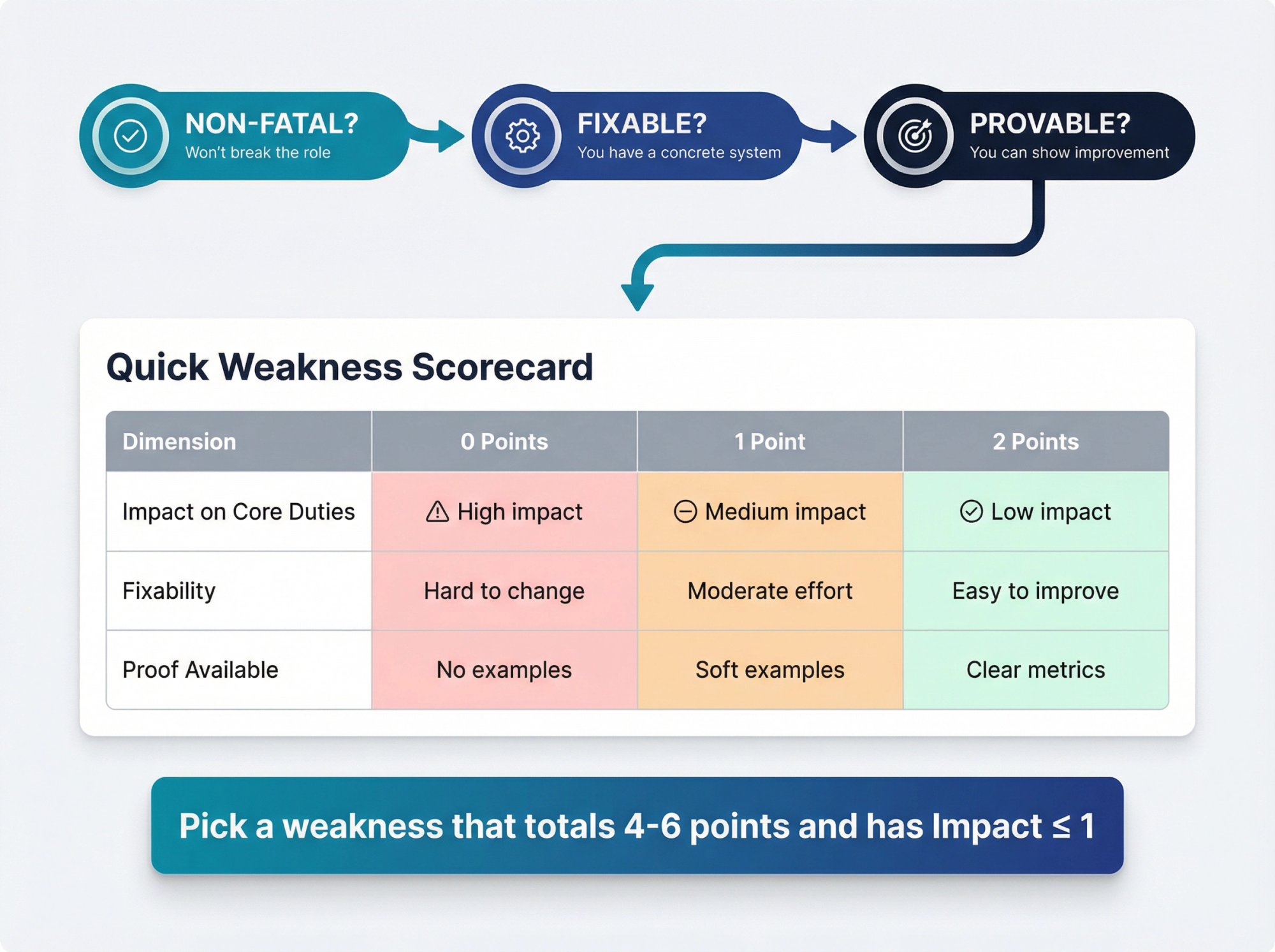
Quick Weakness Scorecard
When you're torn between options, rate each weakness on these dimensions (0-2 points each):
Pick a weakness that totals 4-6 points and has impact ≤ 1.
Biggest Mistakes When Answering This Question
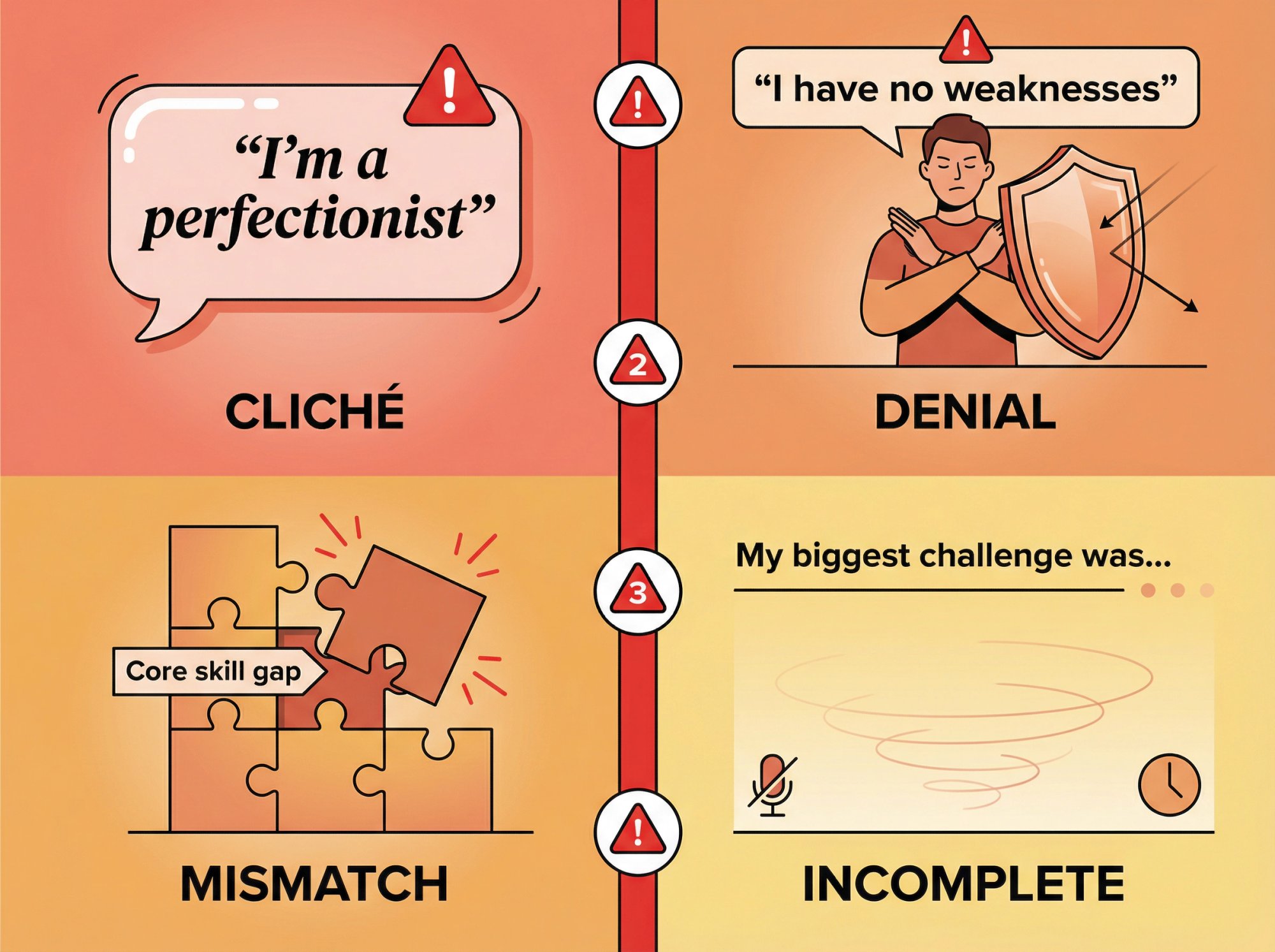
Mistake 1: "I'm a perfectionist"
This is a meme answer. Interviewers have heard it thousands of times. Career experts explicitly warn against vague clichés. Better approach: describe the specific behavior (like "I over-edit presentations late into the night") and the fix.
Mistake 2: "I don't have weaknesses"
This reads as low self-awareness or low honesty. Interview guidance straight-up tells candidates not to list a weakness without improvement steps. The entire setup assumes you have flaws.
Mistake 3: Picking a weakness that's a job requirement
You're basically announcing "I can't do the thing you're hiring me to do." Use the career coach logic: pick something true but not core to success in the role.
Mistake 4: Stopping at the weakness
If you name a weakness and then go silent, you've just left a negative hanging in the air. Always follow through with your improvement actions and results.
30+ Greatest Weakness Answer Examples by Category
Each example includes the weakness, the fix, and a ready-to-say script. Steal the structure, then swap details so it sounds like you.
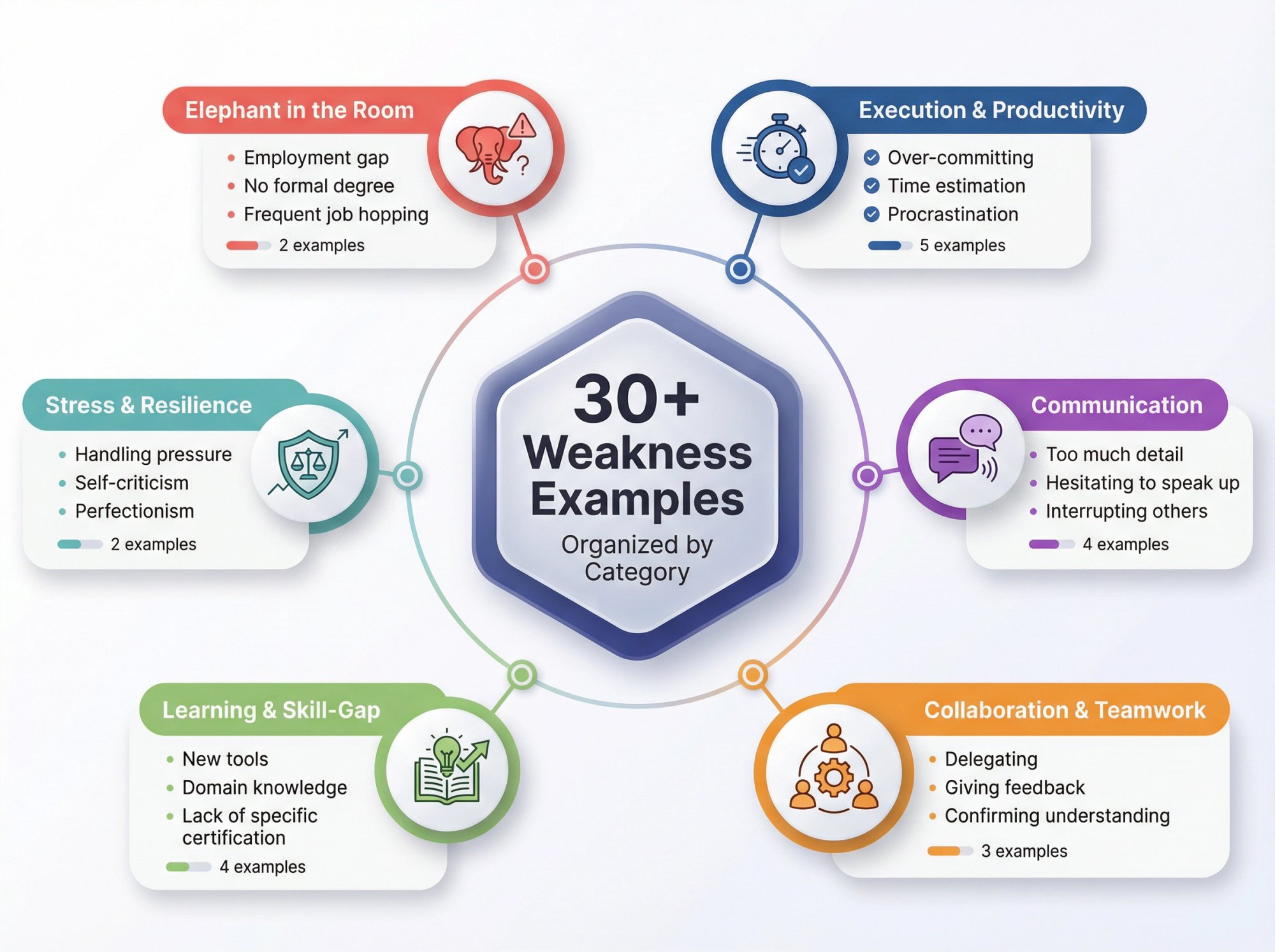
Category A: Execution & Productivity
1. Over-Committing (Hard Time Saying No)
When to use: You're reliable but learning boundaries
When to avoid: Role demands ruthless prioritization and you can't show a system
Script:
"I used to say yes too quickly, especially when teammates needed help, and I'd overload my week. I started doing a quick priority check (what's due, what's blocked, what's the impact) before committing. Now I'll either negotiate the deadline or propose an alternative, and I've been much more consistent about delivering without crunch."
Job search experts recommend pairing this with an organization system to show you've built sustainable habits.
2. Time Estimation on Long Projects
Script:
"I've had to improve my time estimation on longer projects. I used to underestimate edge cases and stakeholder alignment time. Now I break work into smaller milestones, add a buffer for unknowns, and do a mid-week recalibration based on actual progress. It's reduced last-minute surprises and helped me communicate timelines more clearly."
3. Procrastination (Fear of Starting Big Tasks)
When to use: You've built a habit system
Script:
"When a task is ambiguous or high-stakes, I used to delay starting because I wanted the 'perfect' first attempt. What fixed it was forcing a 30-minute 'ugly first draft' session and then iterating. I'm much faster to momentum now, and the quality is actually higher because I'm not compressing everything at the end."
Research lists procrastination as a legitimate weakness when paired with action and result.
4. Prioritization (Everything Feels Urgent)
Script:
"I've had to get better at prioritizing when multiple things land at once. I used to treat everything as urgent. Now I triage by impact, urgency, and dependency (what unblocks others first). I also confirm priorities with my manager early instead of guessing. It's made my weeks calmer and my output more predictable."
5. Getting Stuck in Details
When to use: Role values quality but needs pace
Script:
"I can sometimes over-focus on details longer than necessary. I've learned to timebox reviews and do a quick 'definition of done' check before going deeper. That keeps quality high without slowing the team."
Interview experts explicitly list "focus too much on details" and recommend explaining how you refocus on the bigger picture.
6. Asking for Help Too Late
When to use: You're independent but now collaborate earlier
Script:
"I used to try to solve things solo for too long before asking for help, which wastes time. Now I have a simple rule: if I'm stuck for 30-45 minutes, I ask a clear question with what I tried. It speeds up delivery and actually improves my learning."
Research shows that framing asking for help as a self-awareness skill prevents bottlenecks.
Category B: Communication Weaknesses (Safe Versions)
Communication matters. NACE's Job Outlook 2025 lists written and verbal communication as key attributes employers seek. If you pick a communication weakness, keep it narrow and show a fix fast.

7. Too Much Detail in Explanations (Rambling)
Script:
"I've had to learn to communicate more concisely, especially when I'm excited about a topic. Now I lead with the headline first, then the 2-3 supporting points, then I ask if they want details. It's helped me be clearer in meetings and written updates."
8. Hesitating to Speak Up Early
Especially with senior people
Script:
"Earlier in my career, I sometimes held back ideas in meetings with senior people because I didn't want to be wrong. I've worked on it by preparing one or two points in advance and asking clarifying questions early. Now I'm more consistent about contributing and aligning quickly."
9. Written Communication Tone
Too blunt or too soft
Script:
"I've been improving my written communication, making it clear without sounding abrupt. I now re-read messages with a 'could this be misread?' lens and I use short bullets plus explicit asks. It's reduced back-and-forth and made collaboration smoother."
10. Public Speaking Nerves
Only if public speaking is not core to the role
Script:
"Public speaking used to make me nervous, so I avoided it. I started practicing in smaller settings (team demos, internal updates) and deliberately taking more reps. I'm still not the loudest person in the room, but I'm much more confident presenting clearly."
Career coaches emphasize this is safe for some roles, risky for others.
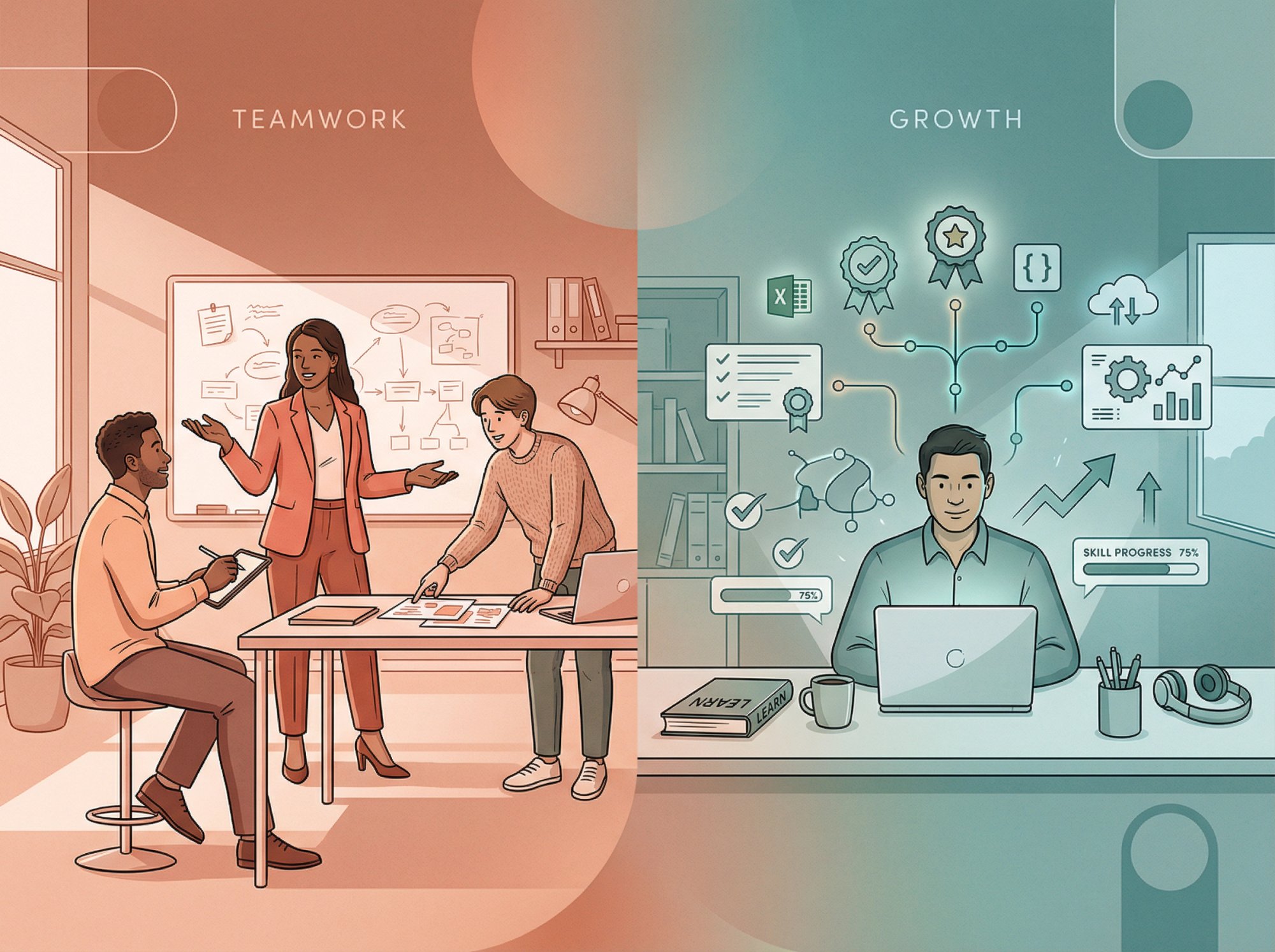
Category C: Collaboration & Teamwork
Teamwork is also a top employer priority. Keep these framed as "I learned a better approach."
11. Difficulty Delegating (For New Managers)
Script:
"When I first started leading projects, I held onto too much work because I wanted it done perfectly. I've improved by delegating outcomes instead of tasks (clear expectations, a check-in cadence, and ownership). It's helped the team grow and helped me focus on higher-impact work."
12. Giving Tough Feedback
Script:
"I used to avoid giving direct constructive feedback because I didn't want tension. I've learned to frame feedback around impact and shared goals, and to do it early rather than letting issues pile up. It's made collaboration cleaner and prevents small problems from becoming big ones."
13. Working With Very Aggressive Personalities
Script:
"I've had to improve how I collaborate with very forceful communication styles. I used to go quiet and then follow up later. Now I ask clarifying questions in the moment and summarize decisions in writing so we stay aligned. It keeps projects moving and makes the team dynamic healthier."
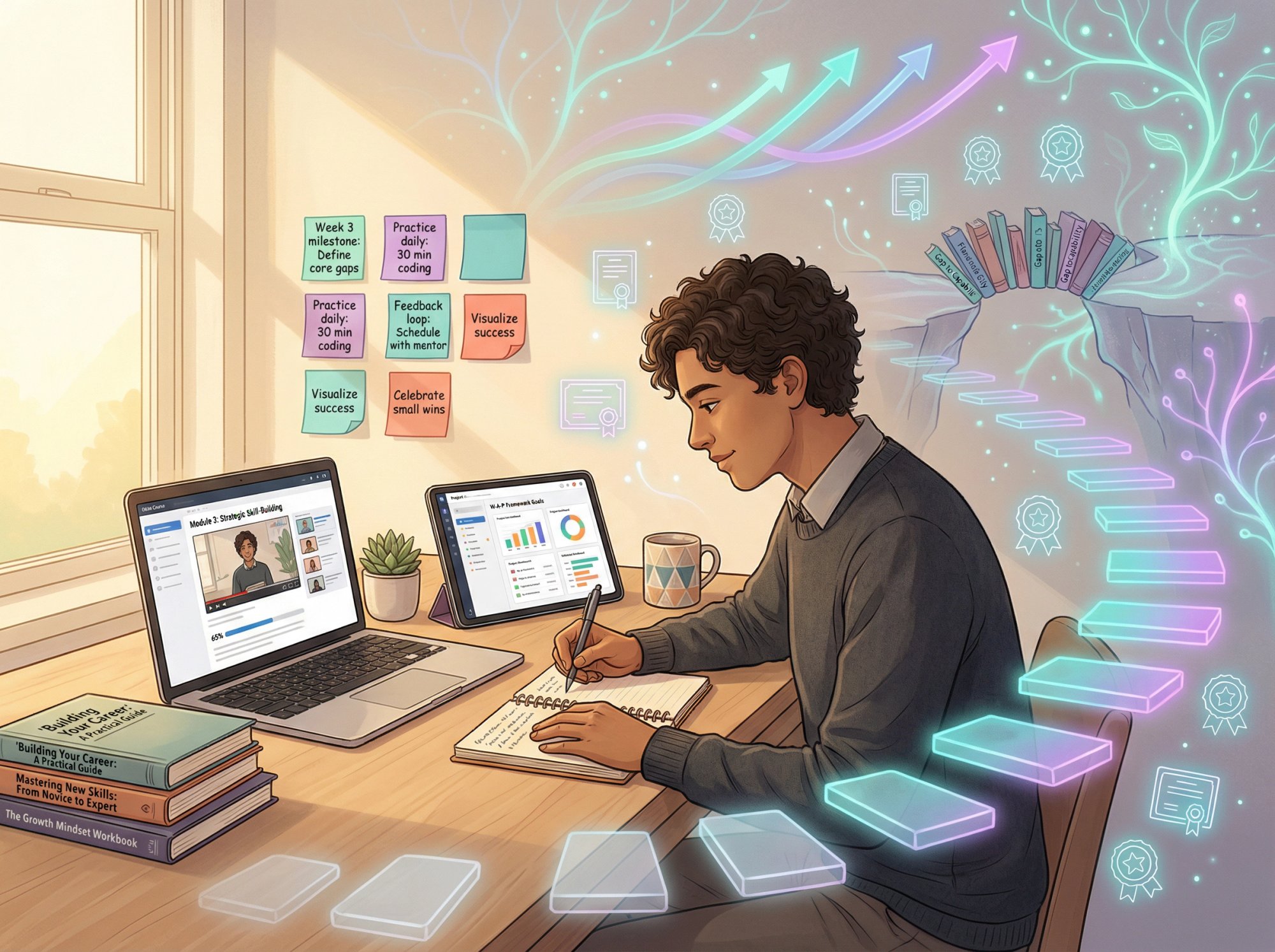
Category D: Learning & Skill-Gap Weaknesses
These are "functional weaknesses" (skill deficiencies you can learn). They're often safer than personality flaws.
Interview experts explicitly recommend skills-based weaknesses because you can take concrete steps to improve.
14. Limited Experience With a Specific Tool
Tool is helpful, not required day one
Script:
"One skill I've been building is [tool name]. I've used adjacent tools, but not that one deeply yet. I've been taking a structured course and applying it in small projects so I'm not learning only in theory. I'm already comfortable with the fundamentals, and I'm excited to ramp quickly."
15. Rusty With Advanced Excel or Reporting
Role isn't heavy modeling, or you can show progress
Script:
"I'm solid in the basics of Excel, but I'm strengthening advanced formulas and more complex reporting. I've been working through practice sets weekly and rebuilding past reports with cleaner logic. I've already gotten faster and more confident."
Interview experts even provide a skills-based Excel example with "courses plus volunteering to use it at work."
16. Limited Domain Knowledge (Industry Switch)
Script:
"Since I'm transitioning into [industry], my gap has been deeper domain context. I've been closing it by reading analyst briefings, following key companies, and doing small side projects that mirror real workflows. I'm not pretending I know everything yet, but I'm ramping fast and I've built a system to keep learning."
17. Not Enough Experience Yet (Entry-Level)
Script:
"Honestly, my biggest gap is that I don't have years of full-time experience yet. But I've been proactive (internships, projects, and feedback loops) so I'm not starting from zero. I'm very coachable, and I learn fast when I get real-world reps."
Category E: Stress & Resilience Weaknesses
Don't overshare. Keep it professional: "I improved my system."
18. Handling Stress (Used to Push Too Hard)
Script:
"I used to handle stress by just pushing harder, which isn't sustainable. I've improved by planning earlier, breaking work into milestones, and communicating risks sooner. The result is I'm more consistent and less reactive under pressure."
Research includes burnout-adjacent weaknesses like self-criticism and emphasizes showing growth actions.
19. Self-Criticism
Script:
"I can be overly self-critical, which can slow me down. I've improved by setting clear success criteria upfront and doing quick retros after delivery instead of replaying mistakes in my head. It helps me learn without spiraling."
Category F: "Elephant in the Room" Weaknesses
Sometimes the "weakness" is obvious from your resume. You can use this question to address it calmly, then pivot to proof.
20. Employment Gap
Script:
"You'll notice a gap in my timeline. During that period, I focused on [learning/certifications/family responsibility], and I kept my skills sharp through [project/volunteer/freelance]. I'm fully ready to return to full-time work, and I can walk you through what I built during that time."
21. No Formal Degree (Or Unrelated Degree)
Script:
"I don't have a formal degree in [field], so early on that was a gap. I've addressed it by building real projects, getting feedback from professionals, and learning through structured coursework. The proof is in [portfolio/results]."
Greatest Weakness Answers by Job Role
These are designed to be safe for each role's typical must-haves.
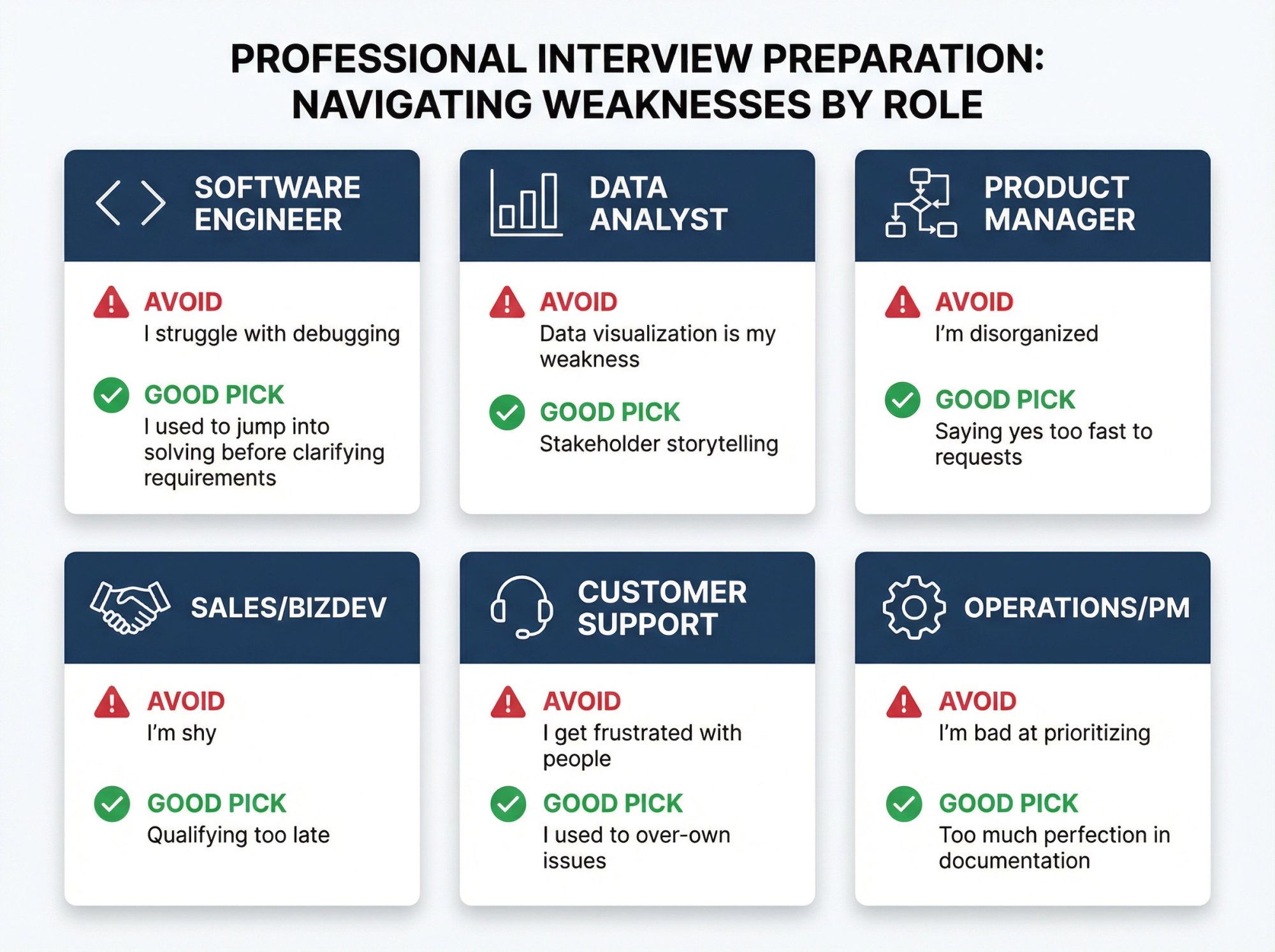
Software Engineer
Avoid: "I struggle with debugging," "I miss details," "I hate code reviews"
Good pick: "I used to jump into solving before clarifying requirements"
Script:
"I used to start coding too quickly before confirming edge cases and acceptance criteria. I've improved by writing a short 'assumptions plus tests' note before implementation and confirming it early. It reduces rework and makes my delivery more predictable."
Learn more about software engineering careers
Data Analyst
Avoid: "Data visualization is my weakness" (if the job is viz-heavy)
Good pick: "Stakeholder storytelling"
Script:
"I'm strong at analysis, but early on I'd over-focus on the technical details instead of the story. I've improved by leading with the decision first, then 2-3 insights, then the supporting data. It's made my work land better with non-technical teams."
Explore data analyst positions
Product Manager
Avoid: "I'm disorganized," "I hate ambiguity"
Good pick: "Saying yes too fast to requests"
Script:
"I used to say yes too quickly to stakeholder asks, which can dilute focus. I now use a simple intake: what's the user impact, what's the cost, what does it trade off. It helps me protect priorities while still being collaborative."
Sales or Business Development
Avoid: "I'm shy," "I dislike cold calling"
Good pick: "Qualifying too late (learning to disqualify faster)"
Script:
"Early on, I spent too long on leads that weren't a fit because I wanted to be helpful. I've improved by qualifying earlier (budget, timeline, pain, and authority) so I invest time where there's real value. It's improved my pipeline hygiene and follow-through."
Customer Support or Customer Success
Avoid: "I get frustrated with people," "I struggle to communicate"
Good pick: "I used to over-own issues instead of escalating early"
Script:
"I used to try to resolve everything myself before escalating, which can slow resolution. I now escalate earlier when there's risk or complexity and I communicate timelines more explicitly. Customers get faster outcomes and fewer surprises."
Explore customer service careers
Operations or Project Management
Avoid: "I'm bad at prioritizing," "I miss deadlines"
Good pick: "Too much perfection in documentation"
Script:
"I can over-polish documentation. I've improved by using templates and 'good enough' standards for internal docs, then iterating only if they're actually used. It keeps the team moving while still staying organized."
How to Handle Follow-Up Questions About Weaknesses
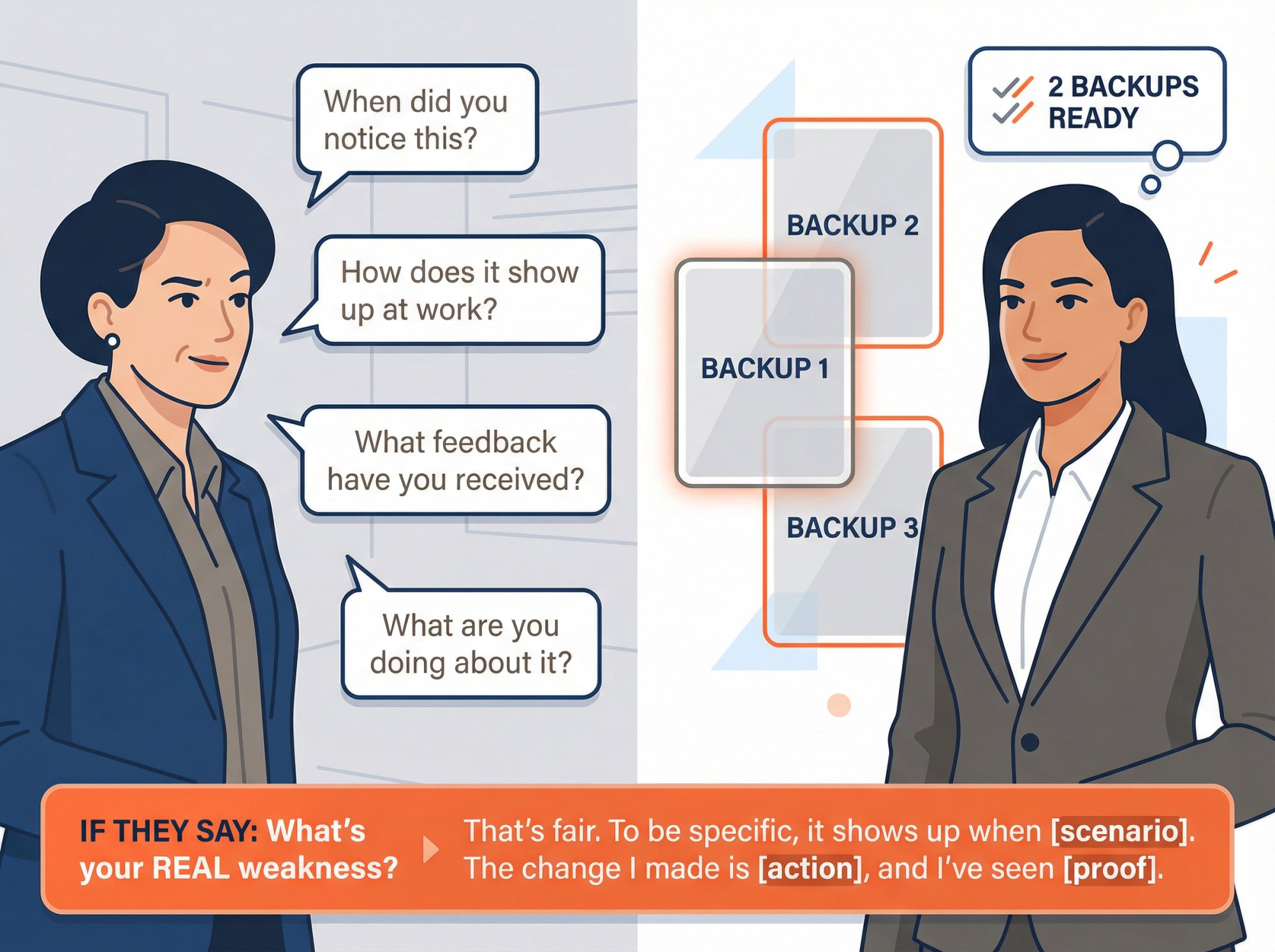
Expect follow-ups like:
→ "When did you notice this?"
→ "How does it show up at work?"
→ "What feedback have you received?"
→ "What are you doing about it?"
Career experts explicitly warn you may be asked for two or three weaknesses, so keep 2 backups ready.
If They Say: "What's Your Real Weakness?"
They suspect you gave a fake one. Respond with calm specificity:
"That's fair. To be specific, it shows up when [scenario]. The change I made is [action], and I've seen [proof]."
How to Practice Your Weakness Answer
Reading examples doesn't help if your brain blanks under pressure. Practice creates retrieval.
At AIApply, we emphasize that knowing the principle isn't the same as executing it under pressure. Structure prevents rambling.
The 10-Minute Drill (Do This Twice)
1. Write your weakness answer in 6 bullets (not a script)
2. Speak it out loud, 45 seconds max
3. Cut 20% of the words
4. Add 1 proof line (feedback, metric, or example)
5. Practice 3 variations:
20 seconds (phone screen)
45 seconds (normal)
75 seconds (if they ask follow-ups)
Use AIApply to Practice and Tailor Faster
AI Mock Job Interview: Paste the job description and rehearse with a tailored mock interview flow. Get instant feedback on your answers.
Interview Answer Buddy: Real-time guidance and transcription so you can stay calm when the question comes unexpectedly. The tool provides on-screen coaching during live interviews (discreetly, so your interviewer won't know).
Ethics note: These tools should help you stay structured and honest, not invent a persona you can't sustain on the job.
Try it yourself: See how the Mock Interview tool helps you practice this exact drill.
The Bottom Line
A great weakness answer is not "I'm secretly amazing." It's:
✓ Honest
✓ Controlled
✓ Improving
✓ Safe for the role
Research shows that structured interview preparation significantly improves candidate performance. When you do this right, the question stops being a trap and becomes a credibility boost.
FAQ: Your Greatest Weakness Questions Answered
Should my weakness be a real weakness or a "safe" one?
Real. But real, fixable, and non-fatal. "Safe" doesn't mean fake. It means it won't break the job. Pick something genuine that you're actively improving, just not something that would prevent you from doing the core responsibilities of the role.
Can I share a personal weakness?
You can, but professional or process weaknesses are usually safer because they're easier to prove you're improving. Skills-based weaknesses are often the most straightforward to fix and demonstrate.
How many weaknesses should I prepare?
Three. One main answer plus two backups (one skills-based, one process-based). Multiple sources confirm you might get asked for multiple weaknesses.
What if my real weakness IS a core job skill?
Pick a different weakness. Never choose something that directly contradicts the job's must-have skills. If you're applying for a content writer role, don't say "I struggle with writing." If it's data analysis, don't pick "I'm bad with numbers."
Is "I work too hard" or "I'm a perfectionist" okay?
No. These are the classic cliché answers that interviewers have heard thousands of times. They signal a lack of genuine reflection. Be specific instead. If perfectionism really is an issue, describe the behavior (like "I over-edit presentations late into the night") and your specific fix.
How long should my answer be?
Aim for 25-35 seconds for your core answer. Have a 60-second version ready if they ask follow-ups. Don't ramble. Use the Weakness-Action-Proof structure to stay focused.
Should I mention I'm using AI tools to prepare?
You don't need to. Tools like AIApply's Mock Interview and Interview Buddy are designed to help you practice and structure your thinking. They're preparation aids, like studying with flashcards or doing practice problems. Focus on delivering an authentic answer based on your real experiences.
What if they ask for a second weakness?
Have 2-3 prepared. Make sure they're in different categories (one execution-related, one communication-related, one skill-related). This shows breadth of self-awareness without sounding like you have too many problems.
Can I use humor in my answer?
Light humor can work if it's natural to your personality and the company culture is relaxed. But don't force it. The safest approach is genuine, professional, and improvement-focused. Save the jokes for building rapport elsewhere in the interview.
What if I genuinely can't think of a weakness?
Everyone has weaknesses. If you're stuck, think about feedback you've received from managers, peers, or mentors. Look at performance reviews. Ask yourself: What skill am I actively trying to improve? What makes me uncomfortable at work? Where do I feel less confident compared to others?
How do I show proof without bragging?
Be factual and specific. Instead of "I'm amazing at delegation now," say "I delegated a key project component last quarter and we finished ahead of schedule." Instead of "My communication is perfect," say "My manager's feedback improved from 'needs work on clarity' to 'communication is a strength' in my last review."
Should I prepare this answer differently for phone vs. video vs. in-person interviews?
The core answer stays the same. For phone screens, deliver a slightly shorter version (20-30 seconds). For video or in-person, you can take 30-45 seconds. The structure (Weakness-Action-Proof) works universally.
What if my weakness is something I'm still struggling with?
That's okay. Frame it as "I'm actively working on this and here's the progress so far." You don't need to be perfect at it yet. The key is showing that you've built a system and you're seeing improvement, even if it's incremental.
Can I use the same weakness answer for multiple job applications?
The structure can stay the same, but tailor the details slightly for each role. Make sure the weakness you choose isn't a dealbreaker for that specific job. For a sales role, your weakness answer might differ from an engineering role answer.
What if they follow up with "What have you learned from this weakness?"
This is perfect. Double down on the growth narrative. Explain what the experience taught you about yourself, your work style, or how you approach challenges. This reinforces that you're self-aware and continuously improving.
Practice With Confidence
At AIApply, we help job seekers prepare for every stage of the interview process. Whether you're using our Resume Builder to create ATS-friendly resumes, our Cover Letter Generator to craft compelling applications, or our Auto Apply feature to submit hundreds of tailored applications, we're with you every step of the way.
Ready to practice your weakness answer? Try our AI Mock Interview tool today. Upload your target job description, rehearse with realistic questions, and get instant feedback. When it's time for the real interview, our Interview Buddy Chrome extension provides real-time guidance to keep you confident and on track.
Your next interview is your opportunity to show growth, self-awareness, and resilience. You've got this.
You're sitting across from your interviewer. Things are going well. Then they lean forward and ask: "What's your greatest weakness?"
Your brain freezes. Do they want honesty or strategy? A real flaw or a humble-brag? And how do you possibly answer without tanking your chances?
If you've ever felt this panic, you're not alone. This question isn't designed to catch you off guard, but it feels that way. The truth is simpler than you think: interviewers are testing whether you understand your own operating system and whether you've built a fix for the parts that sometimes glitch.
This guide gives you everything you need to nail this question:
• A simple three-part answer framework that prevents rambling
• A "safe weakness" selection system so you don't disqualify yourself
• 30+ ready-to-use answer examples with role-specific guidance
• Common mistakes that make interviewers cringe (and how to avoid them)
• How to practice using AIApply's Mock Interview and Interview Buddy tools
The goal? Turn this dreaded question into your moment to shine.
Why Do Interviewers Ask About Your Weaknesses?
Let's start with first principles. When someone asks about your greatest weakness, they're not collecting ammunition to eliminate you. Research shows they're looking for three specific signals:
Signal 1: Self-Awareness
Can you see yourself clearly? If you can't name a real weakness, you might also ignore feedback, repeat mistakes, or deflect blame. Career experts frame this as a basic self-awareness test.
Think about it from their perspective. Every candidate has weaknesses. Pretending you don't is a bigger red flag than admitting you do.
Signal 2: Growth Mindset
Do you have a working improvement loop? A weakness without a plan signals stagnation. A weakness with a plan demonstrates maturity. Many companies use structured interview rubrics to evaluate candidates, and the "I noticed, I changed, here's proof" structure is exactly what those rubrics reward.
Signal 3: Job Fit
Does your weakness threaten the role's core outcomes? According to NACE's Job Outlook 2025 survey, employers prioritize problem-solving (88.3%), teamwork (81.0%), and communication when hiring. If you're applying for a sales role, don't say you struggle with cold outreach. If you're interviewing for an accounting position, don't admit you miss details.
The real game: Pick a weakness that is real, fixable, and not fatal for the job.
How to Answer "What Is Your Greatest Weakness?"
We've analyzed hundreds of successful weakness answers at AIApply. The ones that consistently work follow a simple three-part structure:
W-A-P = Weakness → Action → Proof
1. Name the weakness (specific, not a cliché)
Be direct. One sentence. No drama.
2. Show the control you built (process, tool, habit, training)
What did you change? Tools, habits, training, feedback loops.
3. Prove it's improving (result, feedback, metric, example)
What improved? Metric, result, feedback, concrete example.
Interview guidance literally frames the question as "weakness plus steps you're taking to improve." This structure maps perfectly to what interviewers are scoring.
Here's the template you can customize:
"One area I've been improving is [specific weakness]. I noticed it showed up when [specific situation]. So I started [specific fix], and now [proof of improvement]. I'm still improving it, but I'm much more consistent than I was."
Target delivery time: 25-35 seconds for the core answer. Have a 60-second version ready if they ask follow-ups.
How to Choose a Weakness for Job Interviews
Before you choose a weakness, run it through these filters:
Filter 1: Is it non-fatal for this role?
If the job is customer support, don't choose "I get frustrated with people." If it's data analysis, don't pick "I struggle with numbers." Career coaches consistently emphasize this as the foundational rule.
Filter 2: Can I show an actual fix I'm already doing?
Courses. Checklists. Rehearsal. Feedback loops. Tooling. Mentors. Anything concrete. Research confirms that pairing a weakness with specific improvement actions reflects extremely well on candidates.
Filter 3: Can I give proof?
Even light proof works. "My manager's feedback improved." "I've hit deadlines consistently since." "I now send weekly updates." The proof doesn't need to be dramatic, it just needs to be real.
Here's what makes the difference:
A weakness paired with action and proof tells interviewers you're honest, coachable, and improving. A weakness alone leaves a negative impression hanging.
Quick Weakness Scorecard
When you're torn between options, rate each weakness on these dimensions (0-2 points each):
Pick a weakness that totals 4-6 points and has impact ≤ 1.
Biggest Mistakes When Answering This Question
Mistake 1: "I'm a perfectionist"
This is a meme answer. Interviewers have heard it thousands of times. Career experts explicitly warn against vague clichés. Better approach: describe the specific behavior (like "I over-edit presentations late into the night") and the fix.
Mistake 2: "I don't have weaknesses"
This reads as low self-awareness or low honesty. Interview guidance straight-up tells candidates not to list a weakness without improvement steps. The entire setup assumes you have flaws.
Mistake 3: Picking a weakness that's a job requirement
You're basically announcing "I can't do the thing you're hiring me to do." Use the career coach logic: pick something true but not core to success in the role.
Mistake 4: Stopping at the weakness
If you name a weakness and then go silent, you've just left a negative hanging in the air. Always follow through with your improvement actions and results.
30+ Greatest Weakness Answer Examples by Category
Each example includes the weakness, the fix, and a ready-to-say script. Steal the structure, then swap details so it sounds like you.
Category A: Execution & Productivity
1. Over-Committing (Hard Time Saying No)
When to use: You're reliable but learning boundaries
When to avoid: Role demands ruthless prioritization and you can't show a system
Script:
"I used to say yes too quickly, especially when teammates needed help, and I'd overload my week. I started doing a quick priority check (what's due, what's blocked, what's the impact) before committing. Now I'll either negotiate the deadline or propose an alternative, and I've been much more consistent about delivering without crunch."
Job search experts recommend pairing this with an organization system to show you've built sustainable habits.
2. Time Estimation on Long Projects
Script:
"I've had to improve my time estimation on longer projects. I used to underestimate edge cases and stakeholder alignment time. Now I break work into smaller milestones, add a buffer for unknowns, and do a mid-week recalibration based on actual progress. It's reduced last-minute surprises and helped me communicate timelines more clearly."
3. Procrastination (Fear of Starting Big Tasks)
When to use: You've built a habit system
Script:
"When a task is ambiguous or high-stakes, I used to delay starting because I wanted the 'perfect' first attempt. What fixed it was forcing a 30-minute 'ugly first draft' session and then iterating. I'm much faster to momentum now, and the quality is actually higher because I'm not compressing everything at the end."
Research lists procrastination as a legitimate weakness when paired with action and result.
4. Prioritization (Everything Feels Urgent)
Script:
"I've had to get better at prioritizing when multiple things land at once. I used to treat everything as urgent. Now I triage by impact, urgency, and dependency (what unblocks others first). I also confirm priorities with my manager early instead of guessing. It's made my weeks calmer and my output more predictable."
5. Getting Stuck in Details
When to use: Role values quality but needs pace
Script:
"I can sometimes over-focus on details longer than necessary. I've learned to timebox reviews and do a quick 'definition of done' check before going deeper. That keeps quality high without slowing the team."
Interview experts explicitly list "focus too much on details" and recommend explaining how you refocus on the bigger picture.
6. Asking for Help Too Late
When to use: You're independent but now collaborate earlier
Script:
"I used to try to solve things solo for too long before asking for help, which wastes time. Now I have a simple rule: if I'm stuck for 30-45 minutes, I ask a clear question with what I tried. It speeds up delivery and actually improves my learning."
Research shows that framing asking for help as a self-awareness skill prevents bottlenecks.
Category B: Communication Weaknesses (Safe Versions)
Communication matters. NACE's Job Outlook 2025 lists written and verbal communication as key attributes employers seek. If you pick a communication weakness, keep it narrow and show a fix fast.
7. Too Much Detail in Explanations (Rambling)
Script:
"I've had to learn to communicate more concisely, especially when I'm excited about a topic. Now I lead with the headline first, then the 2-3 supporting points, then I ask if they want details. It's helped me be clearer in meetings and written updates."
8. Hesitating to Speak Up Early
Especially with senior people
Script:
"Earlier in my career, I sometimes held back ideas in meetings with senior people because I didn't want to be wrong. I've worked on it by preparing one or two points in advance and asking clarifying questions early. Now I'm more consistent about contributing and aligning quickly."
9. Written Communication Tone
Too blunt or too soft
Script:
"I've been improving my written communication, making it clear without sounding abrupt. I now re-read messages with a 'could this be misread?' lens and I use short bullets plus explicit asks. It's reduced back-and-forth and made collaboration smoother."
10. Public Speaking Nerves
Only if public speaking is not core to the role
Script:
"Public speaking used to make me nervous, so I avoided it. I started practicing in smaller settings (team demos, internal updates) and deliberately taking more reps. I'm still not the loudest person in the room, but I'm much more confident presenting clearly."
Career coaches emphasize this is safe for some roles, risky for others.
Category C: Collaboration & Teamwork
Teamwork is also a top employer priority. Keep these framed as "I learned a better approach."
11. Difficulty Delegating (For New Managers)
Script:
"When I first started leading projects, I held onto too much work because I wanted it done perfectly. I've improved by delegating outcomes instead of tasks (clear expectations, a check-in cadence, and ownership). It's helped the team grow and helped me focus on higher-impact work."
12. Giving Tough Feedback
Script:
"I used to avoid giving direct constructive feedback because I didn't want tension. I've learned to frame feedback around impact and shared goals, and to do it early rather than letting issues pile up. It's made collaboration cleaner and prevents small problems from becoming big ones."
13. Working With Very Aggressive Personalities
Script:
"I've had to improve how I collaborate with very forceful communication styles. I used to go quiet and then follow up later. Now I ask clarifying questions in the moment and summarize decisions in writing so we stay aligned. It keeps projects moving and makes the team dynamic healthier."
Category D: Learning & Skill-Gap Weaknesses
These are "functional weaknesses" (skill deficiencies you can learn). They're often safer than personality flaws.
Interview experts explicitly recommend skills-based weaknesses because you can take concrete steps to improve.
14. Limited Experience With a Specific Tool
Tool is helpful, not required day one
Script:
"One skill I've been building is [tool name]. I've used adjacent tools, but not that one deeply yet. I've been taking a structured course and applying it in small projects so I'm not learning only in theory. I'm already comfortable with the fundamentals, and I'm excited to ramp quickly."
15. Rusty With Advanced Excel or Reporting
Role isn't heavy modeling, or you can show progress
Script:
"I'm solid in the basics of Excel, but I'm strengthening advanced formulas and more complex reporting. I've been working through practice sets weekly and rebuilding past reports with cleaner logic. I've already gotten faster and more confident."
Interview experts even provide a skills-based Excel example with "courses plus volunteering to use it at work."
16. Limited Domain Knowledge (Industry Switch)
Script:
"Since I'm transitioning into [industry], my gap has been deeper domain context. I've been closing it by reading analyst briefings, following key companies, and doing small side projects that mirror real workflows. I'm not pretending I know everything yet, but I'm ramping fast and I've built a system to keep learning."
17. Not Enough Experience Yet (Entry-Level)
Script:
"Honestly, my biggest gap is that I don't have years of full-time experience yet. But I've been proactive (internships, projects, and feedback loops) so I'm not starting from zero. I'm very coachable, and I learn fast when I get real-world reps."
Category E: Stress & Resilience Weaknesses
Don't overshare. Keep it professional: "I improved my system."
18. Handling Stress (Used to Push Too Hard)
Script:
"I used to handle stress by just pushing harder, which isn't sustainable. I've improved by planning earlier, breaking work into milestones, and communicating risks sooner. The result is I'm more consistent and less reactive under pressure."
Research includes burnout-adjacent weaknesses like self-criticism and emphasizes showing growth actions.
19. Self-Criticism
Script:
"I can be overly self-critical, which can slow me down. I've improved by setting clear success criteria upfront and doing quick retros after delivery instead of replaying mistakes in my head. It helps me learn without spiraling."
Category F: "Elephant in the Room" Weaknesses
Sometimes the "weakness" is obvious from your resume. You can use this question to address it calmly, then pivot to proof.
20. Employment Gap
Script:
"You'll notice a gap in my timeline. During that period, I focused on [learning/certifications/family responsibility], and I kept my skills sharp through [project/volunteer/freelance]. I'm fully ready to return to full-time work, and I can walk you through what I built during that time."
21. No Formal Degree (Or Unrelated Degree)
Script:
"I don't have a formal degree in [field], so early on that was a gap. I've addressed it by building real projects, getting feedback from professionals, and learning through structured coursework. The proof is in [portfolio/results]."
Greatest Weakness Answers by Job Role
These are designed to be safe for each role's typical must-haves.
Software Engineer
Avoid: "I struggle with debugging," "I miss details," "I hate code reviews"
Good pick: "I used to jump into solving before clarifying requirements"
Script:
"I used to start coding too quickly before confirming edge cases and acceptance criteria. I've improved by writing a short 'assumptions plus tests' note before implementation and confirming it early. It reduces rework and makes my delivery more predictable."
Learn more about software engineering careers
Data Analyst
Avoid: "Data visualization is my weakness" (if the job is viz-heavy)
Good pick: "Stakeholder storytelling"
Script:
"I'm strong at analysis, but early on I'd over-focus on the technical details instead of the story. I've improved by leading with the decision first, then 2-3 insights, then the supporting data. It's made my work land better with non-technical teams."
Explore data analyst positions
Product Manager
Avoid: "I'm disorganized," "I hate ambiguity"
Good pick: "Saying yes too fast to requests"
Script:
"I used to say yes too quickly to stakeholder asks, which can dilute focus. I now use a simple intake: what's the user impact, what's the cost, what does it trade off. It helps me protect priorities while still being collaborative."
Sales or Business Development
Avoid: "I'm shy," "I dislike cold calling"
Good pick: "Qualifying too late (learning to disqualify faster)"
Script:
"Early on, I spent too long on leads that weren't a fit because I wanted to be helpful. I've improved by qualifying earlier (budget, timeline, pain, and authority) so I invest time where there's real value. It's improved my pipeline hygiene and follow-through."
Customer Support or Customer Success
Avoid: "I get frustrated with people," "I struggle to communicate"
Good pick: "I used to over-own issues instead of escalating early"
Script:
"I used to try to resolve everything myself before escalating, which can slow resolution. I now escalate earlier when there's risk or complexity and I communicate timelines more explicitly. Customers get faster outcomes and fewer surprises."
Explore customer service careers
Operations or Project Management
Avoid: "I'm bad at prioritizing," "I miss deadlines"
Good pick: "Too much perfection in documentation"
Script:
"I can over-polish documentation. I've improved by using templates and 'good enough' standards for internal docs, then iterating only if they're actually used. It keeps the team moving while still staying organized."
How to Handle Follow-Up Questions About Weaknesses
Expect follow-ups like:
→ "When did you notice this?"
→ "How does it show up at work?"
→ "What feedback have you received?"
→ "What are you doing about it?"
Career experts explicitly warn you may be asked for two or three weaknesses, so keep 2 backups ready.
If They Say: "What's Your Real Weakness?"
They suspect you gave a fake one. Respond with calm specificity:
"That's fair. To be specific, it shows up when [scenario]. The change I made is [action], and I've seen [proof]."
How to Practice Your Weakness Answer
Reading examples doesn't help if your brain blanks under pressure. Practice creates retrieval.
At AIApply, we emphasize that knowing the principle isn't the same as executing it under pressure. Structure prevents rambling.
The 10-Minute Drill (Do This Twice)
1. Write your weakness answer in 6 bullets (not a script)
2. Speak it out loud, 45 seconds max
3. Cut 20% of the words
4. Add 1 proof line (feedback, metric, or example)
5. Practice 3 variations:
20 seconds (phone screen)
45 seconds (normal)
75 seconds (if they ask follow-ups)
Use AIApply to Practice and Tailor Faster
AI Mock Job Interview: Paste the job description and rehearse with a tailored mock interview flow. Get instant feedback on your answers.
Interview Answer Buddy: Real-time guidance and transcription so you can stay calm when the question comes unexpectedly. The tool provides on-screen coaching during live interviews (discreetly, so your interviewer won't know).
Ethics note: These tools should help you stay structured and honest, not invent a persona you can't sustain on the job.
Try it yourself: See how the Mock Interview tool helps you practice this exact drill.
The Bottom Line
A great weakness answer is not "I'm secretly amazing." It's:
✓ Honest
✓ Controlled
✓ Improving
✓ Safe for the role
Research shows that structured interview preparation significantly improves candidate performance. When you do this right, the question stops being a trap and becomes a credibility boost.
FAQ: Your Greatest Weakness Questions Answered
Should my weakness be a real weakness or a "safe" one?
Real. But real, fixable, and non-fatal. "Safe" doesn't mean fake. It means it won't break the job. Pick something genuine that you're actively improving, just not something that would prevent you from doing the core responsibilities of the role.
Can I share a personal weakness?
You can, but professional or process weaknesses are usually safer because they're easier to prove you're improving. Skills-based weaknesses are often the most straightforward to fix and demonstrate.
How many weaknesses should I prepare?
Three. One main answer plus two backups (one skills-based, one process-based). Multiple sources confirm you might get asked for multiple weaknesses.
What if my real weakness IS a core job skill?
Pick a different weakness. Never choose something that directly contradicts the job's must-have skills. If you're applying for a content writer role, don't say "I struggle with writing." If it's data analysis, don't pick "I'm bad with numbers."
Is "I work too hard" or "I'm a perfectionist" okay?
No. These are the classic cliché answers that interviewers have heard thousands of times. They signal a lack of genuine reflection. Be specific instead. If perfectionism really is an issue, describe the behavior (like "I over-edit presentations late into the night") and your specific fix.
How long should my answer be?
Aim for 25-35 seconds for your core answer. Have a 60-second version ready if they ask follow-ups. Don't ramble. Use the Weakness-Action-Proof structure to stay focused.
Should I mention I'm using AI tools to prepare?
You don't need to. Tools like AIApply's Mock Interview and Interview Buddy are designed to help you practice and structure your thinking. They're preparation aids, like studying with flashcards or doing practice problems. Focus on delivering an authentic answer based on your real experiences.
What if they ask for a second weakness?
Have 2-3 prepared. Make sure they're in different categories (one execution-related, one communication-related, one skill-related). This shows breadth of self-awareness without sounding like you have too many problems.
Can I use humor in my answer?
Light humor can work if it's natural to your personality and the company culture is relaxed. But don't force it. The safest approach is genuine, professional, and improvement-focused. Save the jokes for building rapport elsewhere in the interview.
What if I genuinely can't think of a weakness?
Everyone has weaknesses. If you're stuck, think about feedback you've received from managers, peers, or mentors. Look at performance reviews. Ask yourself: What skill am I actively trying to improve? What makes me uncomfortable at work? Where do I feel less confident compared to others?
How do I show proof without bragging?
Be factual and specific. Instead of "I'm amazing at delegation now," say "I delegated a key project component last quarter and we finished ahead of schedule." Instead of "My communication is perfect," say "My manager's feedback improved from 'needs work on clarity' to 'communication is a strength' in my last review."
Should I prepare this answer differently for phone vs. video vs. in-person interviews?
The core answer stays the same. For phone screens, deliver a slightly shorter version (20-30 seconds). For video or in-person, you can take 30-45 seconds. The structure (Weakness-Action-Proof) works universally.
What if my weakness is something I'm still struggling with?
That's okay. Frame it as "I'm actively working on this and here's the progress so far." You don't need to be perfect at it yet. The key is showing that you've built a system and you're seeing improvement, even if it's incremental.
Can I use the same weakness answer for multiple job applications?
The structure can stay the same, but tailor the details slightly for each role. Make sure the weakness you choose isn't a dealbreaker for that specific job. For a sales role, your weakness answer might differ from an engineering role answer.
What if they follow up with "What have you learned from this weakness?"
This is perfect. Double down on the growth narrative. Explain what the experience taught you about yourself, your work style, or how you approach challenges. This reinforces that you're self-aware and continuously improving.
Practice With Confidence
At AIApply, we help job seekers prepare for every stage of the interview process. Whether you're using our Resume Builder to create ATS-friendly resumes, our Cover Letter Generator to craft compelling applications, or our Auto Apply feature to submit hundreds of tailored applications, we're with you every step of the way.
Ready to practice your weakness answer? Try our AI Mock Interview tool today. Upload your target job description, rehearse with realistic questions, and get instant feedback. When it's time for the real interview, our Interview Buddy Chrome extension provides real-time guidance to keep you confident and on track.
Your next interview is your opportunity to show growth, self-awareness, and resilience. You've got this.
.webp)
.webp)
Don't miss out on
your next opportunity.
Create and send applications in seconds, not hours.


