
Working Interview: What to Expect (2026)

.webp)
You're about to walk into a working interview and your hands are a bit sweaty. This isn't like your typical job interview where you sit across from someone answering questions. This time, you'll actually be doing the work. And somewhere in the back of your mind, you're wondering: Am I about to get exploited for free labor, or is this a legitimate way to land a job?
Both concerns are valid. A working interview (also called a trial shift, job trial, or working audition) sits in that uncomfortable space between "proving yourself" and "being used." But when done right, it's actually one of the most valuable parts of the hiring process for both sides.
This guide will help you understand exactly what you're walking into, what's legal, and how to absolutely crush it.

What Is a Working Interview?
A working interview is when an employer evaluates you by watching you perform actual job tasks in a real work environment. Think of it as the difference between describing how you'd make a perfect espresso versus actually pulling shots while a hiring manager watches. It's usually an intensive day (or half-day) where both sides can assess fit beyond what a traditional interview reveals.
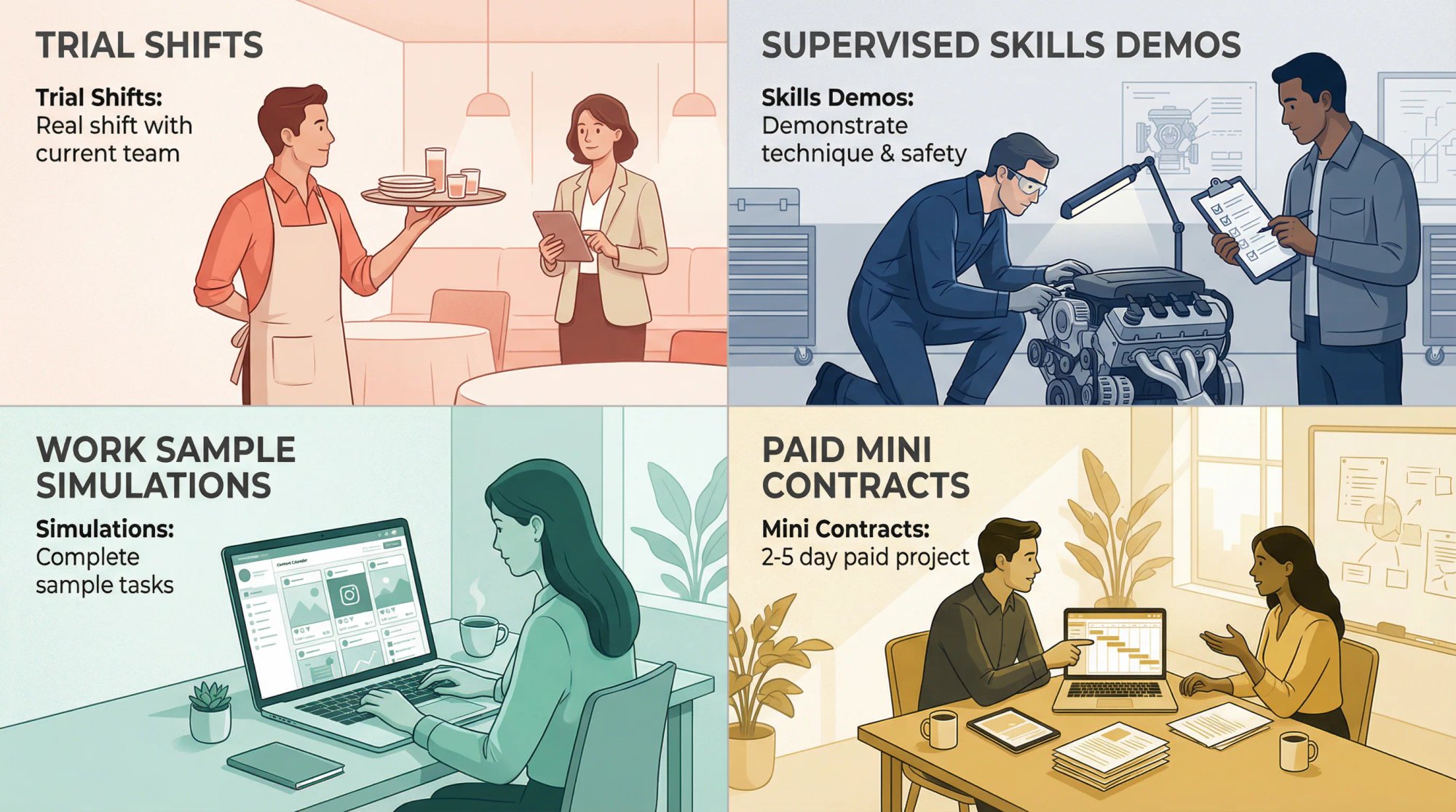
You might encounter this in several forms:
Trial shifts are common in hospitality manager, retail manager, and healthcare administrator roles. You work part of a real shift alongside current employees. A restaurant might have you shadow a server during lunch rush, then handle tables yourself during the slower afternoon.
Supervised skills demos happen in trades and hands-on roles. A salon might watch you do a haircut. A mechanic shop might ask you to diagnose an actual vehicle problem. The focus is on technique and safety awareness.
Work sample simulations are popular in office jobs. Marketing manager candidates might draft social media copy. Customer service representative candidates might handle mock tickets. Sales representative might roleplay client calls.
Paid mini contracts are used by startups and for senior roles. A paid 2-5 day work trial where you collaborate with the actual team on real projects.
Talk is cheap. Work is signal.
Employers use working interviews because standard interviews don't always reveal how you actually execute under pressure, how you learn on the fly, how you communicate while doing (not just talking about doing), and whether you're someone the team would enjoy working with daily.
What Employers Test During Working Interviews
Most candidates think the test is "can I do the task?" But that's only part of it. Employers are watching how you work, not just what you produce.
Here's what's really being evaluated:
Baseline competence matters, obviously. Can you perform core tasks at an acceptable quality level? But perfection isn't the standard. Competence is.
Speed versus quality judgment shows maturity. Do you know when "fast enough" beats "perfect"? A software developer who takes 3 hours to perfectly format code that needed to ship in 90 minutes failed the real test. Conversely, a dental assistant who rushes through sterilization to "save time" just failed the safety test.
Learning curve reveals how you handle gaps in knowledge. When you don't know something, do you freeze, fake it, or ask a clean question and move forward? One of these options makes you hireable. The other two don't.
Communication while working separates good employees from frustrating ones. Do you narrate decisions ("I'm starting with X because it reduces risk"), confirm assumptions ("I'm assuming Y, correct me if that's wrong"), and flag risks early? Or do you work in silence and hope for the best?
Reliability signals are always being observed. Punctuality, preparation, following safety protocols, respecting workplace norms. These aren't "extra credit." They're minimum requirements.
Culture fit matters more than people admit. Job trials are also a vibe check. Would the current team want to work with you? This isn't about being everyone's best friend. It's about being professional, coachable, and pleasant even when stressed.
Are Working Interviews Paid?
Short answer: You usually should be. But this is where things get legally murky, so we need to talk specifics.
Working Interview Laws by Region
United States: The Fair Labor Standards Act uses a concept called "suffer or permit to work." According to the Department of Labor, if an employer allows you to perform work that benefits them, that's generally compensable time. Massachusetts goes even more direct, stating candidates should typically be paid at least minimum wage for working interviews (guidance updated June 2025).
If they want you to work a real shift producing real value, expect it to be paid and clarify in writing.
United Kingdom: ACAS guidance (reviewed October 2024) says unpaid work trials should be "reasonable" (example: 2 hours or a shift) and "should not usually last longer than one day." GOV.UK adds detail: trials lasting longer than one day will "likely" trigger minimum wage requirements "in all but very exceptional circumstances."
Key UK factors: Is it genuinely for recruitment? Are you being observed? Are tasks relevant to the role? Does the work have value beyond testing? If it looks like you're covering staff shortage, that's not a trial.
Canada (Ontario): Crystal clear. Bill 149 received royal assent March 21, 2024. Ontario's government states plainly: "trial shifts are paid." Period.
Australia: Fair Work Ombudsman guidance says unpaid trials may be unlawful if they last longer than needed to demonstrate skills (could range from an hour to one shift) or if you're not under direct supervision. Any time beyond what's reasonably required must be paid.
How to Spot Working Interview Exploitation
Here's a simple mental model:
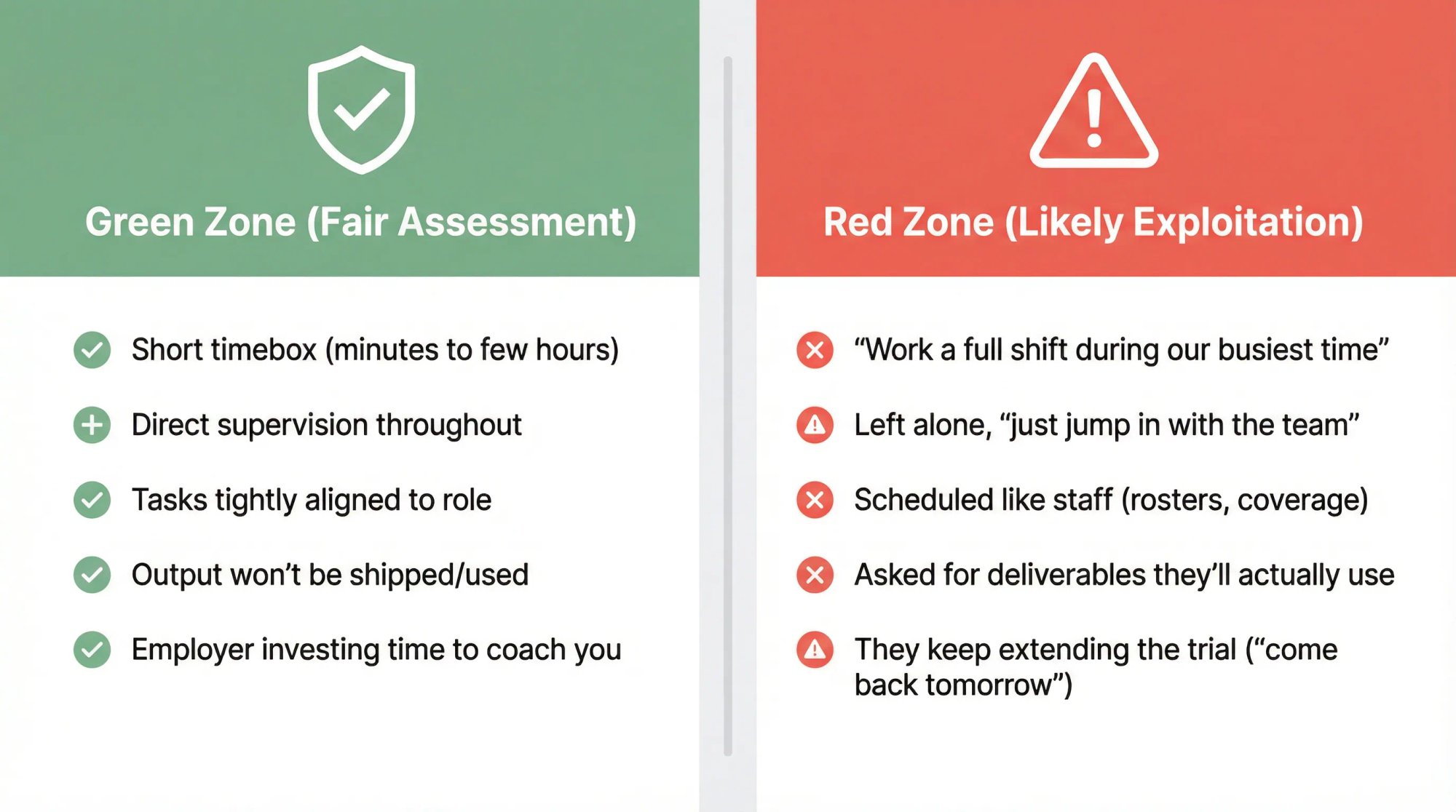
You should clarify expectations and compensation up front. If you see red-zone signals, you can still stay professional while protecting yourself.
Questions to Ask Before Accepting a Working Interview
Send these by email or ask on the scheduling call. You're not being "difficult" when you ask professional questions about a work arrangement:
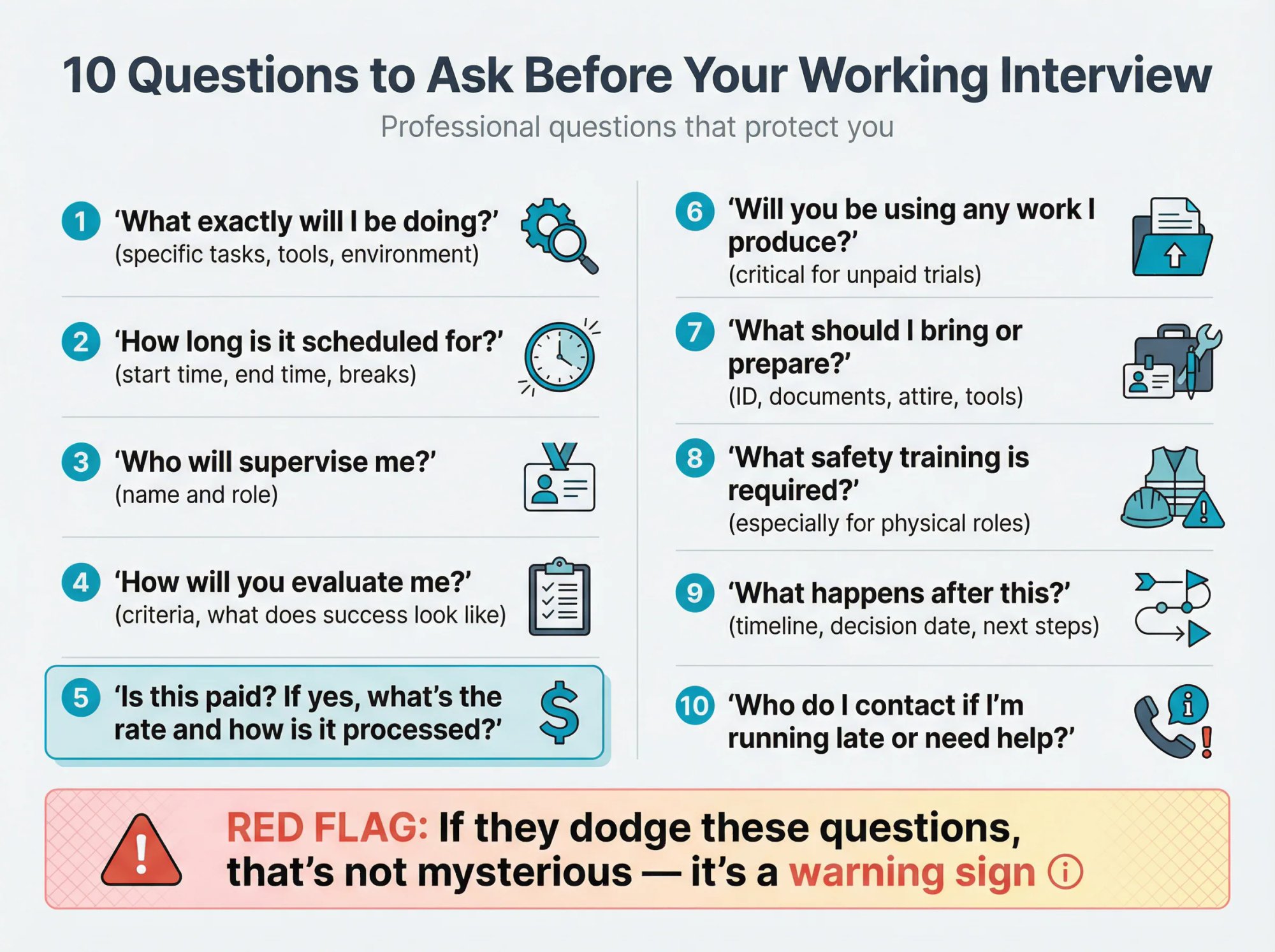
① What exactly will I be doing? (specific tasks, tools, environment)
② How long is it scheduled for? (start time, end time, breaks)
③ Who will supervise me? (name and role)
④ How will you evaluate me? (criteria, what does success look like)
⑤ Is this paid? If yes, what's the rate and how is it processed?
⑥ Will you be using any work I produce? (critical for unpaid trials)
⑦ What should I bring or prepare? (ID, documents, attire, tools)
⑧ What safety training is required? (especially for physical roles)
⑨ What happens after this? (timeline, decision date, next steps)
⑩ Who do I contact if I'm running late or need help?
If they dodge these questions, that's not "mysterious and exciting." That's a red flag the size of a billboard.
How to Prepare for a Working Interview in 24 Hours
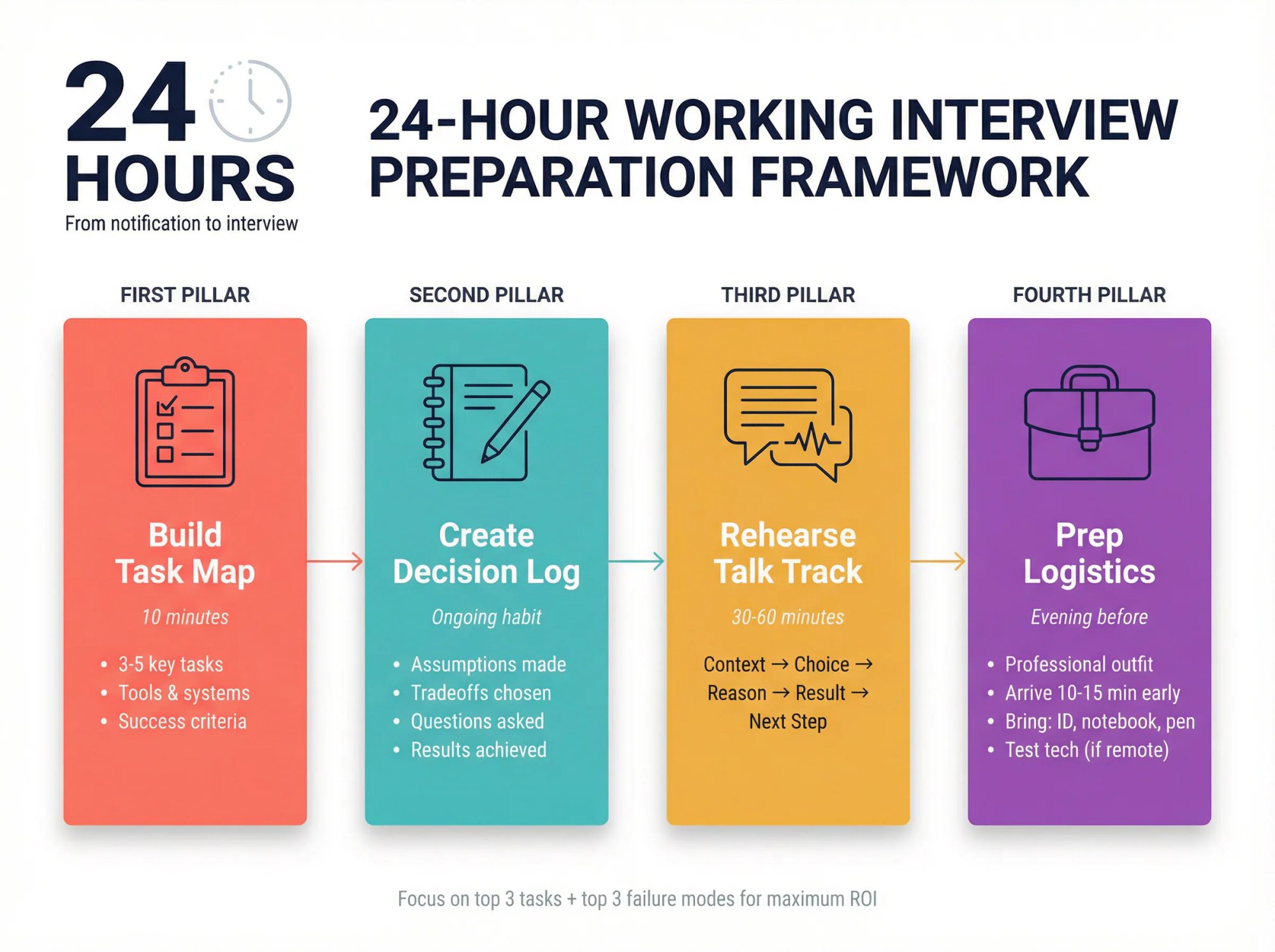
You don't need to prepare for everything. You need to prepare for the top 3 tasks and the top 3 failure modes for this specific role.
Build Your Task Map (10 Minutes)
Write down:
→ What are the 3-5 tasks I'll most likely be asked to do?
→ What tools or systems are involved?
→ What does "good" look like (speed, accuracy, tone, safety)?
This simple exercise transforms vague anxiety into concrete preparation.
Create a Decision Log Habit
During the trial, mentally (or physically) capture:
→ Assumptions I made
→ Tradeoffs I chose
→ Questions I asked
→ Results I got
This turns "I did stuff" into "I made good decisions backed by clear reasoning." That's what separates competent candidates from impressive ones.
Rehearse Your Talk Track
Working interviews still include mini interview moments. Someone will ask:
• "Why did you do it that way?"
• "What would you do next?"
• "What would you improve?"
Practice this simple structure: Context → Choice → Reason → Result → Next Step
Example: "The customer seemed frustrated (context), so I focused on solving their immediate problem first rather than following the usual diagnostic script (choice), because defusing emotion creates space for problem-solving (reason). They calmed down and we fixed the issue together (result). Next time I'd also loop in a supervisor earlier for complex cases (next step)."
AIApply's mock interview tool can help you structure these responses fast if you need a refresher.
Prep Your Logistics Like a Pro
→ Outfit that matches the role and environment
→ Arrive 10-15 minutes early (or log in early if remote)
→ Bring: ID, any certifications, notebook, pen
→ If remote: test camera, mic, screen share, backup internet
These aren't optional. They're the baseline that lets you focus on the work instead of logistics disasters.
What Happens During a Working Interview
Expect some version of this flow:
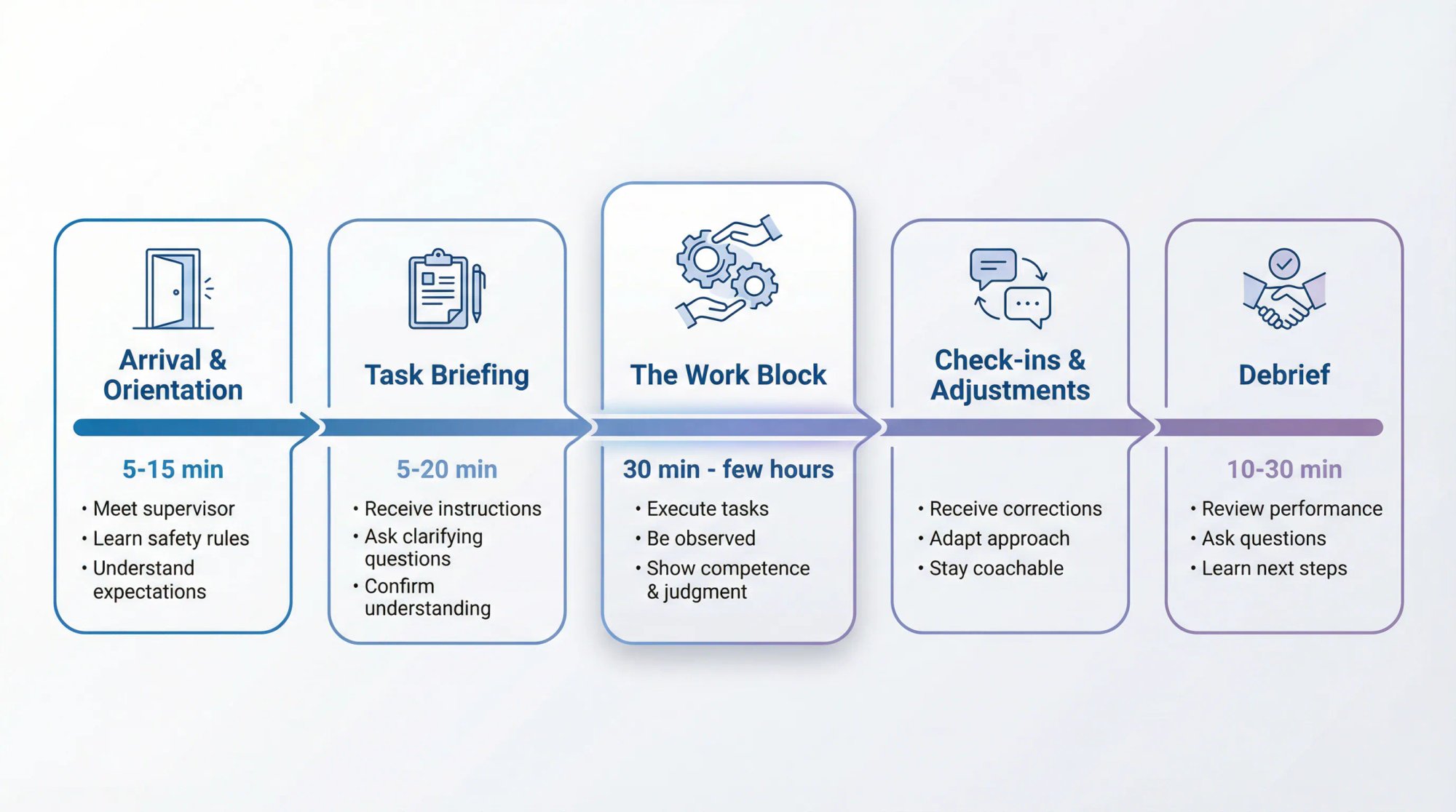
Arrival and Quick Orientation (5-15 minutes)
Who's supervising, what "good" looks like, where things are, safety and house rules. Pay attention. Questions you ask 10 minutes later that were just explained make you look inattentive.
Task Briefing (5-20 minutes)
You're given tasks, constraints, tools, and a timebox. Take notes. Confirm your understanding. This is your chance to clarify before you're expected to perform.
The Work Block (30 minutes to a few hours)
You execute while being observed. This is where everything happens. Your competence, judgment, communication, and professionalism are all on display simultaneously.
Check-ins and Adjustments
Good employers will correct you early. Take it as a gift, not criticism. When they say "actually, we do it this way," the right response is "got it, I'll adjust" not "but I thought..."
Debrief (10-30 minutes)
What went well, what they want clarified, next steps. This is your chance to ask thoughtful questions and end strong.
How to Excel During a Working Interview
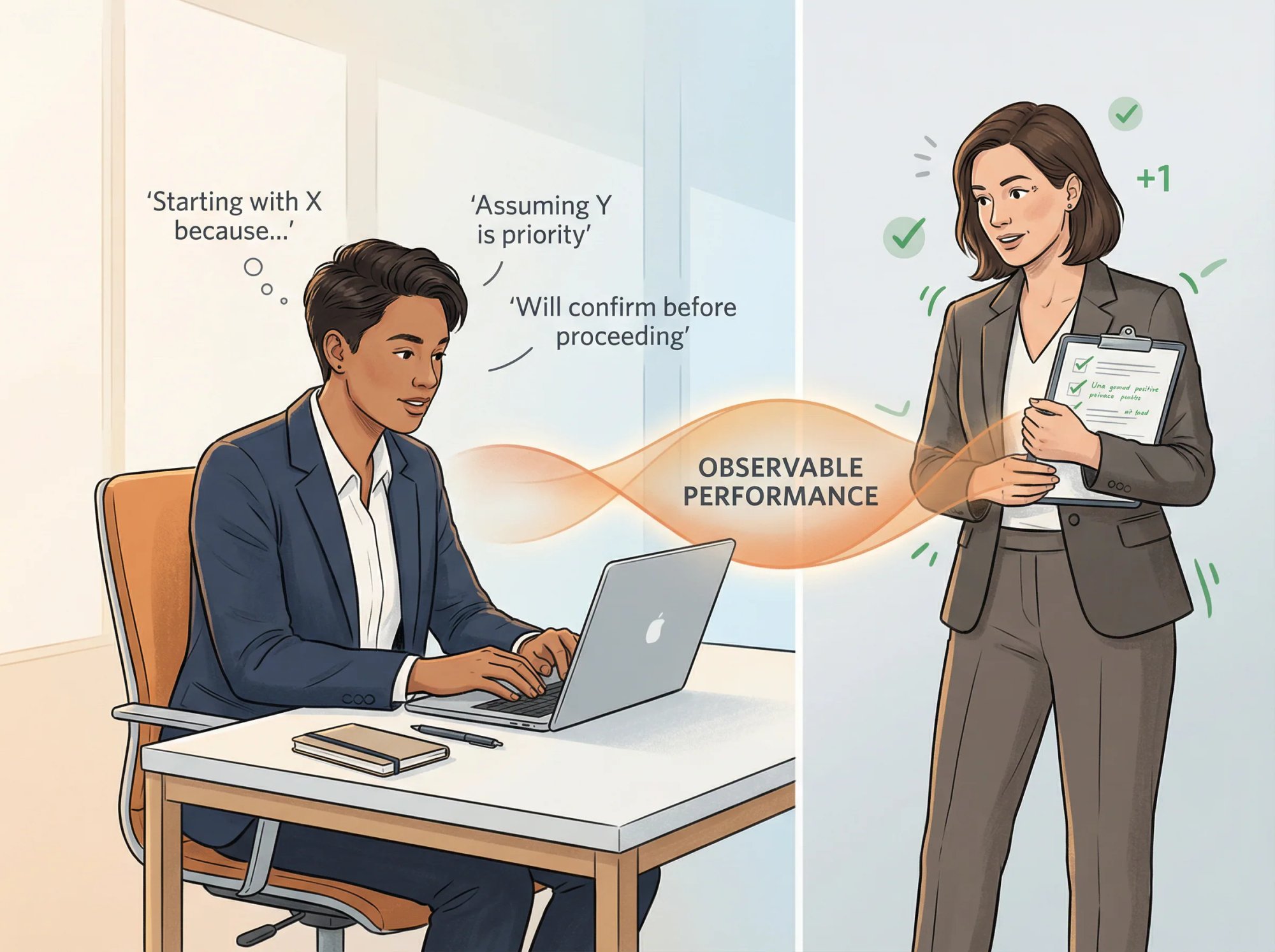
Make Your Work Observable
Silence reads as uncertainty. Narrate lightly while you work:
• "I'm starting with X because it reduces risk"
• "I'm assuming Y is the priority, correct me if I'm wrong"
• "I'll ship a quick draft, then polish if time allows"
This isn't about talking nonstop. It's about making your decision-making visible so they can see you think clearly under pressure.
Ask "One-Way Door vs Two-Way Door" Questions
High-signal question that shows judgment:
"Is this decision reversible? If not, I'll confirm before proceeding."
This one question demonstrates you understand that some mistakes are cheap to fix and some are expensive. Employers love this.
Recover Fast From Mistakes
Everyone makes mistakes. What separates good candidates from bad ones is recovery speed:
• Acknowledge it immediately
• Correct it quickly
• Explain the fix briefly
• Move forward confidently
Don't defend the mistake. Don't dwell on it. Fix it and show you learned from it.
Treat Feedback Like Fuel
When they correct you, don't defend your choice. Mirror their guidance:
"Got it, so you prefer X approach. I'll apply that going forward."
This shows you're coachable. Being coachable matters more than being initially perfect.
End With a Clean Debrief
Before you leave, ask:
• "What would make this a strong 'yes' for you?"
• "Any concerns I can address right now?"
• "What are the next steps and timeline?"
These questions show confidence and give you valuable information about where you stand.
How to Evaluate the Company During a Working Interview
A job trial is one of the rare times you can see the company's reality up close. Working interviews give candidates a real window into culture and fit, not just employers evaluating candidates.
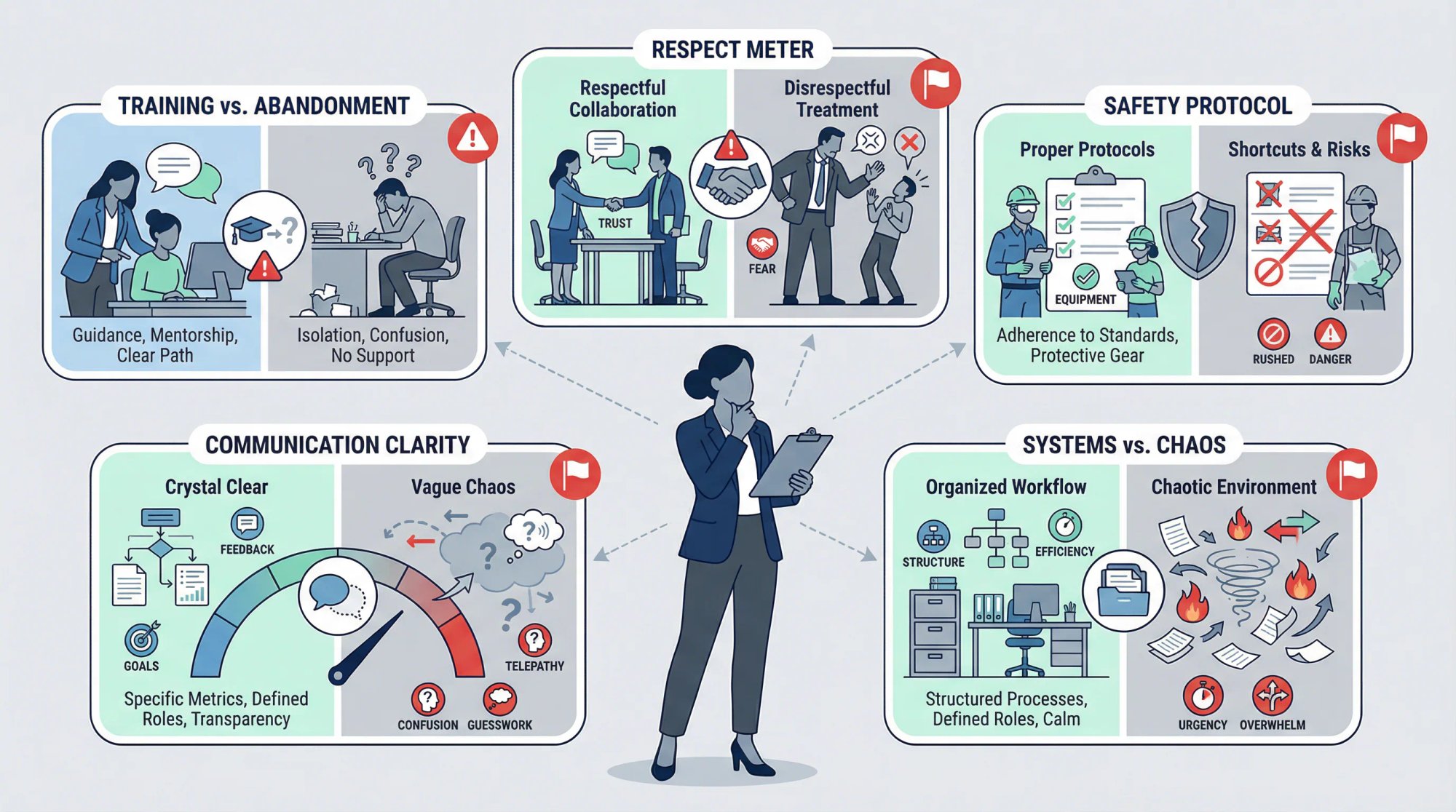
Watch for these signals:
Do they train or throw you in? Good employers provide context before expecting performance. Bad employers say "figure it out" and judge you for struggling.
Do they treat current staff with respect? If they're rude to their team while being nice to you, that's who they really are.
Do they cut corners on safety? Any employer who pressures you to skip safety protocols during a trial will absolutely do it after you're hired.
Do they communicate expectations clearly? Or is everything vague and you're expected to read minds?
Do they run on systems or chaos? Some chaos is fine. Constant chaos means poor management.
If you notice red flags, trust your gut. A job that seems wrong during the trial will definitely be wrong after you're hired.
How AIApply Helps You Prepare for Working Interviews
Working interviews reward preparation, and AIApply can help you prepare efficiently:
Generate Role-Specific Prep Materials Fast
Use AIApply's Resume Builder to align your resume to the exact role so your story matches what they're about to see in action. If you need to send a confirmation email or follow-up, the AI Cover Letter Generator can help you write something that sounds human, not templated.
Rehearse "Explain Your Choices" Questions
Use AIApply's Mock Interview tool: paste the job description and practice the questions that typically wrap around a working interview ("walk me through what you just did," "what would you improve," "why this approach?"). This rehearsal makes the debrief portion dramatically easier.
Get Live Support for the Verbal Part
If your working interview includes live Q&A (most do), AIApply's Interview Buddy is designed to provide real-time guidance during interviews. It won't do the physical work for you, but it can help you articulate your thinking more clearly in the moment.
Close Strong With Follow-Up
After the working interview, you'll want to send a thank-you note that reinforces your value. AIApply's thank-you email guide (published March 2025) provides templates you can customize while you're still fresh in their minds.
What to Send After a Working Interview
Within 4-24 Hours: Send a Tight Thank-You
Your goal is to show professionalism, remind them of your best moments, and reduce decision friction.
Here's a working-interview-specific template:
Subject: Thank you - Working interview for [Role] on [Date]Hi [Name],Thanks again for having me in today. I appreciated the chance to see the work up close and meet the team.Quick recap of what I completed:- [Task 1 + result]- [Task 2 + result]- [Task 3 + result]What I'd improve next time (if helpful):- [1 concrete improvement you'd make]If you'd like, I can also share a brief note on [relevant idea/process] that could help with [team goal].What are the next steps and expected timeline?Thanks,[Your Name][Phone]This format reminds them what you delivered while showing self-awareness and continued interest.
If They Go Quiet: Follow Up Strategically
AIApply's follow-up email guide (published May 2025) includes multi-touch follow-up strategies. The key is persistence without desperation.
Wait until any stated decision date passes, then send one polite check-in. If you don't hear back after that, it's probably a soft no. But you did everything right by following up professionally.
Working Interview Scripts You Can Use
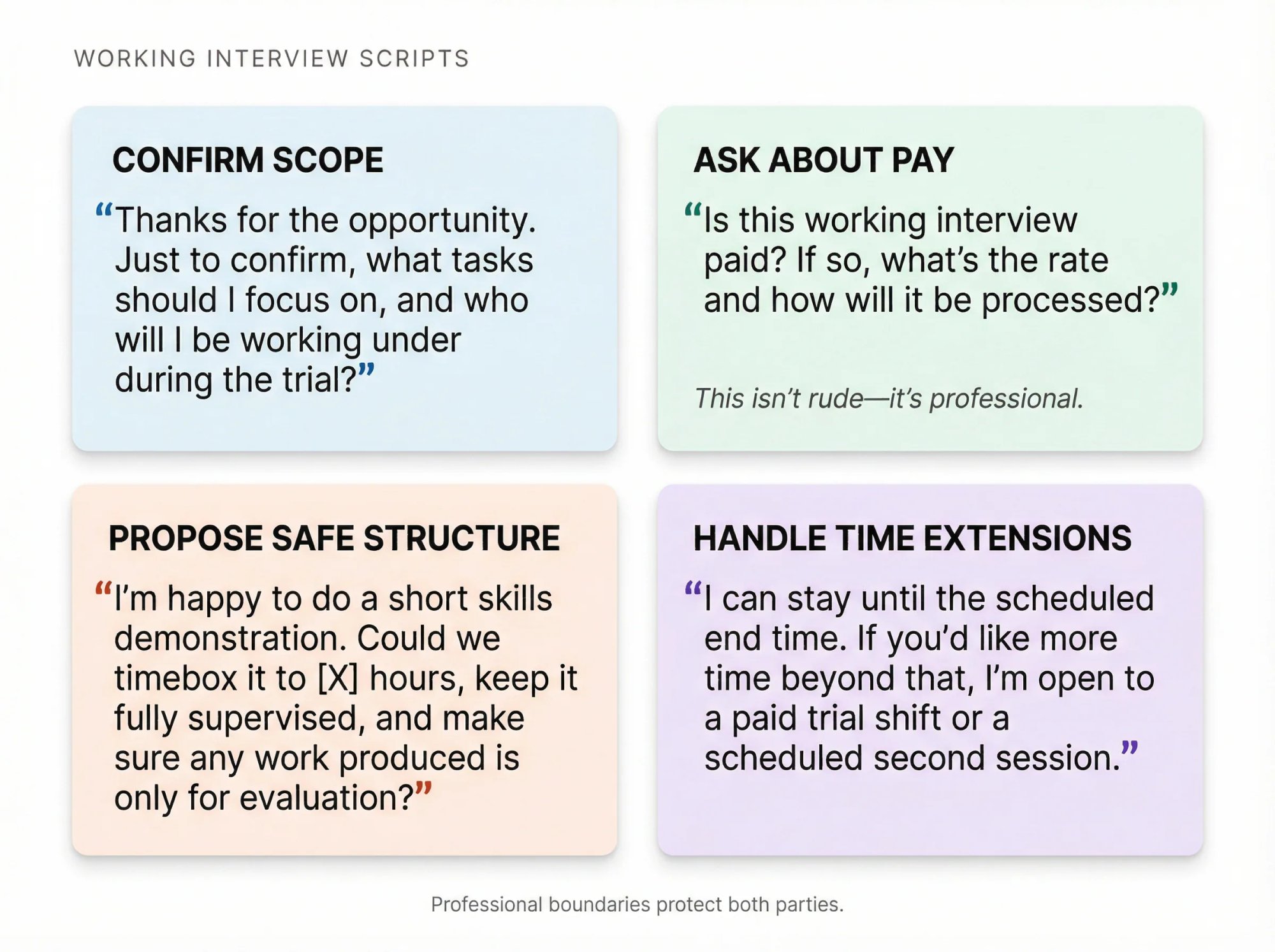
Confirm Scope and Supervision
"Thanks for the opportunity. Just to confirm, what tasks should I focus on, and who will I be working under during the trial?"
Ask About Pay Directly
"Is this working interview paid? If so, what's the rate and how will it be processed?"
This isn't rude. It's professional and necessary to clarify compensation up front.
If It's Unpaid, Propose a Safe Structure
"I'm happy to do a short skills demonstration. Could we timebox it to [X] hours, keep it fully supervised, and make sure any work produced is only for evaluation?"
If They Extend the Time on the Day
"I can stay until the scheduled end time. If you'd like more time beyond that, I'm open to a paid trial shift or a scheduled second session."
These scripts protect you without burning bridges. Professional boundaries aren't rude. They're necessary.
Working Interview FAQ
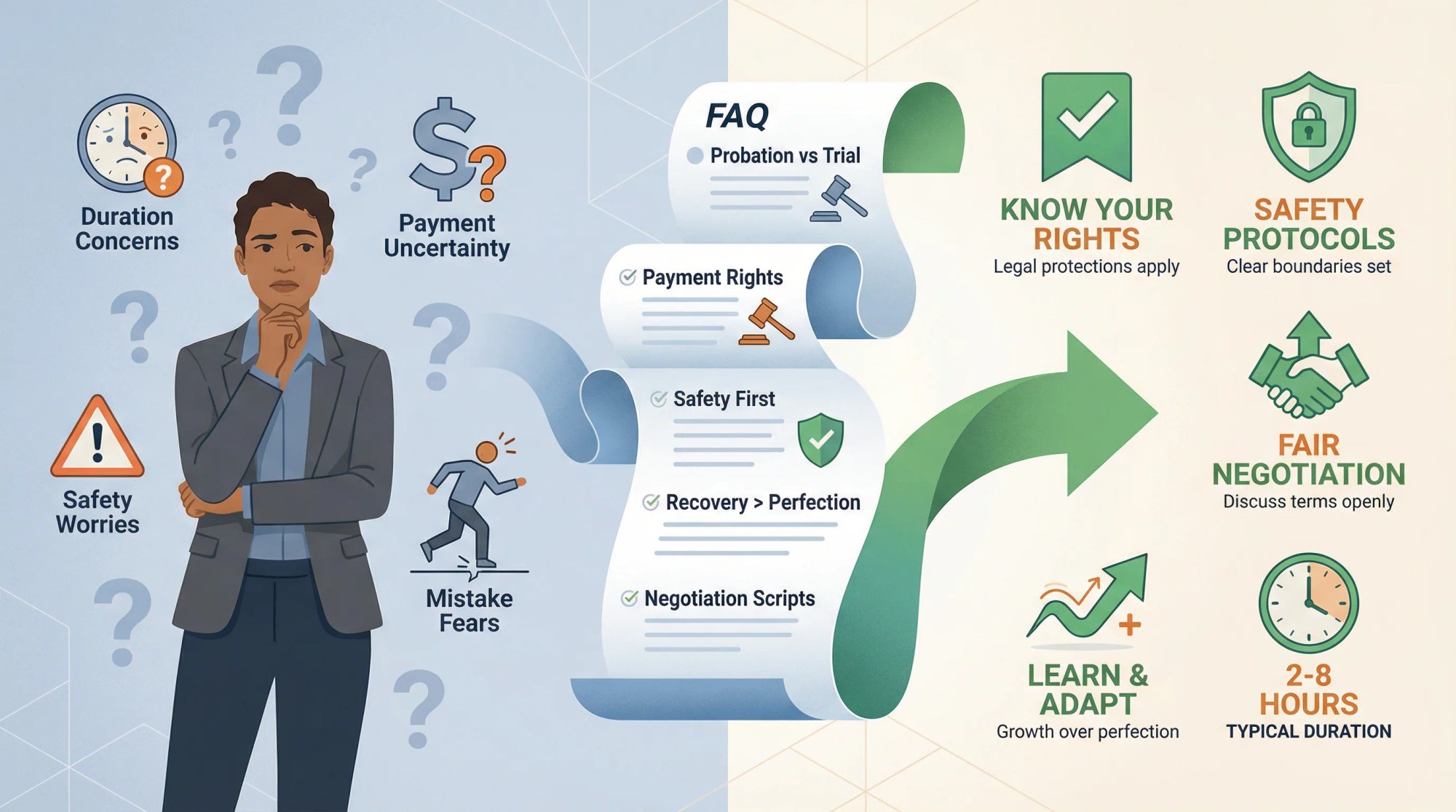
Is a working interview the same as a probation period?
No. Probation happens after you're hired. A working interview is part of the hiring process before an offer is made. Probation lasts months. Working interviews last hours or days.
Should I refuse an unpaid working interview?
Not automatically. But you should timebox it, ensure direct supervision, and avoid producing usable work. Longer trials or trials producing valuable work may trigger pay requirements even in regions where short unpaid trials are allowed.
If it's a 2-hour skills demo with supervision, that's often reasonable. If it's an 8-hour shift covering their busiest period, that should be paid.
What if they ask me to do something unsafe or unrelated to the role?
Say no. Safety and relevance are part of the test too. Any employer who pressures you to skip safety protocols or perform tasks completely unrelated to the job is showing you exactly how they'll treat employees.
Tasks not part of the role can be a factor in determining whether minimum wage applies. But more importantly, it's a red flag about workplace culture.
What if I mess up during the trial?
Own it, fix it, explain the correction. Recovery is a stronger signal than perfection. Employers know you're nervous and learning their systems. They're much more forgiving of mistakes handled well than mistakes hidden poorly.
The best response to a mistake: "I made an error on [X]. Here's what I did to fix it and what I learned to prevent it next time."
How long should a working interview last?
Most working interviews last between a few hours and a full workday to mimic typical job conditions. Some are shorter (2-3 hours) for specific skill tests, while more senior roles might do multi-day paid trials.
Always clarify the expected time commitment before you agree. If they're vague about duration, that's a yellow flag.
Can I negotiate a working interview to be paid if they initially said unpaid?
Absolutely. You can say: "I understand you mentioned this would be unpaid. For a [duration] commitment where I'm contributing to actual operations, I'd like to discuss compensation. What rate did you have in mind?"
Many employers will respect this. If they refuse to pay for substantial work, you've learned something important about how they value people's time.
Make This Your Unfair Advantage
Most candidates approach working interviews with anxiety. They see it as a gauntlet they must survive. But you can flip the script.
A working interview rewards candidates who clarify expectations early (so there are no surprises), make their thinking visible (so supervisors see judgment, not just output), execute the basics cleanly (competence beats perfection), recover fast (mistakes happen, recovery defines you), and debrief like a pro (showing self-awareness and growth mindset).
Do that, and you don't just "pass the test." You become the obvious hire.
The candidates who fail working interviews usually fail because they're silent, defensive about feedback, or sloppy with basics. You won't do any of those things because you've read this guide and you know what actually matters.
Working interviews give you something no resume or traditional interview can provide: proof. Proof that you can do the work. Proof that you fit the culture. Proof that you're someone they want to work with every single day.
Use that proof to your advantage.
The role is yours to win. Go take it.
You're about to walk into a working interview and your hands are a bit sweaty. This isn't like your typical job interview where you sit across from someone answering questions. This time, you'll actually be doing the work. And somewhere in the back of your mind, you're wondering: Am I about to get exploited for free labor, or is this a legitimate way to land a job?
Both concerns are valid. A working interview (also called a trial shift, job trial, or working audition) sits in that uncomfortable space between "proving yourself" and "being used." But when done right, it's actually one of the most valuable parts of the hiring process for both sides.
This guide will help you understand exactly what you're walking into, what's legal, and how to absolutely crush it.
What Is a Working Interview?
A working interview is when an employer evaluates you by watching you perform actual job tasks in a real work environment. Think of it as the difference between describing how you'd make a perfect espresso versus actually pulling shots while a hiring manager watches. It's usually an intensive day (or half-day) where both sides can assess fit beyond what a traditional interview reveals.
You might encounter this in several forms:
Trial shifts are common in hospitality manager, retail manager, and healthcare administrator roles. You work part of a real shift alongside current employees. A restaurant might have you shadow a server during lunch rush, then handle tables yourself during the slower afternoon.
Supervised skills demos happen in trades and hands-on roles. A salon might watch you do a haircut. A mechanic shop might ask you to diagnose an actual vehicle problem. The focus is on technique and safety awareness.
Work sample simulations are popular in office jobs. Marketing manager candidates might draft social media copy. Customer service representative candidates might handle mock tickets. Sales representative might roleplay client calls.
Paid mini contracts are used by startups and for senior roles. A paid 2-5 day work trial where you collaborate with the actual team on real projects.
Talk is cheap. Work is signal.
Employers use working interviews because standard interviews don't always reveal how you actually execute under pressure, how you learn on the fly, how you communicate while doing (not just talking about doing), and whether you're someone the team would enjoy working with daily.
What Employers Test During Working Interviews
Most candidates think the test is "can I do the task?" But that's only part of it. Employers are watching how you work, not just what you produce.
Here's what's really being evaluated:
Baseline competence matters, obviously. Can you perform core tasks at an acceptable quality level? But perfection isn't the standard. Competence is.
Speed versus quality judgment shows maturity. Do you know when "fast enough" beats "perfect"? A software developer who takes 3 hours to perfectly format code that needed to ship in 90 minutes failed the real test. Conversely, a dental assistant who rushes through sterilization to "save time" just failed the safety test.
Learning curve reveals how you handle gaps in knowledge. When you don't know something, do you freeze, fake it, or ask a clean question and move forward? One of these options makes you hireable. The other two don't.
Communication while working separates good employees from frustrating ones. Do you narrate decisions ("I'm starting with X because it reduces risk"), confirm assumptions ("I'm assuming Y, correct me if that's wrong"), and flag risks early? Or do you work in silence and hope for the best?
Reliability signals are always being observed. Punctuality, preparation, following safety protocols, respecting workplace norms. These aren't "extra credit." They're minimum requirements.
Culture fit matters more than people admit. Job trials are also a vibe check. Would the current team want to work with you? This isn't about being everyone's best friend. It's about being professional, coachable, and pleasant even when stressed.
Are Working Interviews Paid?
Short answer: You usually should be. But this is where things get legally murky, so we need to talk specifics.
Working Interview Laws by Region
United States: The Fair Labor Standards Act uses a concept called "suffer or permit to work." According to the Department of Labor, if an employer allows you to perform work that benefits them, that's generally compensable time. Massachusetts goes even more direct, stating candidates should typically be paid at least minimum wage for working interviews (guidance updated June 2025).
If they want you to work a real shift producing real value, expect it to be paid and clarify in writing.
United Kingdom: ACAS guidance (reviewed October 2024) says unpaid work trials should be "reasonable" (example: 2 hours or a shift) and "should not usually last longer than one day." GOV.UK adds detail: trials lasting longer than one day will "likely" trigger minimum wage requirements "in all but very exceptional circumstances."
Key UK factors: Is it genuinely for recruitment? Are you being observed? Are tasks relevant to the role? Does the work have value beyond testing? If it looks like you're covering staff shortage, that's not a trial.
Canada (Ontario): Crystal clear. Bill 149 received royal assent March 21, 2024. Ontario's government states plainly: "trial shifts are paid." Period.
Australia: Fair Work Ombudsman guidance says unpaid trials may be unlawful if they last longer than needed to demonstrate skills (could range from an hour to one shift) or if you're not under direct supervision. Any time beyond what's reasonably required must be paid.
How to Spot Working Interview Exploitation
Here's a simple mental model:
You should clarify expectations and compensation up front. If you see red-zone signals, you can still stay professional while protecting yourself.
Questions to Ask Before Accepting a Working Interview
Send these by email or ask on the scheduling call. You're not being "difficult" when you ask professional questions about a work arrangement:
① What exactly will I be doing? (specific tasks, tools, environment)
② How long is it scheduled for? (start time, end time, breaks)
③ Who will supervise me? (name and role)
④ How will you evaluate me? (criteria, what does success look like)
⑤ Is this paid? If yes, what's the rate and how is it processed?
⑥ Will you be using any work I produce? (critical for unpaid trials)
⑦ What should I bring or prepare? (ID, documents, attire, tools)
⑧ What safety training is required? (especially for physical roles)
⑨ What happens after this? (timeline, decision date, next steps)
⑩ Who do I contact if I'm running late or need help?
If they dodge these questions, that's not "mysterious and exciting." That's a red flag the size of a billboard.
How to Prepare for a Working Interview in 24 Hours
You don't need to prepare for everything. You need to prepare for the top 3 tasks and the top 3 failure modes for this specific role.
Build Your Task Map (10 Minutes)
Write down:
→ What are the 3-5 tasks I'll most likely be asked to do?
→ What tools or systems are involved?
→ What does "good" look like (speed, accuracy, tone, safety)?
This simple exercise transforms vague anxiety into concrete preparation.
Create a Decision Log Habit
During the trial, mentally (or physically) capture:
→ Assumptions I made
→ Tradeoffs I chose
→ Questions I asked
→ Results I got
This turns "I did stuff" into "I made good decisions backed by clear reasoning." That's what separates competent candidates from impressive ones.
Rehearse Your Talk Track
Working interviews still include mini interview moments. Someone will ask:
• "Why did you do it that way?"
• "What would you do next?"
• "What would you improve?"
Practice this simple structure: Context → Choice → Reason → Result → Next Step
Example: "The customer seemed frustrated (context), so I focused on solving their immediate problem first rather than following the usual diagnostic script (choice), because defusing emotion creates space for problem-solving (reason). They calmed down and we fixed the issue together (result). Next time I'd also loop in a supervisor earlier for complex cases (next step)."
AIApply's mock interview tool can help you structure these responses fast if you need a refresher.
Prep Your Logistics Like a Pro
→ Outfit that matches the role and environment
→ Arrive 10-15 minutes early (or log in early if remote)
→ Bring: ID, any certifications, notebook, pen
→ If remote: test camera, mic, screen share, backup internet
These aren't optional. They're the baseline that lets you focus on the work instead of logistics disasters.
What Happens During a Working Interview
Expect some version of this flow:
Arrival and Quick Orientation (5-15 minutes)
Who's supervising, what "good" looks like, where things are, safety and house rules. Pay attention. Questions you ask 10 minutes later that were just explained make you look inattentive.
Task Briefing (5-20 minutes)
You're given tasks, constraints, tools, and a timebox. Take notes. Confirm your understanding. This is your chance to clarify before you're expected to perform.
The Work Block (30 minutes to a few hours)
You execute while being observed. This is where everything happens. Your competence, judgment, communication, and professionalism are all on display simultaneously.
Check-ins and Adjustments
Good employers will correct you early. Take it as a gift, not criticism. When they say "actually, we do it this way," the right response is "got it, I'll adjust" not "but I thought..."
Debrief (10-30 minutes)
What went well, what they want clarified, next steps. This is your chance to ask thoughtful questions and end strong.
How to Excel During a Working Interview
Make Your Work Observable
Silence reads as uncertainty. Narrate lightly while you work:
• "I'm starting with X because it reduces risk"
• "I'm assuming Y is the priority, correct me if I'm wrong"
• "I'll ship a quick draft, then polish if time allows"
This isn't about talking nonstop. It's about making your decision-making visible so they can see you think clearly under pressure.
Ask "One-Way Door vs Two-Way Door" Questions
High-signal question that shows judgment:
"Is this decision reversible? If not, I'll confirm before proceeding."
This one question demonstrates you understand that some mistakes are cheap to fix and some are expensive. Employers love this.
Recover Fast From Mistakes
Everyone makes mistakes. What separates good candidates from bad ones is recovery speed:
• Acknowledge it immediately
• Correct it quickly
• Explain the fix briefly
• Move forward confidently
Don't defend the mistake. Don't dwell on it. Fix it and show you learned from it.
Treat Feedback Like Fuel
When they correct you, don't defend your choice. Mirror their guidance:
"Got it, so you prefer X approach. I'll apply that going forward."
This shows you're coachable. Being coachable matters more than being initially perfect.
End With a Clean Debrief
Before you leave, ask:
• "What would make this a strong 'yes' for you?"
• "Any concerns I can address right now?"
• "What are the next steps and timeline?"
These questions show confidence and give you valuable information about where you stand.
How to Evaluate the Company During a Working Interview
A job trial is one of the rare times you can see the company's reality up close. Working interviews give candidates a real window into culture and fit, not just employers evaluating candidates.
Watch for these signals:
Do they train or throw you in? Good employers provide context before expecting performance. Bad employers say "figure it out" and judge you for struggling.
Do they treat current staff with respect? If they're rude to their team while being nice to you, that's who they really are.
Do they cut corners on safety? Any employer who pressures you to skip safety protocols during a trial will absolutely do it after you're hired.
Do they communicate expectations clearly? Or is everything vague and you're expected to read minds?
Do they run on systems or chaos? Some chaos is fine. Constant chaos means poor management.
If you notice red flags, trust your gut. A job that seems wrong during the trial will definitely be wrong after you're hired.
How AIApply Helps You Prepare for Working Interviews
Working interviews reward preparation, and AIApply can help you prepare efficiently:
Generate Role-Specific Prep Materials Fast
Use AIApply's Resume Builder to align your resume to the exact role so your story matches what they're about to see in action. If you need to send a confirmation email or follow-up, the AI Cover Letter Generator can help you write something that sounds human, not templated.
Rehearse "Explain Your Choices" Questions
Use AIApply's Mock Interview tool: paste the job description and practice the questions that typically wrap around a working interview ("walk me through what you just did," "what would you improve," "why this approach?"). This rehearsal makes the debrief portion dramatically easier.
Get Live Support for the Verbal Part
If your working interview includes live Q&A (most do), AIApply's Interview Buddy is designed to provide real-time guidance during interviews. It won't do the physical work for you, but it can help you articulate your thinking more clearly in the moment.
Close Strong With Follow-Up
After the working interview, you'll want to send a thank-you note that reinforces your value. AIApply's thank-you email guide (published March 2025) provides templates you can customize while you're still fresh in their minds.
What to Send After a Working Interview
Within 4-24 Hours: Send a Tight Thank-You
Your goal is to show professionalism, remind them of your best moments, and reduce decision friction.
Here's a working-interview-specific template:
Subject: Thank you - Working interview for [Role] on [Date]Hi [Name],Thanks again for having me in today. I appreciated the chance to see the work up close and meet the team.Quick recap of what I completed:- [Task 1 + result]- [Task 2 + result]- [Task 3 + result]What I'd improve next time (if helpful):- [1 concrete improvement you'd make]If you'd like, I can also share a brief note on [relevant idea/process] that could help with [team goal].What are the next steps and expected timeline?Thanks,[Your Name][Phone]This format reminds them what you delivered while showing self-awareness and continued interest.
If They Go Quiet: Follow Up Strategically
AIApply's follow-up email guide (published May 2025) includes multi-touch follow-up strategies. The key is persistence without desperation.
Wait until any stated decision date passes, then send one polite check-in. If you don't hear back after that, it's probably a soft no. But you did everything right by following up professionally.
Working Interview Scripts You Can Use
Confirm Scope and Supervision
"Thanks for the opportunity. Just to confirm, what tasks should I focus on, and who will I be working under during the trial?"
Ask About Pay Directly
"Is this working interview paid? If so, what's the rate and how will it be processed?"
This isn't rude. It's professional and necessary to clarify compensation up front.
If It's Unpaid, Propose a Safe Structure
"I'm happy to do a short skills demonstration. Could we timebox it to [X] hours, keep it fully supervised, and make sure any work produced is only for evaluation?"
If They Extend the Time on the Day
"I can stay until the scheduled end time. If you'd like more time beyond that, I'm open to a paid trial shift or a scheduled second session."
These scripts protect you without burning bridges. Professional boundaries aren't rude. They're necessary.
Working Interview FAQ
Is a working interview the same as a probation period?
No. Probation happens after you're hired. A working interview is part of the hiring process before an offer is made. Probation lasts months. Working interviews last hours or days.
Should I refuse an unpaid working interview?
Not automatically. But you should timebox it, ensure direct supervision, and avoid producing usable work. Longer trials or trials producing valuable work may trigger pay requirements even in regions where short unpaid trials are allowed.
If it's a 2-hour skills demo with supervision, that's often reasonable. If it's an 8-hour shift covering their busiest period, that should be paid.
What if they ask me to do something unsafe or unrelated to the role?
Say no. Safety and relevance are part of the test too. Any employer who pressures you to skip safety protocols or perform tasks completely unrelated to the job is showing you exactly how they'll treat employees.
Tasks not part of the role can be a factor in determining whether minimum wage applies. But more importantly, it's a red flag about workplace culture.
What if I mess up during the trial?
Own it, fix it, explain the correction. Recovery is a stronger signal than perfection. Employers know you're nervous and learning their systems. They're much more forgiving of mistakes handled well than mistakes hidden poorly.
The best response to a mistake: "I made an error on [X]. Here's what I did to fix it and what I learned to prevent it next time."
How long should a working interview last?
Most working interviews last between a few hours and a full workday to mimic typical job conditions. Some are shorter (2-3 hours) for specific skill tests, while more senior roles might do multi-day paid trials.
Always clarify the expected time commitment before you agree. If they're vague about duration, that's a yellow flag.
Can I negotiate a working interview to be paid if they initially said unpaid?
Absolutely. You can say: "I understand you mentioned this would be unpaid. For a [duration] commitment where I'm contributing to actual operations, I'd like to discuss compensation. What rate did you have in mind?"
Many employers will respect this. If they refuse to pay for substantial work, you've learned something important about how they value people's time.
Make This Your Unfair Advantage
Most candidates approach working interviews with anxiety. They see it as a gauntlet they must survive. But you can flip the script.
A working interview rewards candidates who clarify expectations early (so there are no surprises), make their thinking visible (so supervisors see judgment, not just output), execute the basics cleanly (competence beats perfection), recover fast (mistakes happen, recovery defines you), and debrief like a pro (showing self-awareness and growth mindset).
Do that, and you don't just "pass the test." You become the obvious hire.
The candidates who fail working interviews usually fail because they're silent, defensive about feedback, or sloppy with basics. You won't do any of those things because you've read this guide and you know what actually matters.
Working interviews give you something no resume or traditional interview can provide: proof. Proof that you can do the work. Proof that you fit the culture. Proof that you're someone they want to work with every single day.
Use that proof to your advantage.
The role is yours to win. Go take it.
.webp)
%20(1).webp)
Don't miss out on
your next opportunity.
Create and send applications in seconds, not hours.


