
How to Negotiate Salary: Complete Guide (2026)

.webp)
Most people who search "how to negotiate salary" are trying to solve one of three very specific problems right now. Either they got an offer and want to counter it without blowing everything up, they're mid-interview and the recruiter just asked what they're expecting, or they've been at the same company for a while and feel underpaid but don't know how to bring it up without making it awkward.
This guide handles all three. But it's built around the job offer moment, because that's where the biggest money is and where most people either leave cash on the table or walk away confident.
Before we get into tactics: what does success actually look like here? Not "extracting maximum dollars." Real success is walking away with a compensation package you can say yes to without resentment, a relationship with your future manager that starts from a place of mutual respect, a written record that prevents misunderstandings down the line, and a skill you can repeat every time you change roles for the next 20 years.
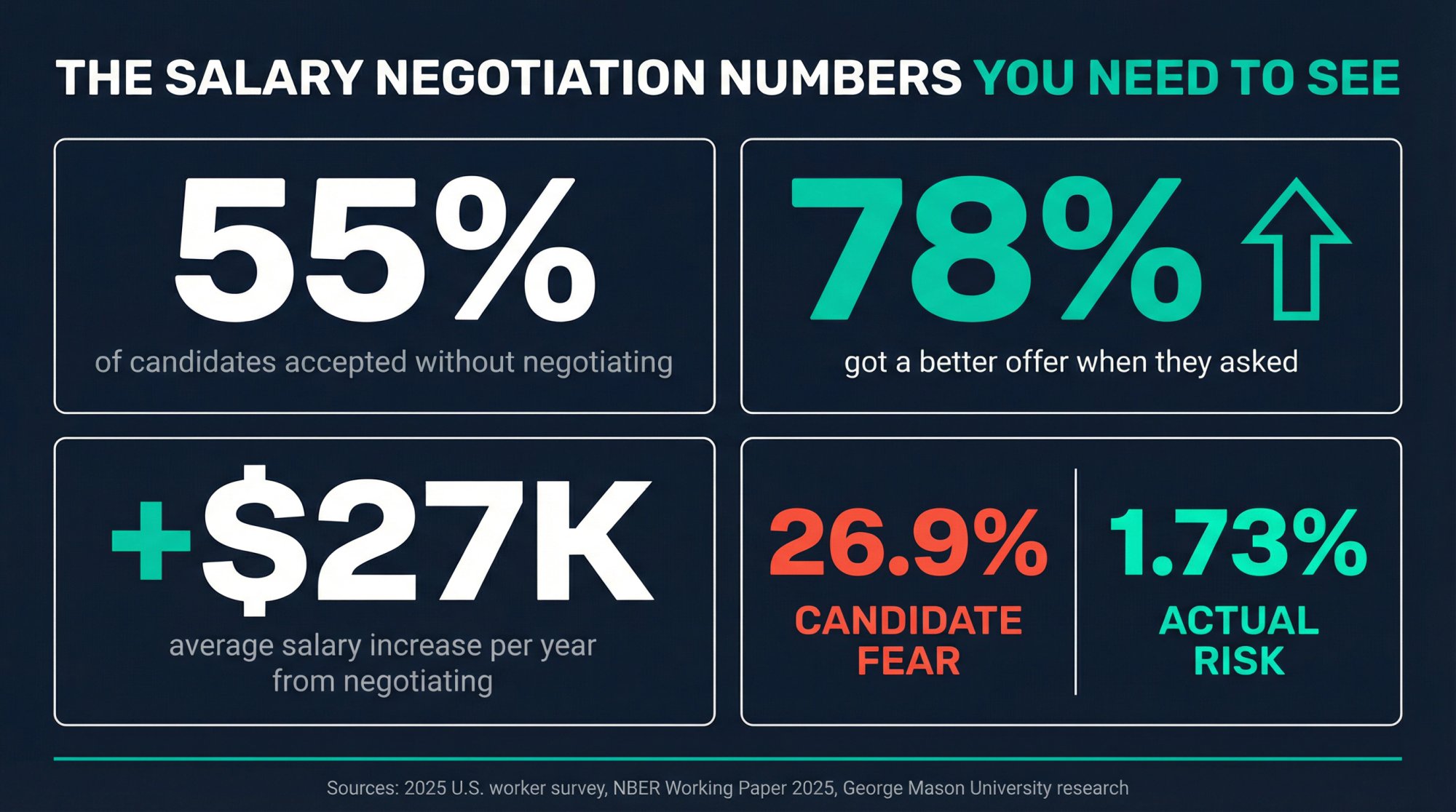
And yes, negotiating is worth the discomfort. A 2025 survey of 1,000 U.S. workers found 55% accepted the initial offer without negotiating. But 78% of those who did negotiate ended up with a better deal. That gap should be uncomfortable to read.

Why Employers Expect You to Negotiate Salary
Understanding why negotiation exists makes you better at it. At its core, salary negotiation is a pricing conversation in a market where neither side has perfect information.
When a company makes you an offer, they're not paying you for effort. They're paying for outcomes they believe you can produce. So the implicit question running through every salary conversation is: How much value does this person create, how risky are they, and how hard would they be to replace?
Your job in the negotiation isn't to "argue." It's to reduce their perceived risk, increase their perceived value of you, and show them that your ask is grounded in market reality. Evidence, not pressure.
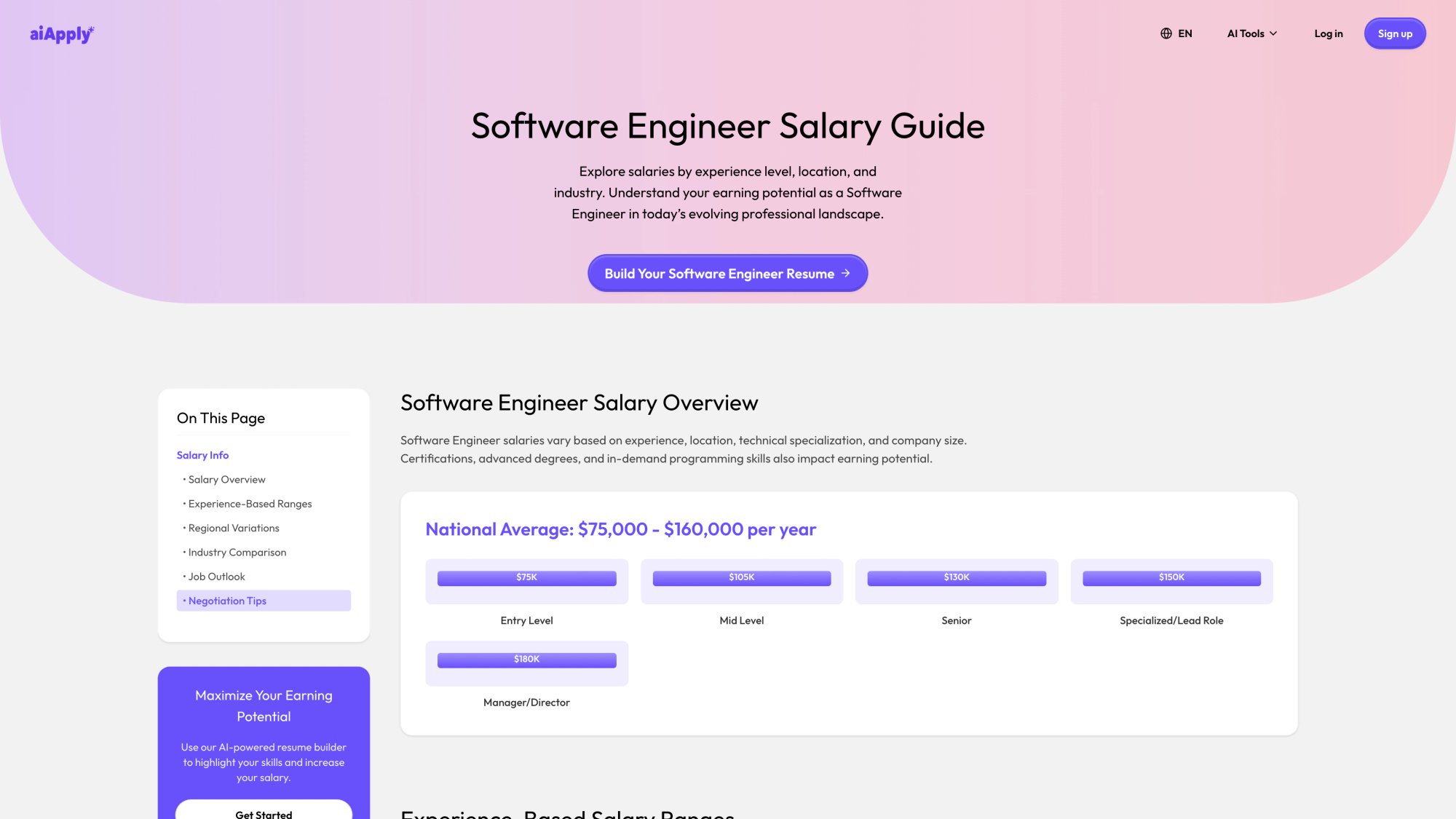
Before any negotiation, it helps to know what the market actually pays for your role. AIApply's salary guide pages break down compensation by experience level, location, and industry, giving you the data anchor you need before any conversation starts.
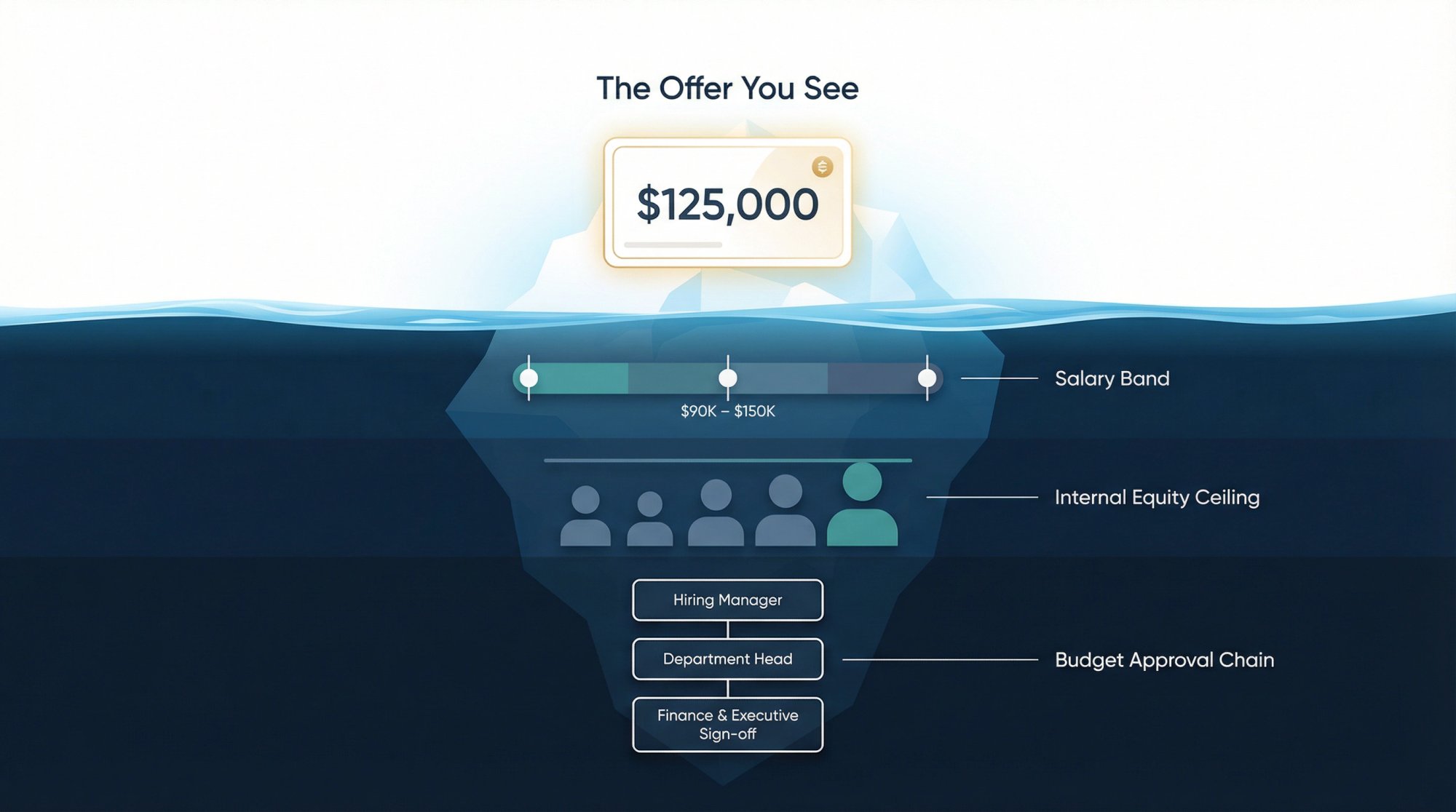
The piece most candidates miss: internal constraints are real. Even a hiring manager who loves you usually can't pay you whatever the market would theoretically bear. They're working inside:
Salary bands (the company's predefined range for each level)
Internal equity concerns (paying a new hire more than existing team members causes real problems)
Budget approval processes (significant deviations often require sign-off from someone above them)
This is why great negotiators don't just push on base salary. They learn to negotiate the full package.
Salary Negotiation Statistics: Does Asking Actually Work?
Time to put actual numbers to the fear.
A 2025 survey of 1,000 U.S. workers found only 45% of people negotiated their last offer. Of those who did? 78% got a better offer. That means the single most effective thing most people could do is simply ask.
The upside can be substantial. A UCLA Anderson Review summary of field experiments conducted with tech job seekers across 2023 to 2025 found that people who countered saw an average compensation increase of roughly 12.45%, which translated to about $27,000 more per year in that sample. The underlying research is an NBER Working Paper published in June 2025, revised July 2025.
Half of all candidates stay quiet. The reason is almost always fear: "What if I lose the offer entirely?"
That fear is rational in the abstract, but wildly out of proportion to reality. A 2024 peer-reviewed study in Organizational Behavior and Human Decision Processes found that candidates significantly overestimate how risky negotiating is, and that this inflated fear is the main driver of negotiation avoidance.
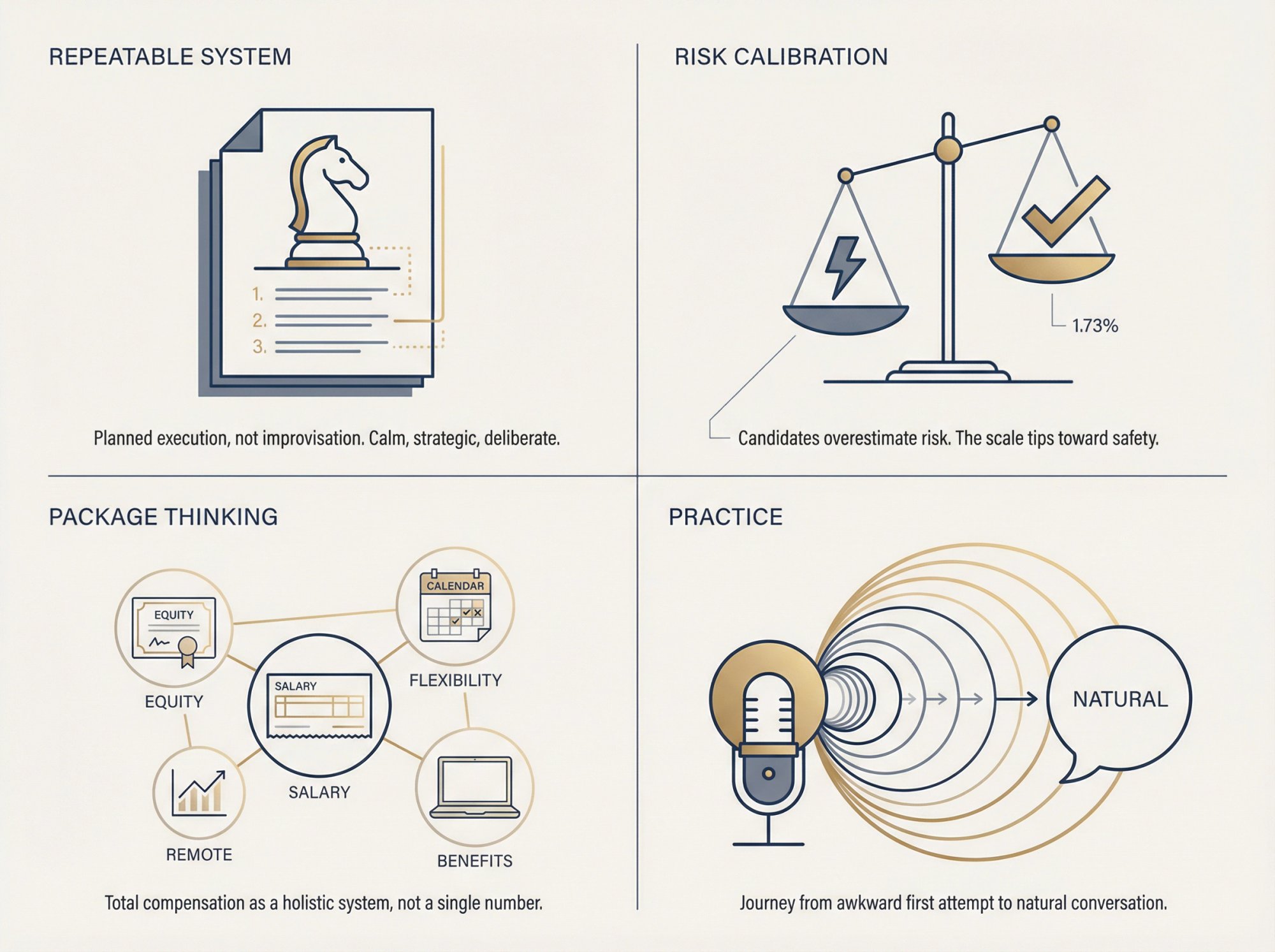
The numbers back this up concretely. Research summarized by George Mason University found that candidates estimate a 26.9% chance their offer gets pulled if they negotiate. Hiring committee members put that number closer to 1.73%.
None of this means the risk is zero. Some companies do have strict policies. But the fear is usually about 15 times larger than the actual danger.
If you're an early-career professional entering your first negotiation, AIApply's entry-level salary negotiation guide walks through the specific tactics and framing that work best when you're newer to the process.
How to Negotiate Salary: 10 Steps That Actually Work
This is the exact workflow that holds up across industries, because it follows how employers actually make decisions (not how we imagine they do).
Step 1: How to Build Negotiating Leverage
Leverage isn't intimidation. It's options.
The cleanest way to think about it: your leverage equals how costly it would be for them to say no. If you have no alternatives and they say no, you're negotiating from need. If you have other strong options and they say no, you're negotiating from choice. That's a completely different conversation.
The most effective way to build leverage fast is to keep interviewing until you've signed. Every additional offer, or even a live process elsewhere, changes the dynamic.
This is part of why at AIApply, we built Auto Apply the way we did. AIApply's Auto Apply is designed to increase your application volume while keeping each application tailored to the specific role, so you can realistically maintain 5 to 10 live processes at once instead of putting all your energy into a single opportunity.
One blind spot to watch: a lot of candidates stop interviewing the moment they "feel close" with one company. That's exactly the wrong time to stop. You're voluntarily giving away your strongest negotiating chip right before the moment you need it most. A solid job search strategy keeps your pipeline healthy all the way through signing.
Step 2: What's Actually Negotiable (Beyond Base Salary)
Most candidates focus entirely on base salary. Companies think in total compensation. Those are genuinely different conversations, and knowing the difference means you don't miss the places where companies actually have flexibility.
Here's a full picture of what's on the table:
Understanding total compensation is especially important if you're targeting senior roles. For context on how these packages scale by level, check out AIApply's guides for roles like software engineer, product manager, financial analyst, and account manager, each breaking down experience-based ranges plus regional and industry variations that factor into total comp.
Why this matters in 2026 specifically: as base salary budgets stay compressed, employers are increasingly using perks and total compensation flexibility as their primary bargaining tools. If you only negotiate base, you might miss 70% of the actual flexibility in the package.
Step 3: How to Research Your Market Salary
"Research your market salary" is standard advice. It's also incomplete. What you actually need is a defensible range: a number you can anchor in real data, not just a figure you found on one website.
The 3-point triangulation method gives you that:
Job postings with pay ranges (increasingly common due to pay transparency laws, more on this below)
Salary benchmark tools (useful for directional context, not precision)
Real humans: peers, ex-colleagues, recruiters, and professional communities where people share compensation openly
A practical starting point: AIApply's salary guide for your specific role provides national averages, experience-level breakdowns, and regional ranges that you can cite directly in a negotiation conversation. For roles in tech, finance, and consulting, where flexibility is highest, having granular data makes your ask significantly more credible.
On the pay transparency front: the legal landscape is genuinely changing in candidates' favor. Several jurisdictions now require employers to post pay ranges:
New York State: Many employers must list compensation ranges in job postings. NY Labor Law Section 194-B took effect September 17, 2023.
Washington State: Covered employers must include wage scale or salary range plus benefits in postings, and Washington L&I guidance restricts salary history inquiries.
California: SB 1162 requires covered employers to include pay scale in job postings.
EU: New EU pay transparency rules require providing starting salary or pay range to job seekers and prevent employers from asking about pay history. The transposition deadline for member states is June 7, 2026, which means this is arriving imminently across Europe.
When a range is already in the posting, you're not guessing anymore. The company has told you they have budget, they have flexibility, and they have a leveling model. Your goal becomes: prove you belong near the top of that range, not at the bottom.
Quick rule: If a job posting shows £60k–£80k, the "floor" of the range is an anchor they set, not a limit for you. Your job is to justify placement toward £80k.
Step 4: Set Your Walk-Away, Target, and Anchor Numbers
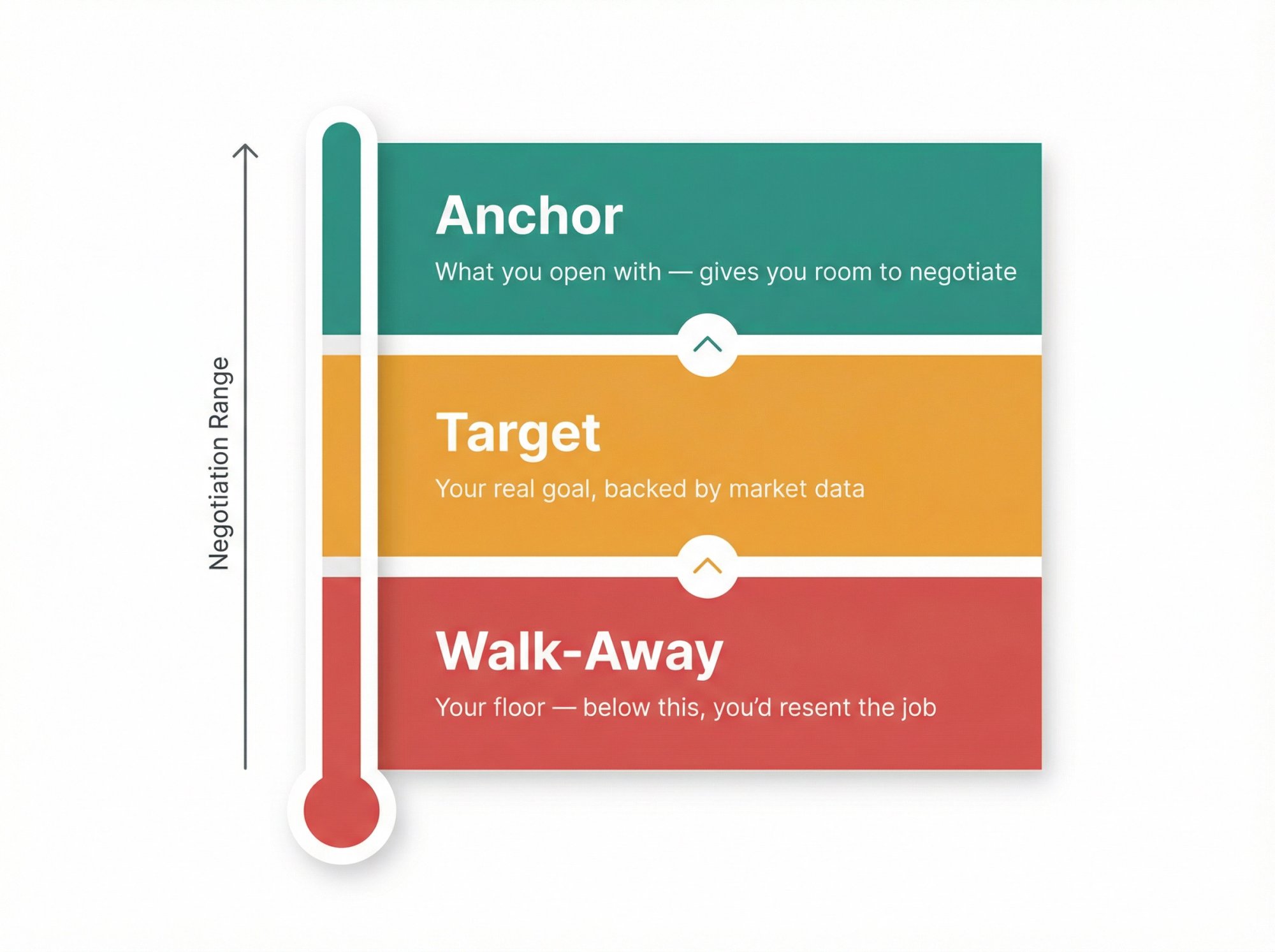
You need three numbers defined before you get on any call:
Walk-away number: the absolute minimum you'd accept without regret. Below this, you'd resent the job within six months.
Target number: what you actually want and have solid market evidence for.
Anchor number: what you open with, which is typically a bit above your target to give yourself room to negotiate down without landing below your goal.
The anchor isn't your dream scenario or a bluff. It's a move to frame the conversation. If you open at exactly your target, you have nowhere to go when they push back. If you open absurdly high, you lose credibility. A good anchor is defensible with data, slightly above your target, and takes itself seriously.
One important note on ranges: if you share a salary range, employers will almost always focus on the lower end. The bottom of your stated range must be a number you'd genuinely accept. Not a floor you're secretly hoping to push past.
The AIApply Expected Salary Calculator helps you build this target range grounded in real market data, so when you name your number, you can back it up immediately.
Step 5: How to Build a Value Case for Your Ask
This is where most negotiations actually succeed or fail, and it's where most candidates get it wrong.
The typical approach: "I was hoping for a bit more."
What the employer hears: "That's not my problem."
The effective approach is to build a value case that makes your ask easy for the hiring manager to justify internally. A good value case answers four questions:
Why you specifically?
Why this level of compensation?
Why this number?
Why now?
Use the 4-value-bucket model. Pick 2 to 3 proof points from each bucket that's relevant to you:
→ Revenue you drove (or can credibly drive)
→ Costs you reduced
→ Risk you prevented
→ Time you saved
Strong example bullets look like:
"Reduced cloud infrastructure spend by 18% by re-architecting our deployment pipeline."
"Increased checkout conversion from 2.1% to 3.4% by redesigning the onboarding flow."
"Cut weekly reporting time from 6 hours to 45 minutes by automating our dashboards."
Notice the pattern: action, metric, outcome. Not "I'm a detail-oriented team player."
If your resume currently has vague descriptions, you'll struggle to make this case convincingly. AIApply's AI Resume Scanner is built specifically for this: it analyzes your existing bullet points and helps you turn weak, vague statements into impact-focused proof points that actually hold up in a negotiation. For inspiration on what strong impact bullets look like across roles, AIApply's resume bullet point examples guide gives you nine proven frameworks to work from.
Getting your resume right before entering a negotiation matters more than people realize. The stronger your documented track record looks on paper, the stronger your value case sounds in conversation. The AIApply Resume Builder helps you articulate your impact clearly, and candidates who enter negotiations with a polished, well-positioned resume consistently land stronger initial offers to negotiate from.
Step 6: How to Structure the Salary Negotiation Conversation
Timing matters. The best conversation sequence is:
Express genuine excitement about the role
Ask for the complete compensation breakdown (base, bonus, equity, benefits, start date flexibility)
Ask for 24 to 48 hours to review
Counter with your value case and market data
Negotiate trade-offs if base is constrained
Confirm everything in writing

The script for asking for time (use this verbatim, it works):
Thanks, I'm really excited about the role and the team.Could you share the full compensation breakdown (base, bonus, equity if any, benefits, start date, and any flexibility on remote/hybrid)?I'd like to take 24 to 48 hours to review everything properly, and then I'd love to reconnect to discuss a couple of details.This one message does three things simultaneously: buys you time to prepare, signals professional maturity, and forces the complete package into the open so you can evaluate all of it.
Step 7: How to Write a Salary Counteroffer
A strong counteroffer follows a consistent structure: gratitude + market anchor + value case + clear ask + collaborative close.
Counteroffer email (customize with your details):
Subject: Offer details and next stepsHi [Name],Thank you again for the offer. I'm genuinely excited about the opportunity and I'm confident I can make a strong impact in [team/product].After reviewing the package and benchmarking similar roles in [location / market] for [level], I'm targeting a base salary of [X]. The main drivers are:- [impact proof #1 tied to their goals]- [impact proof #2 tied to their goals]- [rare skill / scope / leadership factor]If we can get base to [X] (or closer to it), I'm ready to move forward quickly.If base is constrained, I'm also open to structuring this as a combination of base + [sign-on bonus / equity / earlier performance review] so we can make the total package align with market.What's the best way to discuss this? A quick call today or tomorrow?Thanks,[Your name]If you're doing it on a call instead:
I'm excited about this role and I'd love to find a package that makes this an easy yes.Based on the scope we discussed and market ranges for this level in [location], I was hoping we could get the base closer to [X].The reason I'm confident in that number is [two short value points].How much flexibility do we have on base, and if base is tight, what flexibility do we have on sign-on, equity, or an earlier review cycle?Then stop talking. Seriously. Silence is a tool in this conversation, and most people fill it by talking themselves into a lower number.
Once you reach agreement, you'll want to accept the offer formally and in writing, a step that deserves its own focused attention to make sure every term is accurately captured.
Step 8: How to Trade Benefits When Base Salary Won't Move
If they push back on base, the worst move is to simply give up and accept. The second-worst is to repeat your ask louder. What actually works is trading.
There's a real reason employers are often more flexible on perks than base salary: a base salary increase is a permanent, compounding cost. It raises every future raise, every bonus calculation, every benefit tied to salary. A sign-on bonus is a one-time cost. For the employer, those are economically very different things, and that difference creates negotiation room you can use.
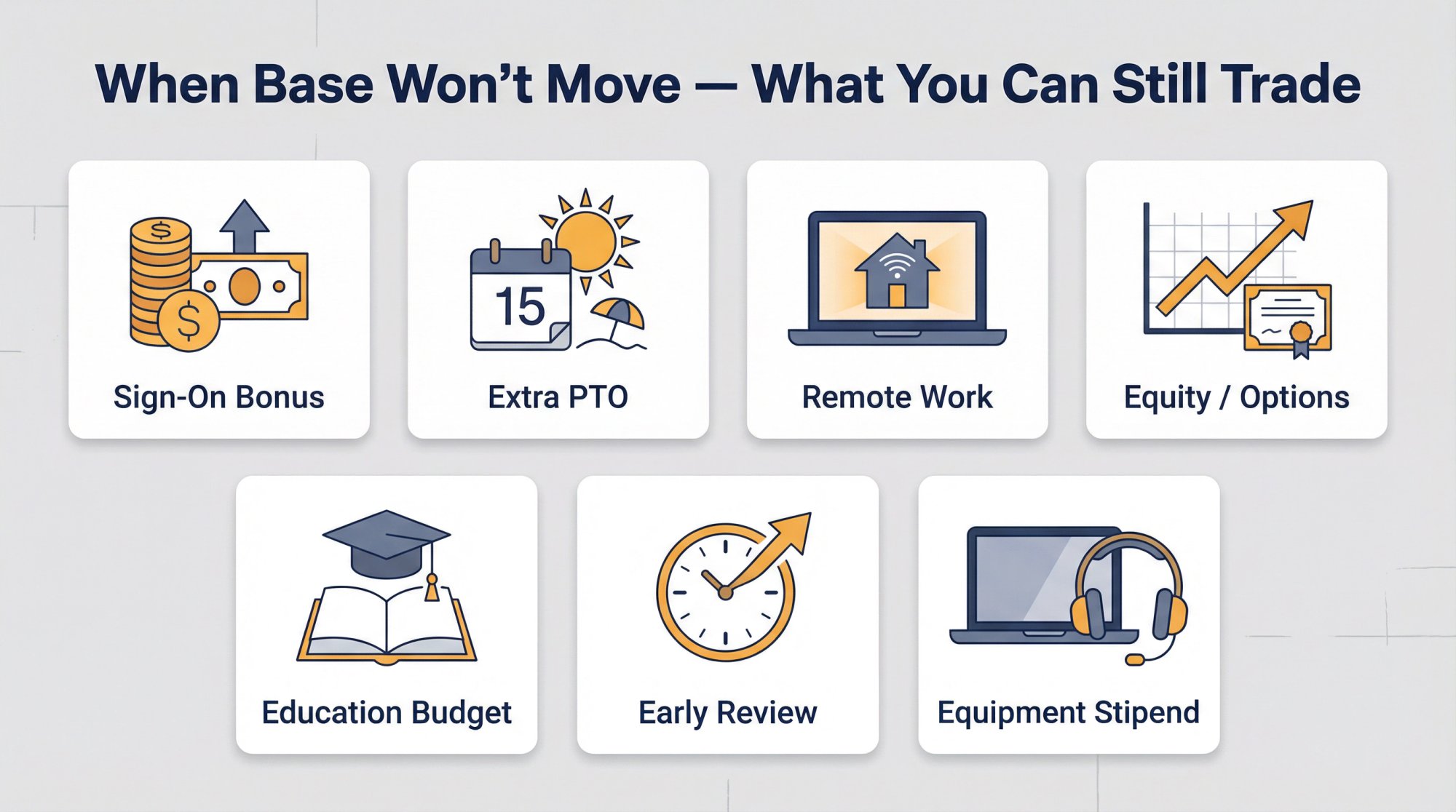
High-value tradeables when base won't move:
Sign-on bonus (one-time cost for them, real money for you)
Guaranteed first-year bonus
Equity refresh or additional options
Remote or hybrid flexibility (worth thousands in commute and real estate costs)
Extra PTO days
Education or conference budget
An early performance review at 60 or 90 days (which can lead to a faster salary adjustment)
One more thing: most candidates skip benefits negotiation entirely. Research shows 88% of workers feel confident negotiating salary, but only 41% know which benefits are negotiable. That's a lot of value walking out the door because nobody asked.

Step 9: How to Handle Salary Negotiation Pushback
Pushback is normal. It's not rejection. Here's how to respond to the four most common versions:
"This is our best and final offer."
What it usually means: "We don't want a prolonged negotiation."
I understand. I'm not trying to drag this out.If base truly can't move, could we explore one adjustment that brings the total package closer to market? Something like a sign-on bonus or an earlier review cycle?I'd love to find a simple path to yes."We don't have budget."
What it often means: "We don't have budget for base, but we might have flexibility elsewhere."
Got it. If base is capped, what flexibility do we have on the rest of the package? Things like sign-on, bonus target, equity, or benefits?I'm open to structuring this in a way that works for both sides."We need to be fair to existing employees."
This one is real. Don't fight it head-on.
That makes sense, and I respect internal equity.Could you share what level and band you're placing this role in, and what factors determine where someone lands within that band?If we're aligned on level, I think we can find a fair placement."If you don't accept now, we'll move on."
This is rare, but it happens. Your decision depends on three things: how far the offer is below your walk-away number, what alternative options you have right now, and whether this threat has real credibility (some companies are bluffing, some aren't).
If you decide to accept, get it in writing and move forward cleanly. If you decide to walk, do it professionally and without burning the relationship.
Step 10: Get Your Salary Agreement in Writing
Once you reach an agreement, send this confirmation email before you do anything else:
Thanks again. To confirm our final agreement:- Title/level:- Base salary:- Bonus:- Equity:- Start date:- Remote/hybrid arrangement:- Any special terms (sign-on, review cycle timing, PTO):Please confirm I have this right, and I'm happy to sign the updated offer letter.This protects you. Verbal agreements get misremembered. Details that felt "understood" in a conversation sometimes don't make it into the formal offer. This email creates a paper trail that prevents those surprises. For the full playbook on navigating everything from reviewing the package to resigning gracefully, AIApply's offer letter guide covers each step in sequence.
How to Answer "What Are Your Salary Expectations?"
The salary expectations question comes up earlier in the process, often in screening calls, and it's designed to filter candidates by price before the company has actually decided they want you.
The risk of going first:
If you name a number before they've committed to wanting you specifically, you might undervalue yourself, get screened out for being "too expensive" before they've even seen what you can do, or set an anchor that caps the entire conversation at your number rather than at their budget.
The best response is simple: ask for their range first.

I'm flexible depending on the full scope and total compensation.Could you share the range budgeted for this role?Most recruiters will tell you. If they do, you now know the band before committing to anything.
If they push back and insist on your number first:
Based on similar roles and my experience in [X], I'm generally targeting [low–high] for total compensation.That said, I'd love to understand the full package and the band before locking anything in.This is a range with genuine uncertainty built in. You're not anchoring hard, and you're signaling flexibility while still giving them what they need to move forward.
For a deeper breakdown of how to navigate this specific question, including timing, phrasing by seniority level, and how to handle follow-up pressure, AIApply's guide on answering salary expectations covers the full framework. The AIApply Salary Negotiation Template also generates a structured, customizable response you can adapt to your specific situation.
How to Ask for a Raise at Your Current Job
Asking for a raise is a different situation from negotiating a job offer. Your manager has history with you, knows your work up close, and is also navigating internal politics. That changes the dynamic significantly.
The wrong framing: "I need more money."
The right framing: "My scope and output have grown, and I want my compensation to match the level I'm actually operating at."
Those aren't the same message. One puts the burden on the company to solve your problem. The other frames it as a calibration issue, a fair alignment of compensation with contribution.
The clean process:
Document the ways your responsibilities have expanded and your measurable impact over the relevant period
Benchmark market rates for someone at your actual current scope (not your job title, which may be lagging behind). AIApply's role-specific salary guides let you benchmark precisely by experience level and location, a must before any raise conversation.
Request a calibration conversation, not a "raise meeting." The language signals professionalism, not desperation
Come prepared to propose either a compensation adjustment now or a written plan with specific targets and a clear timeline
A strong career development plan makes this conversation far easier. When you can show documented growth milestones and a track record of expanded scope, the raise ask becomes a logical calibration rather than a favor request.

The script:
I'd like to talk about role calibration.Over the last [time period], my scope has expanded from [old scope] to [new scope], and the impact has been [2–3 measurable outcomes].I'd like to align on whether I'm operating at the next level, and if so, what compensation adjustment and timeline makes sense.Calm, evidence-based, collaborative. That's the tone that gets results without damaging the relationship.
Pay Transparency Laws: How They Help You Negotiate
If you're negotiating any job offer in 2026, you have a structural advantage that candidates five years ago didn't: pay transparency laws are forcing ranges into the open.
To recap the landscape:
New York State: Salary ranges required in job postings since September 2023
Washington State: Required salary ranges and restrictions on asking pay history
California: Pay scales required in job postings under SB 1162
EU: Pay transparency rules requiring ranges provided to job applicants, with the full EU directive transposition deadline on June 7, 2026

What this changes in practice: you can negotiate with real data instead of guessing. When a company posts a range, you know their budget ceiling. Your goal shifts from finding the right number to proving you belong at the top of what they've already admitted they're willing to pay.
Best Salary Negotiation Tools and Resources
A few resources that directly reduce the blank-page problem when preparing to negotiate:
What Separates Great Salary Negotiators from the Rest
Most salary negotiation content sticks to the surface: "research your market rate and ask for more." That's true, but it leaves out the parts that actually create an edge.
The real difference comes from four things working together.
AIApply's Mock Interview Simulator won't practice salary negotiation scripts specifically, but using it to get comfortable with high-stakes career conversations pays dividends when the real negotiation moment arrives. Similarly, Interview Buddy, AIApply's real-time interview coaching tool, helps you build the composure and confidence that carry directly into negotiation conversations.
Salary Negotiation FAQ: Common Questions Answered
Is it rude to negotiate a job offer?
No. Negotiating is a normal, expected part of the hiring process. Employers make offers knowing that many candidates will respond with questions or a counteroffer. The research is clear: only about 1.73% of offers are withdrawn after negotiation, according to hiring committee members surveyed by researchers at George Mason University. Most hiring managers would rather negotiate than lose a candidate they've already invested weeks evaluating.
How much should I ask for above the offer?
There's no universal number, but most practitioners suggest anchoring 10–20% above your target number, within what market data supports. If the offer is already at the top of the market range, pushing significantly above it without strong justification can feel unrealistic. Use the 3-point triangulation method described above to build a defensible ask. AIApply's role-specific salary pages give you precise market data, entry level through director, that anchor your ask in reality.
What if I've already told them a number?
You can still negotiate. Once you have the full offer in hand, you have new information: you now know the full compensation package, have had time to benchmark properly, and can reference your prepared value case. It's reasonable to say: "After reviewing everything and benchmarking the full package, I'd like to revisit the base."
Should I negotiate salary over email or phone?
Both work, but they serve different moments. Email is great for the initial counter because it gives you time to frame things precisely and gives the employer time to consult before responding. A call is better for back-and-forth and for closing. A common pattern: send the counteroffer email, then offer to hop on a quick call to discuss.
What if the salary is already at the top of the posted range?
You have less leverage on base, but you still have options. Focus on other elements: sign-on bonus, equity, remote flexibility, benefits, or an early performance review. The fact that they're at the top of their range for base doesn't mean every element of the package is maxed out.
How long should I take to respond to an offer?
24 to 48 hours is standard and professional. Most employers expect it. If you need slightly more time (for example, you're waiting on another offer), ask clearly: "Would you be able to give me until [specific date]? I want to give this the consideration it deserves." Most hiring managers will accommodate that if it's reasonable.
Can I negotiate after I've verbally accepted?
Technically yes, but it's awkward and potentially damaging. Verbal acceptances aren't binding in most places, but going back on one signals that your word has conditional value. If you realize you made a mistake accepting too quickly, the cleanest approach is to acknowledge it directly: "I said yes quickly, and I want to be honest. After reviewing everything, I'd like to ask about [specific element]. I should have raised this sooner." This is recoverable if handled promptly and professionally.
What should I do if I don't have any competing offers?
Your leverage is lower, but that doesn't mean you can't negotiate. Lean harder on market data. The conversation shifts from "I have other options" to "my ask is grounded in what this role pays in this market for someone at my level." Be specific with your proof points, and be prepared to be flexible on the package even if base can't move. The AIApply job board and Auto Apply are specifically designed to help you build that pipeline of live options, so you're never negotiating from a position of zero alternatives.
Does negotiating work better for some industries than others?
It's effective everywhere, but the range of motion varies. In tech, finance, and consulting, significant base salary flexibility plus equity and signing bonuses is common. In education, government, and some nonprofits, base is often locked to published salary scales, but benefits, title, level placement, and review timing may still be negotiable. Understanding the constraints of your specific industry shapes how you prioritize your negotiation levers. AIApply's salary guides break down compensation by industry sector within each role, so you can calibrate expectations before you walk into any conversation.
What's the single most important thing to do before any salary negotiation?
Write down your three numbers before you pick up the phone: walk-away, target, and anchor. The candidates who have those numbers defined in advance don't fold under pressure, because they know their minimum. The ones who walk in without a clear floor often accept something they'll resent in six months. Use AIApply's free salary tools to anchor those numbers in real market data before any conversation starts.

Key Takeaways: How to Negotiate Your Salary
Salary negotiation isn't about "winning." It's about stopping the entirely avoidable habit of accepting less than the market would give you because the conversation felt uncomfortable.
The mechanics are learnable. Know your numbers before you start. Build a value case with real proof points, not vague self-descriptions. Use the scripts. Trade instead of pleading when base won't move. Get every agreement in writing.
If you want to make it even easier, AIApply has tools specifically designed for this: salary templates, expected salary calculators, and resume tools that help you show up to negotiations with actual evidence behind your ask. If you want to keep your interview pipeline strong, the foundation of real negotiation leverage, AIApply's Auto Apply keeps multiple live processes running simultaneously so you're never choosing between accepting less or walking away with nothing.
The next action is small: write your three numbers. Walk-away, target, anchor. Six bullets of measurable impact. Then send the counter.
That's it. Do those three things and you'll outperform 55% of everyone who receives an offer this year.

Most people who search "how to negotiate salary" are trying to solve one of three very specific problems right now. Either they got an offer and want to counter it without blowing everything up, they're mid-interview and the recruiter just asked what they're expecting, or they've been at the same company for a while and feel underpaid but don't know how to bring it up without making it awkward.
This guide handles all three. But it's built around the job offer moment, because that's where the biggest money is and where most people either leave cash on the table or walk away confident.
Before we get into tactics: what does success actually look like here? Not "extracting maximum dollars." Real success is walking away with a compensation package you can say yes to without resentment, a relationship with your future manager that starts from a place of mutual respect, a written record that prevents misunderstandings down the line, and a skill you can repeat every time you change roles for the next 20 years.
And yes, negotiating is worth the discomfort. A 2025 survey of 1,000 U.S. workers found 55% accepted the initial offer without negotiating. But 78% of those who did negotiate ended up with a better deal. That gap should be uncomfortable to read.
Why Employers Expect You to Negotiate Salary
Understanding why negotiation exists makes you better at it. At its core, salary negotiation is a pricing conversation in a market where neither side has perfect information.
When a company makes you an offer, they're not paying you for effort. They're paying for outcomes they believe you can produce. So the implicit question running through every salary conversation is: How much value does this person create, how risky are they, and how hard would they be to replace?
Your job in the negotiation isn't to "argue." It's to reduce their perceived risk, increase their perceived value of you, and show them that your ask is grounded in market reality. Evidence, not pressure.
Before any negotiation, it helps to know what the market actually pays for your role. AIApply's salary guide pages break down compensation by experience level, location, and industry, giving you the data anchor you need before any conversation starts.
The piece most candidates miss: internal constraints are real. Even a hiring manager who loves you usually can't pay you whatever the market would theoretically bear. They're working inside:
Salary bands (the company's predefined range for each level)
Internal equity concerns (paying a new hire more than existing team members causes real problems)
Budget approval processes (significant deviations often require sign-off from someone above them)
This is why great negotiators don't just push on base salary. They learn to negotiate the full package.
Salary Negotiation Statistics: Does Asking Actually Work?
Time to put actual numbers to the fear.
A 2025 survey of 1,000 U.S. workers found only 45% of people negotiated their last offer. Of those who did? 78% got a better offer. That means the single most effective thing most people could do is simply ask.
The upside can be substantial. A UCLA Anderson Review summary of field experiments conducted with tech job seekers across 2023 to 2025 found that people who countered saw an average compensation increase of roughly 12.45%, which translated to about $27,000 more per year in that sample. The underlying research is an NBER Working Paper published in June 2025, revised July 2025.
Half of all candidates stay quiet. The reason is almost always fear: "What if I lose the offer entirely?"
That fear is rational in the abstract, but wildly out of proportion to reality. A 2024 peer-reviewed study in Organizational Behavior and Human Decision Processes found that candidates significantly overestimate how risky negotiating is, and that this inflated fear is the main driver of negotiation avoidance.
The numbers back this up concretely. Research summarized by George Mason University found that candidates estimate a 26.9% chance their offer gets pulled if they negotiate. Hiring committee members put that number closer to 1.73%.
None of this means the risk is zero. Some companies do have strict policies. But the fear is usually about 15 times larger than the actual danger.
If you're an early-career professional entering your first negotiation, AIApply's entry-level salary negotiation guide walks through the specific tactics and framing that work best when you're newer to the process.
How to Negotiate Salary: 10 Steps That Actually Work
This is the exact workflow that holds up across industries, because it follows how employers actually make decisions (not how we imagine they do).
Step 1: How to Build Negotiating Leverage
Leverage isn't intimidation. It's options.
The cleanest way to think about it: your leverage equals how costly it would be for them to say no. If you have no alternatives and they say no, you're negotiating from need. If you have other strong options and they say no, you're negotiating from choice. That's a completely different conversation.
The most effective way to build leverage fast is to keep interviewing until you've signed. Every additional offer, or even a live process elsewhere, changes the dynamic.
This is part of why at AIApply, we built Auto Apply the way we did. AIApply's Auto Apply is designed to increase your application volume while keeping each application tailored to the specific role, so you can realistically maintain 5 to 10 live processes at once instead of putting all your energy into a single opportunity.
One blind spot to watch: a lot of candidates stop interviewing the moment they "feel close" with one company. That's exactly the wrong time to stop. You're voluntarily giving away your strongest negotiating chip right before the moment you need it most. A solid job search strategy keeps your pipeline healthy all the way through signing.
Step 2: What's Actually Negotiable (Beyond Base Salary)
Most candidates focus entirely on base salary. Companies think in total compensation. Those are genuinely different conversations, and knowing the difference means you don't miss the places where companies actually have flexibility.
Here's a full picture of what's on the table:
Understanding total compensation is especially important if you're targeting senior roles. For context on how these packages scale by level, check out AIApply's guides for roles like software engineer, product manager, financial analyst, and account manager, each breaking down experience-based ranges plus regional and industry variations that factor into total comp.
Why this matters in 2026 specifically: as base salary budgets stay compressed, employers are increasingly using perks and total compensation flexibility as their primary bargaining tools. If you only negotiate base, you might miss 70% of the actual flexibility in the package.
Step 3: How to Research Your Market Salary
"Research your market salary" is standard advice. It's also incomplete. What you actually need is a defensible range: a number you can anchor in real data, not just a figure you found on one website.
The 3-point triangulation method gives you that:
Job postings with pay ranges (increasingly common due to pay transparency laws, more on this below)
Salary benchmark tools (useful for directional context, not precision)
Real humans: peers, ex-colleagues, recruiters, and professional communities where people share compensation openly
A practical starting point: AIApply's salary guide for your specific role provides national averages, experience-level breakdowns, and regional ranges that you can cite directly in a negotiation conversation. For roles in tech, finance, and consulting, where flexibility is highest, having granular data makes your ask significantly more credible.
On the pay transparency front: the legal landscape is genuinely changing in candidates' favor. Several jurisdictions now require employers to post pay ranges:
New York State: Many employers must list compensation ranges in job postings. NY Labor Law Section 194-B took effect September 17, 2023.
Washington State: Covered employers must include wage scale or salary range plus benefits in postings, and Washington L&I guidance restricts salary history inquiries.
California: SB 1162 requires covered employers to include pay scale in job postings.
EU: New EU pay transparency rules require providing starting salary or pay range to job seekers and prevent employers from asking about pay history. The transposition deadline for member states is June 7, 2026, which means this is arriving imminently across Europe.
When a range is already in the posting, you're not guessing anymore. The company has told you they have budget, they have flexibility, and they have a leveling model. Your goal becomes: prove you belong near the top of that range, not at the bottom.
Quick rule: If a job posting shows £60k–£80k, the "floor" of the range is an anchor they set, not a limit for you. Your job is to justify placement toward £80k.
Step 4: Set Your Walk-Away, Target, and Anchor Numbers
You need three numbers defined before you get on any call:
Walk-away number: the absolute minimum you'd accept without regret. Below this, you'd resent the job within six months.
Target number: what you actually want and have solid market evidence for.
Anchor number: what you open with, which is typically a bit above your target to give yourself room to negotiate down without landing below your goal.
The anchor isn't your dream scenario or a bluff. It's a move to frame the conversation. If you open at exactly your target, you have nowhere to go when they push back. If you open absurdly high, you lose credibility. A good anchor is defensible with data, slightly above your target, and takes itself seriously.
One important note on ranges: if you share a salary range, employers will almost always focus on the lower end. The bottom of your stated range must be a number you'd genuinely accept. Not a floor you're secretly hoping to push past.
The AIApply Expected Salary Calculator helps you build this target range grounded in real market data, so when you name your number, you can back it up immediately.
Step 5: How to Build a Value Case for Your Ask
This is where most negotiations actually succeed or fail, and it's where most candidates get it wrong.
The typical approach: "I was hoping for a bit more."
What the employer hears: "That's not my problem."
The effective approach is to build a value case that makes your ask easy for the hiring manager to justify internally. A good value case answers four questions:
Why you specifically?
Why this level of compensation?
Why this number?
Why now?
Use the 4-value-bucket model. Pick 2 to 3 proof points from each bucket that's relevant to you:
→ Revenue you drove (or can credibly drive)
→ Costs you reduced
→ Risk you prevented
→ Time you saved
Strong example bullets look like:
"Reduced cloud infrastructure spend by 18% by re-architecting our deployment pipeline."
"Increased checkout conversion from 2.1% to 3.4% by redesigning the onboarding flow."
"Cut weekly reporting time from 6 hours to 45 minutes by automating our dashboards."
Notice the pattern: action, metric, outcome. Not "I'm a detail-oriented team player."
If your resume currently has vague descriptions, you'll struggle to make this case convincingly. AIApply's AI Resume Scanner is built specifically for this: it analyzes your existing bullet points and helps you turn weak, vague statements into impact-focused proof points that actually hold up in a negotiation. For inspiration on what strong impact bullets look like across roles, AIApply's resume bullet point examples guide gives you nine proven frameworks to work from.
Getting your resume right before entering a negotiation matters more than people realize. The stronger your documented track record looks on paper, the stronger your value case sounds in conversation. The AIApply Resume Builder helps you articulate your impact clearly, and candidates who enter negotiations with a polished, well-positioned resume consistently land stronger initial offers to negotiate from.
Step 6: How to Structure the Salary Negotiation Conversation
Timing matters. The best conversation sequence is:
Express genuine excitement about the role
Ask for the complete compensation breakdown (base, bonus, equity, benefits, start date flexibility)
Ask for 24 to 48 hours to review
Counter with your value case and market data
Negotiate trade-offs if base is constrained
Confirm everything in writing
The script for asking for time (use this verbatim, it works):
Thanks, I'm really excited about the role and the team.Could you share the full compensation breakdown (base, bonus, equity if any, benefits, start date, and any flexibility on remote/hybrid)?I'd like to take 24 to 48 hours to review everything properly, and then I'd love to reconnect to discuss a couple of details.This one message does three things simultaneously: buys you time to prepare, signals professional maturity, and forces the complete package into the open so you can evaluate all of it.
Step 7: How to Write a Salary Counteroffer
A strong counteroffer follows a consistent structure: gratitude + market anchor + value case + clear ask + collaborative close.
Counteroffer email (customize with your details):
Subject: Offer details and next stepsHi [Name],Thank you again for the offer. I'm genuinely excited about the opportunity and I'm confident I can make a strong impact in [team/product].After reviewing the package and benchmarking similar roles in [location / market] for [level], I'm targeting a base salary of [X]. The main drivers are:- [impact proof #1 tied to their goals]- [impact proof #2 tied to their goals]- [rare skill / scope / leadership factor]If we can get base to [X] (or closer to it), I'm ready to move forward quickly.If base is constrained, I'm also open to structuring this as a combination of base + [sign-on bonus / equity / earlier performance review] so we can make the total package align with market.What's the best way to discuss this? A quick call today or tomorrow?Thanks,[Your name]If you're doing it on a call instead:
I'm excited about this role and I'd love to find a package that makes this an easy yes.Based on the scope we discussed and market ranges for this level in [location], I was hoping we could get the base closer to [X].The reason I'm confident in that number is [two short value points].How much flexibility do we have on base, and if base is tight, what flexibility do we have on sign-on, equity, or an earlier review cycle?Then stop talking. Seriously. Silence is a tool in this conversation, and most people fill it by talking themselves into a lower number.
Once you reach agreement, you'll want to accept the offer formally and in writing, a step that deserves its own focused attention to make sure every term is accurately captured.
Step 8: How to Trade Benefits When Base Salary Won't Move
If they push back on base, the worst move is to simply give up and accept. The second-worst is to repeat your ask louder. What actually works is trading.
There's a real reason employers are often more flexible on perks than base salary: a base salary increase is a permanent, compounding cost. It raises every future raise, every bonus calculation, every benefit tied to salary. A sign-on bonus is a one-time cost. For the employer, those are economically very different things, and that difference creates negotiation room you can use.
High-value tradeables when base won't move:
Sign-on bonus (one-time cost for them, real money for you)
Guaranteed first-year bonus
Equity refresh or additional options
Remote or hybrid flexibility (worth thousands in commute and real estate costs)
Extra PTO days
Education or conference budget
An early performance review at 60 or 90 days (which can lead to a faster salary adjustment)
One more thing: most candidates skip benefits negotiation entirely. Research shows 88% of workers feel confident negotiating salary, but only 41% know which benefits are negotiable. That's a lot of value walking out the door because nobody asked.
Step 9: How to Handle Salary Negotiation Pushback
Pushback is normal. It's not rejection. Here's how to respond to the four most common versions:
"This is our best and final offer."
What it usually means: "We don't want a prolonged negotiation."
I understand. I'm not trying to drag this out.If base truly can't move, could we explore one adjustment that brings the total package closer to market? Something like a sign-on bonus or an earlier review cycle?I'd love to find a simple path to yes."We don't have budget."
What it often means: "We don't have budget for base, but we might have flexibility elsewhere."
Got it. If base is capped, what flexibility do we have on the rest of the package? Things like sign-on, bonus target, equity, or benefits?I'm open to structuring this in a way that works for both sides."We need to be fair to existing employees."
This one is real. Don't fight it head-on.
That makes sense, and I respect internal equity.Could you share what level and band you're placing this role in, and what factors determine where someone lands within that band?If we're aligned on level, I think we can find a fair placement."If you don't accept now, we'll move on."
This is rare, but it happens. Your decision depends on three things: how far the offer is below your walk-away number, what alternative options you have right now, and whether this threat has real credibility (some companies are bluffing, some aren't).
If you decide to accept, get it in writing and move forward cleanly. If you decide to walk, do it professionally and without burning the relationship.
Step 10: Get Your Salary Agreement in Writing
Once you reach an agreement, send this confirmation email before you do anything else:
Thanks again. To confirm our final agreement:- Title/level:- Base salary:- Bonus:- Equity:- Start date:- Remote/hybrid arrangement:- Any special terms (sign-on, review cycle timing, PTO):Please confirm I have this right, and I'm happy to sign the updated offer letter.This protects you. Verbal agreements get misremembered. Details that felt "understood" in a conversation sometimes don't make it into the formal offer. This email creates a paper trail that prevents those surprises. For the full playbook on navigating everything from reviewing the package to resigning gracefully, AIApply's offer letter guide covers each step in sequence.
How to Answer "What Are Your Salary Expectations?"
The salary expectations question comes up earlier in the process, often in screening calls, and it's designed to filter candidates by price before the company has actually decided they want you.
The risk of going first:
If you name a number before they've committed to wanting you specifically, you might undervalue yourself, get screened out for being "too expensive" before they've even seen what you can do, or set an anchor that caps the entire conversation at your number rather than at their budget.
The best response is simple: ask for their range first.
I'm flexible depending on the full scope and total compensation.Could you share the range budgeted for this role?Most recruiters will tell you. If they do, you now know the band before committing to anything.
If they push back and insist on your number first:
Based on similar roles and my experience in [X], I'm generally targeting [low–high] for total compensation.That said, I'd love to understand the full package and the band before locking anything in.This is a range with genuine uncertainty built in. You're not anchoring hard, and you're signaling flexibility while still giving them what they need to move forward.
For a deeper breakdown of how to navigate this specific question, including timing, phrasing by seniority level, and how to handle follow-up pressure, AIApply's guide on answering salary expectations covers the full framework. The AIApply Salary Negotiation Template also generates a structured, customizable response you can adapt to your specific situation.
How to Ask for a Raise at Your Current Job
Asking for a raise is a different situation from negotiating a job offer. Your manager has history with you, knows your work up close, and is also navigating internal politics. That changes the dynamic significantly.
The wrong framing: "I need more money."
The right framing: "My scope and output have grown, and I want my compensation to match the level I'm actually operating at."
Those aren't the same message. One puts the burden on the company to solve your problem. The other frames it as a calibration issue, a fair alignment of compensation with contribution.
The clean process:
Document the ways your responsibilities have expanded and your measurable impact over the relevant period
Benchmark market rates for someone at your actual current scope (not your job title, which may be lagging behind). AIApply's role-specific salary guides let you benchmark precisely by experience level and location, a must before any raise conversation.
Request a calibration conversation, not a "raise meeting." The language signals professionalism, not desperation
Come prepared to propose either a compensation adjustment now or a written plan with specific targets and a clear timeline
A strong career development plan makes this conversation far easier. When you can show documented growth milestones and a track record of expanded scope, the raise ask becomes a logical calibration rather than a favor request.
The script:
I'd like to talk about role calibration.Over the last [time period], my scope has expanded from [old scope] to [new scope], and the impact has been [2–3 measurable outcomes].I'd like to align on whether I'm operating at the next level, and if so, what compensation adjustment and timeline makes sense.Calm, evidence-based, collaborative. That's the tone that gets results without damaging the relationship.
Pay Transparency Laws: How They Help You Negotiate
If you're negotiating any job offer in 2026, you have a structural advantage that candidates five years ago didn't: pay transparency laws are forcing ranges into the open.
To recap the landscape:
New York State: Salary ranges required in job postings since September 2023
Washington State: Required salary ranges and restrictions on asking pay history
California: Pay scales required in job postings under SB 1162
EU: Pay transparency rules requiring ranges provided to job applicants, with the full EU directive transposition deadline on June 7, 2026
What this changes in practice: you can negotiate with real data instead of guessing. When a company posts a range, you know their budget ceiling. Your goal shifts from finding the right number to proving you belong at the top of what they've already admitted they're willing to pay.
Best Salary Negotiation Tools and Resources
A few resources that directly reduce the blank-page problem when preparing to negotiate:
What Separates Great Salary Negotiators from the Rest
Most salary negotiation content sticks to the surface: "research your market rate and ask for more." That's true, but it leaves out the parts that actually create an edge.
The real difference comes from four things working together.
AIApply's Mock Interview Simulator won't practice salary negotiation scripts specifically, but using it to get comfortable with high-stakes career conversations pays dividends when the real negotiation moment arrives. Similarly, Interview Buddy, AIApply's real-time interview coaching tool, helps you build the composure and confidence that carry directly into negotiation conversations.
Salary Negotiation FAQ: Common Questions Answered
Is it rude to negotiate a job offer?
No. Negotiating is a normal, expected part of the hiring process. Employers make offers knowing that many candidates will respond with questions or a counteroffer. The research is clear: only about 1.73% of offers are withdrawn after negotiation, according to hiring committee members surveyed by researchers at George Mason University. Most hiring managers would rather negotiate than lose a candidate they've already invested weeks evaluating.
How much should I ask for above the offer?
There's no universal number, but most practitioners suggest anchoring 10–20% above your target number, within what market data supports. If the offer is already at the top of the market range, pushing significantly above it without strong justification can feel unrealistic. Use the 3-point triangulation method described above to build a defensible ask. AIApply's role-specific salary pages give you precise market data, entry level through director, that anchor your ask in reality.
What if I've already told them a number?
You can still negotiate. Once you have the full offer in hand, you have new information: you now know the full compensation package, have had time to benchmark properly, and can reference your prepared value case. It's reasonable to say: "After reviewing everything and benchmarking the full package, I'd like to revisit the base."
Should I negotiate salary over email or phone?
Both work, but they serve different moments. Email is great for the initial counter because it gives you time to frame things precisely and gives the employer time to consult before responding. A call is better for back-and-forth and for closing. A common pattern: send the counteroffer email, then offer to hop on a quick call to discuss.
What if the salary is already at the top of the posted range?
You have less leverage on base, but you still have options. Focus on other elements: sign-on bonus, equity, remote flexibility, benefits, or an early performance review. The fact that they're at the top of their range for base doesn't mean every element of the package is maxed out.
How long should I take to respond to an offer?
24 to 48 hours is standard and professional. Most employers expect it. If you need slightly more time (for example, you're waiting on another offer), ask clearly: "Would you be able to give me until [specific date]? I want to give this the consideration it deserves." Most hiring managers will accommodate that if it's reasonable.
Can I negotiate after I've verbally accepted?
Technically yes, but it's awkward and potentially damaging. Verbal acceptances aren't binding in most places, but going back on one signals that your word has conditional value. If you realize you made a mistake accepting too quickly, the cleanest approach is to acknowledge it directly: "I said yes quickly, and I want to be honest. After reviewing everything, I'd like to ask about [specific element]. I should have raised this sooner." This is recoverable if handled promptly and professionally.
What should I do if I don't have any competing offers?
Your leverage is lower, but that doesn't mean you can't negotiate. Lean harder on market data. The conversation shifts from "I have other options" to "my ask is grounded in what this role pays in this market for someone at my level." Be specific with your proof points, and be prepared to be flexible on the package even if base can't move. The AIApply job board and Auto Apply are specifically designed to help you build that pipeline of live options, so you're never negotiating from a position of zero alternatives.
Does negotiating work better for some industries than others?
It's effective everywhere, but the range of motion varies. In tech, finance, and consulting, significant base salary flexibility plus equity and signing bonuses is common. In education, government, and some nonprofits, base is often locked to published salary scales, but benefits, title, level placement, and review timing may still be negotiable. Understanding the constraints of your specific industry shapes how you prioritize your negotiation levers. AIApply's salary guides break down compensation by industry sector within each role, so you can calibrate expectations before you walk into any conversation.
What's the single most important thing to do before any salary negotiation?
Write down your three numbers before you pick up the phone: walk-away, target, and anchor. The candidates who have those numbers defined in advance don't fold under pressure, because they know their minimum. The ones who walk in without a clear floor often accept something they'll resent in six months. Use AIApply's free salary tools to anchor those numbers in real market data before any conversation starts.
Key Takeaways: How to Negotiate Your Salary
Salary negotiation isn't about "winning." It's about stopping the entirely avoidable habit of accepting less than the market would give you because the conversation felt uncomfortable.
The mechanics are learnable. Know your numbers before you start. Build a value case with real proof points, not vague self-descriptions. Use the scripts. Trade instead of pleading when base won't move. Get every agreement in writing.
If you want to make it even easier, AIApply has tools specifically designed for this: salary templates, expected salary calculators, and resume tools that help you show up to negotiations with actual evidence behind your ask. If you want to keep your interview pipeline strong, the foundation of real negotiation leverage, AIApply's Auto Apply keeps multiple live processes running simultaneously so you're never choosing between accepting less or walking away with nothing.
The next action is small: write your three numbers. Walk-away, target, anchor. Six bullets of measurable impact. Then send the counter.
That's it. Do those three things and you'll outperform 55% of everyone who receives an offer this year.
.webp)
.webp)
Don't miss out on
your next opportunity.
Create and send applications in seconds, not hours.


