
How to Ask for a Raise in Your First Year (2026)

.webp)
You've been at your new job for a few months. You're contributing, learning fast, maybe even taking on work that wasn't part of the original deal. And now a thought keeps coming back: should I ask for a raise?
Right behind that thought come three fears that almost everyone shares. "Is it too soon?" "Will they think I'm ungrateful?" And the big one: "What do I even say without making this incredibly awkward?"
Those fears are normal. But they're also solvable. Asking for a raise in your first year isn't about courage or entitlement. It's about understanding how your company's compensation system actually works and fitting your request inside it. If you can do that, the conversation gets a lot less scary and a lot more productive.
This guide covers everything you need: when to ask, when to wait, how to build your case, word-for-word scripts for the conversation, how to handle every common pushback, and what to do if the answer is no. No vague advice. Just a system that works.

Why Most First-Year Raise Requests Fail
Most people assume a raise request is a simple conversation. You explain why you're great, your manager agrees, and the money shows up in your next paycheck.
That's not how it works at most companies.
Your manager doesn't just decide your pay in isolation. They're working inside salary budgets, approval chains, and HR policies. And those budgets? They're tighter than you probably think.
Mercer reported that 2026 average merit increase budgets in the US sit around 3.2%, with total salary increase budgets around 3.5%. WTW's salary budget planning data showed similar figures: roughly 3.5% in the US, with the UK, Canada, France, and Germany falling in the 3.2% to 3.6% range. Research from early 2026 found that over 40% of employers are leaning into standardized, across-the-board raises, with base-pay increases holding steady around 3.5%.
So what does this mean for your first-year raise request?
If you walk in asking for 10% or more at a company that's budgeting 3% to 4% for everybody, your manager needs a special justification to make it happen. Think promotion, market correction, or a retention exception. If you don't hand them that justification in a category their HR team actually recognizes, the default answer becomes: "Not this cycle."
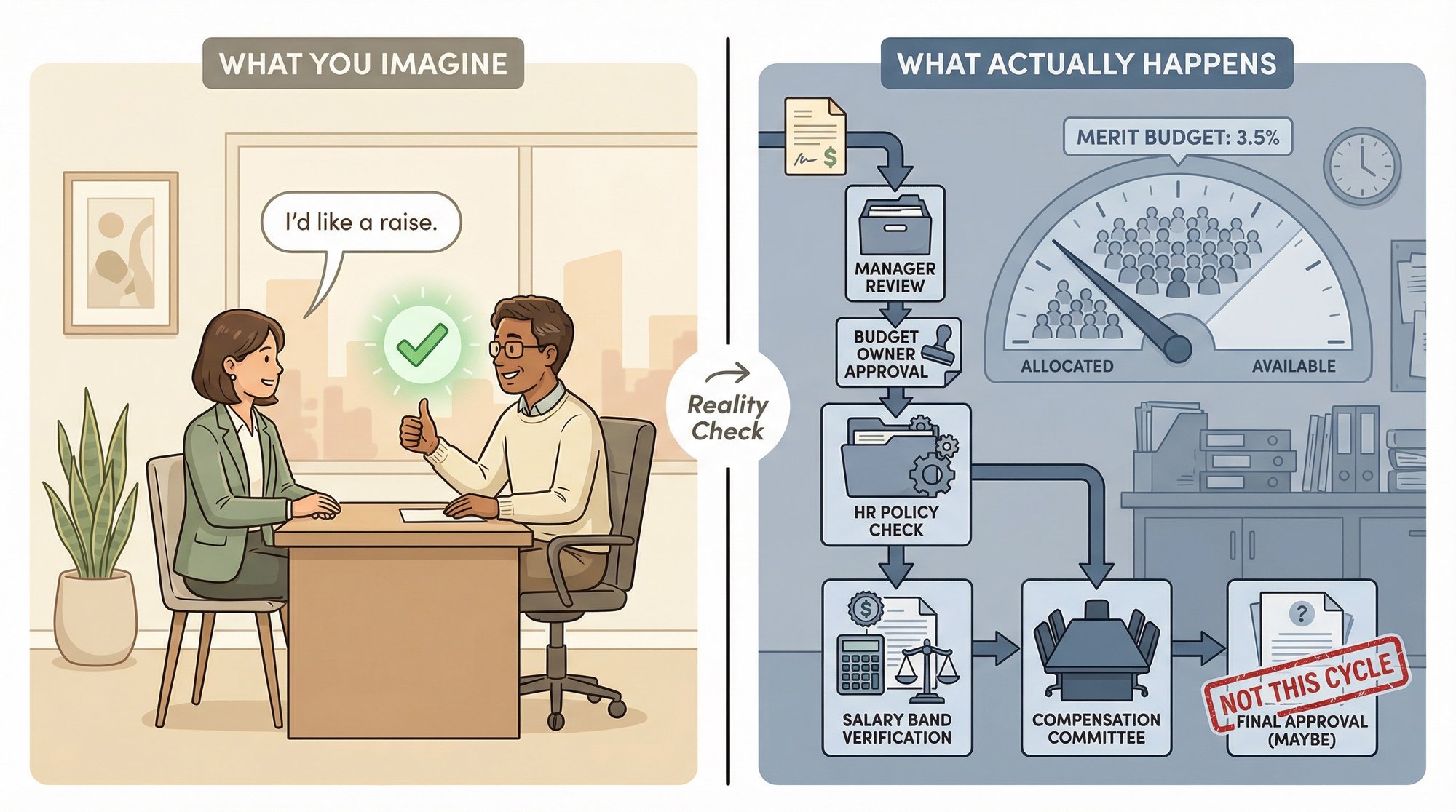
Your strategy isn't about negotiating harder. It's about making the raise make sense inside the system your company already uses. Understanding what a software engineer or data analyst actually earns in the market is the foundation of that strategy.
Should You Ask for a Raise in Year One?
This is the question most guides skip. They assume you should always ask. But timing matters, and asking at the wrong moment can actually set you back.
When Asking for a Raise Makes Sense
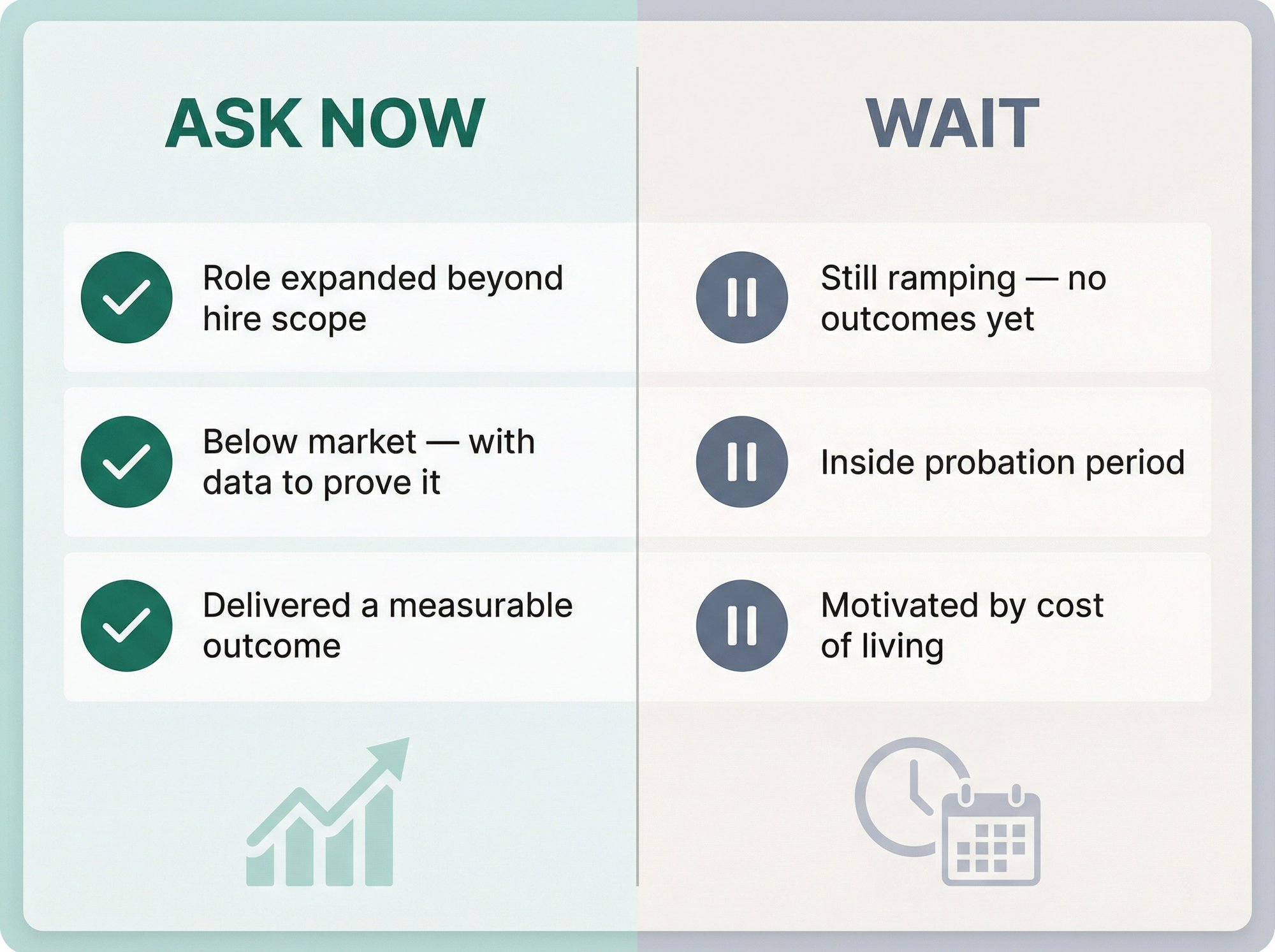
Your role grew beyond what you were hired for. You're doing higher-scope work, owning bigger outcomes, or filling gaps that weren't part of the original job description. If you were hired as a specialist and you're now running a small team's projects, that's a real scope change.
You're clearly under market, and you can prove it. Pay transparency is making salary data much easier to find. Research from the New York Fed found that the share of online US job postings with pay information jumped from about 15% before 2018 to roughly 53% since January 2024. If you can pull up five comparable postings and they all pay 15% more than what you're making, you have a credible case. Role-specific salary pages (for example, financial analyst salaries) make it easy to see what comparable roles typically earn right now.
You've delivered a measurable win that changed outcomes. Revenue generated, costs cut, processes that used to take weeks now taking days, a retention problem you helped solve. The key word is measurable. "I work really hard" isn't a metric. "I reduced onboarding time by 30%" is.
Approaching a comp cycle is probably the single most underused timing advantage. Budgets often get drafted months before raises actually land. If you bring this up after decisions are locked, you're essentially asking for a miracle. Timing your conversation before the budget cycle closes is one of the smartest things you can do.
When You Should Wait Before Asking
You're still ramping and can't point to outcomes. Effort is not the same as impact. If you've been at the company for three months and you're still learning the systems, you probably don't have the evidence you need yet. That's okay. Focus on building results first.
You're inside probation and haven't cleared baseline trust. Some companies won't make compensation changes until probation ends. You can start laying groundwork by asking about the comp review process (more on that in a moment), but framing it as an urgent demand will likely backfire.
You're mostly motivated by cost of living. This is a classic blind spot. Your bills aren't your company's pricing model. Inflation matters, and it's a legitimate concern, but you'll make a much stronger case by tying your request to business results rather than personal expenses.
Which Type of Raise to Ask For
Most people walk into a raise conversation with "I want more money." But that's vague, and your manager can't really action vague. Companies approve pay changes in specific categories, and if your request doesn't fit one of them, it gets stuck.
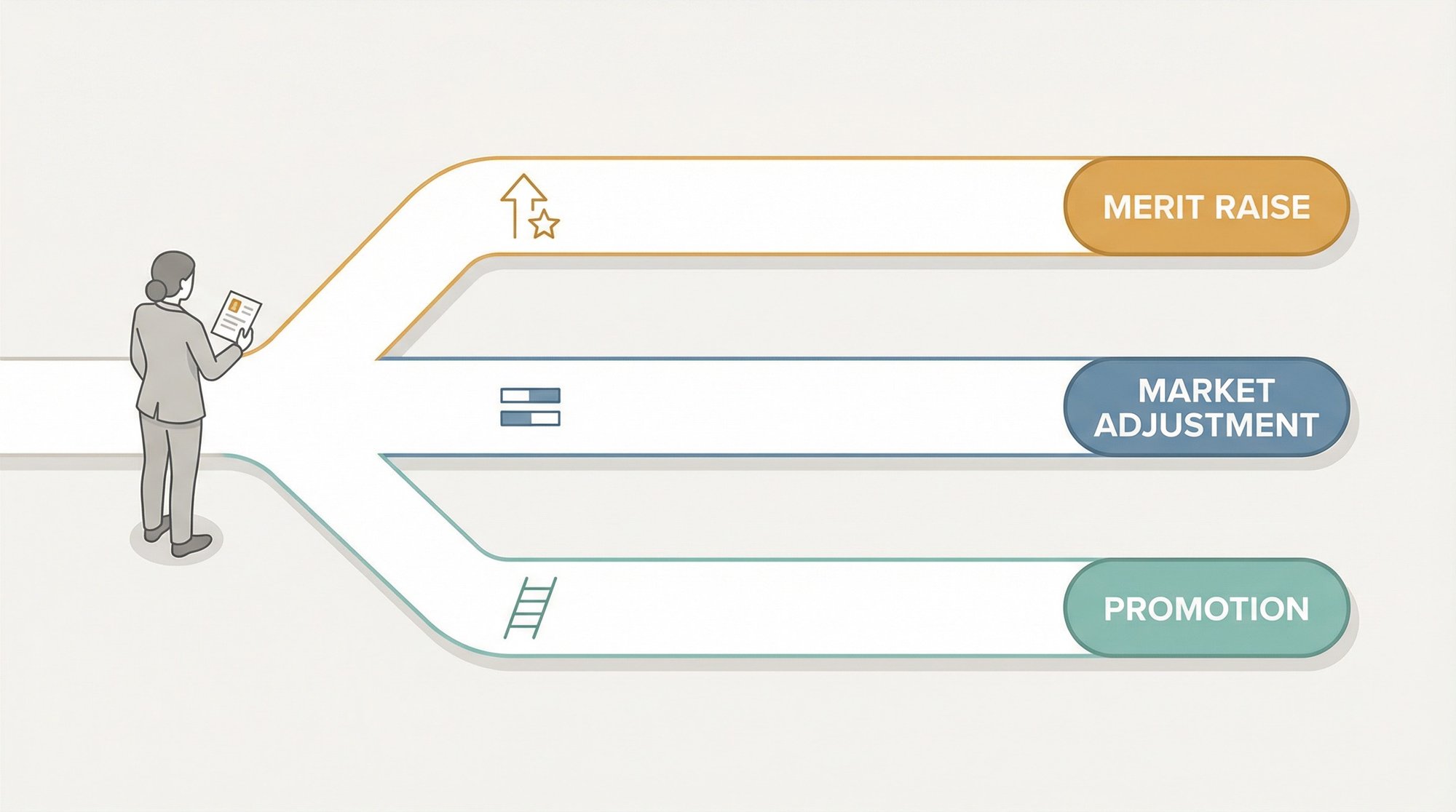
Here are the three categories that actually move through approval:
You can combine merit + market, or merit + promotion. But don't mash all three together in one conversation. Keep your ask clean and specific so your manager knows exactly which approval path to take.
For a market adjustment case, role-specific salary data is non-negotiable. Check what comparable roles earn (for example, project manager salaries or account manager salaries) so you can walk in with numbers your company can verify independently.
How to Build a Raise Case Your Manager Can Approve
A raise request fails when it creates work for your manager. If they have to go dig up your accomplishments, assemble market data, and figure out what you're actually asking for, you've already lost momentum.
Your goal is the opposite: hand them a clean, credible one-page justification they can forward straight to HR.
Here's what that Raise Dossier looks like:
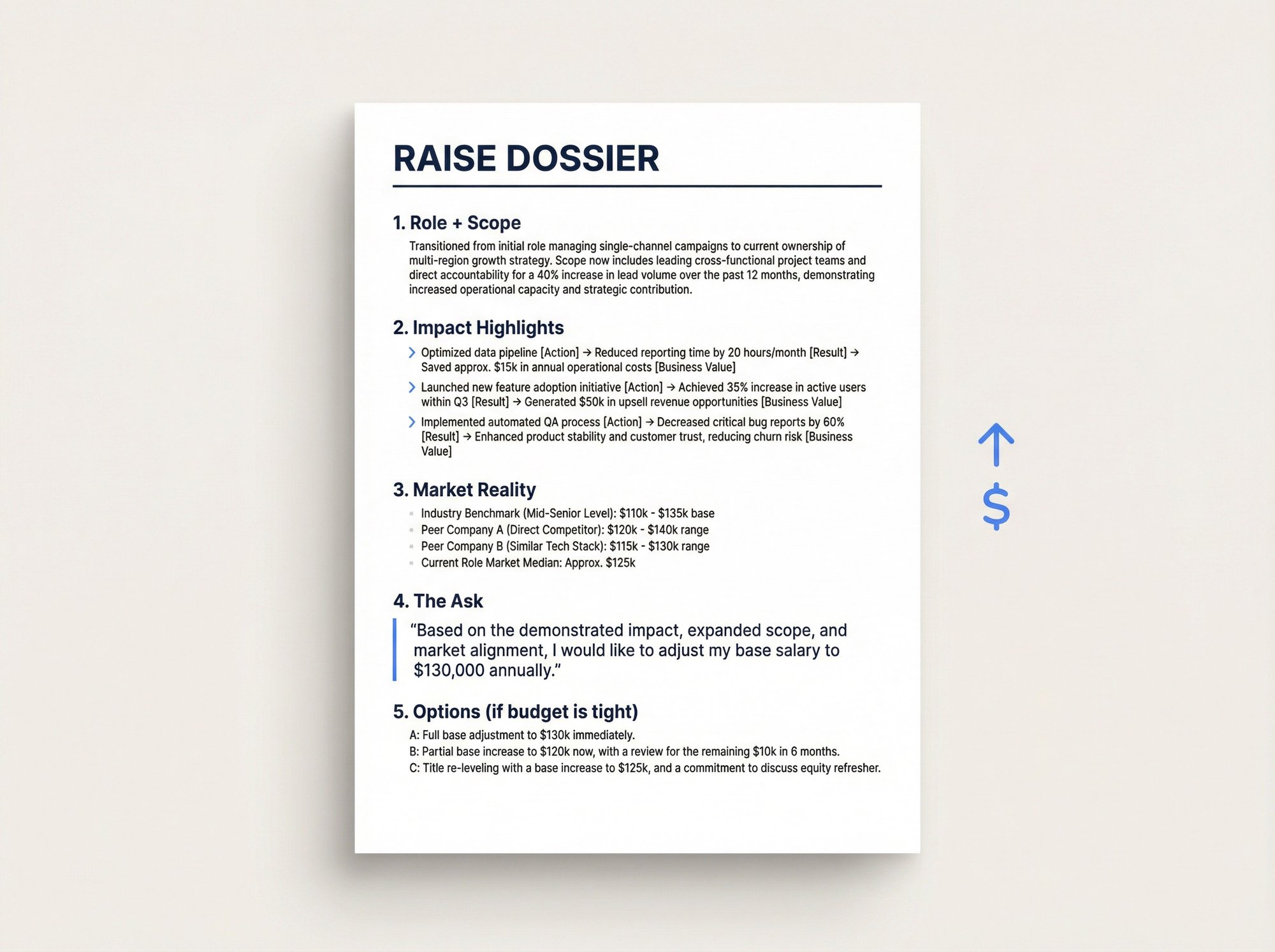
1) Role + Scope (one short paragraph)
State your title, then describe what you actually own today compared to what you were originally hired to do. If there's a gap, make it obvious. AIApply's AI Resume Builder can help you articulate this scope clearly. It's the same way you'd position yourself for a new role, just applied to your growth within the current one.
URL: https://aiapply.co/resume-builder
Location: "How to Build a Raise Case" section — after AIApply Resume Builder mention
Instructions: Navigate to https://aiapply.co/resume-builder in a regular browser (logged in if possible to show the full UI). Wait for the resume builder interface to fully load. Dismiss any cookie banner. Capture at 1920x1080. Save as images/screenshots/screenshot-sc-02-aiapply-resume-builder-1920x1080@2x.png and insert here with alt text: "AIApply Resume Builder interface showing how to create a job-specific resume that clearly articulates your scope and career progression".
2) Impact Highlights (3 to 6 bullets, measurable when possible)
Use this format for each one:
Action → Result → Business value
For example:
Built the new client onboarding flow → reduced onboarding time from 3 weeks to 8 days → saved ~40 hours per month across the team
Took ownership of the Q3 product launch → shipped on time with zero critical bugs → contributed to $120K in new revenue
Identified and fixed a data pipeline bottleneck → reduced report generation time by 60% → unblocked the analytics team's quarterly deliverables
3) Market Reality (2 to 4 bullets)
Include 3 to 6 comparable salary postings or benchmarks. Same title, same level, same location, similar company size. If posted ranges are required by law in your region, note that. Role-specific salary data pages (such as for operations manager salaries, recruiter, or software developer) give you real, verifiable benchmarks to anchor your ask.
4) The Ask (one sentence)
"I'd like to adjust my base salary from [current] to [target], based on my impact and market alignment."
5) If Budget Is Tight: Options (2 lines)
Option A: Full salary adjustment now
Option B: Partial adjustment now + written re-review date in [X] months with clear targets
Option C: Title or level review tied to specific scope milestones
This is the difference between "asking for a raise" and "making a case your manager can actually approve."
How to Research Your Market Rate for a Raise
A lot of people think salary research means pulling random numbers from a database and picking the highest one. That's not research. That's confirmation bias.
In 2026, the quality of available salary data is genuinely improving. The New York Fed's research on pay transparency in job postings is one of the clearest signs of this trend: more employers are required (or choosing) to list salary ranges, which means you have better data to work with than job seekers did even three years ago.
But better data still needs good interpretation. Three rules to keep your research honest:
Rule 1: Compare the same level, not just the same title. Titles are wildly inconsistent across companies. A "Manager" at a 50-person startup might do the same work as a "Senior Analyst" at a Fortune 500. Always dig into the actual scope and seniority level, not just the words on the posting.
Rule 2: Adjust for location and remote policies. Some pay transparency laws cover remote roles depending on where the job is performed or where the company is registered. A role listed in San Francisco will show a very different range than the same role in Austin or Manchester.
Rule 3: Use multiple sources, then triangulate. One data point is noise. Five is a signal. Pull from job postings, salary databases, and industry reports. When three or four sources cluster around the same range, you've got a defensible number.
The goal isn't to find the highest number. It's to find the honest number you can defend when your manager pushes back. A range you can explain is always stronger than a ceiling you grabbed from one database.
Here is what a real-world salary benchmark page looks like. AIApply's salary pages pull current market data by role so you can anchor your ask to verified numbers rather than gut feel.
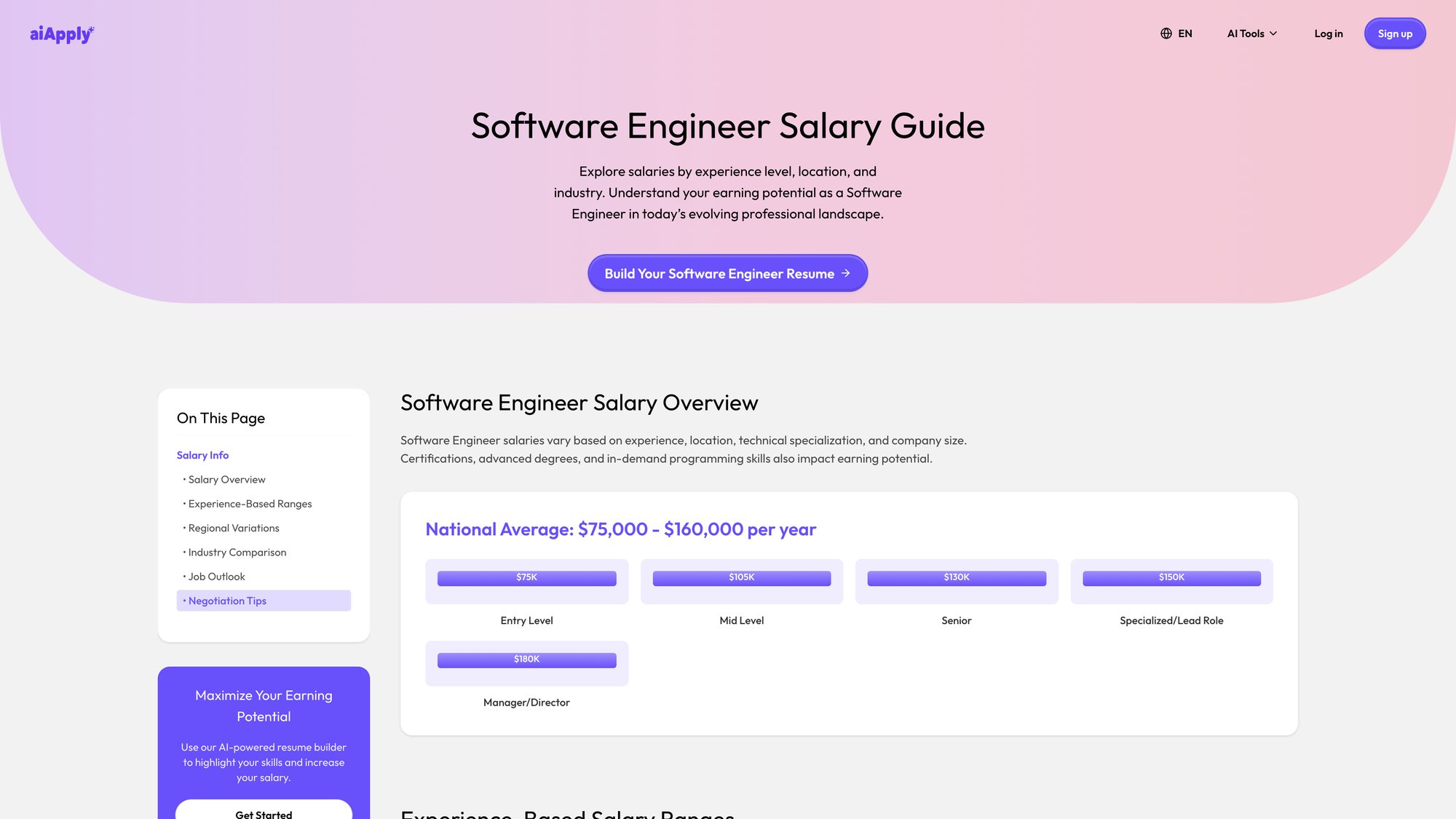
If you want a structured starting point, the Expected Salary Calculator gives you a quick benchmark by role, location, and experience level. That's useful as a baseline before you dig deeper. You can also browse role-specific data pages (from data scientist salaries to business analyst salaries) to build a comprehensive picture of what the market is paying.
What Raise Percentage to Ask For
This is where people sabotage themselves. They pick a number based on what they feel they deserve, what they need to cover rent, or what sounds impressive enough to matter. None of those are useful frameworks.
The better approach: pick a number based on what your company can rationalize.
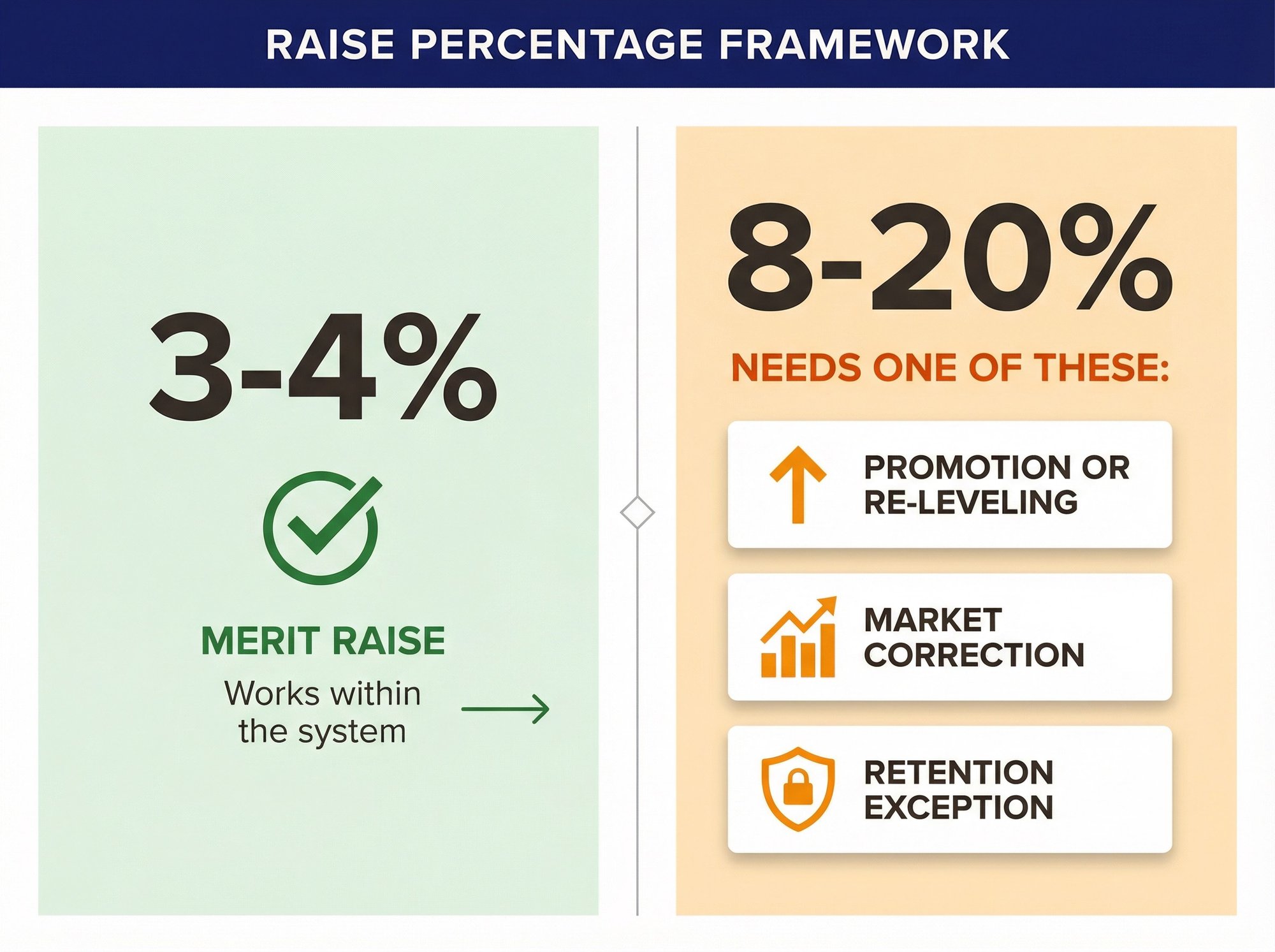
Here's the sanity check. If your ask falls near the company's normal merit pool (often around 3% to 4% in the US and UK for 2026), frame it as a performance raise aligned with your impact. You're working within the system, and that's the path of least resistance.
If your ask is much larger, say 8% to 20%, you usually need one of these:
A promotion or re-leveling (you're operating above your current level)
A market correction (you're clearly below the going rate for your role)
A retention exception (the company believes you'll leave, and replacing you is expensive)
This isn't about "what's fair." It's about what category HR recognizes as a valid reason to approve an above-average increase. If you can name the category, your manager can work with it. For context, look at what sales manager or marketing analyst roles command in your region. If your current pay is significantly below those benchmarks, a market correction argument becomes much easier to make.
How to Schedule a Raise Conversation with Your Manager
Don't drop this at the end of a regular one-on-one. Compensation conversations need their own dedicated time because they require focus, possibly research, and almost always follow-up.

Here's an email template that works:
Subject: Compensation alignment discussion
Hi [Manager Name],
I'd like to schedule 20-30 minutes to talk about aligning my compensation with my current scope and impact in the role.
I'll share a short summary of outcomes I've delivered and some market benchmarks so we can make it concrete. What time works for you this week or next?
Thanks,
[Your Name]
And a shorter Slack or Teams version if that fits your workplace culture better:
Hey [Name], can we book 20-30 minutes to talk comp alignment? I'll bring a 1-page summary of my current scope, impact, and market benchmarks so it's straightforward.
Notice what both of these do: they signal that you're prepared, that you'll bring data, and that this is a professional conversation about alignment, not a complaint session. That framing matters more than you'd think. If you need help crafting follow-up messages after the initial discussion, AIApply's HR follow-up email generator can help you keep the conversation professional and moving forward.
What to Say When Asking for a Raise
The conversation itself can feel like the hardest part. So here are scripts you can use almost verbatim, adapting for your specific details.

Your 60-Second Raise Request Script
"I'm really happy with how things have been going and I want to keep growing here. I'd like to talk about aligning my compensation with the scope I'm operating at today and the impact I've delivered. I put together a short summary of outcomes and market benchmarks. Based on that, I'm aiming to move from [current] to [target]. How does that fit with how compensation decisions work here?"
Then stop talking.
Seriously. Silence after your ask isn't awkward. It's processing time for your manager. Let them respond.
Script for Asking for a Market Adjustment
"When I accepted, I was excited to join and I prioritized learning and impact. Now that I've delivered [outcomes], I want to make sure my base is aligned with the market for this role and level. Here are a few recent ranges and benchmarks I found. Based on that, I'm asking for [target]."
Script for a Promotion-Level Raise Request
"I want to discuss leveling. The work I'm doing matches [next level] because I'm already owning [scope]. If we agree that's true, I'd like my title and compensation to reflect that."
Each of these scripts is clean, non-dramatic, and focused on business logic rather than personal need. That's intentional. If you're simultaneously exploring a role change, AIApply's AI Interview Simulator can help you practice articulating your value. Those skills are just as useful in an internal compensation discussion as in an external interview.
How to Handle the 6 Most Common Raise Objections
Even with a strong case, you'll likely hear some version of these. Here's how to respond to each one without getting defensive or losing the thread.
The pattern across all six: you're never arguing. You're redirecting toward next steps, criteria, and timelines. That keeps the conversation productive even when the immediate answer is no.

1) "We don't do raises in the first year."
"Got it. What's the earliest point we can do a compensation review here? And what specific outcomes would you need to see from me between now and then?"
You're turning a dead end into a roadmap.
2) "Budgets are tight."
"Understood. If we can't do the full adjustment now, what options do we have? For example, a partial adjustment now and a written re-review date in [X] months tied to clear targets?"
Make it easy for them to say yes to something.
3) "You're doing well, but it's not the right time."
"What would make it the right time? Is it performance cycle timing, business results, or approvals? If it's timing, can we agree on a date to revisit and what the decision criteria will be?"
4) "HR won't approve that."
"What part won't pass: the amount, the category, or the timing? If we reframe as a market adjustment or a leveling review, does it become more feasible?"
5) "Why this number?"
"It's based on the outcomes I've delivered plus the market ranges I found for comparable roles at this level. I'm open to a range, but I want to land in a spot that matches the scope I'm operating at."
6) "We can revisit at annual review."
"That makes sense. To avoid surprises later, can we align now on what 'earning it' looks like? I'd love a simple set of targets we both agree on."
What Not to Say When Asking for a Raise
There's a subtle dynamic most guides don't mention. If you make the compensation conversation feel like a threat, your manager may start managing risk instead of advocating for you. And you want them advocating for you, because they're the person who carries your case to HR.
Avoid saying these:
"I deserve this." (Sounds like entitlement, even if it's true.)
"Other people make more." (Creates drama and triggers confidentiality concerns.)
"If you don't do this, I'll leave." (A nuclear option that often backfires, even when you mean it.)

Instead, keep every conversation anchored in four things:
① Here's my impact.
② Here's the market data.
③ Here's what I'm asking.
④ If not now, what's the plan?
That's it. Professional, calm, forward-looking. Your manager will remember how you handled this conversation long after they've forgotten the specific numbers.
Know Your Rights When Discussing Salary at Work
You don't need to make this a legal conversation. But it helps to know where you stand, especially if your company has an unwritten "don't talk about pay" culture.

In the United States, the National Labor Relations Board states that employees covered by the NLRA have the right to communicate with coworkers about wages. Many workplace "you can't discuss your salary" policies are unenforceable, though there are some exceptions and nuances depending on your employment type.
In the UK, Section 77 of the Equality Act 2010 makes certain pay secrecy terms unenforceable when pay discussions relate to investigating pay discrimination. The legislation text is current as of early 2026.
In the EU, Directive (EU) 2023/970 sets new pay transparency standards with a transposition deadline of 7 June 2026. This is going to make salary information significantly more accessible across EU member states.
The practical takeaway: it's getting easier to find credible pay data, and harder for employers to keep compensation a mystery. Use this trend to your advantage when building your market case.
What to Do If Your Raise Request Is Denied
A "no" only becomes a loss if you walk away with nothing. Your goal is to leave every compensation conversation with at least one of these three outcomes.

How to Get a Commitment for a Future Raise
Ask these questions:
"What would need to be true for this to be approved?"
"When is the next decision point?"
"Can we put a review date on the calendar now?"
"What metrics will we use to evaluate it?"
If your manager gives you specific criteria and a timeline, you haven't lost. You've set up a structured path to the raise.
What to Negotiate Besides Base Salary
If base salary is frozen, there are other levers worth pulling:
→ Signing or performance bonus
→ Equity (especially valuable in startups)
→ Training budget or professional development funding
→ Conference budget
→ A title change that unlocks a higher pay band later
→ Scope expansion paired with a written review date
Sometimes the best outcome isn't the one you originally asked for. A title bump that puts you in a higher pay band for next year's review can be worth more than a 3% base increase right now. If a title change happens, updating your resume to reflect your new scope is worth doing immediately. AIApply's AI Resume Editor makes it fast to refresh your existing document without starting from scratch.
When to Consider Looking for a New Job
If the company can't or won't pay market rate, you now have clarity. And clarity is valuable.
ADP's January 2026 data showed pay growth for job-changers at 6.4% compared to 4.5% for people who stayed. That doesn't mean you should rage-quit. But it does mean that external offers can move your market price faster than internal cycles.
If you decide to explore your options, doing it efficiently matters. Spending 20 hours a week on applications while managing your current job isn't sustainable. At AIApply, we built tools specifically for this situation:
The AI Resume Builder generates job-specific resumes in minutes, so you're not rewriting from scratch for every application
The AI Cover Letter Generator creates role-specific letters that sound natural, not templated
Auto Apply scans postings and submits tailored applications automatically, saving hours of manual work
Interview Buddy provides real-time coaching during live interviews so you walk in confident
The point isn't to threaten your employer with a competing offer. Threatening often creates long-term trust damage, even if you "win" the raise. But having options gives you confidence and data. And sometimes just knowing your market value is enough to decide whether to keep pushing internally or make a move.
AIApply's platform brings all of these tools together in one place — from resume generation to automated applications and live interview coaching.
First-Year Raise Checklist: Are You Ready?
Before you walk into that conversation, confirm you can say yes to most of these:
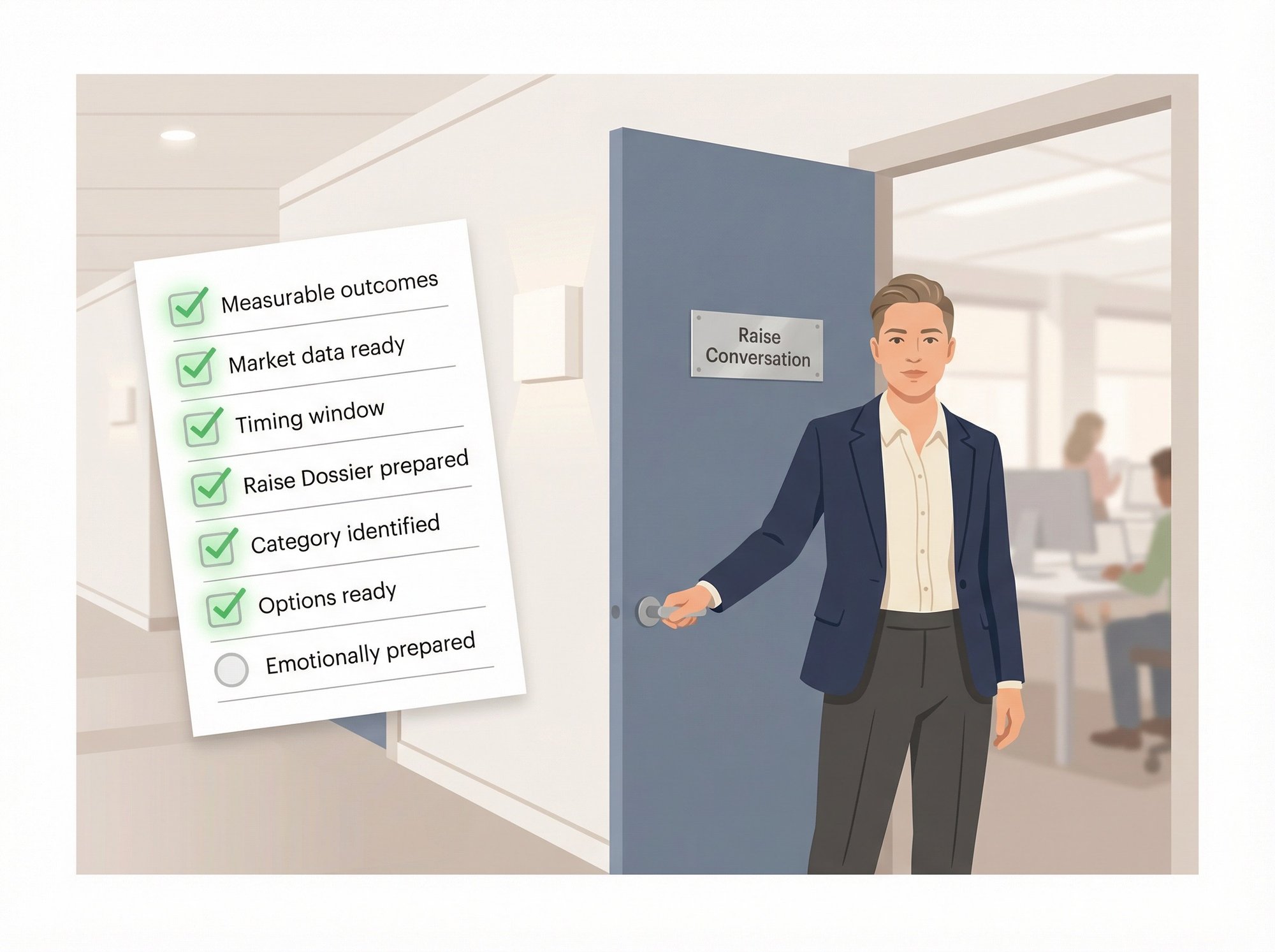
I can point to 3 to 6 measurable outcomes I delivered
My scope increased, or my pay is below market, or both
I understand my company's raise cycle and approval process
I have a one-page Raise Dossier prepared
I know the category: merit raise, market adjustment, or promotion
I'm asking in a time window where decisions can still be influenced
I'm ready with options if the answer is "not now"
I can have this conversation calmly, without turning it into a referendum on my worth
If you're missing the evidence, don't ask yet. Build it. Then ask from a position of strength. And if you decide to look externally while you build that evidence, Auto Apply lets you run a quiet job search in parallel without disrupting your current work.
Frequently Asked Questions About Asking for a Raise

Is it bad to ask for a raise at 6 months?
It depends entirely on your situation. If you've already taken on higher-level scope, fixed a major problem, or are clearly below market, six months is a perfectly reasonable timeline. Checking current salary benchmarks by role can help you determine whether you have a credible case. But if you're still ramping up and can't point to concrete outcomes yet, it's usually smarter to wait until you have evidence to back the request.
How much of a raise should I ask for in your first year?
There's no universal number, but context matters. If your company budgets 3% to 4% for merit increases, a request in that range is straightforward. Anything significantly above that (8% to 20%) typically requires a special category like a promotion, market correction, or retention exception. Base your number on market data (role-specific pages like software engineer salaries, product manager salaries, or data analyst salaries) and your measurable impact, not on what you feel you need.
Should I mention a coworker's salary?
Almost always no. It turns into drama fast and puts your manager in an uncomfortable position around confidentiality. You're much better off using market ranges from published data and tying your request to your own impact. Your case should stand on its own merits, not on what someone else is getting paid.
What if my manager likes me but has no power over compensation?
That's more common than you'd think, especially at larger companies where HR or a compensation committee makes final decisions. Your job in that case is to arm your manager with everything they need to advocate for you: clear outcomes, credible benchmarks, clean framing, and a realistic ask. Make their job as easy as possible. A well-structured resume example that clearly articulates scope and impact can serve as a reference document for your manager when making the case to HR.
Should I bring up pay transparency laws in the conversation?
Only if it helps you access data, not as a threat. Saying "I found several posted ranges for comparable roles, and here's how my pay compares" is productive. Saying "The law says you have to be transparent" is confrontational and rarely helps your cause.
Can I ask for a raise during probation?
You can start the groundwork by asking about the compensation review process, which signals long-term thinking without making an awkward demand. Most companies won't make pay changes during probation, but getting clarity on the timeline and criteria now puts you in a strong position once probation ends. Use the probation period to build a track record of outcomes. The AI Resume Builder can help you keep a running achievement log that converts directly into your Raise Dossier when the time comes.
What if I don't have hard metrics to show?
Not every role produces neat revenue numbers, and that's fine. Focus on outcomes you can describe: problems solved, processes improved, feedback from stakeholders, projects delivered on time, team members unblocked. Qualitative impact still counts, especially when you can describe it specifically. "I improved the team's handoff process, which reduced client complaints by roughly half" is a lot more compelling than "I worked hard." If you're in a role like account manager or operations manager career path, there are usually relationship metrics, process improvements, or retention outcomes you can point to even without revenue numbers.
What's the difference between a raise and a salary adjustment?
A raise typically refers to a merit-based increase tied to performance. A salary adjustment (or market adjustment) is about correcting a gap between your current pay and what the market pays for your role. The distinction matters because they follow different approval paths at most companies. Knowing which one you're asking for makes the conversation cleaner and gives your manager a clear route to get it approved. Researching what comparable roles like marketing manager, business analyst, or accountant earn in your market is the first step to determining which category applies to your situation.
You've been at your new job for a few months. You're contributing, learning fast, maybe even taking on work that wasn't part of the original deal. And now a thought keeps coming back: should I ask for a raise?
Right behind that thought come three fears that almost everyone shares. "Is it too soon?" "Will they think I'm ungrateful?" And the big one: "What do I even say without making this incredibly awkward?"
Those fears are normal. But they're also solvable. Asking for a raise in your first year isn't about courage or entitlement. It's about understanding how your company's compensation system actually works and fitting your request inside it. If you can do that, the conversation gets a lot less scary and a lot more productive.
This guide covers everything you need: when to ask, when to wait, how to build your case, word-for-word scripts for the conversation, how to handle every common pushback, and what to do if the answer is no. No vague advice. Just a system that works.
Why Most First-Year Raise Requests Fail
Most people assume a raise request is a simple conversation. You explain why you're great, your manager agrees, and the money shows up in your next paycheck.
That's not how it works at most companies.
Your manager doesn't just decide your pay in isolation. They're working inside salary budgets, approval chains, and HR policies. And those budgets? They're tighter than you probably think.
Mercer reported that 2026 average merit increase budgets in the US sit around 3.2%, with total salary increase budgets around 3.5%. WTW's salary budget planning data showed similar figures: roughly 3.5% in the US, with the UK, Canada, France, and Germany falling in the 3.2% to 3.6% range. Research from early 2026 found that over 40% of employers are leaning into standardized, across-the-board raises, with base-pay increases holding steady around 3.5%.
So what does this mean for your first-year raise request?
If you walk in asking for 10% or more at a company that's budgeting 3% to 4% for everybody, your manager needs a special justification to make it happen. Think promotion, market correction, or a retention exception. If you don't hand them that justification in a category their HR team actually recognizes, the default answer becomes: "Not this cycle."
Your strategy isn't about negotiating harder. It's about making the raise make sense inside the system your company already uses. Understanding what a software engineer or data analyst actually earns in the market is the foundation of that strategy.
Should You Ask for a Raise in Year One?
This is the question most guides skip. They assume you should always ask. But timing matters, and asking at the wrong moment can actually set you back.
When Asking for a Raise Makes Sense
Your role grew beyond what you were hired for. You're doing higher-scope work, owning bigger outcomes, or filling gaps that weren't part of the original job description. If you were hired as a specialist and you're now running a small team's projects, that's a real scope change.
You're clearly under market, and you can prove it. Pay transparency is making salary data much easier to find. Research from the New York Fed found that the share of online US job postings with pay information jumped from about 15% before 2018 to roughly 53% since January 2024. If you can pull up five comparable postings and they all pay 15% more than what you're making, you have a credible case. Role-specific salary pages (for example, financial analyst salaries) make it easy to see what comparable roles typically earn right now.
You've delivered a measurable win that changed outcomes. Revenue generated, costs cut, processes that used to take weeks now taking days, a retention problem you helped solve. The key word is measurable. "I work really hard" isn't a metric. "I reduced onboarding time by 30%" is.
Approaching a comp cycle is probably the single most underused timing advantage. Budgets often get drafted months before raises actually land. If you bring this up after decisions are locked, you're essentially asking for a miracle. Timing your conversation before the budget cycle closes is one of the smartest things you can do.
When You Should Wait Before Asking
You're still ramping and can't point to outcomes. Effort is not the same as impact. If you've been at the company for three months and you're still learning the systems, you probably don't have the evidence you need yet. That's okay. Focus on building results first.
You're inside probation and haven't cleared baseline trust. Some companies won't make compensation changes until probation ends. You can start laying groundwork by asking about the comp review process (more on that in a moment), but framing it as an urgent demand will likely backfire.
You're mostly motivated by cost of living. This is a classic blind spot. Your bills aren't your company's pricing model. Inflation matters, and it's a legitimate concern, but you'll make a much stronger case by tying your request to business results rather than personal expenses.
Which Type of Raise to Ask For
Most people walk into a raise conversation with "I want more money." But that's vague, and your manager can't really action vague. Companies approve pay changes in specific categories, and if your request doesn't fit one of them, it gets stuck.
Here are the three categories that actually move through approval:
You can combine merit + market, or merit + promotion. But don't mash all three together in one conversation. Keep your ask clean and specific so your manager knows exactly which approval path to take.
For a market adjustment case, role-specific salary data is non-negotiable. Check what comparable roles earn (for example, project manager salaries or account manager salaries) so you can walk in with numbers your company can verify independently.
How to Build a Raise Case Your Manager Can Approve
A raise request fails when it creates work for your manager. If they have to go dig up your accomplishments, assemble market data, and figure out what you're actually asking for, you've already lost momentum.
Your goal is the opposite: hand them a clean, credible one-page justification they can forward straight to HR.
Here's what that Raise Dossier looks like:
1) Role + Scope (one short paragraph)
State your title, then describe what you actually own today compared to what you were originally hired to do. If there's a gap, make it obvious. AIApply's AI Resume Builder can help you articulate this scope clearly. It's the same way you'd position yourself for a new role, just applied to your growth within the current one.
URL: https://aiapply.co/resume-builder
Location: "How to Build a Raise Case" section — after AIApply Resume Builder mention
Instructions: Navigate to https://aiapply.co/resume-builder in a regular browser (logged in if possible to show the full UI). Wait for the resume builder interface to fully load. Dismiss any cookie banner. Capture at 1920x1080. Save as images/screenshots/screenshot-sc-02-aiapply-resume-builder-1920x1080@2x.png and insert here with alt text: "AIApply Resume Builder interface showing how to create a job-specific resume that clearly articulates your scope and career progression".
2) Impact Highlights (3 to 6 bullets, measurable when possible)
Use this format for each one:
Action → Result → Business value
For example:
Built the new client onboarding flow → reduced onboarding time from 3 weeks to 8 days → saved ~40 hours per month across the team
Took ownership of the Q3 product launch → shipped on time with zero critical bugs → contributed to $120K in new revenue
Identified and fixed a data pipeline bottleneck → reduced report generation time by 60% → unblocked the analytics team's quarterly deliverables
3) Market Reality (2 to 4 bullets)
Include 3 to 6 comparable salary postings or benchmarks. Same title, same level, same location, similar company size. If posted ranges are required by law in your region, note that. Role-specific salary data pages (such as for operations manager salaries, recruiter, or software developer) give you real, verifiable benchmarks to anchor your ask.
4) The Ask (one sentence)
"I'd like to adjust my base salary from [current] to [target], based on my impact and market alignment."
5) If Budget Is Tight: Options (2 lines)
Option A: Full salary adjustment now
Option B: Partial adjustment now + written re-review date in [X] months with clear targets
Option C: Title or level review tied to specific scope milestones
This is the difference between "asking for a raise" and "making a case your manager can actually approve."
How to Research Your Market Rate for a Raise
A lot of people think salary research means pulling random numbers from a database and picking the highest one. That's not research. That's confirmation bias.
In 2026, the quality of available salary data is genuinely improving. The New York Fed's research on pay transparency in job postings is one of the clearest signs of this trend: more employers are required (or choosing) to list salary ranges, which means you have better data to work with than job seekers did even three years ago.
But better data still needs good interpretation. Three rules to keep your research honest:
Rule 1: Compare the same level, not just the same title. Titles are wildly inconsistent across companies. A "Manager" at a 50-person startup might do the same work as a "Senior Analyst" at a Fortune 500. Always dig into the actual scope and seniority level, not just the words on the posting.
Rule 2: Adjust for location and remote policies. Some pay transparency laws cover remote roles depending on where the job is performed or where the company is registered. A role listed in San Francisco will show a very different range than the same role in Austin or Manchester.
Rule 3: Use multiple sources, then triangulate. One data point is noise. Five is a signal. Pull from job postings, salary databases, and industry reports. When three or four sources cluster around the same range, you've got a defensible number.
The goal isn't to find the highest number. It's to find the honest number you can defend when your manager pushes back. A range you can explain is always stronger than a ceiling you grabbed from one database.
Here is what a real-world salary benchmark page looks like. AIApply's salary pages pull current market data by role so you can anchor your ask to verified numbers rather than gut feel.
If you want a structured starting point, the Expected Salary Calculator gives you a quick benchmark by role, location, and experience level. That's useful as a baseline before you dig deeper. You can also browse role-specific data pages (from data scientist salaries to business analyst salaries) to build a comprehensive picture of what the market is paying.
What Raise Percentage to Ask For
This is where people sabotage themselves. They pick a number based on what they feel they deserve, what they need to cover rent, or what sounds impressive enough to matter. None of those are useful frameworks.
The better approach: pick a number based on what your company can rationalize.
Here's the sanity check. If your ask falls near the company's normal merit pool (often around 3% to 4% in the US and UK for 2026), frame it as a performance raise aligned with your impact. You're working within the system, and that's the path of least resistance.
If your ask is much larger, say 8% to 20%, you usually need one of these:
A promotion or re-leveling (you're operating above your current level)
A market correction (you're clearly below the going rate for your role)
A retention exception (the company believes you'll leave, and replacing you is expensive)
This isn't about "what's fair." It's about what category HR recognizes as a valid reason to approve an above-average increase. If you can name the category, your manager can work with it. For context, look at what sales manager or marketing analyst roles command in your region. If your current pay is significantly below those benchmarks, a market correction argument becomes much easier to make.
How to Schedule a Raise Conversation with Your Manager
Don't drop this at the end of a regular one-on-one. Compensation conversations need their own dedicated time because they require focus, possibly research, and almost always follow-up.
Here's an email template that works:
Subject: Compensation alignment discussion
Hi [Manager Name],
I'd like to schedule 20-30 minutes to talk about aligning my compensation with my current scope and impact in the role.
I'll share a short summary of outcomes I've delivered and some market benchmarks so we can make it concrete. What time works for you this week or next?
Thanks,
[Your Name]
And a shorter Slack or Teams version if that fits your workplace culture better:
Hey [Name], can we book 20-30 minutes to talk comp alignment? I'll bring a 1-page summary of my current scope, impact, and market benchmarks so it's straightforward.
Notice what both of these do: they signal that you're prepared, that you'll bring data, and that this is a professional conversation about alignment, not a complaint session. That framing matters more than you'd think. If you need help crafting follow-up messages after the initial discussion, AIApply's HR follow-up email generator can help you keep the conversation professional and moving forward.
What to Say When Asking for a Raise
The conversation itself can feel like the hardest part. So here are scripts you can use almost verbatim, adapting for your specific details.
Your 60-Second Raise Request Script
"I'm really happy with how things have been going and I want to keep growing here. I'd like to talk about aligning my compensation with the scope I'm operating at today and the impact I've delivered. I put together a short summary of outcomes and market benchmarks. Based on that, I'm aiming to move from [current] to [target]. How does that fit with how compensation decisions work here?"
Then stop talking.
Seriously. Silence after your ask isn't awkward. It's processing time for your manager. Let them respond.
Script for Asking for a Market Adjustment
"When I accepted, I was excited to join and I prioritized learning and impact. Now that I've delivered [outcomes], I want to make sure my base is aligned with the market for this role and level. Here are a few recent ranges and benchmarks I found. Based on that, I'm asking for [target]."
Script for a Promotion-Level Raise Request
"I want to discuss leveling. The work I'm doing matches [next level] because I'm already owning [scope]. If we agree that's true, I'd like my title and compensation to reflect that."
Each of these scripts is clean, non-dramatic, and focused on business logic rather than personal need. That's intentional. If you're simultaneously exploring a role change, AIApply's AI Interview Simulator can help you practice articulating your value. Those skills are just as useful in an internal compensation discussion as in an external interview.
How to Handle the 6 Most Common Raise Objections
Even with a strong case, you'll likely hear some version of these. Here's how to respond to each one without getting defensive or losing the thread.
The pattern across all six: you're never arguing. You're redirecting toward next steps, criteria, and timelines. That keeps the conversation productive even when the immediate answer is no.
1) "We don't do raises in the first year."
"Got it. What's the earliest point we can do a compensation review here? And what specific outcomes would you need to see from me between now and then?"
You're turning a dead end into a roadmap.
2) "Budgets are tight."
"Understood. If we can't do the full adjustment now, what options do we have? For example, a partial adjustment now and a written re-review date in [X] months tied to clear targets?"
Make it easy for them to say yes to something.
3) "You're doing well, but it's not the right time."
"What would make it the right time? Is it performance cycle timing, business results, or approvals? If it's timing, can we agree on a date to revisit and what the decision criteria will be?"
4) "HR won't approve that."
"What part won't pass: the amount, the category, or the timing? If we reframe as a market adjustment or a leveling review, does it become more feasible?"
5) "Why this number?"
"It's based on the outcomes I've delivered plus the market ranges I found for comparable roles at this level. I'm open to a range, but I want to land in a spot that matches the scope I'm operating at."
6) "We can revisit at annual review."
"That makes sense. To avoid surprises later, can we align now on what 'earning it' looks like? I'd love a simple set of targets we both agree on."
What Not to Say When Asking for a Raise
There's a subtle dynamic most guides don't mention. If you make the compensation conversation feel like a threat, your manager may start managing risk instead of advocating for you. And you want them advocating for you, because they're the person who carries your case to HR.
Avoid saying these:
"I deserve this." (Sounds like entitlement, even if it's true.)
"Other people make more." (Creates drama and triggers confidentiality concerns.)
"If you don't do this, I'll leave." (A nuclear option that often backfires, even when you mean it.)
Instead, keep every conversation anchored in four things:
① Here's my impact.
② Here's the market data.
③ Here's what I'm asking.
④ If not now, what's the plan?
That's it. Professional, calm, forward-looking. Your manager will remember how you handled this conversation long after they've forgotten the specific numbers.
Know Your Rights When Discussing Salary at Work
You don't need to make this a legal conversation. But it helps to know where you stand, especially if your company has an unwritten "don't talk about pay" culture.
In the United States, the National Labor Relations Board states that employees covered by the NLRA have the right to communicate with coworkers about wages. Many workplace "you can't discuss your salary" policies are unenforceable, though there are some exceptions and nuances depending on your employment type.
In the UK, Section 77 of the Equality Act 2010 makes certain pay secrecy terms unenforceable when pay discussions relate to investigating pay discrimination. The legislation text is current as of early 2026.
In the EU, Directive (EU) 2023/970 sets new pay transparency standards with a transposition deadline of 7 June 2026. This is going to make salary information significantly more accessible across EU member states.
The practical takeaway: it's getting easier to find credible pay data, and harder for employers to keep compensation a mystery. Use this trend to your advantage when building your market case.
What to Do If Your Raise Request Is Denied
A "no" only becomes a loss if you walk away with nothing. Your goal is to leave every compensation conversation with at least one of these three outcomes.
How to Get a Commitment for a Future Raise
Ask these questions:
"What would need to be true for this to be approved?"
"When is the next decision point?"
"Can we put a review date on the calendar now?"
"What metrics will we use to evaluate it?"
If your manager gives you specific criteria and a timeline, you haven't lost. You've set up a structured path to the raise.
What to Negotiate Besides Base Salary
If base salary is frozen, there are other levers worth pulling:
→ Signing or performance bonus
→ Equity (especially valuable in startups)
→ Training budget or professional development funding
→ Conference budget
→ A title change that unlocks a higher pay band later
→ Scope expansion paired with a written review date
Sometimes the best outcome isn't the one you originally asked for. A title bump that puts you in a higher pay band for next year's review can be worth more than a 3% base increase right now. If a title change happens, updating your resume to reflect your new scope is worth doing immediately. AIApply's AI Resume Editor makes it fast to refresh your existing document without starting from scratch.
When to Consider Looking for a New Job
If the company can't or won't pay market rate, you now have clarity. And clarity is valuable.
ADP's January 2026 data showed pay growth for job-changers at 6.4% compared to 4.5% for people who stayed. That doesn't mean you should rage-quit. But it does mean that external offers can move your market price faster than internal cycles.
If you decide to explore your options, doing it efficiently matters. Spending 20 hours a week on applications while managing your current job isn't sustainable. At AIApply, we built tools specifically for this situation:
The AI Resume Builder generates job-specific resumes in minutes, so you're not rewriting from scratch for every application
The AI Cover Letter Generator creates role-specific letters that sound natural, not templated
Auto Apply scans postings and submits tailored applications automatically, saving hours of manual work
Interview Buddy provides real-time coaching during live interviews so you walk in confident
The point isn't to threaten your employer with a competing offer. Threatening often creates long-term trust damage, even if you "win" the raise. But having options gives you confidence and data. And sometimes just knowing your market value is enough to decide whether to keep pushing internally or make a move.
AIApply's platform brings all of these tools together in one place — from resume generation to automated applications and live interview coaching.
First-Year Raise Checklist: Are You Ready?
Before you walk into that conversation, confirm you can say yes to most of these:
I can point to 3 to 6 measurable outcomes I delivered
My scope increased, or my pay is below market, or both
I understand my company's raise cycle and approval process
I have a one-page Raise Dossier prepared
I know the category: merit raise, market adjustment, or promotion
I'm asking in a time window where decisions can still be influenced
I'm ready with options if the answer is "not now"
I can have this conversation calmly, without turning it into a referendum on my worth
If you're missing the evidence, don't ask yet. Build it. Then ask from a position of strength. And if you decide to look externally while you build that evidence, Auto Apply lets you run a quiet job search in parallel without disrupting your current work.
Frequently Asked Questions About Asking for a Raise
Is it bad to ask for a raise at 6 months?
It depends entirely on your situation. If you've already taken on higher-level scope, fixed a major problem, or are clearly below market, six months is a perfectly reasonable timeline. Checking current salary benchmarks by role can help you determine whether you have a credible case. But if you're still ramping up and can't point to concrete outcomes yet, it's usually smarter to wait until you have evidence to back the request.
How much of a raise should I ask for in your first year?
There's no universal number, but context matters. If your company budgets 3% to 4% for merit increases, a request in that range is straightforward. Anything significantly above that (8% to 20%) typically requires a special category like a promotion, market correction, or retention exception. Base your number on market data (role-specific pages like software engineer salaries, product manager salaries, or data analyst salaries) and your measurable impact, not on what you feel you need.
Should I mention a coworker's salary?
Almost always no. It turns into drama fast and puts your manager in an uncomfortable position around confidentiality. You're much better off using market ranges from published data and tying your request to your own impact. Your case should stand on its own merits, not on what someone else is getting paid.
What if my manager likes me but has no power over compensation?
That's more common than you'd think, especially at larger companies where HR or a compensation committee makes final decisions. Your job in that case is to arm your manager with everything they need to advocate for you: clear outcomes, credible benchmarks, clean framing, and a realistic ask. Make their job as easy as possible. A well-structured resume example that clearly articulates scope and impact can serve as a reference document for your manager when making the case to HR.
Should I bring up pay transparency laws in the conversation?
Only if it helps you access data, not as a threat. Saying "I found several posted ranges for comparable roles, and here's how my pay compares" is productive. Saying "The law says you have to be transparent" is confrontational and rarely helps your cause.
Can I ask for a raise during probation?
You can start the groundwork by asking about the compensation review process, which signals long-term thinking without making an awkward demand. Most companies won't make pay changes during probation, but getting clarity on the timeline and criteria now puts you in a strong position once probation ends. Use the probation period to build a track record of outcomes. The AI Resume Builder can help you keep a running achievement log that converts directly into your Raise Dossier when the time comes.
What if I don't have hard metrics to show?
Not every role produces neat revenue numbers, and that's fine. Focus on outcomes you can describe: problems solved, processes improved, feedback from stakeholders, projects delivered on time, team members unblocked. Qualitative impact still counts, especially when you can describe it specifically. "I improved the team's handoff process, which reduced client complaints by roughly half" is a lot more compelling than "I worked hard." If you're in a role like account manager or operations manager career path, there are usually relationship metrics, process improvements, or retention outcomes you can point to even without revenue numbers.
What's the difference between a raise and a salary adjustment?
A raise typically refers to a merit-based increase tied to performance. A salary adjustment (or market adjustment) is about correcting a gap between your current pay and what the market pays for your role. The distinction matters because they follow different approval paths at most companies. Knowing which one you're asking for makes the conversation cleaner and gives your manager a clear route to get it approved. Researching what comparable roles like marketing manager, business analyst, or accountant earn in your market is the first step to determining which category applies to your situation.
.webp)
%20(1).webp)

Don't miss out on
your next opportunity.
Create and send applications in seconds, not hours.


